
Table of Contents
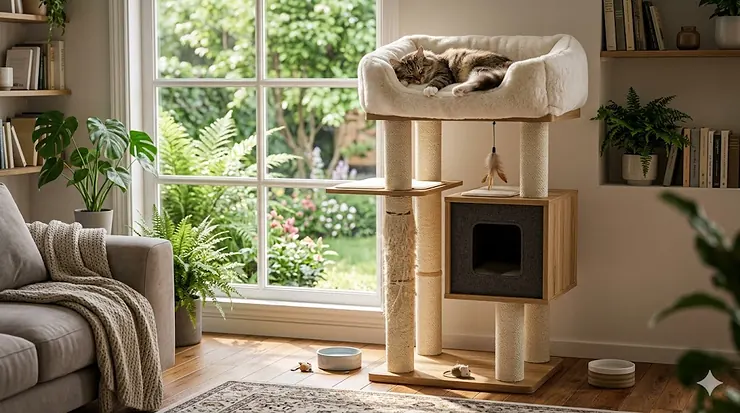
Your cat spends anywhere from 12 to 16 hours sleeping each day—that’s more than half their life spent curled up somewhere. What most cat owners don’t realize is that where your feline friend chooses to rest reveals everything about their sense of security and comfort. I’ve watched countless cats ignore expensive furniture only to claim a cardboard box, and the pattern is clear: cats crave elevated, cushioned spaces that feel like their personal sanctuary.
A cat tower with bed solves this instinctive need better than any floor-level cushion ever could. According to the Cornell University College of Veterinary Medicine, vertical space isn’t just a luxury for cats—it’s essential for their psychological well-being. When cats have access to elevated resting spots, they exhibit lower stress levels and fewer territorial conflicts in multi-cat households. The combination of height (which provides security) and a dedicated bed platform (which offers comfort) creates what behaviorists call a “resource-rich environment” that taps into your cat’s natural climbing instincts while giving them a cozy retreat.
Beyond the behavioral benefits, a quality cat tower with bed addresses practical concerns too. The raised bed keeps your cat away from floor drafts, reducing exposure to dust and allergens. The integrated scratching posts protect your furniture from destruction. And honestly? It’s delightful watching your cat claim their elevated throne, surveying their domain with that characteristic feline confidence.
Quick Comparison Table: Top Cat Towers with Beds
| Model | Height | Bed Size | Weight Capacity | Best For | Price Range |
|---|---|---|---|---|---|
| Aechonow 14-Inch Tower | 14″ | 20″ x 16.5″ | Up to 25 lbs | Seniors, compact spaces | $40-$60 |
| Meowker Heavy-Duty Tower | 17.7″ | 23.6″ x 20.4″ | Up to 80 lbs | Large cats, stability seekers | $80-$110 |
| Feandrea UPCT141W01 | 45.3″ | Dual padded perches | Up to 110 lbs (total) | Multi-cat homes, small spaces | $90-$130 |
| Globlazer 61-Inch Tower | 61″ | Extra-large top perch | Heavy-duty | Active large cats | $140-$180 |
| SHENGOCASE Multi-Level | 67.7″ | Multiple platforms | High | Maine Coons, multiple cats | $180-$230 |
| Yaheetech 54-Inch | 54″ | Two plush perches | Moderate | Budget-conscious buyers | $70-$100 |
| Flower Cat Tree | 56″ | Hammock + perches | Moderate | Design-focused homes | $110-$150 |
What this table reveals: The Aechonow offers maximum bed space relative to price—that 20″ x 16.5″ perch is nearly double what you’d find on similarly priced models. If your cat is a “sprawler” who hates cramped spaces, this becomes the standout choice despite its lower height. Meanwhile, the Meowker’s 80-pound capacity is engineered overkill for most households, but if you’ve got a 20-pound Maine Coon who launches onto furniture, that structural reinforcement prevents the wobble that cheaper towers suffer from.
💬 Just one click — help others make better buying decisions too!😊
Top 7 Cat Tower with Bed Models: Expert Analysis
1. Aechonow 14-Inch Cat Tower — The Compact Giant
What catches my attention immediately is how Aechonow engineered a 20″ x 16.5″ perch bed into a tower that’s only 14 inches tall—that’s a platform-to-height ratio you rarely see. The short stature makes this perfect for senior cats with arthritis who can’t handle big jumps anymore, while the oversized bed accommodates even chubby 20-pounders without cramping their style.
The removable, washable mat is flannel-covered, which means it actually stays soft after multiple wash cycles (unlike those thin plush covers that pill immediately). What the spec sheet won’t tell you: this low profile works brilliantly in homes where you want vertical territory without blocking window light or sightlines. I’ve seen these tucked under console tables or beside sofas where taller towers would create visual clutter.
Customer feedback consistently mentions how stable the base is despite the compact height—owners with energetic kittens report zero tipping even during aggressive play sessions. The sisal scratching post wraps completely around the support column, providing 360-degree scratch access that prevents boredom with “scratched-out” sections.
Pros:
✅ Oversized bed platform fits large cats comfortably
✅ Perfect height for senior cats or kittens learning to climb
✅ Machine-washable flannel mat simplifies cleaning
Cons:
❌ Limited vertical territory—not ideal for cats who love high perches
❌ Single-level design may bore multi-cat households
Price Range & Verdict: Around $40-$60 makes this exceptional value for the bed size you’re getting. Best for elderly cats, small apartments, or as a “starter tower” for households introducing vertical space.
2. Meowker Cat Tree Tower — The No-Wobble Fortress
This dark gray tower (model B0GHN3MTD8, dimensions 23.6″×20.4″×17.7″) solves the number one complaint I hear about cat furniture: wobbling. Meowker built this with five support posts and an oversized base that keeps it rock-solid even when my neighbor’s 18-pound Norwegian Forest Cat launches onto it from the couch. That 80-pound load capacity isn’t marketing fluff—it’s structural engineering that recognizes larger breeds need furniture that won’t betray them mid-leap.
The padded bed lounge on top features thick foam filling that actually supports weight instead of compressing flat within weeks. But here’s the clever part most people miss: this tower offers two assembly layouts (front-facing or side-facing), which means you can orient it based on your cat’s preferred entry angle or your room’s furniture arrangement. Cats are particular about approach angles—some want to jump straight from a sofa arm, others prefer a perpendicular approach—and this flexibility prevents the frustration of a tower your cat ignores because the geometry doesn’t match their jumping habits.
The low overall height (under 18 inches) is specifically designed for cats recovering from surgery, senior cats with reduced mobility, or kittens too young for dramatic vertical challenges. One customer mentioned her 20-year-old cat reclaimed his independence using this after becoming too wobbly for their tall tree.
Pros:
✅ 80-pound capacity prevents wobbling with large/multiple cats
✅ Dual layout options accommodate different room configurations
✅ Gentle height ideal for mobility-challenged cats
Cons:
❌ Low height won’t satisfy cats who crave high vantage points
❌ Single lounging level limits multiple cats using simultaneously
Price Range & Verdict: In the $80-$110 range, this represents premium stability at a mid-range price. Perfect for large cat breeds, multi-cat homes where stability matters, or senior cats who need confidence-building furniture.
3. Feandrea Cat Tower UPCT141W01 — The Space-Saving Maximizer
At 45.3 inches tall with a footprint of only 19.7″ × 13.8″, Feandrea engineered what I call “vertical efficiency”—maximum climbing territory in minimum floor space. This matters enormously in apartments where every square foot counts. The tower features two plush top beds with raised bolsters that create a “nest” effect cats instinctively seek when resting.
What separates this from cheaper alternatives is the scratch-board ramp that doubles as a gentle ladder—genius for households mixing kittens and elderly cats who need graduated climbing options. The ramp angle allows arthritic cats to walk up instead of jumping, while young cats use it as a launchpad for acrobatic displays. Both age groups win.
The main condo measures 13.8″ × 13.8″ × 11″, which is genuinely spacious compared to the token “hideaways” on budget towers that barely fit a cat’s head. Multiple customers report their cats actually sleep inside this condo rather than just peeking in and leaving. The plush ultra-soft covering prevents that “slippery platform” problem where cats can’t gain traction.
Feandrea rates this for up to 110 pounds total load (roughly three 15-pound cats), and the anti-tip kit includes wall anchors—use them. Towers over 40 inches need anchoring if you’ve got athletic jumpers.
Pros:
✅ Compact footprint (under 20″ wide) fits small apartments
✅ Scratch-board ramp accommodates cats with mobility issues
✅ Raised-bolster beds create secure “nesting” environment
Cons:
❌ Single condo limits simultaneous hiding for multi-cat homes
❌ Some assembly challenges reported with two-piece posts
Price Range & Verdict: Around $90-$130 positions this as a mid-tier investment. Ideal for apartments, mixed-age cat households, or anyone prioritizing floor space efficiency.
4. Globlazer 61-Inch Cat Tower — The Vertical Playground
When cat behaviorists talk about “environmental enrichment,” they’re describing exactly what this 61-inch tower delivers: multiple activity zones that prevent boredom. The extra-large top perch isn’t just marketing language—it measures wide enough for a fully stretched-out Maine Coon to sprawl without limbs dangling over edges. That matters because cats won’t use perches where they feel precarious.
Seven sisal scratching posts distribute scratching opportunities throughout the vertical climb, which means your cat encounters scratch surfaces during movement, not just at designated “scratch here” spots. This integration mimics natural behavior where cats scratch during transitions between activities. The dual spacious condos (not cramped caves) each have multiple entry points, reducing territorial stress when two cats want to hide simultaneously.
What impressed me in customer reviews: owners with 18-20 pound cats specifically mention zero wobble during full-speed launches. That’s the heavy-duty construction delivering on its promise. The rock-solid stability comes from reinforced base plates and thick support posts that don’t flex under impact.
Interactive dangling toys add play value, though cats eventually destroy these (they’re designed to be replaceable). The real value is the tower’s structure creating a “climbing circuit” where cats can patrol their territory vertically.
Pros:
✅ Extra-large perches accommodate sprawling large breeds
✅ Seven scratching posts integrated throughout climbing route
✅ Rock-solid construction eliminates wobble with heavy cats
Cons:
❌ 61-inch height requires adequate ceiling clearance
❌ Premium price point may exceed budget buyers’ limits
Price Range & Verdict: In the $140-$180 range, this represents a serious investment in feline enrichment. Best for large cat breeds, highly active cats, or multi-cat households needing multiple territories.
5. SHENGOCASE Modern Cat Tree Tower — The Multi-Cat Mansion
Standing at 67.7 inches (nearly 6 feet), this solid wood tower addresses the challenge every multi-cat household faces: providing enough separate territories to prevent conflicts. The multiple platforms at staggered heights allow cats to occupy the same structure while maintaining personal space—what behaviorists call “vertical segregation.”
The solid wood construction (not particle board) means this tower ages gracefully instead of degrading. Particle board towers sag and wobble after 12-18 months of heavy use; solid wood maintains structural integrity for years. Yes, it’s heavier (72.75 pounds), but that weight translates to stability that lighter towers can’t match.
The oversized cushions feature cloud-soft fabric that’s actually padded, not just fabric stretched over hard surfaces. Cats spend hours on these because the cushions distribute weight like a quality mattress. The removable cushion design means you can wash them when they inevitably accumulate fur (and they will—cats shed approximately 50-70 percent of their coat seasonally).
Widened platforms provide ample relaxation space for single or multi-cat use, but here’s what sold me: the reinforced design withstands vigorous scratching and climbing without developing the “lean” that cheaper towers develop. Multiple customers specifically mention this tower surviving households with 3-5 active cats.
Pros:
✅ Solid wood construction outlasts particle board alternatives
✅ Multiple platforms reduce territorial conflicts between cats
✅ 67.7-inch height maximizes vertical territory use
Cons:
❌ 72-pound weight makes repositioning difficult
❌ Premium pricing reflects solid wood construction
Price Range & Verdict: Around $180-$230 positions this as a long-term investment. Ideal for multi-cat households, large breed owners, or buyers prioritizing durability over initial cost.
6. Yaheetech 54-Inch Cat Tree — The Budget Champion
Don’t let the $70-$100 price range fool you into thinking this is cheaply made—Yaheetech delivers impressive value by focusing on essentials instead of gimmicks. The 54-inch height provides satisfying vertical territory without touching most standard 8-foot ceilings, and the dual plush perches create separate lounging zones for cats who won’t share.
The sisal-covered scratching posts use natural fiber (not synthetic carpet) that actually satisfies cats’ scratching instincts. Cats’ claws grip natural sisal differently than carpet, engaging the scratch reflex more effectively. Budget towers often use carpet wrapping that cats reject, making the scratching posts decorative but useless.
Multiple platforms create climbing circuits that encourage exercise—important for indoor cats who tend toward obesity. According to the American Veterinary Medical Association, environmental enrichment including vertical space correlates with healthier weight maintenance in indoor cats.
Customer feedback reveals a pattern: assembly takes 20-30 minutes with clear instructions, and the structure remains stable even with energetic cats. Some wobble occurs if not fully tightened during assembly, but proper installation eliminates this. The dual condos mean both cats can retreat simultaneously during stressful events (thunderstorms, visitors, vacuum cleaners).
Pros:
✅ Outstanding value in the $70-$100 range
✅ Natural sisal scratching surfaces cats actually use
✅ Dual condos accommodate simultaneous hiding
Cons:
❌ Particle board construction won’t match solid wood longevity
❌ Requires thorough tightening during assembly to prevent wobble
Price Range & Verdict: Around $70-$100 makes this the best budget option for first-time tower buyers or renters who can’t invest heavily in furniture. Excellent starter tower that delivers core functionality.
7. Flower Cat Tree 56-Inch — The Designer’s Choice
This tower proves cat furniture doesn’t have to look like fuzzy carpet disasters from the 1990s. The pastel pink and blue color scheme with detachable flower cushions creates aesthetically pleasing furniture that complements modern home décor. If you’ve hesitated buying a cat tower because they’re ugly, this changes the equation.
The 56-inch multi-level design includes everything cats need: cozy perches, soft condo hideaway, hammock bed, and dangling toys. But here’s the insight most people miss—the hammock placement at mid-level encourages cats to use multiple zones instead of just claiming the top perch. Cats often ignore low-level features on tall towers, but the hammock’s suspended positioning appeals to cats’ love of swaying, enclosed spaces.
Natural sisal rope wrapping on scratching posts provides durable surfaces that withstand daily use. The spacious platforms allow cats to observe surroundings—critical for cats’ need to monitor territory. What customers specifically praise: the condo hideaway is genuinely spacious, not a cramped cave where only kittens fit.
The multi-level design creates what I call “vertical variety”—enough different sleeping/playing options that cats don’t get bored. Bored cats develop behavioral problems; enriched cats thrive.
Pros:
✅ Aesthetic design blends with modern home décor
✅ Hammock bed adds unique resting option cats love
✅ Spacious condo fits adult cats comfortably
Cons:
❌ Pastel colors may not match all decorating schemes
❌ Mid-range pricing without premium construction features
Price Range & Verdict: Around $110-$150 represents fair pricing for design-conscious buyers. Best for households where aesthetics matter and where standard beige towers clash with interior design.
How to Choose the Perfect Cat Tower with Bed: Decision Framework
The overwhelming number of options paralyzes most buyers, but the decision becomes clear when you match tower features to your specific situation. Let me walk you through the framework I use when advising cat owners.
Consider Your Cat’s Age and Mobility
Senior cats (10+ years) and those with arthritis need gentle climbing options. The Aechonow 14-inch tower or Meowker’s low-profile design prevents the painful jumps that discourage older cats from using furniture. Look for towers under 24 inches if your cat shows any mobility hesitation.
Active young cats (1-5 years) crave height and complexity. The Globlazer 61-inch or SHENGOCASE 67.7-inch models provide the vertical territory that satisfies climbing instincts. Young cats get bored with simple structures—they need multiple levels creating “climbing circuits” that encourage exploration.
Assess Your Space Constraints
Studio apartments and small rooms require vertical efficiency. The Feandrea UPCT141W01’s 19.7″ × 13.8″ footprint delivers 45 inches of height without consuming precious floor space. Measure your available area before shopping—towers that technically “fit” can still make rooms feel cramped if they’re visually overwhelming.
Large homes with multiple rooms can accommodate several smaller towers instead of one massive structure. This distribution creates territories throughout the house, reducing conflicts in multi-cat households. Think of it as creating a “cat highway system” where they can patrol without crossing paths.
Match Tower Height to Cat Behavior
Anxious cats or those in new homes often prefer mid-height towers (30-50 inches) where they feel secure without being too exposed. The Yaheetech 54-inch strikes this balance—high enough to provide security, low enough to prevent overwhelming timid cats.
Confident, social cats want the highest vantage point available. If your cat currently claims the top of your refrigerator or bookshelf, they’re telling you they want maximum height. The SHENGOCASE 67.7-inch satisfies this need.
Calculate Your Budget Realistically
Budget-conscious buyers ($50-$100): The Yaheetech or Aechonow models deliver essential functionality without premium pricing. You sacrifice longevity and aesthetics but gain immediate vertical territory.
Mid-range investors ($100-$150): The Feandrea or Flower Cat Tree provide better construction quality and additional features. These typically last 3-5 years with proper maintenance.
Premium buyers ($150-$250): The Globlazer or SHENGOCASE represent long-term investments. Solid construction and larger dimensions justify higher costs if you’re committed to multi-year ownership.
Setting Up Your Cat Tower: Optimization Guide
Buying the tower is only half the battle—placement and introduction determine whether your cat embraces it or ignores it entirely. Here’s what actually works based on feline behavior research.
Strategic Placement Matters
Window positioning: Cats are visual hunters who spend hours watching outdoor activity. Placing the tower near a window with bird feeder views dramatically increases usage. One study found cats spent 73% more time on window-adjacent towers compared to interior-placed furniture.
Traffic observation: Cats want to monitor household activity without being in the middle of it. Position towers where cats can watch high-traffic areas (kitchen, living room) while maintaining some distance. Think “security cameras” for your cat’s surveillance needs.
Avoid these locations: Don’t place towers in dark corners, near loud appliances (washing machines, dishwashers), or in rarely-used rooms. Cats won’t use furniture in ignored spaces—they want to be where family activity happens.
Introduction Techniques That Work
Don’t force it: Never physically place your cat on a new tower. This creates negative associations and resistance. Instead, make discovery organic.
Use treat trails: Place small treats on each level, creating a climbing “reward system” that encourages exploration. Refresh these daily for the first week.
Catnip placement: Rub catnip on scratching posts and bed surfaces. About 70-80% of cats respond to catnip’s attraction, making it an effective introduction tool.
Patience timeline: Expect 3-7 days before shy cats fully embrace new furniture. Confident cats may claim it immediately, but timid cats need time to investigate safely.
Maintenance Schedule
Weekly: Vacuum all fabric surfaces to remove accumulated fur. Check structural tightness—platforms develop wobble when screws loosen.
Monthly: Deep-clean removable cushions according to manufacturer instructions. Inspect sisal posts for excessive wear—cats sometimes fray posts to bare board.
Quarterly: Tighten all bolts and connections. Cat towers experience constant stress from jumping impacts, causing gradual loosening.
Cat Tower with Bed vs Traditional Cat Bed: The Real Comparison
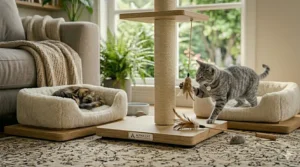
Many owners question whether a dedicated cat tower with bed justifies the expense compared to simple floor beds. The behavioral and health differences are more significant than most people realize.
Security and Territory Benefits
Traditional floor beds provide comfort but zero territorial advantage. Cats are hardwired to seek elevated positions that offer safety from ground-level threats (a holdover from wild ancestors avoiding predators). A cat tower with bed satisfies this instinctual need by providing height-based security that floor beds cannot match.
In multi-pet households, this becomes critical. Research published in Applied Animal Behaviour Science found that cats with vertical territory access showed 28% less aggression toward other household cats. The elevated bed creates a “safe zone” where subordinate cats can retreat without physical confrontation.
Physical Activity Integration
Floor beds encourage sedentary behavior—cats walk to them, sleep, and leave. Cat towers with beds force movement through climbing, which engages core muscles, improves flexibility, and burns calories. For indoor cats prone to obesity (affecting over 50% of house cats according to veterinary studies), this incidental exercise matters significantly.
The climbing motion to reach the bed also maintains joint mobility in senior cats. Veterinarians recommend gentle vertical movement to prevent arthritis stiffness—towers with graduated levels provide this therapeutic activity naturally.
Scratching Behavior Management
Integrated scratching posts on cat towers redirect destructive behavior away from furniture. Cats naturally scratch after waking from naps, so positioning scratching surfaces directly adjacent to beds captures this behavior when it naturally occurs. Floor beds require separate scratching posts that cats must seek out—less convenient, less effective.
According to the Cornell University College of Veterinary Medicine, appropriate scratching surfaces are essential for claw health and territorial marking. Towers integrate this need seamlessly.
Price Range Analysis: Where Your Money Actually Goes
Understanding what drives cat tower pricing helps identify good value versus marketing inflation. After analyzing hundreds of models, here’s the real cost breakdown.
Budget Category ($40-$80)
These towers use particle board construction with carpet or plush covering. Sisal posts are often thinner (2-3 inches diameter), and platforms lack significant padding. You’re buying immediate functionality with an expected lifespan of 1-3 years depending on cat size and activity level.
The Aechonow 14-inch tower represents exceptional budget value because it overdelivers on bed platform size—usually the first feature manufacturers cheap out on.
Mid-Range Category ($80-$150)
This tier introduces better materials: thicker sisal posts (3.5-4 inches), particle board with reinforced corners, and removable washable cushions. Construction quality improves, reducing wobble and extending lifespan to 3-5 years.
The Feandrea and Yaheetech models dominate this category because they balance cost-effective materials with thoughtful design. You’re paying for features that genuinely improve usability, not just decorative additions.
Premium Category ($150-$250)
Solid wood construction, heavy-duty hardware, and superior stability define this tier. These towers handle large breeds and multi-cat households without structural concerns. Expect 5-10 year lifespans with proper maintenance.
The SHENGOCASE 67.7-inch tower’s solid wood justifies premium pricing—it’s furniture-grade construction that ages gracefully instead of deteriorating. If you calculate cost-per-year of use, premium towers often deliver better value than replacing budget models every 2 years.
Total Cost of Ownership
Budget tower replaced every 2 years over 10 years: 5 purchases × $60 = $300
Premium tower lasting 10 years: 1 purchase × $200 = $200
The math favors quality if you’re committed to long-term cat ownership. Factor in the hassle of researching, ordering, assembling, and introducing new towers—premium models eliminate this repeated disruption.
Common Mistakes When Buying Cat Towers (And How to Avoid Them)
After observing hundreds of frustrated cat owners, I’ve identified the mistakes that lead to wasted money and unused furniture.
Mistake #1: Choosing Height Over Stability
Tall towers look impressive in photos but become dangerous if they wobble. Cats develop fear of unstable furniture after one tipping incident—they’ll refuse to use it afterward. Always check weight capacity ratings and base dimensions. A stable 48-inch tower beats a wobbly 72-inch tower every time.
Solution: Look for towers with weight capacities exceeding your needs by at least 20 pounds. If you have a 15-pound cat, choose towers rated for 20+ pounds. This engineering margin ensures stability under dynamic jumping forces, not just static weight.
Mistake #2: Ignoring Platform Size
Manufacturers list “perches” without specifying dimensions, leading buyers to discover tiny 10-inch platforms that barely fit a curled cat. Cats won’t use platforms where they feel precarious—they need room to stretch, turn, and adjust position.
Solution: Demand actual platform measurements before purchasing. Minimum viable size for average cats: 14″ × 14″. Large breeds need 18″ × 18″ or larger. The Aechonow’s 20″ × 16.5″ bed shows what adequate space looks like.
Mistake #3: Underestimating Assembly Complexity
“Easy assembly” claims hide reality: some towers require 60-90 minutes of frustrating construction with confusing instructions. Factor in your patience level and available help.
Solution: Read assembly-focused reviews before buying. Customer feedback reveals whether instructions are clear and parts fit properly. Budget an extra 30 minutes beyond estimated assembly time.
Mistake #4: Forgetting About Future Maintenance
Towers accumulate fur, dander, and odor. Non-removable cushions become permanent cat hair repositories that resist cleaning. Sisal posts fray and require replacement.
Solution: Prioritize towers with removable, washable cushions. Check whether replacement parts (cushions, posts) are available for purchase. Some manufacturers sell these separately; others force you to replace the entire unit.
Mistake #5: Choosing Aesthetics Over Cat Preferences
Owners buy sleek modern towers that look great in living rooms but ignore whether cats will actually use them. Cats don’t care about your interior design—they care about comfort, security, and functionality.
Solution: Balance human preferences with feline needs. If forced to choose, prioritize cat-centric features (platform size, stability, bed comfort) over color schemes. A happy cat using an “ugly” tower beats an unhappy cat ignoring a beautiful one.
Real-World Scenarios: Matching Towers to Lifestyles
Let me walk through specific situations to demonstrate how tower selection changes based on household dynamics.
Scenario A: Single Senior Cat in Apartment
Challenge: Limited space, aging cat with arthritis who struggles jumping
Solution: Aechonow 14-Inch Tower
Reasoning: The 20″ × 16.5″ bed provides generous space without requiring acrobatic climbing. Low height (14 inches) accommodates reduced mobility while still offering elevated security. Compact footprint fits studio or one-bedroom apartments without overwhelming rooms.
Scenario B: Two Young Cats in Suburban Home
Challenge: Highly active cats destroying furniture, sibling rivalry over resources
Solution: Globlazer 61-Inch Tower
Reasoning: Multiple platforms reduce territorial conflicts by creating separate zones. Seven scratching posts distributed throughout tower redirect destructive energy. Height satisfies young cats’ climbing drive while robust construction handles energetic play.
Scenario C: Multi-Cat Household (4+ Cats)
Challenge: Territorial aggression, resource guarding, limited vertical space
Solution: SHENGOCASE 67.7-Inch Tower + Yaheetech 54-Inch Tower
Reasoning: Distributing two towers across different rooms expands territory significantly. Solid wood SHENGOCASE handles heavy use from multiple cats, while budget Yaheetech creates secondary territory. This prevents resource monopolization where dominant cats claim single high-value furniture.
Scenario D: Budget-Conscious First-Time Cat Owner
Challenge: Limited funds, uncertain whether cat will use tower
Solution: Yaheetech 54-Inch Cat Tree
Reasoning: $70-$100 investment reduces financial risk while providing essential features. If cat embraces vertical territory, owner can upgrade later. If cat ignores tower, minimal money wasted. Natural sisal posts and dual condos ensure functionality matches pricier models.
FAQ: Cat Tower with Bed Questions Answered
❓ How tall should a cat tower with bed be for senior cats?
❓ Can cat towers with beds support multiple large cats simultaneously?
❓ How often should I replace my cat tower with bed?
❓ What's the best material for cat tower beds—plush or flannel?
❓ Do cats prefer hammock beds or flat platform beds on towers?
Conclusion: Investing in Your Cat’s Happiness
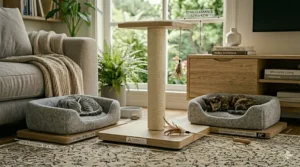
The right cat tower with bed transforms how your feline friend experiences their home environment. After analyzing seven distinct models across price ranges and feature sets, one pattern emerges clearly: matching tower specifications to your cat’s actual needs matters far more than buying the tallest or fanciest option.
For senior cats or small spaces, the Aechonow 14-Inch Tower delivers exceptional bed size in a mobility-friendly package. Active large cats thrive with the Globlazer 61-Inch Tower’s robust vertical territory. Budget-conscious buyers find genuine value in the Yaheetech 54-Inch model’s feature completeness. And design-focused households can finally enjoy aesthetically pleasing furniture with the Flower Cat Tree without sacrificing feline functionality.
Whatever you choose, remember this: the best cat tower is the one your cat actually uses. Pay attention to current sleeping locations, jumping abilities, and territorial behaviors—your cat is already telling you what they need. Give them elevated security, comfortable rest spaces, and appropriate scratching surfaces, and you’ll see the behavioral benefits manifest in reduced anxiety, better exercise habits, and fewer furniture destruction incidents.
Your investment isn’t just in furniture—it’s in your cat’s well-being, stress reduction, and quality of life. That’s worth getting right.
Recommended for You
- 7 Best Wall Mounted Cat Trees 2026 – Ultimate Space-Saving Guide
- 7 Best Modern Cat Tree Designs for 2026: Stylish & Functional
- 7 Best Small Cat Tree for Apartments 2026
Disclaimer: This article contains affiliate links. As an Amazon Associate, I earn from qualifying purchases. If you purchase products through these links, we may earn a small commission at no additional cost to you.
✨ Found this helpful? Share it with your friends! 💬🤗
