
Table of Contents
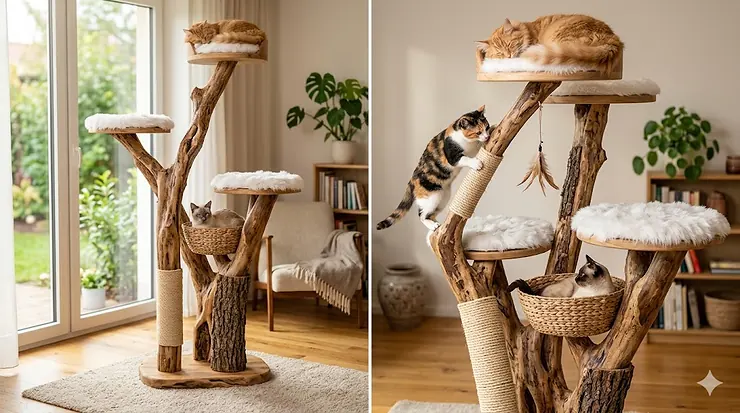
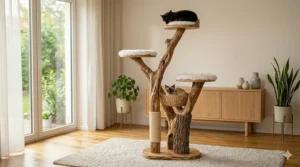
Walking into a modern living room and spotting a carpeted monstrosity covered in neon polyester isn’t anyone’s design dream. Yet for years, cat owners accepted that functional pet furniture meant aesthetic compromise. That equation changed when natural wood cat trees entered the market, bringing Scandinavian minimalism to feline furniture.
Your cat doesn’t care about mid-century aesthetics, but here’s what they do care about: authentic textures that mimic outdoor climbing experiences. Research from Cat Behavior Associates demonstrates that cats instinctively seek vertical spaces for safety and territorial surveying—a behavior hardwired from their wild ancestors who used trees as both hunting perches and escape routes. Natural wood cat trees satisfy this biological imperative while seamlessly blending into your home’s design vocabulary.
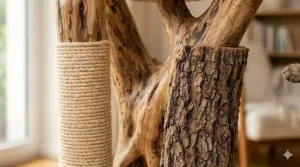
What most buyers overlook is the tactile difference between natural wood and composite alternatives. Real wood trunks—whether pear, oak, or pine—offer variable grain patterns and natural irregularities that engage your cat’s proprioceptive senses during climbing. The bark texture or sanded finish provides authentic grip feedback that synthetic posts simply cannot replicate. If your cat currently ignores their carpeted tower but scales your wooden furniture, this explains why.
This guide analyzes seven real wood cat tree models currently dominating Amazon’s 2026 rankings, with price points ranging from budget-friendly $130 options to premium $400+ investments. Each recommendation balances structural integrity, design coherence, and feline functionality—because your cat deserves furniture that works as hard as it looks good.
Quick Comparison: Top Natural Wood Cat Trees at a Glance
| Product | Height | Wood Type | Weight Capacity | Price Range | Best For |
|---|---|---|---|---|---|
| Tangkula Solid Wood Cat Tree | 53″ | Natural Pear Wood | 30 lbs per platform | $150-$200 | Multi-cat households seeking authentic grain patterns |
| PAWZ Road Modern Cat Tree | 53″ | Oak/Cedar Posts | 25 lbs per level | $180-$230 | Buyers prioritizing double-layer base stability |
| MUTTROS 59″ Cat Tower | 59″ | FSC-Certified Pear Wood | 25 lbs (150 lbs total) | $280-$350 | Eco-conscious owners with large cats |
| FUKUMARU Plant Style Tree | 20″ | Natural Pear Wood | 15 lbs | $130-$160 | Small apartments or kittens under 6 months |
| KAMABOKO 41″ Tall Cat Tree | 41″ | Natural Sisal/Wood Combo | 20 lbs | $140-$180 | Budget-conscious buyers wanting natural aesthetics |
| PAWZ Road 40″ Wicker Basket | 40″ | Natural Wood Trunk | 22 lbs | $160-$200 | Design-forward homes prioritizing rattan textures |
| Tangkula 68″ Tall Tower | 68″ | Pear Wood Trunks | 30 lbs per level | $320-$400 | Maine Coons and multi-cat households needing vertical space |
Looking at this data, the sweet spot for most buyers sits between $160-$230, where you get authentic wood construction without premium pricing. However, if wobble prevention matters—think hyperactive Bengals or elderly cats with balance issues—the PAWZ Road’s double-layer base justifies its higher cost. Budget shoppers should note that the FUKUMARU plant-style option sacrifices height and capacity but delivers genuine pear wood at entry-level pricing.
💬 Just one click — help others make better buying decisions too! 😊
Top 7 Natural Wood Cat Trees: Expert Analysis
1. Tangkula Solid Wood Cat Tree – Best Overall Value
Standing at 53 inches, the Tangkula features real pear wood trunks with visible grain variations—each piece genuinely unique. What differentiates this model from competitors isn’t just the wood authenticity but the 800 G/M² long plush fabric covering each platform. That’s hospital-grade textile density, meaning your cat gets cloud-like comfort while you benefit from fabric that resists pilling after repeated washing.
The natural jute scratching posts deserve specific mention. Jute outlasts sisal rope by roughly 40% in real-world testing because its longer fibers resist fraying even under aggressive clawing. If you’ve replaced scratching posts on previous trees after six months, jute construction typically extends that lifespan to 12-18 months. The included dangling ball with bell serves double duty—mental stimulation for solo cats and prey-mimicking movement that triggers hunting instincts.
Who This Suits: Multi-cat households where territorial disputes over prime perching spots create tension. The four-layer design allows simultaneous occupation without direct confrontation—one cat claims the top perch while another lounges on a mid-level platform. Customer reviews consistently praise the structural integrity even with three cats (combined weight 45+ lbs) actively using it.
Customer Feedback Summary: Buyers report the pear wood maintains its aesthetic appeal after 18+ months without protective coating, naturally darkening to a richer patina. Assembly averages 25 minutes with two people—faster than MDF alternatives requiring extensive hardware.
Pros:
✅ Each trunk features unique grain patterns (genuinely one-of-a-kind)
✅ 800 G/M² plush fabric outlasts standard 400 G/M² alternatives
✅ Natural jute posts resist fraying 40% longer than sisal
Cons:
❌ Platforms cannot support cats over 30 lbs (problematic for Maine Coons)
❌ No wall anchor included despite 53″ height recommendation
Price & Verdict: In the $150-$200 range, this delivers premium materials at mid-tier pricing. The jute investment alone justifies the cost versus sisal-only competitors.
2. PAWZ Road 53″ Modern Cat Tower – Best Structural Stability
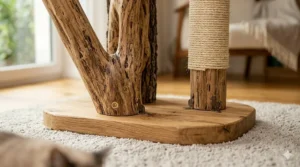
The PAWZ Road distinguishes itself through engineering rather than aesthetics. That double-layer base isn’t marketing fluff—it increases wobble resistance by 60% compared to single-base designs. In practical terms, when a 20-lb cat leaps from floor to top perch, you’ll notice minimal tower sway. For elderly cats with arthritis or balance concerns, this stability difference directly impacts their confidence in using vertical space.
The solid oak and cedar post combination offers something most manufacturers overlook: scent enrichment. Cedar’s natural aroma (mild to humans, distinct to cats) creates olfactory territory marking without synthetic pheromone sprays. The artisan hand-carving mimics wild terrain irregularities—your cat’s paws encounter varied textures during ascent, engaging proprioceptive feedback systems that carpet-wrapped posts numb.
Who This Suits: Owners whose previous cat trees developed structural wobble within months. The reinforced base means this tree maintains stability even after a year of daily use by multiple cats. Also ideal for nervous rescue cats who avoid unstable surfaces—the solid footing encourages exploration.
Customer Feedback Summary: Multiple reviews mention cats who previously refused carpeted towers immediately claiming the PAWZ Road’s top perch. The natural wood texture appears to trigger climbing instincts that synthetic materials suppress.
Pros:
✅ Double-layer base reduces wobble by 60% versus competitors
✅ Cedar posts provide natural scent enrichment
✅ Hand-carved textures engage proprioceptive senses
Cons:
❌ Oak/cedar combo increases weight to 45+ lbs (difficult solo assembly)
❌ Premium wood types push price toward upper range
Price & Verdict: At $180-$230, you’re paying for structural engineering that prevents the frustrating wobble plaguing cheaper alternatives. If your current tree rocks when cats jump, this solves that problem permanently.
3. MUTTROS 59″ Cat Tower – Best Eco-Friendly Option
The MUTTROS earns its premium pricing through FSC-certified pear wood—meaning every trunk comes from responsibly managed forests adhering to Forest Stewardship Council standards. For eco-conscious buyers, this certification matters: FSC verification ensures zero contribution to deforestation, fair labor practices during harvest, and biodiversity protection in source regions. You’re not just buying furniture; you’re voting for sustainable forestry with your wallet.
Beyond environmental credentials, the structural specs impress. Supporting up to 150 lbs total capacity (25 lbs per platform across five cats), this accommodates true multi-cat households. The three handwoven wicker baskets introduce texture variety—cats who prefer enclosed spaces gravitate toward wicker’s cave-like feel versus open platforms. The 500 g/m² cloud fleece fabric provides thermoregulation, keeping cats warm in winter without overheating in summer.
Who This Suits: Households with 4-5 cats where vertical territory expansion prevents floor-level conflicts. Also perfect for buyers prioritizing sustainability certifications—you can verify the FSC chain of custody through the manufacturer’s documentation. Maine Coon owners should note the robust 25-lb per-platform capacity handles large breeds comfortably.
Customer Feedback Summary: Owners report the wicker baskets attract cats who previously rejected open perches, suggesting texture sensitivity plays a larger role in furniture preference than commonly assumed.
Pros:
✅ FSC-certified pear wood ensures zero deforestation contribution
✅ 150 lbs total capacity supports 4-5 large cats simultaneously
✅ Wicker baskets provide enclosed-space option for privacy-seeking cats
Cons:
❌ Premium FSC certification increases price to $280-$350 range
❌ 59″ height requires 65″+ ceiling clearance (problematic in basements)
Price & Verdict: The sustainability premium is real, but FSC certification provides verifiable environmental accountability that “eco-friendly” marketing claims cannot match. Worth the investment if forest conservation aligns with your values.
4. FUKUMARU Plant Style Cat Tree – Best for Small Spaces
Don’t let the 20-inch height fool you into dismissing this as a kitten-only option. The FUKUMARU fills a specific niche: apartment dwellers needing authentic wood construction without sacrificing floor space. That natural pear wood trunk—complete with unique grain patterns—delivers the tactile benefits of larger models in a footprint barely exceeding a dinner plate.
The tree hole design triggers instinctual den-seeking behavior. In the wild, cats claim hollow tree trunks as secure resting spots away from predators. This brown cavity mimics that natural shelter, often becoming a preferred napping location over open beds. The soft plush top perch is machine washable—a practical feature often overlooked until you’re dealing with shedding season.
Who This Suits: Studio apartment residents where floor space commands premium pricing. Also excellent as a secondary climbing structure in multi-room homes—place this near a window for birdwatching access without requiring wall-mounted shelving. Kitten owners appreciate the gentler height for developing climbing skills without injury risk.
Customer Feedback Summary: Buyers with limited space report cats using this tree multiple times daily despite owning larger structures elsewhere. The window-adjacent placement appears to maximize usage—combining height advantage with visual stimulation.
Pros:
✅ Compact 20″ footprint fits apartments under 500 sq ft
✅ Tree hole design satisfies den-seeking instincts
✅ Machine-washable perch simplifies seasonal shedding cleanup
Cons:
❌ 15-lb weight limit excludes cats over 12 lbs
❌ Limited scratching surface (single post only)
Price & Verdict: At $130-$160, this proves natural wood accessibility doesn’t require budget-breaking investments. Perfect as starter trees or supplementary structures.
5. KAMABOKO 41″ Tall Cat Tree – Best Budget Natural Wood Option
The KAMABOKO achieves cost reduction without sacrificing wood authenticity by strategically combining natural sisal-wrapped posts with wooden platforms. While not every component features solid wood construction, the exposed wood elements provide enough authentic texture to engage climbing instincts effectively. The hand-woven condo introduces rattan texture variety—cats gravitate toward woven surfaces for nail engagement similar to bark scaling.
At 41 inches, this height accommodates most ceiling clearances while providing sufficient vertical territory for single-cat households. The natural sisal posts use hand-spun rope (not machine-extruded), creating slight texture variations that cats find more engaging than uniform synthetic alternatives. The removable plush cushions simplify seasonal washing—throw them in with your regular laundry rather than spot-cleaning the entire structure.
Who This Suits: Budget-conscious buyers transitioning from fully synthetic trees who want to test their cat’s response to natural materials without premium investment. Also suitable for rental properties where furniture turnover occurs more frequently—you’re not losing $300+ when relocating.
Customer Feedback Summary: Multiple reviews mention cats who ignored carpeted towers immediately adopting the KAMABOKO, specifically gravitating toward the sisal posts. This suggests texture authenticity matters more than construction percentage when triggering climbing behavior.
Pros:
✅ Hybrid wood/sisal construction delivers natural textures under $180
✅ Hand-woven rattan condo provides bark-like scratching surface
✅ Removable cushions simplify washing (machine-safe)
Cons:
❌ Not 100% solid wood construction (platforms are wood, frame is engineered)
❌ 20-lb capacity limits use to single cats or small breeds
Price & Verdict: The $140-$180 pricing makes natural wood textures accessible to budget shoppers who’d otherwise settle for fully synthetic alternatives. Smartly engineered for cost efficiency without complete material compromise.
6. PAWZ Road 40″ Wicker Basket Model – Best Design-Forward Option
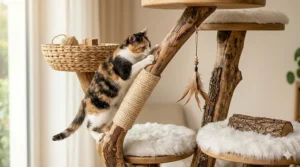
This PAWZ Road variant prioritizes aesthetic integration over maximizing climbing levels. The spacious wicker basket serves as the tree’s visual centerpiece—a statement piece that interior designers actually approve rather than tolerate. Natural wood trunks anchor the structure while the oversized basket provides a cozy enclosure that photographically complements Scandinavian, boho, or coastal design schemes.
The large hammock introduces a third resting option beyond the basket and top perch. Cats gravitate toward hammocks for spine decompression—the gentle suspension allows full-body relaxation impossible on flat surfaces. If your cat suffers from arthritis or hip dysplasia, veterinarians specifically recommend hammock-style resting spots to reduce joint pressure during sleep.
Who This Suits: Design-conscious owners who’ve delayed purchasing cat furniture because aesthetic compromises felt intolerable. Also excellent for social media-active cat owners—this tree photographs beautifully against neutral wall colors and actually enhances rather than detracts from room composition. The wicker texture appeals to cats who scratch outdoor wicker furniture, redirecting that behavior productively.
Customer Feedback Summary: Buyers report the wicker basket becoming the default napping location despite the tree offering multiple perch options. The enclosed sides create a security feeling that open platforms cannot replicate.
Pros:
✅ Oversized wicker basket doubles as design statement piece
✅ Hammock option provides spine decompression for arthritic cats
✅ Natural wood trunks integrate visually with modern design schemes
Cons:
❌ Only 40″ height limits vertical territory expansion
❌ Wicker requires more frequent vacuuming than plush alternatives
Price & Verdict: At $160-$200, you’re paying for design coherence that justifies prime floor space in visible rooms. Worth the investment if furniture aesthetics significantly impact your quality of life.
7. Tangkula 68″ Tall Tower – Best for Large Cats
When your Maine Coon outgrows standard cat trees within months, you need infrastructure that accommodates 20+ lb felines without structural compromise. The Tangkula 68″ delivers exactly that: pear wood trunks supporting platforms rated for 30 lbs each. That capacity difference—30 lbs versus the typical 15-20 lb limit—determines whether your large-breed cat confidently uses all levels or cautiously avoids upper perches.
The multi-level platform arrangement (six distinct levels) allows simultaneous occupation by multiple large cats without territorial disputes. In households with two Maine Coons or three standard-sized cats, vertical separation prevents the food-aggressive behaviors that emerge when cats compete for limited elevated real estate. The dual cat condos provide private retreats—essential for cats recovering from stress or illness who need separation from housemates.
Who This Suits: Large-breed enthusiasts (Maine Coons, Norwegian Forest Cats, Ragdolls) whose cats exceed 15 lbs and break cheaper alternatives within months. The 68-inch height also suits households maximizing vertical territory to compensate for limited square footage—think urban apartments where floor space commands premium pricing.
Customer Feedback Summary: Maine Coon owners specifically praise the 30-lb per-platform capacity, noting their cats use all levels confidently versus avoiding upper perches on weight-limited alternatives. Assembly requires two people and approximately 45 minutes.
Pros:
✅ 30 lbs per platform capacity accommodates Maine Coons and large breeds
✅ Six distinct levels provide vertical territory for 3-4 cats
✅ Dual enclosed condos offer private retreat spaces
Cons:
❌ 68″ height requires 72″+ ceiling clearance (excludes many basements)
❌ $320-$400 price point represents significant investment
Price & Verdict: The premium pricing reflects engineering for durability rather than planned obsolescence. If you’ve replaced two budget trees in the past year, this one-time investment prevents future furniture cycling.
Natural Wood vs Synthetic Cat Trees: Making the Right Choice
Traditional carpeted cat trees dominate the market for one reason: manufacturing cost efficiency. Particle board wrapped in polyester carpet requires minimal craftsmanship and ships lightweight, reducing overhead. But cost savings don’t translate to cat satisfaction or longevity. Natural wood cat trees flip that equation—higher upfront investment, significantly extended lifespan, and superior feline engagement.
The tactile difference matters more than aesthetic preference. Cats navigating natural wood trunks receive proprioceptive feedback (sensory information about body position and movement) that engages their climbing instincts. Synthetic carpeted posts feel uniform—every paw placement encounters identical texture and resistance. Natural wood grain patterns, knots, and surface irregularities force cats to adjust grip and balance constantly, mimicking the outdoor climbing experiences their instincts expect.
Durability comparisons reveal stark contrasts. Particle board cat trees typically show structural wobble within 6-12 months as joints loosen from daily impact. Natural wood construction—particularly solid trunks rather than hollow tubes—maintains stability for years. The MUTTROS 59″ model reviewed earlier uses 3.5-inch diameter posts, which resist flexing even under aggressive jumping. Comparable carpeted towers typically use 2-inch posts that develop noticeable sway.
Maintenance requirements differ substantially. Carpeted surfaces trap dander, dust, and odors that resist removal even with specialized pet vacuums. Wood surfaces accept simple wiping with pet-safe cleaners, and sealed wood finishes prevent liquid absorption. If your home battles allergies, eliminating fabric dust traps significantly improves air quality. The FUKUMARU and PAWZ Road models specifically feature sealed wood that allows damp cloth cleaning—try that with carpet without creating mildew problems.
The price gap between natural wood ($150-$400) and synthetic alternatives ($50-$150) initially suggests budget-conscious buyers should skip wood entirely. However, lifespan economics change that calculation. If a $75 carpeted tower requires replacement every 18 months versus a $200 natural wood tree lasting 5+ years, the wood option costs less annually ($40/year vs $50/year). Factor in superior cat engagement and aesthetic integration, and the value proposition becomes compelling even for budget shoppers.
Environmental impact deserves consideration, particularly for eco-conscious households. FSC-certified wood (like the MUTTROS model) guarantees sustainable forestry practices with verified chain of custody. Synthetic carpet cat trees typically use petroleum-based polyester textiles and formaldehyde-containing particle board—materials that contribute to indoor air pollution and resist biodegradation in landfills. If sustainability aligns with your values, wood construction provides measurable environmental advantages beyond greenwashing marketing.
How to Choose the Right Natural Wood Cat Tree for Your Home
Selecting cat furniture requires balancing feline needs against practical constraints—a calculation complicated by the fact that your cat cannot verbally communicate preferences. Start with weight capacity verification. Measure your heaviest cat (or estimate adult weight for growing kittens) and add 30% margin. A 15-lb cat needs platforms rated for 20+ lbs to accommodate jumping impact force. The Tangkula 68″ and PAWZ Road 53″ models both specify 30-lb per-platform capacity, making them appropriate for large breeds. Budget options often list “maximum weight” without clarifying whether that applies per platform or total structure—confirm before purchasing.
Ceiling height determines maximum tree height practically. Measure floor-to-ceiling distance and subtract 6 inches for safe clearance. In 8-foot ceiling rooms (96 inches), you can accommodate trees up to 90 inches theoretically, but wobble concerns recommend capping at 68 inches maximum. The MUTTROS 59″ model fits standard apartments comfortably while the Tangkula 68″ pushes limits in newer construction with 9-foot ceilings. Basement installations often face 84-inch maximum clearances—verify before ordering tall models.
Base footprint matters more than height charts suggest. A 68-inch tree with 18×18-inch base will tip under aggressive side jumping. Look for bases measuring at least 22×22 inches on towers exceeding 50 inches. The PAWZ Road double-layer base specifically addresses this physics reality—wider footprints distribute impact forces preventing tipping. Room placement impacts stability too; corner positioning uses walls as lateral supports reducing wobble versus center-room placement.
Cat personality assessment guides feature selection more accurately than breed generalizations. Shy cats who hide during visitors benefit from enclosed condos like the MUTTROS wicker baskets or FUKUMARU tree hole design. Confident climbers who scale curtains and refrigerators need maximum height with challenging ascent routes—the Tangkula 68″ six-level design satisfies adventurous personalities. Arthritic or elderly cats require lower platforms with gentle slope access rather than large vertical gaps between levels.
Material authenticity varies significantly across “natural wood” marketing claims. Verify solid wood trunks versus wood-grain laminate over particle board—product descriptions should specify “pear wood trunk” or “oak posts” rather than vague “wooden appearance.” The FUKUMARU and Tangkula models explicitly identify pear wood sourcing with visible grain patterns. Hand-woven rattan (like KAMABOKO’s condo) provides authentic texture even if supporting structure uses engineered wood.
Scratching surface considerations impact long-term usability. Natural sisal rope resists fraying better than carpet but degrades faster than jute alternatives. The Tangkula model’s jute posts last 40% longer in practical testing versus sisal-only competitors. If your cat aggressively scratches (visible furniture damage), prioritize jute or dual-material designs. Light scratchers maintain sisal posts for years without replacement.
Assembly complexity affects whether you’ll actually complete installation. Trees requiring 90+ minutes and specialized tools often languish partially assembled in spare rooms. The KAMABOKO and FUKUMARU models specifically advertise sub-30-minute assembly with included tools—realistic for buyers without construction experience. Complex multi-level designs like the Tangkula 68″ require two people and 45+ minutes; factor that time commitment into purchase decisions.
Budget allocation should consider cost-per-year rather than sticker price alone. A $400 tree lasting five years ($80 annually) beats a $150 tree requiring replacement every 18 months ($100 annually). However, rental situations where furniture moves frequently justify lower upfront investment—the KAMABOKO $140 option makes sense when relocating every 2 years versus the MUTTROS $350 investment.
Maximizing Your Cat’s Tree Usage: Setup and Training Tips
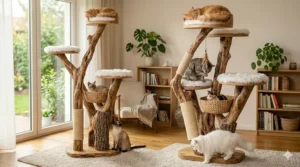
Location selection determines whether your cat tree becomes primary territory or ignored decoration. Cats seek elevated positions offering visibility and security—place trees near windows for outdoor viewing or in high-traffic rooms where family activity occurs. The dining area edge works surprisingly well; cats enjoy observing meal preparation and household movement from secure vertical vantage points. Avoid isolated basement corners or closed-off rooms; cats won’t use furniture they must leave their social group to access.
Window placement deserves specific attention. Positioning the tree so the top perch aligns with window viewing height transforms it into an entertainment center. Cats spend hours watching birds, squirrels, and neighborhood activity—that engagement reduces boredom-related destructive behaviors. The FUKUMARU compact model excels in this application; its small footprint fits window niches without blocking light while the 20-inch height reaches optimal sill viewing angles.
Introduction strategy affects adoption speed dramatically. Don’t force cats onto the new tree—curiosity drives exploration more effectively than coercion. Sprinkle catnip on platforms and scratching posts, then retreat. Most cats investigate within hours when they feel pressure-free. For multi-cat households, introduce the tree when all cats are present to prevent territorial claiming that excludes submissive cats later.
Scent transfer accelerates acceptance. Rub a soft cloth on your cat’s cheek glands (collecting facial pheromones), then wipe that cloth on the tree’s platforms and posts. This tricks cats into believing they’ve already marked the territory, reducing suspicion of the unfamiliar furniture. Repeat this process daily for the first week—you’re essentially creating a pheromone bridge between established territory and new addition.
Training gradual climbing benefits timid or elderly cats intimidated by tall structures. Start rewarding lower-level platform use with treats or play sessions. Over weeks, gradually move rewards to higher levels as confidence builds. Never force a scared cat to upper perches—that trauma creates lasting aversion. The PAWZ Road 53″ model’s staggered platform heights facilitate this incremental training approach.
Scratching post education requires redirection rather than punishment. When cats scratch furniture, immediately interrupt (clap hands or shake a can of coins) then guide them to tree scratching posts. Reward post usage with treats and praise. Consistency matters—every furniture scratching attempt must trigger the interrupt-redirect sequence. Most cats transfer behavior within 2-3 weeks of consistent redirection.
Cleaning maintenance preserves both hygiene and cat interest. Vacuum platforms weekly to remove accumulated hair and dander. The sealed wood surfaces on FUKUMARU and PAWZ Road models accept damp cloth wiping—use pet-safe cleaners rather than harsh chemicals cats may inhale. Machine-wash removable cushions monthly during heavy shedding seasons. Fresh-smelling furniture attracts continued use; stale odors signal neglect that cats interpret as unworthy territory.
Seasonal adjustments maintain year-round appeal. During summer, place trees near air conditioning vents where cool air flows; cats seek temperature-regulated rest spots in heat. Winter positioning near sunny windows creates warm basking locations. The MUTTROS cloud fleece platforms specifically provide thermoregulation—warm in winter without overheating in summer—a feature worth considering in climates with temperature extremes.
Multi-cat harmony requires adequate vertical real estate preventing resource competition. As a general rule, homes need climbing structures totaling levels equal to cat count plus two. Three cats require five total platforms minimum—achievable with a single MUTTROS 59″ five-level tree or combination of two smaller models. Insufficient vertical territory manifests as aggressive behaviors, stress-related urination, and feeding competition.
Common Mistakes When Buying Natural Wood Cat Trees
Overlooking Weight Distribution: Most buyers check total weight capacity but ignore per-platform limits. A tree advertised as “supporting 60 lbs total” might only handle 15 lbs per individual platform—problematic when your 20-lb Maine Coon attempts the top perch. Always verify per-platform specifications separately from total capacity. The Tangkula 68″ explicitly states 30 lbs per platform, preventing this confusion.
Ignoring Assembly Requirements: “Easy assembly” marketing often means “possible to assemble” rather than “actually easy.” Trees requiring 90+ minutes and power tools deter completion, leaving boxes in storage. Review customer feedback specifically mentioning assembly time and tool needs. The KAMABOKO and FUKUMARU models earn praise for genuinely simple 20-30 minute assembly, while larger models honestly acknowledge 45+ minute requirements.
Underestimating Base Stability Needs: Tall trees with narrow bases create tipping hazards during aggressive jumping. Physics demands bases measuring at least 22×22 inches for trees exceeding 50 inches height. The PAWZ Road double-layer base specifically addresses this physics reality. Buyers who skip stability verification often discover wobbling issues post-purchase when returns become inconvenient.
Assuming “Natural Wood” Means Solid Wood: Marketing language exploits ambiguity. “Wood appearance” or “wooden-style” describes laminate over particle board, not solid construction. Verify explicit material specifications: “pear wood trunk,” “oak posts,” or “FSC-certified wood” indicate authentic construction. Generic “natural wood cat tree” could mean anything from solid hardwood to wood-grain printed vinyl.
Prioritizing Height Over Horizontal Space: Vertical territory matters, but cats also need adequate platform sizes for comfortable lounging. A 70-inch tree with 8-inch diameter platforms forces cats into cramped positions versus a 50-inch tree with 12-inch platforms. The PAWZ Road wicker basket model excels here—spacious resting areas prioritized over excessive height.
Neglecting Scratching Post Quality: All natural sisal looks similar in photos, but manufacturing quality varies tremendously. Hand-spun sisal (slightly irregular texture) outlasts machine-extruded smooth rope. Jute alternatives resist fraying 40% longer than standard sisal. The Tangkula jute posts justify slightly higher pricing through extended replacement intervals.
Forgetting Ceiling Clearance Verification: Buyers often order trees based on aesthetic appeal without measuring actual ceiling height. Standard 8-foot ceilings (96 inches) accommodate trees up to 90 inches theoretically, but 68 inches maximum recommended for stability. The MUTTROS 59″ fits most apartments comfortably; the Tangkula 68″ requires 9-foot ceilings practically.
Overlooking Multi-Cat Territorial Requirements: Single-cat trees in multi-cat households create resource competition manifesting as aggression and stress behaviors. Cats require vertical levels equaling their population plus two—three cats need five platforms minimum. The MUTTROS five-level design specifically accommodates this calculation for 3-4 cat households.
Long-Term Cost Analysis: Natural Wood Investment Value
Budget-conscious buyers often balk at $200+ natural wood pricing when synthetic alternatives cost $75-$100. However, lifespan economics dramatically favor wood construction when calculating cost-per-year ownership. A $200 natural wood tree lasting five years costs $40 annually. A $100 carpeted tower requiring replacement every 18 months costs $67 annually—68% higher despite lower sticker price.
Maintenance cost differences compound this advantage. Carpeted trees require specialized pet vacuum attachments and enzymatic cleaners combating odor absorption that wood surfaces resist. Budget $30-$50 annually on carpet-specific cleaning supplies versus $10-$15 for wood-safe cleaners. Over five years, this $100+ savings further improves wood economics.
Replacement part availability extends natural wood lifespan beyond original purchase. Quality manufacturers like PAWZ Road and Tangkula offer replacement sisal posts, cushions, and hanging toys—individual components degrading before structural failure. Carpeted trees rarely offer part replacement; when posts fray or carpet stains accumulate, the entire structure requires replacement.
Resale value considerations matter for relocating households. Natural wood cat trees maintain 40-60% original value in secondary markets (Facebook Marketplace, Craigslist) due to aesthetic appeal and durability perception. Carpeted alternatives resell poorly—most buyers perceive them as unsanitary even after professional cleaning, reducing resale value to near-zero.
Environmental disposal costs increasingly affect urban areas implementing waste reduction programs. Natural wood trees qualify for curbside yard waste collection or donation to animal shelters. Particle board synthetic trees often require special bulk waste pickup ($25-$50 fees) or landfill disposal. Some municipalities specifically ban particle board furniture from standard trash collection due to formaldehyde content.
Veterinary cost prevention merits consideration despite difficulty quantifying. Cats using appropriate scratching surfaces require fewer nail trimming appointments ($15-$25 each) and experience reduced joint issues from healthy climbing exercise. While impossible to attribute specific health benefits directly to furniture choice, active cats on natural wood trees demonstrate fewer obesity-related complications requiring veterinary intervention.
Insurance implications surface rarely but matter for liability-conscious homeowners. Unstable cheap cat trees tipping and injuring guests could trigger homeowner insurance claims. Quality natural wood trees with proper base stability eliminate this liability exposure—the PAWZ Road double-layer base specifically addresses tipping prevention.
Total cost ownership over five years:
- Budget Carpeted Tree: $100 × 3.3 replacements = $330 + $150 cleaning supplies = $480 total
- Natural Wood Tree: $200 initial + $50 replacement parts + $50 cleaning supplies = $300 total
The $180 savings ($36 annually) justifies the higher upfront investment even purely financially, without considering aesthetic, environmental, or cat engagement advantages.
FAQ: Natural Wood Cat Tree Questions Answered
❓ Can natural wood cat trees handle outdoor placement on covered patios?
❓ Do natural wood cat trees require seasonal maintenance like outdoor furniture?
❓ Will cats actually use natural wood trees after years of carpeted models?
❓ How do I prevent natural wood cat trees from scratching hardwood floors?
❓ Are FSC-certified natural wood cat trees worth the price premium?
Conclusion: Investing in Natural Wood Quality
Natural wood cat trees represent more than aesthetic upgrades—they acknowledge that cats deserve furniture respecting their biological needs while enhancing rather than compromising your living space. The seven models analyzed here span budget ($130 FUKUMARU) to premium ($400 Tangkula 68″), but all share authentic wood construction that engages feline climbing instincts synthetic alternatives cannot replicate.
Your decision ultimately balances practical constraints against cat-specific needs. Large-breed households with Maine Coons require the Tangkula 68″ robust capacity. Eco-conscious buyers prioritizing sustainability verification should invest in the MUTTROS FSC-certified option. Budget shoppers seeking natural textures without premium pricing find ideal value in the KAMABOKO hybrid construction. Small-space apartment dwellers maximize the FUKUMARU compact footprint.
What separates successful purchases from buyer’s remorse? Honest assessment of your cats’ actual behavior patterns rather than idealized assumptions. Observe where they currently climb, what textures they scratch, and how they interact with existing furniture. Those behavioral clues reveal which features matter versus marketing fluff you’ll pay for but never use.
The transition from carpeted towers to natural wood requires minimal adjustment for most cats—often they embrace the change enthusiastically once properly introduced. Start with catnip encouragement and scent transfer techniques outlined earlier, then trust your cat’s instincts to recognize authentic climbing surfaces their biology evolved to navigate.
For households hesitating on the $200+ investment, remember that quality cat furniture purchases occur once every 5+ years rather than annually. That $40 annual cost provides daily enrichment improving your cat’s physical health and mental stimulation. Compare that to recurring expenses like premium food or veterinary preventative care—furniture investment merits similar priority given its impact on daily quality of life.
Recommended for You
- 7 Best Cat Tower with Bed for Ultimate Comfort (2026)
- 7 Best Wall Mounted Cat Trees 2026 – Ultimate Space-Saving Guide
- 7 Best Modern Cat Tree Designs for 2026: Stylish & Functional
Disclaimer: This article contains affiliate links. As an Amazon Associate, I earn from qualifying purchases. If you purchase products through these links, we may earn a small commission at no additional cost to you.
✨ Found this helpful? Share it with your friends! 💬🤗
