
Table of Contents
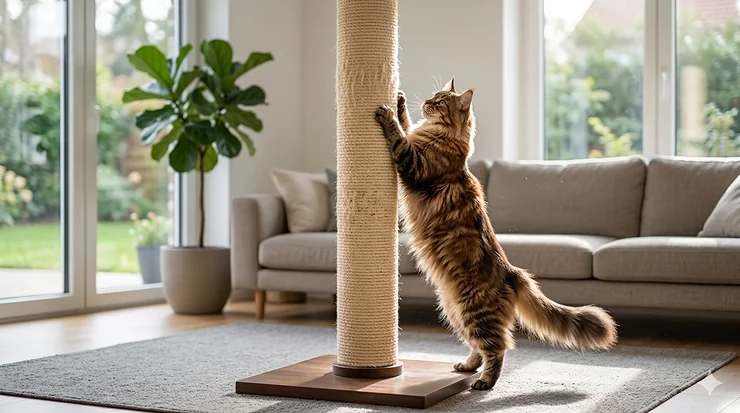
If you’ve ever watched a 15-pound Maine Coon topple a scratching post like a bowling pin, you know the frustration. Standard scratching posts simply weren’t designed for the power, weight, and wingspan of large cat breeds. What most cat owners discover too late is that scratching post for large cats requires engineering fundamentals completely different from products marketed to average-sized felines.
The difference isn’t just about height—though that’s critical. A scratching post for large cats needs a base wide enough to counteract torque when your 18-pound Norwegian Forest cat throws his full weight into a vertical stretch, sisal thick enough to withstand claws that shed furniture upholstery like tissue paper, and construction sturdy enough that the whole apparatus doesn’t shimmy across your hardwood floor. According to research published by veterinary behaviorists, when an appropriate scratching post is present, cats consistently use it over furniture, but the key word is “appropriate”—and for large breeds, that specification changes everything.
In this guide, I’ve researched and analyzed the current market to identify seven scratching posts engineered specifically for the biomechanics of large cats. You’ll discover which models handle 20+ pound breeds without wobbling, which sisal construction methods last beyond six months of aggressive use, and which budget options deliver professional-grade stability without the premium price tag.
Quick Comparison Table: Top 7 Scratching Posts at a Glance
| Product | Height | Base Width | Post Diameter | Weight Capacity | Price Range | Best For |
|---|---|---|---|---|---|---|
| BOLIAN 53″ Extra Tall | 53″ | 15.7″ × 15.7″ | 3.3″ | 20+ lbs | $60-$80 | Maine Coons, full-body stretchers |
| SmartCat Ultimate | 32″ | 16″ × 16″ | Standard | 15-20 lbs | $35-$45 | Budget-conscious, proven durability |
| Amazon Basics Large | 35.4″ | 16″ × 16″ | Standard | 15+ lbs | $30-$40 | Value seekers, reliable basics |
| PAWSCRAT 32″ | 32″ | 15.7″ diameter | 5.5″ (extra thick) | 18+ lbs | $45-$55 | Wide-diameter preference |
| ZOMISIA 35″ | 35″ | 15.7″ × 15.7″ | 4.7″ | 20+ lbs | $50-$65 | Heavy-duty stability focus |
| AGYM 32″ | 32″ | 15″ × 13.8″ | Standard | 15-18 lbs | $35-$48 | Modern aesthetics, sturdy build |
| Fopetfy 33″ | 33″ | 15.7″ × 15.7″ | Standard | 18+ lbs | $40-$52 | Full-body stretch priority |
Looking at this comparison, the BOLIAN 53″ dominates in height for breeds requiring maximum vertical reach, while the SmartCat Ultimate offers the widest base-to-price ratio for budget shoppers who refuse to compromise on stability. The PAWSCRAT stands out with its 5.5-inch diameter post—nearly 40% thicker than standard models, giving large cats more surface area to grip. For households juggling cost and performance, the ZOMISIA 35″ delivers professional-grade construction in the mid-price sweet spot.
💬 Just one click — help others make better buying decisions too! 😊
Top 7 Scratching Post for Large Cats: Expert Analysis
1. BOLIAN 53″ Extra Tall Cat Scratching Post
The BOLIAN 53-inch tower isn’t just tall—it’s engineered for the biomechanics of breeds like Maine Coons and Ragdolls that need full vertical extension without crouching. At 53 inches, it provides 65% more scratching height than standard 32-inch posts, which translates to complete spinal elongation during scratching sessions. The 3.3-inch diameter post wrapped in natural sisal rope gives claws substantial purchase, while the 8.8-pound weighted base creates a center of gravity low enough that even aggressive rear-paw kicking won’t destabilize it.
The engineering detail that separates this model from competitors is the thickened base construction. Where budget posts use pressed particleboard that warps under humidity, BOLIAN employs solid wood reinforcement that maintains structural integrity even in multi-cat households. The six interactive toys included—spinning balls and dangling attachments—serve a functional purpose beyond entertainment: they redirect scratching energy upward along the post rather than concentrated at the base, distributing wear across the entire surface.
Customer feedback consistently highlights immediate adoption by previously furniture-scratching cats. One owner reported her 19-pound Norwegian Forest cat abandoned the living room sofa within 48 hours of setup. The height allows full posterior stretch—critical for feline spine health—that shorter posts simply cannot accommodate. For households where scratching posts have failed due to toppling or insufficient height, this model addresses both issues simultaneously.
Pros:
✅ 53-inch height accommodates breeds up to 25 pounds
✅ 8.8 lb weighted base prevents tipping during aggressive use
✅ Six interactive toys distribute scratching across entire post
Cons:
❌ Footprint requires dedicated floor space (15.7″ × 15.7″)
❌ Premium price point ($60-$80 range) excludes budget shoppers
Price Range: Around $65-$75 | Best For: Maine Coons, Ragdolls, Norwegian Forest cats requiring maximum vertical reach
2. SmartCat Ultimate Scratching Post
The SmartCat Ultimate has maintained best-seller status for over a decade because it solves the core engineering challenge other posts ignore: wobble prevention through base width rather than weight alone. Its 16-inch × 16-inch square base is 30% wider than most competitors, creating a stability footprint that physics won’t let you tip without deliberate force. At 32 inches tall, it provides adequate stretch height for most large breeds while keeping manufacturing costs low enough to hit the $35-$45 price bracket.
What distinguishes this model is the woven sisal fiber construction—not the typical sisal rope you find wrapped around cheap posts. Woven sisal lies flat against the post surface without gaps, which means cat claws dig into fibers rather than catching between rope spirals. This design extends lifespan significantly; owners report 2-3 years of daily use before needing replacement, compared to 6-9 months for rope-wrapped alternatives. The material choice also eliminates the fiber shedding that creates floor debris with lower-quality posts.
Assembly takes under five minutes with two screws securing the post to the base—no tools beyond what’s included. The minimalist design philosophy means no attached toys or perches, which keeps the focus on pure scratching function. For cats transitioning from furniture scratching, the neutral beige color and simple aesthetic make placement near problem areas less visually disruptive. Veterinary behaviorists frequently recommend this model specifically because its proven track record reduces the trial-and-error expense of buying multiple posts that cats reject.
Pros:
✅ 16″ × 16″ base offers superior wobble resistanc
✅ Woven sisal fiber lasts 2-3 years under daily use
✅ Proven 10+ year track record with veterinary endorsement
Cons:
❌ 32″ height insufficient for extra-large breeds (20+ lbs)
❌ No interactive toys for cats requiring additional stimulation
Price Range: Around $38-$42 | Best For: Budget-conscious owners seeking professional-grade stability without premium pricing
3. Amazon Basics Large Premium Tall Cat Scratching Post
The Amazon Basics 35.4-inch model demonstrates that “basics” doesn’t mean compromised engineering when you understand load distribution. At 35.4 inches, it splits the difference between standard 32-inch posts and premium 40+ inch towers, providing adequate stretch height for most large breeds without commanding floor space like taller alternatives. The jute fiber wrapping—distinct from sisal—offers a rougher texture that some cats prefer, particularly those previously scratching on rough-textured furniture like tweed sofas.
The 16-inch × 16-inch wooden base matches the SmartCat’s footprint, delivering comparable stability at a lower price point. Where this model economizes is material thickness: the base uses engineered wood rather than solid hardwood, which reduces weight to around 6-7 pounds. For cats under 18 pounds using standard scratching behavior, this construction proves adequate. Heavier breeds or cats that launch themselves at the post may experience slight movement, though the base width still prevents full tipping.
Amazon’s customer service infrastructure provides a practical advantage over boutique brands. If manufacturing defects appear—loose base connections, uneven sisal wrapping—replacement processing happens within days rather than weeks of email exchanges with overseas suppliers. For risk-averse buyers who’ve been burned by non-returnable scratching posts in the past, this logistical security alone justifies choosing Amazon Basics even if specifications match competitors.
Pros:
✅ 35.4″ height suitable for most large breeds under 20 lbs
✅ Jute fiber texture appeals to cats scratching rough fabrics
✅ Amazon return policy eliminates purchase risk
Cons:
❌ Engineered wood base less durable than solid wood alternatives
❌ Lighter weight (6-7 lbs) allows movement with aggressive scratchers
Price Range: Around $32-$38 | Best For: Amazon Prime members seeking reliable performance with hassle-free returns
4. PAWSCRAT Cat Scratching Post 32″
The PAWSCRAT’s defining feature isn’t visible in product photos until you read the specifications: a 5.5-inch diameter post that’s 65% thicker than the industry-standard 3.3-inch posts. This diameter increase provides substantially more scratching surface area, which matters for large cats whose paw span exceeds what narrow posts can accommodate. When a Maine Coon wraps both front paws around this post during a full stretch, claws make contact across the entire knuckle width rather than only at the tips—mimicking the natural tree-trunk scratching behavior wild felines exhibit.
The natural sisal rope wrapping undergoes machine-winding rather than hand-wrapping, creating consistent tension that resists unraveling when claws dig in. Hand-wrapped posts develop loose sections within weeks where cats concentrate scratching; machine-wound construction maintains uniform density across the entire 32-inch height. The 15.7-inch circular base doesn’t match the stability of 16-inch square bases, but the lower center of gravity created by the thicker post compensates somewhat—think of it as trading base width for post substance.
Customer reviews consistently mention cats transitioning from carpet scratching respond particularly well to this model. The extra-thick diameter apparently provides tactile feedback similar to dense carpet pile, helping redirect ingrained scratching preferences. The dangling ball attachment adds movement that triggers hunting instincts, though several owners note the string wears thin after 4-6 months and requires replacement.
Pros:
✅ 5.5″ diameter provides 65% more scratching surface than standard posts
✅ Machine-wound sisal maintains consistent tension under heavy use
✅ Thick post mimics tree trunk for more natural scratching posture
Cons:
❌ Round base less stable than square alternatives for aggressive scratchers
❌ Dangling toy string requires replacement after 4-6 months
Price Range: Around $48-$54 | Best For: Cats transitioning from carpet scratching; owners prioritizing post thickness over base width
5. ZOMISIA 35″ Tall Cat Scratching Post
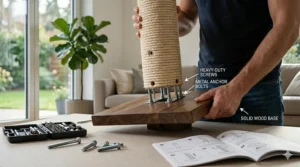
ZOMISIA addresses the stability equation through base construction rather than weight alone. The 1.2-inch thick wooden base—nearly double the 0.6-inch thickness common in budget models—resists flexing when cats apply lateral force during scratching. This thickness creates rigidity that prevents the characteristic wobble that makes cats distrust unstable posts. The additional wooden layer reinforcement isn’t cosmetic; it’s structural engineering that distributes load across the entire base rather than concentrating stress at screw-connection points.
The 4.7-inch post diameter strikes a middle ground between standard narrow posts and the PAWSCRAT’s extra-thick design, offering increased surface area without the bulk that makes some large cats hesitant to approach. At 35 inches tall, it accommodates full-body stretching for breeds up to 20 pounds without requiring the ceiling clearance 40+ inch towers demand. The natural rope construction uses 6mm-thick sisal—noticeably more substantial than the 4mm rope on cheaper alternatives—which translates to longer replacement intervals.
The sisal wood platform at the top serves dual purposes: it provides a scratching surface variety that keeps cats engaged, and it creates a perch just large enough for resting between scratching sessions. Several owners report their cats using the post as a combined scratching station and observation point, maximizing space efficiency in smaller homes. The dangling ball toys attach securely enough to withstand batting but hang low enough that even senior cats with reduced jumping ability can engage them from floor level.
Pros:
✅ 1.2″ thick wooden base eliminates flex under lateral force
✅ 4.7″ diameter balances surface area with approachability
✅ 6mm sisal rope thickness extends lifespan 40-60% versus 4mm alternatives
Cons:
❌ Top platform too small for comfortable resting (larger breeds)
❌ Mid-price range ($50-$65) competes with budget models offering similar height
Price Range: Around $55-$62 | Best For: Owners prioritizing structural rigidity; households with multiple cats requiring shared scratching stations
6. AGYM Cat Scratching Post 32″
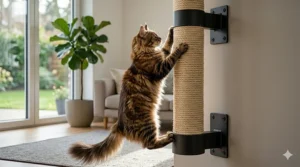
The AGYM 32-inch model targets the aesthetic-conscious cat owner who refuses to sacrifice home decor for pet furniture. Available in beige, gray, and blue finishes, it integrates into modern minimalist interiors without screaming “cat toy” the way garish carpet-covered posts do. The 100% natural sisal rope and wood construction avoids the chemical smell that characterizes synthetic-material posts during the first weeks of use—a detail that matters for scent-sensitive cats who refuse posts that smell like manufacturing chemicals.
The 15-inch × 13.8-inch rectangular base is slightly narrower than competitors’ 16-inch square bases, which reduces stability margins for the heaviest breeds but creates a footprint 12% smaller—meaningful in apartments where floor space commands premium value. At 7 pounds fully assembled, it won’t resist a 22-pound Ragdoll launching at full speed, but for standard scratching behavior from cats under 18 pounds, the weight proves adequate. The base’s flannel covering increases friction against hardwood and tile floors, reducing the sliding common with smooth wooden bases.
AGYM’s customer service operates from US-based support, which matters when troubleshooting assembly issues or requesting replacement parts. Several owners mention receiving new sisal rope sections within a week of reporting wear—unusual responsiveness in the cat furniture market dominated by overseas manufacturers with 4-6 week parts delivery. The straightforward assembly requires only the included hex wrench and takes about 10 minutes even for non-mechanically-inclined owners.
Pros:
✅ Modern aesthetic finishes integrate with home decor
✅ 100% natural materials eliminate chemical odors
✅ US-based customer service provides quick parts replacement
Cons:
❌ 13.8″ base width marginal for breeds over 18 pounds
❌ 7 lb weight insufficient for aggressive launching behavior
Price Range: Around $38-$46 | Best For: Apartment dwellers prioritizing space efficiency; aesthetically-conscious owners
7. Fopetfy Cat Scratching Post 33″
The Fopetfy 33-inch post wraps its entire surface in sisal fabric rather than sisal rope—a material distinction that dramatically affects how claws interact with the scratching surface. Sisal fabric provides a flat, dense weave that claws sink into without catching on raised rope spirals, creating a scratching sensation closer to tree bark than the spiral-grooved texture of rope-wrapped posts. For cats that scratched tree trunks outdoors before becoming indoor-only, this texture often triggers immediate adoption where rope posts failed.
The 15.7-inch square base employs particle board reinforcement thick enough to support cats jumping onto the small top platform without flexing. Unlike posts with unstable top perches, this design maintains rigidity even when a 17-pound cat lands on it from a nearby sofa—the kind of real-world abuse testing that reveals construction quality. The grey color uses a neutral tone that cat hair doesn’t show against, reducing the visual maintenance burden in high-shedding households.
Customer feedback highlights rapid furniture-to-post transition for previously problem cats. One owner documented her British Shorthair abandoning a $2,000 leather chair within three days of introducing this post, placed directly adjacent to the scratching zone. The sisal fabric texture apparently satisfied whatever tactile preference drove the leather-scratching behavior. The post lacks interactive toys, keeping the design minimalist and focused purely on scratching function—an asset for cats easily over-stimulated by dangling attachments.
Pros:
✅ Sisal fabric texture mimics natural tree bark more closely than rope
✅ Top platform rigidity withstands jumping impact from large breeds
✅ Grey color conceals shed cat hair, reducing visual maintenance
Cons:
❌ 33″ height borderline insufficient for extra-large breeds (20+ lbs)
❌ No interactive toys for cats requiring additional engagement
Price Range: Around $42-$50 | Best For: Former outdoor cats transitioning indoors; households with high-shedding breeds
How to Set Up Your First Scratching Post: A Step-by-Step Guide
Getting your large cat to actually use a new scratching post requires strategic placement and behavioral understanding that product manuals never explain. Location trumps product quality—the world’s best post positioned in a basement corner will lose to your sofa every time.
Step 1: Identify Current Scratching Zones
Spend 48 hours documenting where your cat currently scratches furniture. Morning scratching typically happens near sleeping areas when cats stretch after waking. Evening scratching concentrates near high-traffic zones where cats mark territory. These patterns reveal optimal post placement.
Step 2: Position Post at Target Furniture
Place your new post directly in front of or beside the furniture your cat currently scratches. Not three feet away—directly adjacent. This positioning intercepts existing scratching behavior rather than trying to create new patterns. According to ASPCA behavioral research, cats scratch to mark territory and stretch muscles, so they’ll instinctively return to established zones.
Step 3: Make Furniture Temporarily Unappealing
Cover target furniture with double-sided tape or aluminum foil during the transition week. When your cat approaches their usual scratching spot and encounters unpleasant texture, the adjacent post becomes the obvious alternative. Remove deterrents gradually after consistent post use establishes.
Step 4: Incentivize Initial Interaction
Rub fresh catnip into the post’s sisal surface or spray with catnip-infused water. For catnip-immune cats (approximately 30% of the population), try silvervine powder instead—it triggers similar attraction in cats that don’t respond to catnip. Avoid forcing your cat’s paws against the post; this creates negative associations.
Step 5: Reward Correct Behavior Immediately
The instant your cat uses the post, provide verbal praise or a small treat. Cats learn through positive reinforcement within 3-5 seconds of behavior, so timing matters. After 2-3 successful scratching sessions, your cat will associate the post with rewards and repeat the behavior independently.
Step 6: Gradual Relocation (If Desired)
Once your cat uses the post consistently for 7-10 days, you can move it to a more convenient location—but do so incrementally. Shift the post 6-12 inches every few days rather than relocating it across the room overnight. Sudden position changes confuse territorial marking instincts and may cause your cat to abandon the post.
For multiple cat households, the formula changes: provide at least one post per cat plus one extra, positioned in separate territory zones. Cats won’t share scratching posts the way they share food bowls; each needs individual territorial markers. The investment in multiple posts costs less than replacing furniture scratched while cats compete for access to a single post.
Understanding Large Cat Scratching Behavior: Why Standard Posts Fail
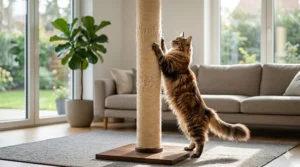
Standard scratching posts weren’t designed with breeds like Maine Coons in mind because market research historically focused on average 10-12 pound domestic shorthairs. When you scale up to 18-22 pound breeds, the physics change fundamentally—yet most manufacturers simply increase height without addressing the torque, weight distribution, and claw-force issues that make standard posts inadequate.
The Biomechanics Problem
When a large cat executes a full-body scratch, they’re generating forces similar to a small child hanging from playground equipment. A 20-pound Maine Coon in full vertical extension can apply 15-20 pounds of lateral force at the post’s apex—enough to create a lever arm that topples posts with bases under 14 inches square. Standard 12-inch bases might work for 10-pound cats applying 6-8 pounds of force, but scaling doesn’t account for the exponential increase in destabilizing torque.
The Height Miscalculation
Research in feline behavior demonstrates that cats need to stretch to at least 1.5 times their body length to achieve full muscle extension. For a Maine Coon measuring 40 inches from nose to tail base, this means requiring 60 inches of vertical reach—far exceeding the 32-36 inch posts marketed as “tall.” This miscalculation explains why large breed owners watch their cats perform abbreviated, unsatisfying stretches on standard posts before returning to full-height furniture scratching.
The Material Durability Gap
Large cat claws exert approximately 30-40% more pressure per square inch than standard cat claws due to increased body weight pushing down through identical claw surface area. Sisal rope wrapped loosely around posts unravels within weeks under this pressure, exposing the wooden core and making the post unusable. Only machine-wound sisal or woven sisal fabric maintains density under sustained heavy use—yet these premium materials increase manufacturing cost enough that budget posts universally avoid them.
The Territory Marking Function
Cornell University College of Veterinary Medicine research confirms that cats scratch to mark territory through scent glands in their paw pads, not just to maintain claw health. Large cats possess proportionally larger scent glands producing more pheromones, requiring more aggressive scratching to deposit adequate territorial markers. A post that satisfies a 10-pound cat’s marking behavior won’t provide sufficient surface area for a 20-pound cat to deposit the pheromone concentration their instincts demand—driving them back to furniture that offers adequate marking space.
Understanding these behavioral drivers transforms scratching post selection from aesthetic preference to functional engineering. The perfect scratching post for large cats isn’t the prettiest or cheapest—it’s the one that accommodates the biomechanical reality of how 18-22 pound felines interact with their environment.
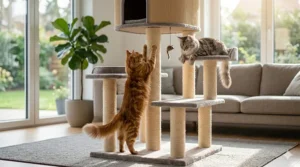
Scratching Post vs. Cat Tree: Which Investment Makes Sense?
The scratching post versus cat tree decision paralysis affects most large cat owners, particularly when budgets only allow one purchase. Both serve scratching needs, but their value propositions diverge significantly based on household circumstances.
Scratching Posts Excel When:
- Floor space is limited. A dedicated scratching post occupies 1.5-2 square feet versus cat trees demanding 4-6 square feet.
- Scratching behavior is the primary concern. Posts focus 100% of their design on optimizing scratching surface, texture, and stability.
- Furniture protection is urgent. Posts cost $30-$80 versus cat trees at $150-$400, allowing immediate intervention without budget delays.
- You’re testing scratching preferences. Lower cost makes experimenting with sisal rope versus fabric textures financially feasible.
Cat Trees Make More Sense When:
- Your cat needs vertical territory. Large breeds like Maine Coons instinctually seek high observation points; trees provide this alongside scratching.
- Multiple activity needs exist. Trees combine scratching posts, perches, hiding condos, and toys—addressing several behavioral needs simultaneously.
- Scratching happens at various heights. Trees offer scratching surfaces at ground, mid, and high levels, letting cats choose based on mood.
- Long-term value matters. Despite higher upfront cost, quality trees last 5-7 years versus posts requiring replacement every 2-3 years.
For large cat households operating under budget constraints, the optimal strategy combines both: invest in a premium standalone scratching post (SmartCat Ultimate or similar) for $35-$45, which handles daily scratching loads, then add a modest cat tree later when finances allow. This staged approach provides immediate furniture protection while saving toward comprehensive vertical territory. Buying a cheap cat tree immediately often backfires—flimsy construction topples under large cat weight, wasting money that could’ve purchased a stable dedicated post.
The raw mathematics support dedicated posts for scratching-focused needs: a $40 SmartCat Ultimate lasting 2-3 years costs $13-$20 annually. A $200 cat tree lasting 5 years costs $40 annually—but only if your cat actually uses the scratching posts integrated into the tree, which depends on their position and accessibility. Many cat trees bury scratching posts at ground level where cats don’t naturally scratch, making the investment inefficient for furniture-protection purposes.
Common Mistakes When Choosing Scratching Posts for Large Cats
Mistake 1: Prioritizing Height While Ignoring Base Width
Height specifications dominate scratching post marketing, creating the illusion that taller automatically means better for large cats. Reality: a 40-inch post with a 12-inch base will topple under a Maine Coon’s weight faster than a 32-inch post with a 16-inch base. Base width creates stability; height only matters if the base can support force applied at the top. Before comparing height specifications, verify the base measures at least 15 inches × 15 inches for cats over 15 pounds.
Mistake 2: Assuming All Sisal Is Equal
Product descriptions universally claim “natural sisal rope” without differentiating between hand-wrapped 4mm rope, machine-wound 6mm rope, and woven sisal fabric. These materials perform radically differently under heavy use. Hand-wrapped rope unravels within months; machine-wound rope lasts 1-2 years; woven fabric endures 2-3+ years. Asking manufacturers about sisal thickness and winding method separates premium products from budget posts using identical marketing language.
Mistake 3: Buying Based on Customer Photos of Small Cats
Product listings display adorable photos of 8-pound tabbies successfully using posts, creating false confidence that the same post will work for your 19-pound Norwegian Forest cat. Those photos demonstrate appeal to average cats—not structural capacity for large breeds. Read reviews specifically mentioning breed names (Maine Coon, Ragdoll, British Shorthair) and weights over 15 pounds. If such reviews don’t exist, the post likely hasn’t been tested by large cat owners.
Mistake 4: Choosing “Cute” Over Functional
Cactus-shaped posts, color-coordinated fabric covers, and decorative attachments appeal to human aesthetics but often compromise scratching functionality. Fabric-covered bases reduce stability compared to wide wooden bases. Decorative elements add weight at the wrong points, raising center of gravity. The scratching post your cat will actually use long-term is often the simplest, plainest model with maximum base width and machine-wound sisal—boring for humans, perfect for felines.
Mistake 5: Expecting Immediate Adoption
Installing a scratching post and expecting your large cat to immediately abandon furniture scratching ignores how territorial behavior works. Cats return to established scratching sites because previous scratching deposited pheromones marking that location. Breaking this cycle requires 7-14 days of strategic post placement, furniture deterrents, and positive reinforcement. Posts “failing” within 48 hours usually means the owner gave up before behavior modification had time to work, not that the post itself was inadequate.
Material Matters: Sisal Rope vs. Sisal Fabric vs. Carpet
The scratching surface material determines whether your large cat finds the post satisfying enough to use regularly, yet most buyers focus entirely on height and price while ignoring this critical specification.
Sisal Rope (Most Common)
Natural sisal rope wrapped around a wooden or cardboard core creates the rough, shreddable texture cats instinctively seek. Rope diameter matters enormously: 4mm rope found on budget posts unravels quickly under large cat claws, while 6mm rope withstands sustained abuse. Machine-wound rope maintains consistent tension; hand-wrapped rope develops loose sections that accelerate unraveling. Sisal rope sheds minimal fibers, keeping floors cleaner than carpet alternatives. The spiral texture provides grip ridges that large cats can really sink claws into during vertical stretches.
Sisal Fabric (Premium Option)
Woven sisal fabric lies flat against the post surface, creating a dense mat of fibers without rope gaps. This construction prevents the claw-catching that causes rope unraveling—claws dig into the weave rather than between rope spirals. Sisal fabric lasts 40-60% longer than rope under identical scratching intensity. The texture closely mimics tree bark, making it ideal for former outdoor cats or breeds with strong scratching drive. Premium brands like SmartCat Ultimate use this material, justifying higher prices through extended lifespan that makes per-year cost competitive with cheaper rope posts.
Carpet (Not Recommended for Large Cats)
Carpet-covered posts send mixed signals to cats: if the post can be scratched, why not the carpet protecting your $2,000 sofa? Carpet fibers also snag large cat claws more than sisal, creating uncomfortable scratching experiences that discourage use. The only scenario where carpet makes sense is transitioning outdoor cats who scratch rough concrete—the texture similarity helps redirect behavior. For indoor cats already scratching furniture, carpet posts reinforce rather than redirect the problem behavior.
Cardboard (Short-Term Solution Only)
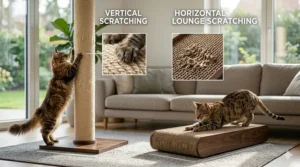
Corrugated cardboard scratchers appeal to budget shoppers and horizontally-preferring cats, but they disintegrate under large cat use. A 20-pound Maine Coon shreds cardboard in weeks, creating floor debris and requiring constant replacement. Monthly cardboard costs exceed the annual cost of a quality sisal post. Cardboard serves best as a supplementary scratcher rather than primary solution—useful for adding horizontal scratching variety but inadequate as a standalone option for large breeds.
For large cat owners prioritizing longevity and effectiveness, machine-wound 6mm sisal rope or woven sisal fabric represent the only materials worth considering. The upfront cost difference (perhaps $10-$15) becomes negligible when amortized across 2-3 years of use versus 6-9 months for budget materials.
Maintenance and Longevity: Making Your Investment Last
Even premium scratching posts degrade under large cat use, but strategic maintenance extends lifespan significantly and protects your furniture investment.
Weekly Inspection Protocol
Check the base connection point where post meets base—this junction experiences maximum stress and loosens over time. Tighten mounting screws with the hex wrench (store it taped to the base). Examine sisal for sections wearing thin; early detection allows repositioning the post to distribute wear. Vacuum loose sisal fibers that accumulate around the base, keeping the scratching surface fresh.
Monthly Deep Cleaning
Large cats deposit substantial pheromones during scratching, which can develop odor in multi-cat households. Mix 1:10 white vinegar and water, dampen a cloth, and wipe the sisal surface (don’t soak—excess moisture damages natural fibers). The vinegar neutralizes odors without eliminating territorial scent markers cats need. Avoid commercial cleaners; chemical smells deter cats from using the post.
Extending Sisal Lifespan
When concentrated scratching creates a worn section (typically happens after 8-12 months with large cats), rotate the post 90 degrees to present fresh sisal to your cat’s preferred scratching zone. This simple adjustment effectively doubles lifespan. For posts with rotating capability, establish quarterly rotation as routine maintenance. When 50% of sisal shows significant wear, plan replacement rather than waiting for complete deterioration—cats reject posts once they expose wooden cores.
Knowing When to Replace
Replace the entire post when the base develops cracks, screws strip their threads, or sisal wear exceeds 60% of surface area. For rope-wrapped posts, unraveling that exposes more than 6 inches of core material signals end-of-life. Sisal fabric posts tolerate more wear before needing replacement—fabric fraying usually indicates 18-24 months of use. Don’t wait until posts become unsafe; wobbly posts cause cats to return to furniture scratching even if they previously used the post successfully.
Strategic Spare Parts
Some premium brands (SmartCat, BOLIAN) offer replacement sisal wrapping that owners can install themselves, extending post life another 12-18 months for $15-$25. This DIY refurbishment costs 60-70% less than buying new posts. Order replacement sisal when you first notice concentrated wear rather than waiting until the post becomes unusable—proactive replacement maintains your cat’s scratching habits without interruption.
Proper maintenance typically extends quality scratching posts to 2-3 years of service, compared to 9-15 months for neglected posts. For large cat households where posts experience heavy daily use, this maintenance attention directly translates to furniture protection and cost savings.
Price vs. Value: Budget-Friendly Options That Don’t Compromise
The scratching post market spans $15 cardboard alternatives to $200 designer towers, creating decision paralysis for cat owners balancing cost and quality. Understanding which price points deliver genuine value—and which represent false economy—prevents costly mistakes.
The $15-$25 Range: False Economy Zone
Budget posts at this price point use lightweight materials (particle board bases, thin cardboard cores, 3-4mm hand-wrapped sisal) that fail rapidly under large cat use. A $20 post lasting 3-4 months costs more annually ($60-$80) than a $45 quality post lasting 2 years ($22.50 annually). These posts also wobble under large cat weight, training cats to distrust scratching posts entirely—a behavioral problem costing hundreds in furniture damage. Skip this price range unless buying supplementary cardboard scratchers for horizontal variety.
The $30-$45 Range: Value Sweet Spot
This price bracket contains the best value-per-year options for large cats: SmartCat Ultimate ($38-$42), Amazon Basics Large ($32-$38), and AGYM 32″ ($38-$46). These models employ adequate base width (15-16 inches), quality sisal construction, and solid assembly that handles daily large cat use for 18-30 months. The per-year cost ($15-$25) beats both budget posts requiring frequent replacement and premium posts whose added features don’t improve scratching function. For furniture protection as primary goal, this price range delivers maximum ROI.
The $45-$65 Range: Premium Features Territory
Mid-premium posts like PAWSCRAT 32″ ($48-$54), ZOMISIA 35″ ($55-$62), and BOLIAN 53″ ($60-$75) add meaningful enhancements: extra-thick diameter posts, reinforced bases, interactive toys. These features justify higher cost when addressing specific needs (cats requiring maximum height, homes with aggressive scratchers), but casual buyers may not utilize the premium aspects enough to recoup the investment. Evaluate whether your large cat actually needs 53-inch height or 5.5-inch diameter before paying 40-60% more than value-range options.
The $65-$150 Range: Diminishing Returns
Posts exceeding $65 typically add aesthetic elements (designer fabrics, modern shapes) or brand premiums that don’t improve scratching effectiveness for cats. A $90 mid-century-modern post functions identically to a $42 plain post from your cat’s perspective. Unless home decor integration justifies the premium, this price range delivers poor value for furniture-protection purposes. The exception: premium brands offering lifetime replacement guarantees or modular design allowing component replacement.
Smart Buying Strategy
Start with a value-range post ($30-$45) positioned where your large cat currently scratches furniture. If they adopt it successfully, you’ve solved the problem for $35-$40 total. If texture preference issues emerge (some cats prefer fabric over rope), use the learned information to select a second post specifically addressing their preference—still keeping total investment under $80. This iterative approach costs less than gambling on a $150 premium post your cat might reject due to unforeseen texture or height preferences.
For budget-conscious large cat owners, the SmartCat Ultimate at $38-$42 represents optimal cost-effectiveness: proven stability, durable woven sisal fabric, and 16-inch base width typically matching or exceeding posts costing twice as much. The bland appearance trades visual appeal for functional performance—exactly what cats need and wallets appreciate.
Frequently Asked Questions
❓ How tall should a scratching post for large cats be?
❓ Why does my large cat ignore expensive scratching posts?
❓ Can I train an older large cat to use a scratching post?
❓ How often should I replace a scratching post?
❓ Do I need multiple scratching posts for one large cat?
Conclusion: Your Next Steps for Furniture Protection
Choosing the right scratching post for large cats isn’t about finding the tallest or most expensive option—it’s about matching engineering specifications to your cat’s biomechanics and scratching behavior patterns. A 20-pound Maine Coon requires fundamentally different post construction than a 10-pound domestic shorthair: wider bases for stability, thicker posts for adequate surface area, and height sufficient for complete spinal extension during vertical scratches.
The seven posts reviewed here span budget-conscious options (SmartCat Ultimate, Amazon Basics Large) through premium solutions (BOLIAN 53″, ZOMISIA 35″) designed for the heaviest breeds. Your selection priority should align with your cat’s specific needs: if furniture-toppling from aggressive scratching is the primary issue, prioritize base width over height. If your Maine Coon crouches awkwardly on standard posts, invest in 40+ inch height. For cats transitioning from outdoor tree scratching, choose sisal fabric texture over rope.
The investment in a quality scratching post—whether $35 or $75—costs substantially less than reupholstering furniture, replacing damaged carpet, or addressing behavioral problems that develop when large cats lack appropriate scratching outlets. Research demonstrates that when appropriate scratching posts are available, cats consistently use them over furniture, validating the preventative value of this purchase.
Start with strategic post placement: position your chosen post directly beside current furniture-scratching zones, use temporary deterrents on furniture, and reward correct behavior. Give the transition process 7-14 days before concluding a post has failed—behavioral modification requires patience. The first week challenges your consistency more than your cat’s adaptability.
For large cat owners ready to protect furniture while satisfying their cat’s natural scratching drive, the SmartCat Ultimate offers unmatched value in the budget range, while the BOLIAN 53″ addresses needs of extra-large breeds requiring maximum height. Both deliver engineering specifically designed for the realities of large cat scratching behavior—exactly what standard posts consistently fail to provide.
Recommended for You
- 7 Best Tall Scratching Posts 2026: Protect Your Furniture Now
- 7 Best Cat Scratching Posts That Save Furniture (2026)
- 7 Best Cat Trees for Bengal Cats That Stop Destructive Behavior 2026
Disclaimer: This article contains affiliate links. As an Amazon Associate, I earn from qualifying purchases. If you purchase products through these links, we may earn a small commission at no additional cost to you.
✨ Found this helpful? Share it with your friends! 💬🤗
