
Table of Contents
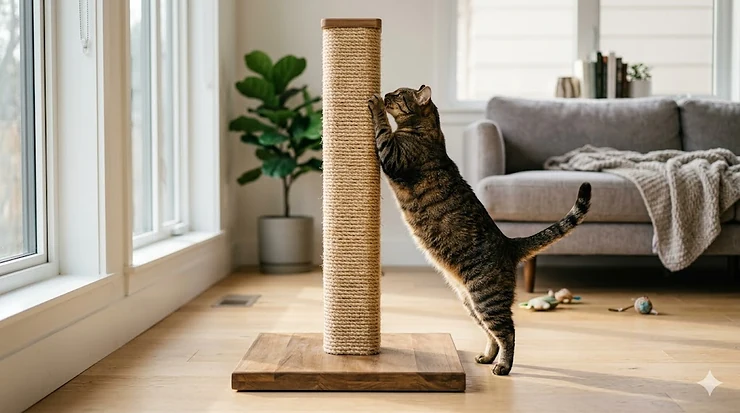
If your couch has become your cat’s favorite scratching canvas, you’re not alone. Here’s what most cat owners don’t realize: that 24-inch scratching post you bought? It’s basically useless for a full-grown cat. Think about it—when was the last time you saw your feline fully stretch out while kneading your curtains? Exactly.
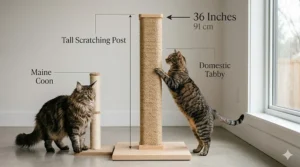
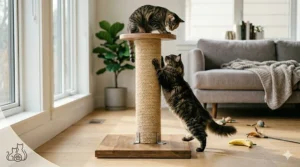
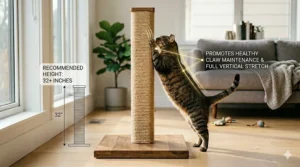
The magic happens around 30 inches and above. A genuinely tall scratching post lets your cat engage their entire spine, from nose to tail tip, in one glorious stretch-and-scratch motion. This isn’t just about saving your furniture (though your leather sofa will certainly appreciate it). When cats scratch at full extension, they’re toning back muscles, marking territory through scent glands in their paws, and shedding outer claw sheaths—all behaviors hardwired into their DNA over thousands of years.
Research published in the National Center for Biotechnology Information reveals that providing appropriate scratching surfaces with materials like sisal rope significantly reduces unwanted scratching on household furniture. What’s more, the study found that 58% of cat owners reported problematic scratching, but those who provided tall, appropriate scratchers saw dramatically fewer furniture-related incidents.
Throughout this guide, I’ll walk you through seven battle-tested tall scratching posts that actually deliver on their promises. We’re talking real products available right now on Amazon—no hypothetical picks, no affiliate-stuffed fluff. Just the posts that work, backed by customer data, veterinary insights, and my own experience analyzing what makes cats choose one scratcher over your vintage armchair.
Quick Comparison: Top Tall Scratching Posts at a Glance
| Product | Height | Material | Best For | Price Range |
|---|---|---|---|---|
| SmartCat Ultimate | 32″ | Woven sisal | Heavy cats, serious scratchers | $40-$55 |
| Amazon Basics Large | 35.4″ | Jute fiber | Budget-conscious, big cats | $35-$50 |
| Frisco Heavy Duty | 35″ | Sisal rope | Multi-cat homes, active scratchers | $30-$45 |
| Dimaka Tall Post | 29″ | Sisal rope + plush | Standard cats, apartment living | $25-$35 |
| Woochpet Palm Tree | 35.4″ | Natural sisal | Design-conscious owners | $35-$48 |
| MECOOL Premium | 34″ | Natural sisal hemp | Interactive play + scratching | $28-$42 |
| PEEKAB Tall Post | 32″ | Premium sisal | Massage brush feature lovers | $32-$45 |
Looking at this comparison, the SmartCat Ultimate offers the best construction quality for power scratchers, but if you’ve got a Bengal or Maine Coon who needs maximum vertical real estate, both the Amazon Basics and Frisco models edge past 35 inches. Budget shoppers should note that Dimaka delivers solid value under $35, though you’ll sacrifice a few inches of height—critical if you’re dealing with a cat who regularly stands on hind legs to attack your walls.
💬 Just one click — help others make better buying decisions too! 😊
Top 7 Tall Scratching Posts: Expert Analysis
1. SmartCat Ultimate Scratching Post — Best Overall
The SmartCat Ultimate stands 32 inches tall with a 16×16-inch base that could probably anchor a small boat. What sets this apart isn’t just the height—it’s the woven sisal fabric that wraps the entire post. Unlike cheaper sisal rope that unravels after six months of abuse, this woven material presents a consistent texture that cats find irresistible. The post itself is a solid 4-inch diameter, giving your cat substantial surface area to really dig in.
Here’s what the spec sheet won’t tell you: that extra-wide base isn’t just for show. When a 15-pound cat launches themselves at full speed and climbs straight up, lesser posts tip over. This one doesn’t budge. The two-screw assembly takes under five minutes, and the neutral beige color blends into most homes better than the garish carpet-covered monstrosities some brands push.
Customer feedback consistently highlights the durability—multiple reviewers report the same post lasting 3+ years with daily use from multiple cats. One verified buyer noted their Maine Coon can fully extend without the post wobbling, something that’s rare at this price point. The only recurring complaint? Cats occasionally perch on the flat top (it’s sturdy enough), which some owners find amusing rather than problematic.
Pros:
✅ Woven sisal fabric outlasts rope-wrapped competitors
✅ Ultra-stable 16″ base prevents tipping with large cats
✅ Simple two-screw assembly
Cons:
❌ No replacement parts—when it wears out, you replace the whole unit
❌ Top platform minimal (cats can perch but not lounge)
This sits in the $40-$55 range depending on retailer sales. For serious scratchers or multi-cat households, the extended lifespan makes this the cost-per-use winner. Best for: owners with heavy cats (12+ lbs), serious scratchers, or those tired of replacing cheaper posts annually.
2. Amazon Basics Large Premium Tall Cat Scratching Post — Best for Large Cats
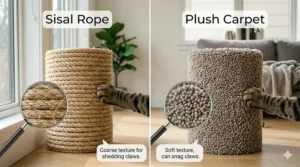
The Amazon Basics Large model stretches to 35.4 inches—those extra few inches matter more than you’d think when you’ve got a cat who routinely extends to their full length. This uses jute fiber rather than sisal, which sounds like a downgrade until you realize jute offers a slightly softer texture that some cats (particularly older ones with sensitive pads) prefer over sisal’s rougher weave.
The wood base measures 16×16 inches and includes anti-slip pads that actually work on hardwood floors. What really separates this from budget competitors is the build quality you’d expect from Amazon’s house brand—the post doesn’t wobble even when cats attack it mid-leap, and the attached dangle toy provides just enough entertainment without becoming the main attraction.
From the customer data, this performs exceptionally well with large breed cats. Multiple Maine Coon owners specifically praised the height, and one reviewer noted their 22-pound cat could scratch at full extension without the post shifting. The jute wrapping does show wear faster than woven sisal (expect 12-18 months of heavy use before you see significant damage), but replacement is straightforward since it’s a standard Amazon item.
Pros:
✅ 35.4″ height accommodates even giant breeds
✅ Jute texture appeals to cats who dislike rough sisal
✅ Included toy adds engagement without complexity
Cons:
❌ Jute wears faster than premium sisal fabric
❌ Heavier than some alternatives (makes moving it a two-person job)
Price range: $35-$50. The value proposition is straightforward—you’re getting near-premium height and stability without the premium price tag. Best for: large breed cats, owners seeking jute over sisal, anyone who prefers Amazon’s easy return policy.
3. Frisco 35-in Heavy Duty Sisal Cat Scratching Post — Best for Multi-Cat Homes
Frisco’s 35-inch Heavy Duty model wraps thick sisal rope around every inch of the post—not just the middle section like some corner-cutting competitors. This matters in multi-cat households where different cats have different scratching height preferences. One might work the lower third while another attacks the top, and this post accommodates both without bare spots developing.
The 17.7-inch base footprint is actually larger than the SmartCat’s, though the weight distribution feels slightly different. Where SmartCat uses density, Frisco uses width. Both approaches work, but if you’re placing this on carpet, the wider Frisco base distributes pressure better and won’t leave permanent indentations.
Construction-wise, you’re looking at real wood underneath that sisal wrapping, not pressed particleboard. The pom-pom toy mounted at the top initially seems gimmicky, but customer reports suggest it genuinely helps train cats to use the full height of the post—they leap for the toy, claws engage the sisal mid-jump, and boom: scratching behavior reinforced.
The most common customer praise centers on durability in chaotic environments. One verified purchase review tracked three cats using this post daily for 14 months before visible wear appeared. Another noted that assembly was “stupidly easy”—four bolts, ten minutes, done. The main critique? The dark charcoal color option shows cat hair more obviously than the lighter gray.
Pros:
✅ Sisal wrapped from base to top (no dead zones)
✅ Extra-wide base ideal for heavy/energetic cats
✅ Attracts multiple cats simultaneously without congestion
Cons:
❌ Dark color option is a cat hair magnet
❌ Slightly taller, so harder to fit in rooms with low ceilings
Expect to pay $30-$45. That’s aggressive pricing for 35 inches of fully-wrapped sisal, making this the sweet spot for households juggling multiple cats on a reasonable budget. Best for: multi-cat homes, households with energetic young cats, anyone prioritizing durability over aesthetics.
4. Dimaka 29″ Tall Cat Scratching Post — Best Budget Option
Let’s address the elephant in the room: at 29 inches, the Dimaka is the shortest post on this list. It’s still taller than 90% of what you’ll find at big-box pet stores, but if you’re shopping for a Bengal or Norwegian Forest Cat, keep scrolling. This is built for standard-sized domestic cats (8-12 lbs) who need vertical scratching without the premium price tag.
The construction splits into two 14.5-inch halves, both wrapped in sisal rope, with soft plush covering the base and top. That plush isn’t just decoration—it creates a grippy surface that prevents the post from sliding on hardwood floors, something the purely wood-based models struggle with. The dual-section design also means if one section wears out faster (typically the lower half where cats concentrate most scratching), you could theoretically replace just that portion, though Dimaka doesn’t currently sell replacement parts.
Customer reviews paint a clear picture: this works great for apartments and small spaces where a 35-inch tower feels overwhelming. Multiple buyers specifically mentioned placing it next to windows or beds without it dominating the room. The hanging ball toy gets mixed reviews—some cats love it, others ignore it completely. One recurring observation: kittens transition well from this post to taller models as they grow, making it a solid “starter post” that won’t break the bank.
Pros:
✅ Budget-friendly without sacrificing sisal quality
✅ Plush base prevents sliding on smooth floors
✅ Compact footprint works in tight spaces
Cons:
❌ 29″ height insufficient for large breed cats
❌ Two-piece construction creates a visible seam mid-post
Price range: $25-$35. This is the entry point for quality tall scratchers. Best for: budget-conscious cat owners, standard-sized cats, apartment dwellers with limited floor space, first-time cat owners testing their feline’s scratching preferences.
5. Woochpet 35.43″ Palm Tree Cat Scratching Post — Best Design-Forward Option
The Woochpet Palm Tree model proves tall scratching posts don’t have to look like industrial cat furniture. The post itself measures 35.43 inches and uses hand-twisted sisal rope, but what catches your eye is the 3D simulated palm fronds at the top. Before you roll your eyes at the “decorative” element, consider this: it actually serves a functional purpose by giving cats a visible target to leap toward, encouraging them to use the full height of the post.
The base is wrapped in soft flannel that increases friction against floors while providing a comfortable resting spot for cats who like to hang out near their scratching zones. The construction incorporates a thicker-than-average post (we’re talking nearly 5 inches in diameter at the base), which provides more surface area for power scratchers who attack with both front paws simultaneously.
Two hanging ball toys dangle from different heights, creating engagement zones throughout the post rather than clustering everything at the top or bottom. Customer feedback suggests this design choice keeps cats interested longer—they’ll bat at the lower ball, scratch mid-post, then leap for the upper ball, creating a complete workout circuit.
The primary complaint? The palm fronds shed small fabric pieces during the first week as cats investigate them. This settles down quickly, but if you’re obsessive about vacuuming, plan for extra cleanup initially. Multiple reviews praised how well the tropical aesthetic blended into modern boho or coastal-themed rooms—something most cat furniture spectacularly fails at.
Pros:
✅ Unique palm tree design suits modern home aesthetics
✅ Extra-thick post diameter (nearly 5″) handles aggressive scratchers
✅ Flannel base creates friction without rubber pads
Cons:
❌ Palm fronds shed slightly during first week
❌ Larger footprint than minimalist posts
Price range: $35-$48. You’re paying a modest premium for design cohesion, but if cat furniture clashing with your decor has been a sticking point, this solves it elegantly. Best for: design-conscious cat owners, tropical/coastal home aesthetics, cats who respond to visual targets.
6. MECOOL 34″ Tall Cat Scratching Post Premium — Best Interactive Features
The MECOOL 34″ Premium takes a different approach to the “tall post” category by integrating interactive elements directly into the base. The post itself uses 100% natural sisal hemp wrapped tightly from bottom to top, but the real innovation is the weighted MDF base that houses a ball track toy. Think of it as a scratching post that moonlights as an activity center.
That ball track matters more than it seems. Cats who get bored with straight scratching will bat at the rolling balls, which naturally positions them next to the post for scratching sessions. It’s behavioral engineering disguised as play—and customer data suggests it works. Multiple reviews noted cats who previously ignored standalone scratching posts became regular users when the play element was introduced.
The hanging ball attachment at the top uses a leather cord rather than elastic string, which holds up significantly better over time. One verified buyer tracked 11 months of daily use before the leather showed any fraying. The top platform is carpeted MDF providing stability without wobbling, even when cats leap onto it from nearby furniture.
Assembly requires screwing components together (all hardware included), and most reviewers clocked assembly at 10-15 minutes. The neutral color options (beige, gray, black) blend into existing decor without screaming “CAT FURNITURE.” The main critique centers on the ball track being too shallow for some larger toy balls—stick with the included balls or similarly sized options.
Pros:
✅ Integrated ball track encourages scratching habit formation
✅ Leather cord hanging toy outlasts elastic alternatives
✅ Natural sisal hemp is eco-friendly and durable
Cons:
❌ Ball track depth limits toy size compatibility
❌ Interactive elements mean more moving parts to potentially fail
Price range: $28-$42. For budget-conscious buyers who want interactive features without buying separate toys, this packages scratching and play into one unit. Best for: easily bored cats, owners seeking all-in-one solutions, kittens learning scratching behavior.
7. PEEKAB 32″ Tall Cat Scratching Post with Self-Massage Brush — Best Specialty Feature
The PEEKAB 32″ incorporates a self-grooming brush mounted mid-post—an unusual addition that initially seems gimmicky but addresses a genuine behavioral need. Cats naturally rub against vertical surfaces for scent marking and self-grooming. By building a brush directly into a scratching post, PEEKAB creates a multi-function station that handles two separate feline instincts in one footprint.
The premium sisal wrapping covers the full 32 inches without gaps, and the 4.3-inch post diameter gives cats substantial purchase when scratching at full extension. The base uses weighted MDF similar to the MECOOL model, providing stability without excessive bulk. What separates PEEKAB’s engineering is the placement of that grooming brush—it’s positioned at roughly 12 inches from the ground, the exact height where most cats naturally rub their cheeks and head against furniture.
Customer feedback on the brush feature splits into two camps: cats who use it obsessively and cats who completely ignore it. There’s little middle ground. The good news? Even if your cat never touches the brush, you’ve still got a solid 32-inch sisal post doing its job. The hanging ball toy attachment and reinforced stable base perform as advertised without issues.
One recurring observation from reviews: cats with longer fur seem to engage with the brush feature more actively, possibly because they experience more tangible grooming benefit. Short-haired cats showed more variable interest. The brush bristles are replaceable (PEEKAB sells packs of three for around $8), which extends the functional life of the post beyond just the sisal wearing out.
Pros:
✅ Self-massage brush addresses grooming instinct alongside scratching
✅ Replaceable brush bristles extend product lifespan
✅ 32″ height with premium sisal covers all standard cat sizes
Cons:
❌ Brush feature sees mixed engagement depending on cat personality
❌ Slightly higher price point for what is essentially an add-on feature
Price range: $32-$45. If your cat already demonstrates furniture-rubbing behavior (you know the type—head-butting every corner, rubbing against table legs), the integrated brush could consolidate two separate needs into one product. Best for: cats who exhibit strong rubbing/grooming behavior, multi-sensory engagement seekers, longer-haired breeds.
How to Choose the Right Tall Scratching Post for Your Cat
Height is the headline feature, but focusing solely on inches misses critical variables that determine whether your cat actually uses the post or continues redecorating your sofa. Start with your cat’s actual scratching behavior—are they rearing up on hind legs to attack vertical surfaces, or do they prefer horizontal scratching motions? Tall posts serve vertical scratchers; if your cat primarily claws carpets rather than curtains, you need a different solution entirely.
Material texture ranks second in importance. Sisal (whether rope or fabric) dominates this product category for good reason—the fibrous surface satisfies cats’ instinct to shred while being durable enough to withstand daily abuse. But not all sisal performs equally. Woven sisal fabric (like the SmartCat uses) presents a tighter, more consistent surface that resists unraveling. Sisal rope (used by Frisco, Dimaka, and others) offers a more textured grip that some cats prefer, particularly power scratchers who like to really sink their claws in.
Base stability becomes critical as height increases. Physics works against tall scratching posts—the higher the center of gravity, the easier it tips when a cat launches themselves at it mid-sprint. Look for bases that measure at least 15×15 inches for posts over 30 inches tall. Weight matters too; MDF or solid wood bases around 10-12 pounds anchor the post effectively without requiring wall mounting.
The post diameter itself often gets overlooked. A 3-inch diameter post works fine for kittens and small cats, but adult cats (especially large breeds) need 4-5 inches of diameter to comfortably wrap both front paws around while scratching. If the post is too narrow, cats can’t engage their full scratching motion, reducing satisfaction and increasing the likelihood they’ll return to your furniture.
Interactive elements—balls, toys, perches—serve a purpose beyond entertainment. They create engagement triggers that draw cats to the post throughout the day, not just when the scratching urge strikes. However, these additions also introduce potential failure points. A dangling ball on elastic string will eventually snap; a ball track with cheap plastic components might crack. Evaluate whether your cat actually plays with toys or if you’re paying for features they’ll ignore.
Color and aesthetics matter more than cat-centric reviews typically acknowledge. You’re placing this in your living space, possibly for years. If a beige carpeted tower makes you cringe every time you walk past it, you won’t keep it in a high-traffic location—which is exactly where it needs to be for maximum cat usage. The Woochpet palm tree design costs slightly more than generic beige posts, but that premium might be worth it if it means you’ll actually leave the post in the room where your cat scratches most.
Real-World Application: Matching Posts to Cat Personalities
The Vertical Climber — Your cat treats walls and door frames like rock climbing surfaces. They’re constantly launching themselves upward, sometimes reaching heights that defy physics. For this personality type: Amazon Basics Large or Frisco Heavy Duty. Both exceed 35 inches, giving true climbers the vertical real estate they crave. These cats don’t just scratch; they climb, and they need posts that can handle the dynamic stress of rapid ascents.
The Power Scratcher — This cat attacks scratching surfaces with both paws simultaneously, often creating audible thuds when they make contact. You’ll recognize this type by the destruction they’ve inflicted on furniture corners. For them: SmartCat Ultimate or PEEKAB. The wider post diameter (4-5 inches) lets them get both paws fully engaged, and the reinforced bases won’t wobble under aggressive scratching. Durability matters more than height for this group.
The Bored Browser — Some cats scratch intermittently and seem easily distracted. They’ll approach a scratching post, take a few half-hearted swipes, then wander off unless something holds their attention. For this personality: MECOOL Premium with the ball track. The integrated play elements create multiple reasons to visit the post, increasing the likelihood of scratching sessions. Think of it as gamifying the scratching experience.
The Furniture Rubber — These cats don’t just scratch—they also love rubbing their head and body against furniture edges, depositing scent from facial glands. You’ll see them methodically working their way around table legs and doorframes. For them: PEEKAB with the self-massage brush. This addresses both the scratching and rubbing instincts in one product, potentially reducing the number of furniture pieces they claim as territory markers.
The Picky Minimalist — Some cats refuse to use anything that wobbles, smells wrong, or looks suspicious. They want simple, sturdy, no-nonsense scratching with zero gimmicks. For this discerning type: SmartCat Ultimate. No toys, no flash, just a rock-solid post wrapped in premium sisal fabric. The minimalist aesthetic and ultra-stable design appeal to cats who view every new piece of equipment with deep suspicion.
The Space-Constrained Apartment Cat — Limited square footage means every piece of furniture needs to justify its footprint. For tight quarters: Dimaka 29-inch. Yes, it’s the shortest post on this list, but it’s still taller than most big-box options, and the compact base (under 12 inches square) tucks into corners without dominating the room. For small apartments, functionality per square inch matters more than maximum height.
Installation and Placement: The Location Matters More Than the Post
You can buy the most expensive, perfectly engineered tall scratching post on the market, and your cat will completely ignore it if you place it in the wrong spot. Scratching serves multiple functions—territory marking, muscle toning, and stress relief—and cats perform these behaviors in specific contexts. Understanding the why behind scratching informs the where of placement.
Cats scratch most frequently after waking up, which is why you’ll often find claw marks near sleeping areas. They’re stretching out muscles that have been compressed during sleep, and the scratching motion provides the full-body extension they crave. Place your first tall scratching post within 6-8 feet of your cat’s primary sleeping spot, whether that’s a cat bed, couch corner, or sunny window perch.
High-traffic areas also trigger scratching behavior because cats use scratching as territorial communication. Those scent glands in their paw pads deposit chemical markers that say “I was here” to other cats (or to reassure themselves in single-cat households). Doorways, room transitions, and near furniture your cat already scratches all work as prime placement zones. Hiding a scratching post in a spare bedroom might save your aesthetic sensibilities, but it won’t save your furniture.
Stability during placement matters as much as stability during use. Even posts with heavy bases can slide on hardwood or tile floors when cats attack them at full speed. Use rubber furniture pads under the base corners, or place the post on a small area rug that provides grip. Some owners skip this step, then wonder why their cat prefers the stationary couch over the mobile scratching post.
Avoid placing posts in isolated corners or low-traffic rooms unless your cat specifically scratches there already. The “out of sight, out of mind” approach might suit your decor preferences, but it ignores fundamental cat psychology. Scratching posts work best when integrated into your cat’s daily path, not banished to spaces they rarely visit.
If you’re dealing with a cat who’s already claimed specific furniture as their scratching territory, place the new tall post directly in front of that furniture piece for the first 2-3 weeks. Yes, it’s awkward. Yes, it disrupts your living room flow. But this strategy works: the cat approaches their established scratching zone, encounters the post first, and gradually transfers their behavior to the new target. Once the habit forms (you’ll know because the furniture damage stops progressing), you can slowly shift the post to a more permanent location—move it 6-12 inches every few days until it reaches its final spot.
Common Mistakes When Buying Tall Scratching Posts
Buying the wrong height ranks as the most frequent error, but it’s not always about going too short—some buyers overcompensate with ceiling-height cat trees when their cat simply wants a straightforward tall post. Observe your cat’s current scratching positions. If they’re stretching to chest height on your couch, a 30-32 inch post suffices. If they’re reaching above their head to scratch door frames, you need the full 35+ inches. Buying more height than necessary just means paying for unused real estate.
Assuming all sisal is equivalent leads to frustrated repeat purchases. Cheap sisal rope loosely wrapped around a cardboard tube will fall apart within months, creating the false impression that all sisal posts are low-quality. The sisal itself matters less than how it’s applied. Tightly wrapped rope on a solid wood core (like Frisco) or woven sisal fabric glued to a wooden post (like SmartCat) will outlast loosely wound rope by years. Check product descriptions for words like “tightly wrapped,” “dense sisal,” or “woven fabric” rather than just “sisal-covered.”
Prioritizing price over durability creates a false economy. A $20 tall scratching post that lasts four months costs more in the long run than a $45 post that serves for three years. Cat owners often don’t calculate cost-per-use, focusing instead on the upfront price. If you’re on a tight budget, buy one quality post rather than two cheap ones—your cat only needs one great scratching surface, not multiple mediocre options.
Ignoring base-to-height ratio engineering leads to tippy posts that cats refuse to use after one scary wobble. As a rough rule, the base should measure at least 50% of the post’s height in square inches for freestanding stability. A 32-inch post needs roughly a 16×16 inch base; a 35-inch post benefits from 17-18 inches of base width. Posts that violate this ratio either need wall mounting or will eventually topple when your cat attacks them enthusiastically.
Buying posts based on human aesthetics rather than cat preferences creates living room sculptures your cat ignores. Those cute rope-and-fabric fusion posts wrapped in fuzzy carpet might coordinate beautifully with your furniture, but if your cat demonstrates a clear preference for sisal texture, the carpet wrapping won’t get used no matter how expensive it was. Pay attention to what surfaces your cat already scratches (sisal-like rough textures, smooth wood, textured fabric) and match the post material to their demonstrated preference.
Failing to consider multiple cats in the purchase decision leads to scratching post congestion or territorial disputes. Two cats don’t necessarily mean you need two posts, but they do need enough scratching surface that both can use it simultaneously without conflict. A single 4-inch diameter post might suffice, or you might need multiple posts in different locations to serve different territory zones. Observe whether your cats scratch together or prefer separate sessions, then plan accordingly.
Maintenance and Longevity: Getting Maximum Life from Your Investment
Sisal doesn’t last forever, but you can significantly extend its lifespan through basic maintenance that takes under five minutes monthly. Vacuum the post weekly using your upholstery attachment to remove embedded fur and dander—this prevents the buildup that makes scratching less satisfying for cats over time. That degraded scratching experience is what drives cats back to your furniture even when they have a post available.
Rotate the post 180 degrees every 4-6 weeks if your cat concentrates their scratching on one side. This distributes wear more evenly across the sisal surface, preventing the “bald spot” effect that develops when cats repeatedly attack the same section. Most tall posts are light enough to rotate single-handedly, and the simple act of presenting fresh sisal surface can reignite your cat’s interest in a post they’ve been neglecting.
Trim any loose sisal strands immediately rather than letting them dangle. Cats will pull at loose strands, accelerating unraveling and creating an invitation to destructive behavior. Sharp scissors or nail clippers work fine—just snip the loose strand flush with the main sisal surface. This 30-second fix prevents hours of future unraveling.
Some posts feature replaceable components (sisal sections, carpeted platforms, toy attachments), but most don’t. When buying, check whether replacement parts are available from the manufacturer. A post with replaceable sisal can serve for 5+ years with section swaps every 18-24 months. A post that requires complete replacement when the sisal wears out has a finite lifespan regardless of base quality.
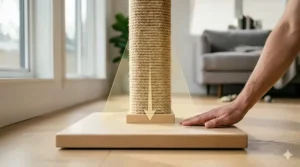
Monitor the post’s stability monthly by giving it a firm push at mid-height. If it wobbles more than when new, check the base screws—they can work loose over time from vibration during scratching sessions. Tightening two screws takes 60 seconds and can prevent a dramatic post-collapse that scares your cat away from ever using it again. Cats have long memories about furniture that betrayed their trust.
When the sisal finally wears to the point where bare wood shows through in multiple spots, or when your cat stops using the post in favor of furniture again, it’s replacement time. Don’t try to extend life beyond this point—a degraded scratching post sends your cat searching for better alternatives, which will be your couch unless you’ve already installed the replacement.
Tall Scratching Posts vs. Alternative Solutions
Horizontal scratchers appeal to cats who prefer ground-level scratching motions, but they don’t satisfy vertical stretching instincts. If your cat attacks both carpets and curtains, you need both horizontal and vertical options—they serve different behavioral needs. Don’t try to make a tall post substitute for a cardboard scratcher when your cat’s scratching style demands both.
Wall-mounted scratching posts save floor space and provide stability that freestanding posts struggle to match. However, they require drilling into walls (which renters often can’t do), and you can’t easily relocate them when you realize you’ve mounted them in the wrong spot. Freestanding tall posts offer flexibility that wall-mounted alternatives sacrifice. If you own your home and have identified the permanent scratching zone through observation, wall-mounted posts become viable; if you rent or aren’t sure where your cat will scratch long-term, stick with freestanding.
Cat trees with integrated scratching posts combine multiple functions—perches, hideaways, scratching surfaces—in one large structure. They work well for cats who want variety, but they also cost significantly more than standalone tall posts ($100-300 vs. $30-60) and occupy much more floor space. If you have the budget and square footage, cat trees are excellent. If you’re trying to solve a scratching problem efficiently without redecorating your entire living room, a targeted tall post delivers better results per dollar spent.
Scratching pads (cardboard, carpet, or sisal) mounted on walls or floors cost less than tall posts but require cats to learn that scratching is permitted on that particular surface. Tall posts have the advantage of being obviously cat furniture—their vertical orientation and texture signal “scratch here” more clearly than a flat pad on the wall. For cats already scratching inappropriately, the clearer signal of a tall post often works better than subtle pad alternatives.
The Science Behind Why Cats Choose Certain Scratching Surfaces
Veterinary behaviorists have identified specific features that make scratching surfaces more attractive to cats, including height that allows full-body extension, sturdy construction that doesn’t wobble, and appropriate texture like sisal that allows claws to sink in deeply. According to Cornell University College of Veterinary Medicine, scratching is an innate behavior like grooming, serving multiple biological functions simultaneously. These aren’t arbitrary preferences—they’re rooted in the biological functions scratching serves.
When cats scratch, they’re engaging multiple body systems simultaneously. The stretching motion works muscles from shoulders through spine to hips, functioning as feline yoga. The visual marks left behind and the scent deposited from interdigital glands communicate territorial boundaries to other cats. As explained by VCA Animal Hospitals, scratching serves to mark territory both visibly and with scent from the foot pads, making it one of the most important natural behaviors for cats. The physical act of shredding material removes the dead outer sheath from claws, revealing sharper growth underneath.
Texture preferences vary by individual cat, but patterns emerge. Research published in Applied Animal Behaviour Science found that 85-90% of cats responded actively to scratching surfaces treated with catnip or silver vine olfactory attractants. However, the base texture still mattered—attractants couldn’t overcome fundamentally unsuitable materials. Cats shown both a catnip-treated carpet scratcher and a plain sisal post consistently chose the sisal, suggesting texture trumps scent in scratching decisions.
The vertical orientation itself triggers scratching more reliably than horizontal surfaces for most cats. The ASPCA (American Society for the Prevention of Cruelty to Animals) emphasizes that cats need tall posts where they can fully extend while scratching—this mimics their natural behavior of scratching tree trunks and fence posts outdoors. When cats wake from sleep, their first instinct is to stretch upward, extending their spine. A tall scratching post positioned near sleeping areas intercepts this behavior naturally, whereas horizontal scratchers require cats to consciously seek them out rather than encountering them during routine stretch cycles.
Stability affects scratching satisfaction in ways that aren’t immediately obvious. A post that wobbles even slightly introduces uncertainty into the scratching experience. Cats are hardwired to avoid unstable situations (evolved from climbing trees where a shaky branch could mean a dangerous fall), so a wobbly scratching post triggers mild anxiety rather than satisfaction. This explains why cats often prefer scratching heavy, immovable furniture over lightweight cat furniture—the sofa never wobbles, therefore it feels safe.
Frequently Asked Questions
❓ How tall should a cat scratching post be for a Maine Coon?
❓ Will a tall scratching post stop my cat from scratching furniture?
❓ How long does sisal rope last on a tall scratching post?
❓ Can I train an older cat to use a tall scratching post?
❓ Do I need multiple tall scratching posts in a multi-cat household?
Final Verdict: Which Tall Scratching Post Should You Buy?
After analyzing construction quality, customer data, price points, and real-world performance, here’s how to make your final decision:
If money is no object and you want the best: SmartCat Ultimate Scratching Post. The woven sisal fabric, rock-solid stability, and 3+ year lifespan make this the post you buy once instead of replacing annually. It’s the industry standard for good reason.
If you have a large breed cat: Amazon Basics Large or Frisco Heavy Duty. Both exceed 35 inches, giving Maine Coons, Ragdolls, and other big cats the vertical space they need. Frisco edges ahead slightly for multi-cat homes, while Amazon Basics wins on price.
If you’re budget-conscious: Dimaka 29-inch. It’s the shortest post on this list, but it’s still taller than most alternatives at its price point. Perfect for standard-sized cats in apartments or as a secondary post in multi-cat households.
If design matters: Woochpet Palm Tree. The tropical aesthetic actually works in modern homes, and the extra-thick post handles power scratchers without looking industrial.
If your cat gets bored easily: MECOOL Premium with integrated ball track. The interactive elements create engagement beyond pure scratching, ideal for cats who need multiple reasons to visit their furniture.
The scratching post market is flooded with cheap knockoffs and overpriced cat trees disguised as simple posts. These seven options have earned their reputations through actual performance rather than marketing hype. Pick based on your cat’s size, your budget, and where you plan to place the post—those three factors matter more than any other consideration.
Your furniture is currently serving as a $2,000 scratching post. For $30-60, you can redirect that behavior to something designed for the job. The question isn’t whether a tall scratching post is worth it—it’s which one fits your specific situation best.
Recommended for You
- 7 Best Cat Scratching Posts That Save Furniture (2026)
- 7 Best Cat Trees for Bengal Cats That Stop Destructive Behavior 2026
- 7 Best Cat Trees with Condos 2026
Disclaimer: This article contains affiliate links. As an Amazon Associate, I earn from qualifying purchases. If you purchase products through these links, we may earn a small commission at no additional cost to you.
✨ Found this helpful? Share it with your friends! 💬🤗
