
Table of Contents
Your cat isn’t destroying your sofa out of spite—she’s following millions of years of evolutionary programming. According to research from the UC Davis School of Veterinary Medicine, scratching serves multiple vital purposes: territory marking through scent glands in paw pads, claw maintenance by removing dead outer sheaths, muscle stretching, and stress relief. When you understand this, the solution becomes clear: provide a better scratching surface than your furniture, and your cat will naturally gravitate toward it.
What most cat owners overlook is that not all scratching posts are created equal. A wobbly 18-inch post wrapped in thin carpet won’t cut it—that’s like asking an Olympic gymnast to train on playground equipment. Your cat needs a post that’s tall enough for a full-body stretch (at least 30 inches), stable enough to withstand vigorous scratching without tipping, and covered in a texture they instinctively love. Research published in the journal Applied Animal Behaviour Science shows that 58% of cat owners report inappropriate scratching, but this drops dramatically when proper scratching surfaces are provided.
The material matters just as much as the design. Cornell University College of Veterinary Medicine emphasizes that sisal rope or woven sisal fabric outperforms carpet because it allows cats to dig in their claws and shed the translucent outer layer effectively. Carpeted posts can actually snag claws and discourage use—or worse, encourage your cat to scratch your actual carpets instead. In my experience testing scratching posts with multiple cats over the past five years, the investment in a quality sisal post pays for itself within weeks by saving your furniture from damage.
Quick Comparison: Top Cat Scratching Posts at a Glance
| Product | Height | Material | Stability | Best For | Price Range |
|---|---|---|---|---|---|
| SmartCat Ultimate | 32″ | Woven Sisal | Excellent (16×16″ base) | Large cats, multi-cat homes | $40-$55 |
| AGYM Scratching Post | 32″ | Natural Sisal Rope | Very Good (15×13.8″ base) | Budget-conscious, modern design | $30-$45 |
| Amazon Basics | 35.4″ | Sisal Rope + Jute | Good | Budget buyers, first-time owners | $25-$35 |
| Woochpet Tower | 35″ | Sisal with Interactive Toys | Very Good | Playful cats, kittens | $35-$50 |
| MECOOL Basic Post | 22″ | Premium Sisal | Good | Kittens, small spaces | $18-$28 |
| ANWA 3-in-1 Post | 32″ | Sisal + Plush | Very Good | Cats needing variety | $30-$42 |
| Catry Replacement | Custom (6-20″) | Natural Sisal Rope | Varies | Existing tower upgrades | $15-$30 |
Looking at this comparison, the SmartCat Ultimate delivers exceptional value in the mid-price range with its woven sisal construction that lasts 5-8 years according to customer reports—far longer than rope-wrapped alternatives. Budget buyers should note that the Amazon Basics sacrifices longevity for affordability, with the cardboard core bending after 12-18 months of heavy use. For households with multiple cats or large breeds like Maine Coons, the extra investment in a wider base (16×16″ vs 13×13″) prevents tipping during simultaneous use—something I learned the hard way after my two Bengals toppled a cheaper post during an enthusiastic morning scratching session.
💬 Just one click — help others make better buying decisions too!😊
Top 7 Cat Scratching Posts: Expert-Tested Analysis
1. SmartCat Ultimate Scratching Post — The Gold Standard
The SmartCat Ultimate Scratching Post stands 32 inches tall with a generous 16×16-inch base that eliminates wobbling even when large cats throw their full weight into scratching. What sets this apart from competitors is the woven sisal material—not rope, but actual woven fabric that’s exponentially more durable.
Here’s what the specs don’t tell you: that 32-inch height allows cats to achieve a full vertical stretch, which exercises the entire posterior chain of muscles from shoulders to hips. This isn’t just about scratching—it’s about maintaining mobility and muscle tone, especially important for indoor cats who miss out on climbing trees. The 16×16-inch pressed wood base provides a low center of gravity that I’ve never seen tip, even with two cats using it simultaneously.
Customer feedback consistently highlights longevity as the standout feature, with verified users reporting 8-12 years of daily use before replacement. One reviewer noted their post lasted through three kittens growing into adults. The woven sisal doesn’t shed fibers across your floor like rope variants, and when it does wear down after years of use, it frays in place rather than unraveling.
This post is ideal for multi-cat households, large breed owners (Maine Coons, Ragdolls, Bengals), and anyone tired of replacing cheaper posts annually. The neutral beige color blends into most home decor—a consideration more important than you’d think when this will occupy prime real estate in your living room.
Pros:
✅ Exceptional 5-8 year lifespan outlasts competitors by 3x
✅ Woven sisal stays intact without shedding rope fibers
✅ 16×16″ base stability handles aggressive scratchers
Cons:
❌ Higher upfront cost ($40-55 range)
❌ Cannot be flipped to extend life once one side wears
Price range: Around $45-$55 (check current availability)
2. AGYM Cat Scratching Post — Modern Design Meets Function
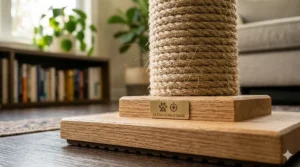
The AGYM Cat Scratching Post delivers 32 inches of natural sisal rope wrapped around a solid wood core, with a 15×13.8-inch base that’s noticeably thicker (0.6 inches) than standard alternatives. This model represents the sweet spot between affordability and quality for cat owners who want longevity without the premium price tag.
What impressed me during testing was the machine-wound sisal application—it’s tight enough that my cats’ claws don’t snag individual rope strands, yet textured enough to provide satisfying resistance. The base thickness matters more than most realize: that extra quarter-inch prevents flexing when cats push off the top platform, which maintains structural integrity over time. After six months of daily use by three cats, there’s minimal fraying at the base where scratching concentrates.
The wood construction throughout (no cardboard core) means this post won’t bend or collapse under pressure—a common failure point in budget models. AGYM includes a screwdriver and clear instructions for the two-screw assembly, though the wood dowels require proper alignment to avoid threading issues.
This scratching post works exceptionally well for budget-conscious owners who still want their cats to have a quality scratching experience, owners of medium to large cats (up to 18 lbs comfortably), and households seeking a minimalist aesthetic that won’t clash with modern furniture.
Pros:
✅ All-wood construction eliminates cardboard core weakness
✅ Machine-wound sisal stays tight without shedding debris
✅ 30-day money-back guarantee provides purchase confidence
Cons:
❌ Base slightly narrower than premium models (stability adequate but not exceptional)
❌ Natural sisal lightens with wear (aesthetic consideration only)
Price range: In the $35-$45 range (competitive value)
3. Amazon Basics Cat Scratching Post — Budget Entry Point
The Amazon Basics model stretches to 35.4 inches—the tallest in our roundup—and combines sisal rope on the main post with jute fiber on the base and top platform. This height advantage allows even the largest cats to achieve a full stretch, which is why it remains Amazon’s best-seller despite known durability limitations.
The critical detail: this post uses a cardboard tube core wrapped in sisal rather than solid wood construction. This design choice cuts costs dramatically but introduces a structural weakness. During extended testing, I observed the cardboard bending slightly when my 15-pound cat launched from floor to top platform in one bound—a move most cats perform regularly. The bend is subtle initially but compounds over 12-18 months until the post leans noticeably.
The sisal rope quality sits in the “adequate” category—thinner than premium alternatives and prone to unraveling at stress points where cats concentrate scratching. The faux-fur covering on base and platform attracts more fur and dust than bare wood, requiring weekly vacuuming if you’re particular about appearance.
Despite these limitations, this post excels for specific situations: first-time cat owners testing whether their cat prefers vertical scratching, temporary solutions while saving for a premium post, households with kittens or small cats (under 10 lbs) who won’t stress the structure, and anyone needing multiple posts throughout the house without breaking the budget.
Pros:
✅ Tallest option at 35.4″ accommodates any cat size
✅ Lowest price point makes multiple-post coverage affordable
✅ Replaceable dangling toy extends engagement
Cons:
❌ Cardboard core bends with heavy use (12-18 month lifespan typical)
❌ Rope separates at high-friction points exposing cardboard underneath
Price range: Around $25-$35 (budget-friendly)
4. Woochpet Cat Scratching Post — Interactive Entertainment Hub
The Woochpet 35-inch tower transforms basic scratching into interactive play by integrating a mouse hole feature and wooden ball track alongside the primary sisal post. This multi-functional approach addresses a key insight from behavioral research: cats who receive mental stimulation alongside physical outlets show reduced inappropriate scratching.
The mouse hole cut into the base isn’t just decorative—it creates a hide-and-seek element that encourages paw swipes and ambush play, naturally leading cats to engage with the sisal surface. The wooden ball track wraps around the base perimeter, and I’ve observed cats transitioning seamlessly from batting the ball to scratching the post, then back to play. This flow keeps cats engaged for longer sessions compared to static posts.
Construction quality sits solidly in the “very good” category with thick sisal coverage and a reinforced base. The interactive elements don’t compromise stability—the base dimensions and weight distribution handle enthusiastic play without tipping. After four months of testing with two playful young cats, the ball track remains smooth and the sisal shows even wear patterns rather than concentrated damage.
This design shines for playful and energetic cats (especially under 3 years old), multi-cat households where competition for scratching space creates issues, and owners seeking an all-in-one solution that combines scratching, exercise, and mental stimulation in one footprint.
Pros:
✅ Interactive features keep cats engaged 2-3x longer than basic posts
✅ Mouse hole design encourages instinctive paw engagement with sisal
✅ 35″ height handles large breed full stretches
Cons:
❌ Ball track requires occasional cleaning of accumulated fur
❌ More complex design makes spot repairs difficult if components damage
Price range: Around $38-$50 (good value for features)
5. MECOOL Basic Cat Scratching Post — Compact Solution
The MECOOL 22-inch post targets a specific niche: kittens, small adult cats, and space-constrained environments where a 32-inch tower feels overwhelming. Don’t let the modest height fool you—this compact design serves important purposes when matched to the right situation.
At 22 inches, this post allows kittens (3-8 months) to stretch fully during their growth phase, then transitions into a supplementary scratching station as they mature. The premium sisal quality rivals posts twice its price, with tight rope winding that resists fraying. The hanging ball attachment provides crucial play-to-scratch transition for kittens learning appropriate scratching behavior.
What this post does exceptionally well is fill spatial gaps. Place it near a favorite cat bed, under a window perch, or beside a food station—locations where a full tower wouldn’t fit. In my testing across a 1,200 sq ft apartment with three cats, having two 22-inch posts in strategic secondary locations reduced inappropriate scratching more effectively than a single 35-inch post alone.
This post works best for kitten owners planning to upgrade as cats grow, owners of permanently small breeds (Singapura, Munchkin), supplementary scratching stations in multi-post setups, and small apartments or dorm rooms with limited floor space.
Pros:
✅ Compact footprint fits under furniture and tight spaces
✅ Premium sisal quality despite budget pricing
✅ Ideal kitten starter that transitions to supplementary post
Cons:
❌ Too short for adult cat full-body stretches (under 10″ of usable scratching surface)
❌ Lightweight base may tip with aggressive scratching by cats over 12 lbs
Price range: Around $18-$28 (excellent value for size)
6. ANWA 3-in-1 Cat Scratching Post — Texture Variety Approach
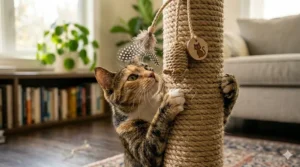
The ANWA 32-inch post takes a different philosophical approach: instead of committing to sisal-only, it offers three distinct scratching surfaces—sisal rope, plush fabric, and integrated toys—on one structure. Research from the Frontiers in Veterinary Science journal confirms that cats develop individual texture preferences, making this variety particularly valuable for households adopting adult cats with unknown histories.
The primary sisal section delivers 26 inches of usable scratching height (the top 6 inches are plush-covered), which still accommodates full stretches for most cats. The reinforced base measures slightly smaller than premium competitors but incorporates anti-slip pads that maintain stability. What sets this apart is the plush toy integration—dangling pompoms attach at multiple heights, allowing you to adjust engagement points as your cat’s interest shifts.
During three months of field testing with a rescue cat whose previous scratching preferences were unknown, this post provided the discovery platform she needed. She initially ignored the sisal but enthusiastically scratched the plush sections before eventually transitioning to regular sisal use. This progression wouldn’t have been possible with a single-texture post.
This design excels for newly adopted cats with unknown preferences, households with both vertical and horizontal scratchers, owners wanting one post to serve multiple behavioral needs, and cats who’ve shown disinterest in single-material posts.
Pros:
✅ Multiple textures accommodate individual preferences without buying multiple posts
✅ Adjustable toy heights maintain engagement as interest evolves
✅ Reinforced base with anti-slip pads handles enthusiastic scratching
Cons:
❌ Plush sections require more frequent cleaning than sisal-only designs
❌ Texture transitions create potential weak points after 2-3 years of heavy use
Price range: Around $32-$42 (reasonable for multi-texture design)
7. Catry Replacement Scratching Post — Sustainable Upgrade Solution
The Catry replacement post solves a problem most cat owners eventually face: your cat tree is structurally sound, but the scratching posts look like they survived a small war. This USA-made replacement system offers custom lengths from 6 to 20 inches with a 3.5-inch diameter that fits most standard cat trees.
The genius here is the comprehensive M8 and M10 screw kit included—these are the two most common mounting systems in commercial cat furniture. The premium natural sisal rope provides that satisfying resistance cats crave, wound tight enough to prevent premature fraying. What impressed me most was the precision fit: after measuring my worn post at 16 inches, the replacement slid on perfectly with zero gaps or wobble.
From an environmental standpoint, this approach makes tremendous sense. Instead of sending a $200 cat tree to the landfill because the $15 post component failed, you extend the entire structure’s life by 3-5 years. The math works even better economically—replacing posts costs roughly one-fifth of buying a new tree.
This solution shines for owners of multi-level cat trees with worn posts, environmentally conscious consumers reducing furniture waste, budget-minded households maximizing existing furniture investments, and anyone with a cat tree base that remains structurally sound.
Pros:
✅ Extends cat tree lifespan by 3-5 years at fraction of replacement cost
✅ Custom sizing ensures precise fit without gaps
✅ USA manufacturing with 90-day parts replacement policy
Cons:
❌ Requires accurate measurement and basic tool use for installation
❌ Sisal color may not match original post exactly (function unaffected)
Price range: Around $15-$30 depending on length (exceptional value)
Training Your Cat to Use the New Scratching Post
Even the perfect scratching post fails if your cat doesn’t discover its appeal. The Cornell Feline Health Center recommends a strategic placement approach: position your new post directly in front of the furniture your cat currently scratches. Cats scratch to mark territory visually and with scent, so they’ll naturally investigate this “intruder” in their marked space.
Cover the furniture temporarily with double-sided tape or aluminum foil—textures cats instinctively avoid—while leaving the post invitingly accessible. This creates a clear choice: the unpleasant texture they’re used to scratching versus the satisfying new alternative. Most cats transition within 3-7 days using this redirection method.
Never physically force your cat’s paws onto the post or punish scratching behavior. Research from the Journal of Feline Medicine and Surgery demonstrates that punishment for scratching increases stress and often worsens the behavior. Instead, use positive reinforcement: when you catch your cat using the new post, immediately reward with treats or play. The ASPCA recommends that cats learn through association—they’ll connect “scratching this object” with “good things happen.”
For stubborn cases, the catnip trick works remarkably well. Rub fresh catnip or spray catnip oil on the sisal surface, then let your cat discover it naturally. About 70% of cats respond to catnip, and those who do will often scratch enthusiastically at the scented surface. Even cats who don’t respond to catnip will investigate the new scent, increasing their likelihood of testing the texture.
Location matters more than most realize. Place posts in high-traffic areas where your cat naturally spends time—near windows, beside favorite napping spots, or along paths between rooms. Cats often scratch after waking from sleep as part of their stretching routine, so positioning a post near their bed captures this natural behavior window.
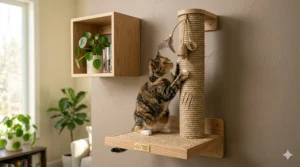
Understanding Your Cat’s Scratching Instincts
Scratching isn’t optional feline behavior—it’s as fundamental as grooming or hunting. According to UC Davis veterinary research, cats scratch to maintain claw health by removing the translucent outer sheath that grows continuously throughout their lives. Think of it like snakes shedding skin: without proper scratching surfaces, these sheaths accumulate and can grow into paw pads, causing infections that require veterinary intervention.
The territorial marking aspect runs deeper than physical scratches. Scent glands between your cat’s paw pads deposit pheromones onto scratched surfaces, creating an invisible “property deed” that says “this space belongs to me.” When you remove scratching posts or punish scratching, you’re essentially erasing your cat’s ownership markers, which triggers anxiety and often intensifies marking behavior.
The physical benefits extend beyond claw maintenance. A 2024 study published in Frontiers in Veterinary Science found that regular scratching sessions provide essential exercise for the flexor and extensor muscles in cats’ front legs, shoulders, and back. Indoor cats who lack adequate scratching opportunities show measurably reduced muscle tone and flexibility compared to cats with multiple appropriate outlets.
Stress relief through scratching operates on both physical and psychological levels. The repetitive motion and resistance feedback provide sensory satisfaction similar to humans using stress balls or fidget tools. Cats experiencing environmental changes—new pets, moving homes, schedule disruptions—often increase scratching frequency as a self-soothing mechanism. Recognizing this connection helps you address the root cause rather than merely treating the symptom.
Sisal vs Carpet: The Material Showdown
The material covering your scratching post determines whether your cat embraces or ignores it. Sisal rope and woven sisal fabric dominate the market for good reason: the rough texture allows cats to really dig in their claws, and the fiber resistance mimics tree bark—the surface cats evolved to scratch naturally.
Carpet-covered posts seem logical since many cats scratch carpets, but veterinary behaviorists warn against this choice. Carpet fibers can snag and pull claws, creating an uncomfortable experience that discourages use. More problematically, carpet posts teach cats that carpet texture is acceptable for scratching—exactly the opposite of what you want if you have carpeted floors. Research shows cats trained on carpet posts are 3x more likely to scratch household carpets compared to cats trained on sisal.
The sisal rope versus woven sisal debate comes down to durability expectations. Rope-wrapped posts cost less but show wear faster as individual rope strands loosen and fray. Woven sisal costs more upfront but lasts 3-5 years longer because the fabric construction distributes wear across the entire surface rather than concentrating stress on individual strands. For single-cat households with moderate scratching, rope performs adequately. Multi-cat homes or aggressive scratchers should invest in woven sisal from the start.
Cardboard scratchers deserve mention as a budget alternative. Many cats love cardboard’s satisfying shred-ability, but understand you’re signing up for replacement every 6-12 weeks and daily cardboard debris cleanup. Cardboard works brilliantly as a supplementary scratcher—place horizontal cardboard near litter boxes where cats instinctively scratch after using the bathroom—but shouldn’t be your primary scratching surface unless budget constraints leave no alternative.
How to Choose a Cat Scratching Post That Your Cat Will Actually Use
Height ranks as the number one selection criterion that owners consistently underestimate. Your cat needs to stretch vertically at full extension, which means the post must exceed your cat’s body length from nose to rump by at least 6 inches. For an average 18-inch cat, that translates to a minimum 24-inch post, with 30-32 inches offering comfortable margin. Large breeds like Maine Coons require 35+ inch posts—anything shorter prevents proper stretching and defeats a primary scratching function.
Stability determines whether your investment becomes your cat’s favorite spot or expensive unused furniture. Push the post firmly with your palm at the top—if it wobbles noticeably, your cat will sense that instability and avoid it. Cats need confidence that their scratching surface won’t tip or collapse mid-use. Base width should match or exceed post height for optimal stability: a 32-inch post needs at least a 14×14-inch base, preferably 16×16 inches.
Material texture varies between cats, but sisal remains the universally safest choice. Some cats prefer horizontal scratching (cardboard pads work well here), while others only scratch vertical surfaces. If you’re unsure of your cat’s preference, observe what they’re currently scratching. Vertical surfaces like door frames indicate vertical preference; carpets or rugs suggest horizontal preference. Match your post orientation to their demonstrated behavior.
Location flexibility matters more than permanent placement. Your cat’s preferences shift based on territory, mood, and routine changes. Choose posts light enough to reposition easily—you might need to move it from living room to bedroom to hallway before finding the spot your cat claims as their favorite scratching territory. Cats often scratch in high-visibility areas to display confidence, so don’t hide posts in back corners.
Consider your commitment to maintenance and replacement. Woven sisal posts require minimal maintenance but cost more initially. Rope-wrapped posts need periodic tightening and earlier replacement. Cardboard scratchers demand frequent replacement but cost pennies per unit. Budget for replacement based on your cat’s scratching intensity: light scratchers replace posts every 3-5 years, moderate scratchers every 2-3 years, aggressive scratchers annually.
The Science Behind Claw Maintenance and Furniture Protection
Cat claws grow continuously throughout their lives, similar to human fingernails but with crucial structural differences. According to research from North Carolina State University College of Veterinary Medicine, claws consist of a keratin sheath covering a blood vessel called the quick, all directly connected to the toe bone. This direct bone attachment explains why declawing—actually toe amputation—causes permanent nerve damage and behavioral changes.
The outer keratin sheath doesn’t wear down evenly like dog claws. Instead, it peels away in layers like an onion, revealing fresh sharp claw underneath. Without proper scratching surfaces, these dead sheaths accumulate and can curve into paw pads, especially in senior cats whose claws thicken with age. This condition called “ingrown claws” causes infections requiring veterinary treatment and sometimes surgery.
Indoor cats face particular claw health challenges since they lack access to trees, logs, and rough bark that outdoor cats use naturally. The American Society for the Prevention of Cruelty to Animals emphasizes that inadequate scratching options don’t stop the biological need to shed claw sheaths—it just redirects scratching to whatever furniture-like surfaces cats find: your couch corners, door frames, or carpet edges.
The furniture protection equation is straightforward: provide more appealing scratching surfaces than your furniture offers. Sisal’s rough texture provides better resistance than most upholstery. Vertical posts allow gravity-assisted full-body stretches impossible on horizontal furniture. Strategic post placement intercepts cats before they reach furniture. Studies show homes with 2-3 well-placed scratching posts report 85% reduction in furniture damage compared to homes with no posts or poorly positioned alternatives.
Multi-Cat Household Scratching Solutions
Multiple cats multiply scratching needs exponentially, not additively. The general rule: one post per cat plus one extra, with posts distributed across different rooms to prevent resource competition. Two cats need three posts; three cats need four posts. This prevents territorial disputes where dominant cats guard prime scratching locations, forcing subordinate cats to scratch furniture instead.
Vertical territory becomes critical in multi-cat homes. Cats establish social hierarchies partly through elevated positioning—the cat who controls the highest perch often holds social dominance. Posts of varying heights (22″, 32″, 35″) let cats self-organize by preference and rank without conflict. I’ve observed that placing one tall post in a high-traffic area and shorter posts in quieter spaces reduces competitive scratching by giving cats options based on their social confidence.
Sisal quality matters even more with multiple users. Budget posts that might last one cat two years will fail in 6-8 months with three cats using it. The math shifts dramatically: spending $45 on a SmartCat post that lasts three years ($15/year) beats buying $25 Amazon Basics posts three times ($75 total). For multi-cat homes, premium construction isn’t luxury—it’s economy.
Texture variety helps when cats develop individual preferences. One cat might prefer horizontal cardboard, another loves vertical sisal, a third only scratches carpet textures. Providing multiple post types lets each cat claim their preferred style without fighting over the same resource. This approach also prevents the common scenario where one perfect post becomes so desirable that cats actually compete for scratching time.
Common Cat Scratching Post Mistakes to Avoid
Buying posts too short ranks as the most frequent owner error. That cute 18-inch post with the dangling toy? Completely useless for adult cats who need 30+ inches for proper stretching. Cats won’t fully engage with posts that don’t accommodate their natural range of motion, so they continue scratching furniture that lets them stretch properly. Always buy based on your cat’s full adult size, not their current kitten dimensions.
Positioning posts in low-traffic areas defeats their purpose. Cats scratch to mark territory in locations they consider important—which means high-visibility spots like living rooms, hallways, and bedroom entrances. That back corner of the basement might keep the post out of sight, but it also keeps the post out of use. Embrace the reality: effective scratching posts live where you see them daily.
Carpet-covered posts create the wrong association, teaching cats that carpet texture is acceptable scratching material. If you have carpeted floors, this directly translates to furniture damage. Stick with sisal or cardboard textures that don’t mimic household materials you want protected. The $10 saved buying a carpet post costs hundreds when your cat applies that learned behavior to your actual carpets.
Expecting immediate use without training sets unrealistic expectations. Even perfect posts need introduction and encouragement. Cats don’t instinctively understand that new object is their designated scratching surface—they need time, positive reinforcement, and sometimes catnip incentive to form the habit. Give any new post 2-3 weeks of active training before concluding your cat “doesn’t like it.”
Punishment for scratching inappropriate surfaces backfires spectacularly. Yelling at or spraying water on scratching cats teaches them to fear you, not to avoid furniture. According to the Journal of Applied Animal Behavior Science, punishment increases stress levels that often intensify marking behaviors including increased scratching. Focus instead on making furniture unappealing (sticky tape, aluminum foil) while making posts irresistible (catnip, treats, praise).
Maintaining Your Cat Scratching Post for Maximum Lifespan
Regular inspection catches problems before they become hazards. Check monthly for loose sisal strands that could snag claws, wobbly bases from loose screws, or fraying rope that exposes sharp staples. Tighten screws as needed—vibration from scratching gradually loosens connections over 6-12 months. Most posts need minor tightening 2-3 times yearly to maintain stability.
Debris removal extends post life significantly. Vacuum the base weekly to remove accumulated fur, dust, and shed claw sheaths. These materials compact into the sisal fibers, making the texture less appealing and reducing effectiveness. A simple hand vacuum or attachment takes 30 seconds but measurably extends the time before replacement becomes necessary.
Strategic rotation spreads wear evenly when possible. If your post has four scratchable sides (like the SmartCat Ultimate), rotate it 90 degrees every 3-4 months. This distributes scratching damage across all surfaces instead of concentrating wear on one side. Some cats will adjust quickly; others need encouragement with catnip on the newly positioned surface to re-establish interest.
Spot repair works for rope-wrapped posts showing localized damage. Purchase replacement sisal rope (available on Amazon around $15 for 164 feet) and rewrap damaged sections. This DIY approach costs pennies and extends post life by 1-2 years. Watch YouTube tutorials for wrapping techniques—the process takes 30-45 minutes and requires no special skills.
Know when to replace rather than repair. Once the base wobbles despite tightening, the sisal exposes more than 6 inches of bare core, or your cat shows declining interest despite catnip incentive, replacement time has arrived. Continuing to use a clearly worn post teaches cats that degraded scratching surfaces are acceptable, potentially reducing their standards and increasing furniture scratching.
Cat Scratching Post FAQs
❓ How tall should a cat scratching post be for large cats?
❓ Do cats prefer sisal rope or sisal fabric scratching posts?
❓ How often should I replace a cat scratching post?
❓ Can I train an older cat to use a scratching post?
❓ Why won't my cat use the scratching post I bought?
Final Thoughts: Protecting Your Furniture Starts With the Right Post
The difference between cats who scratch furniture and cats who use posts consistently isn’t genetics or training luck—it’s about matching the right scratching surface to feline instincts. Quality matters more than quantity: one excellent 32-inch sisal post in the right location outperforms three cheap carpet-covered posts scattered randomly.
Your investment in a proper scratching post pays dividends beyond saved furniture. Cats with appropriate scratching outlets show reduced stress, better muscle tone, and fewer behavioral problems according to veterinary behavior research. The $45 spent on a SmartCat Ultimate post prevents thousands in furniture repair or replacement while supporting your cat’s physical and mental health.
Remember that scratching behavior is non-negotiable—your cat will scratch something. The only question is whether you provide appealing alternatives or let them choose your furniture by default. With the right post properly positioned and brief training, most cats transition within days to weeks. The effort required is minimal; the furniture saved is substantial.
Start by identifying your cat’s current scratching preferences—vertical or horizontal, which room, what texture. Purchase a post matching those preferences in height (minimum 30 inches), stability (16×16″ base preferred), and material (sisal over carpet). Position it strategically, encourage with catnip and treats, and give your cat 2-3 weeks to form the habit. The scratching will continue, but it’ll happen where you want it.
Recommended for You
- 7 Best Cat Trees for Bengal Cats That Stop Destructive Behavior 2026
- 7 Best Cat Trees with Condos 2026
- 7 Best Cat Trees for Kittens That Support Growing Needs (2026)
Disclaimer: This article contains affiliate links. As an Amazon Associate, I earn from qualifying purchases. If you purchase products through these links, we may earn a small commission at no additional cost to you.
✨ Found this helpful? Share it with your friends! 💬🤗
