
Table of Contents
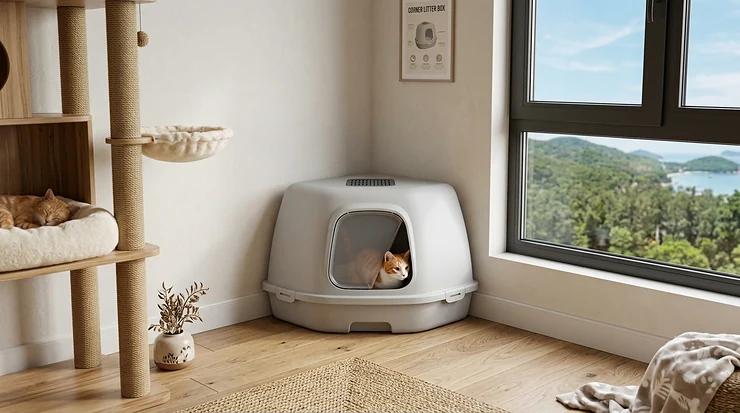
Every cat owner eventually has the same argument with their own living room: where, exactly, is the litter box supposed to go? A corner litter box exists because someone got tired of that argument. It’s a triangular or wedge-shaped pan built to slide into a 90-degree corner instead of hogging a rectangle of open floor, and it’s become the default fix for apartments, bathrooms, laundry nooks, and any home where square footage is a luxury nobody budgeted for.
Here’s the deal, though: not every corner litter box on the market actually delivers on that promise. Some genuinely reclaim dead space without shortchanging your cat’s comfort. Others just repackage a smaller pan with fancier branding and hope you don’t measure it. Below, I’ve pulled together seven real, currently available corner litter box options — spanning open pans, hooded designs, sifting systems, and one legitimately premium top-entry model — and broken down what each one actually does well, based on real specs and aggregated customer-review sentiment, not marketing copy.
Along the way you’ll get a straight answer on triangle litter box shapes versus rectangular ones, why room corners are such underrated real estate, and how to think about space efficiency without cramming your cat into something too small to comfortably use. If you’re weighing a corner fit litter pan for a small bathroom or just trying to reclaim a few square feet in a studio apartment, this guide walks through the real tradeoffs — the ones that don’t show up in a product photo.
Quick Comparison Table: Corner Litter Box Styles at a Glance
| Style | Floor Footprint | Odor Control | Best For |
|---|---|---|---|
| Open corner pan | Smallest | Low | Budget buyers, well-ventilated rooms |
| Hooded corner box | Small-medium | High | Odor-sensitive households |
| Sifting corner system | Small-medium | Medium | Owners who hate scooping |
| Top-entry corner-fit | Medium | High | Litter tracking, multi-cat homes |
A quick read of this table tells you most of what you need before diving deeper: open pans win on price and footprint but lose on smell containment, while hooded and top-entry designs trade a little extra bulk for a lot less odor in your living space. If tracking litter across your floors bothers you more than the smell does, a top-entry corner-fit design like the one further down this list is worth the higher price tag. Budget-conscious renters, on the other hand, tend to do just fine with an open pan as long as they’re diligent about daily scooping.
💬 Just one click — help others make better buying decisions too!😊
Top 7 Corner Litter Boxes: Expert Analysis
Below are seven real, currently sold corner litter box models, covering budget open pans through a premium top-entry option. Each one includes genuine spec interpretation, an honest analytical take on who it suits, and aggregated real review sentiment where it’s available and verifiable.
1. Van Ness High-Sides Corner Cat Litter Pan — best budget open-pan corner fit
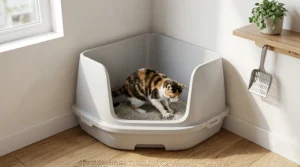
The name says it all: this is a no-frills, high-walled triangular pan built specifically to nestle into a 90-degree corner, and it’s about as budget-friendly as corner litter boxes get. The angled sides mean the footprint tapers as it approaches the wall, so it actually claims less usable floor space than its outer dimensions suggest — something worth checking against your own corner before buying. Made of heavy-duty, non-stick plastic, the high back wall does real work here, catching backward sprayers and enthusiastic diggers that a shallow pan simply couldn’t contain.
Based on the spec comparison with other open pans in this price tier, the Van Ness earns its reputation less through innovation and more through reliability: it’s a straightforward shape that just works, especially for cats who don’t mind an open top. Reviewers consistently report that it fits snugly behind toilets, beside vanities, and into tight bathroom nooks where a standard rectangular pan simply wouldn’t go. A recurring theme in aggregated feedback is that some litter escapes through the low front cutout during exit, so a litter mat underneath is basically mandatory rather than optional.
Pros:
✅ High back walls contain scatter and spray effectively
✅ Heavy-duty plastic resists cracking over years of use
✅ Angled shape reclaims dead corner space efficiently
Cons:
❌ Open top means zero odor containment
❌ Litter escapes through the low front cutout during exit
At around $15-$20 depending on retailer promotions, this is the cheapest legitimate way to test whether your cat tolerates a corner-shaped litter box before spending more.
2. SmartCat Corner Litter Box — sturdiest triangular design under $30
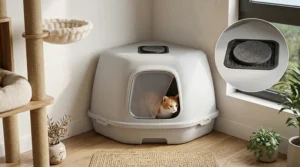
SmartCat built this one around a single obsession: not tipping over. The triangular shape uses noticeably thicker resin than most entry-level pans, and a printed fill line takes the guesswork out of how deep your litter layer should sit — a small detail that ends up mattering more than it sounds, since underfilled boxes are a common cause of litter tracking and digging frustration. The low front entry keeps things accessible for kittens and older cats with joint stiffness, while the high back and side walls do the heavy lifting on containment.
What most buyers overlook about this model is that its “generous” interior sizing claim really only holds up for cats under about 12 pounds; go bigger than that and the taper toward the corner starts eating into usable turning room. Reviewers consistently praise the sturdy, high-quality feel of the plastic and note that cats tend to adopt it quickly, though a subset of owners with larger cats specifically flagged it as too small for comfortable digging and turning.
Pros:
✅ Thick, durable resin resists warping and tipping
✅ Fill line removes guesswork on litter depth
✅ Low front entry works well for kittens and seniors
Cons:
❌ Cramped interior for cats over roughly 12 pounds
❌ No hood option available for this model
Priced in the $20-$30 range, the SmartCat represents strong value for single-cat, small-to-medium-cat households prioritizing durability over frills.
3. So Phresh High-Back Corner Litter Box — roomiest open corner pan
So Phresh went a different direction than most corner boxes on this list: instead of shrinking the interior to fit the corner shape, this X-Large model keeps a genuinely spacious litter bed while still tapering into the wall. The elevated back and side walls specifically target the two biggest complaints about open pans — kicked-out litter and backward urine spray — without adding a hood that some cats reject outright.
Here’s what the spec sheet won’t tell you, but user reports suggest: the seamless, single-piece molding with no interior corners or ridges makes scooping noticeably faster than boxes with hidden seams where waste and litter dust tend to accumulate. Reviewers consistently note that the shape slots cleanly against a wall or into a room corner and that the high sides genuinely stop cats from kicking litter onto the floor. A repeated complaint in aggregated feedback centers on price relative to what is, materially, a simple molded pan — several buyers specifically flagged it as pricier than expected for the level of construction involved.
Pros:
✅ Extra-large interior avoids the cramped-corner tradeoff
✅ Seamless molding with no hidden litter-trapping seams
✅ High back and side walls stop most kick-out mess
Cons:
❌ Premium pricing for what is fundamentally a molded pan
❌ No hood, so odor control depends entirely on scooping frequency
At a $25-$35 price range, this is the pick for owners who refuse to compromise on interior space just because they’re saving floor space.
4. Frisco Corner Sifting Litter Box with Rim — scoop-free sifting cleanup
This one swaps the daily scoop-and-dump routine for a two-tray sifting system: a slotted screen sits between an upper and lower pan, so lifting the top tray strains clumps out of the litter automatically, leaving reusable litter behind. It’s a genuinely different maintenance model built into a familiar triangular corner shape, and the scatter-guard rim is meant to keep litter from spilling over the top edges during vigorous digging.
Based on the spec comparison with traditional scoop-based corner pans, the appeal here is speed — once you learn the lift-and-shake rhythm, cleaning takes noticeably less hands-on time than manual scooping. That said, reviewers consistently flag a real learning curve: the triangular shape makes pouring sifted litter from one tray into the other trickier than it would be with a rectangular sifting box, and more than one buyer described nearly spilling litter across the floor mid-transfer. A separate complaint pattern involves the scatter-guard shield detaching from the rear mounting point, letting litter through the gap it’s supposed to block.
Pros:
✅ Sifting system eliminates most manual scooping
✅ Reduces litter waste since usable litter gets reused
✅ Corner shape saves space over rectangular sifting boxes
Cons:
❌ Triangular shape makes tray-to-tray pouring awkward
❌ Scatter-guard shield reportedly detaches for some users
Sitting in the $25-$35 range, this box makes the most sense for owners who genuinely dislike scooping and are willing to accept a slightly fiddlier cleaning process in exchange.
5. Frisco Flip Top Hooded Corner Litter Box — best hooded odor control on a budget
Frisco’s hooded corner model tackles the biggest weakness of open pans — smell escaping into the room — without pushing the price anywhere near premium territory. The flip-top hood lifts on a hinge for scooping, a detachable charcoal filter helps absorb odor before it drifts out, and the enclosed shape is specifically aimed at cats who spray or dig aggressively enough to send litter airborne in an open pan.
What most buyers overlook about hooded corner boxes generally, and this one specifically, is that the hood swings the space-savings calculation in a slightly different direction: the enclosure itself adds bulk, so the net floor-space win over a rectangular hooded box is smaller than with open corner pans, even though it’s still real. Reviewers consistently report that the design fits snugly against two walls and holds up well over repeated use, and multiple buyers specifically praised the filter for cutting down noticeable odor. A recurring complaint involves the door flap, which several cats reportedly refused to use until owners removed it entirely.
Pros:
✅ Charcoal filter meaningfully reduces litter box smell
✅ Flip-top hinge makes scooping genuinely fast
✅ Enclosed shape contains scatter from vigorous diggers
Cons:
❌ Door flap is frequently removed due to cat resistance
❌ Hood adds bulk, shrinking the space-saving margin
Around the $30-$40 range, this box is the practical pick for renters who want odor control without paying for premium materials.
6. Nature’s Miracle Hooded Corner Litter Box — antimicrobial odor-blocking technology
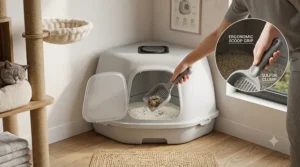
Nature’s Miracle leans into chemistry here rather than just physical containment. The plastic itself carries Ionpure antimicrobial treatment, meant to stop odor-causing bacteria from colonizing the surface between cleanings, paired with a non-stick coating designed to keep clumps from bonding to the walls. A charcoal filter mounted in the hood is rated to absorb tough odors for roughly three months before it needs replacing, and snap latches let the hood come off quickly for full cleaning access.
On paper this means the box is fighting odor on two fronts simultaneously — surface-level bacterial growth and airborne smell — rather than relying on the filter alone to do all the work, which is the more common approach among hooded competitors. The extra-large sizing specifically targets multi-cat households, giving it real headroom that budget hooded boxes in this list don’t offer. Reviewers consistently report satisfaction with odor control performance and the ease of snapping the hood on and off, though the antimicrobial and non-stick claims are inherently harder for individual buyers to verify against a control box over time.
Pros:
✅ Antimicrobial plastic targets odor-causing bacteria directly
✅ Charcoal filter rated for roughly three months of use
✅ Extra-large size accommodates multi-cat households
Cons:
❌ Snap latches can require some force to fully seat
❌ Premium features come at a moderate price bump
Priced in the $35-$45 range, this is the strongest hooded pick here for households layering multiple odor-control strategies at once.
7. Modkat XL — premium top-entry corner-fit anti-tracking design
The Modkat XL isn’t a triangular box, but its compact square footprint — roughly 21 by 16.5 inches — was specifically engineered to tuck into a room corner or against two walls while offering something the other six boxes on this list don’t: a genuinely configurable top-entry or front-entry design with a swiveling, walk-off lid. Cats exiting through the top brush their paws across a textured grate that’s designed to knock litter loose before it ever touches your floor.
Based on the spec comparison with hooded and open corner pans, the top-entry configuration solves two problems at once that those designs can’t: floor-space consumption and litter tracking, since there’s no front approach clearance required and the paw-cleaning grate does real mechanical work most flat lids don’t attempt. Reviewers consistently note that older cats sometimes need time adjusting to a top-entry format, which is exactly why Modkat built in the front-entry option as a fallback — you can switch configurations without buying a second box. The reusable tarp liners, rated for roughly three months each, cut down on plastic waste versus disposable liners, though they’re a genuine added cost to factor into long-term ownership.
Pros:
✅ Configurable top or front entry adapts to any cat
✅ Textured exit grate meaningfully reduces litter tracking
✅ Reusable liners last months and cut ongoing waste
Cons:
❌ Significantly pricier than every other box on this list
❌ Reusable liners are an added recurring cost
At roughly $140-$160 depending on current promotions, the Modkat XL is the splurge pick for anyone whose real problem is tracked litter, not just a wasted corner.
Practical Setup & Placement Guide
Getting a new corner litter box right on day one prevents most of the headaches people blame on the box itself. Start by actually measuring your intended corner with a tape measure before ordering — corner litter boxes are notorious for looking smaller in person than product photos suggest, and returns over a half-inch miscalculation are common and avoidable.
Once it’s in place, resist the urge to fill it to the brim. A 2-3 inch litter layer is the standard recommendation across most brands, deep enough for digging and covering without wasting litter that just gets kicked out the entry cutout. If you’re transitioning from a rectangular box, keep the old one available for a week or two alongside the new corner box; abrupt swaps are one of the most common triggers for litter box avoidance in cats who are otherwise perfectly healthy.
For the first 30 days, scoop at least once daily without exception — corner boxes generally have less interior volume than rectangular pans, so waste accumulates proportionally faster relative to the available space. Watch for a specific mistake owners repeatedly make with hooded corner boxes: skipping filter replacement because the box “still looks clean.” Odor buildup inside a hood happens well before it becomes visually obvious, so set a recurring reminder rather than relying on your nose.
✨ Ready to set up your new litter station the right way? Grab a mat to catch stray litter while you’re at it! 🐾
Real-World Scenarios: Which Corner Litter Box Fits Your Life
The studio apartment renter: If you’re living in roughly 500 square feet with one cat and a bathroom that barely fits a shower curtain, an open corner pan like the Van Ness or SmartCat makes the most sense. You’re prioritizing footprint over odor containment, and you can compensate with more frequent scooping and a good litter mat.
The multi-cat household with a nose for trouble: Two or more cats sharing space means odor multiplies fast, and a hooded or antimicrobial option like the Nature’s Miracle or Frisco Flip Top earns its keep here. Budget accordingly for filter replacements as an ongoing cost, not a one-time purchase.
The tracking-obsessed clean freak: If your actual complaint isn’t space but the trail of litter across your hallway every morning, the Modkat XL’s top-entry grate is the only design on this list purpose-built to solve that specific problem, corner placement or not.
How to Choose a Corner Litter Box
- Measure your actual corner first. Wall-facing sides on most corner litter box models run 18-24 inches; confirm your space before anything else.
- Match interior space to your cat’s size. A box needs to be roughly 1.5 times your cat’s nose-to-tail length for comfortable turning and digging.
- Decide on hooded versus open. Hooded boxes control odor better but some cats reject the confined feeling — test with the door flap removed if needed.
- Factor in entry height. Kittens and senior cats need a lower front cutout; high-sided boxes can become an accessibility problem for older joints.
- Consider your cleaning tolerance. Sifting systems save scooping time but add a learning curve; standard scoop-and-dump remains the simplest long-term routine.
- Check filter and liner costs. Hooded and premium top-entry boxes often carry recurring replacement costs that budget pans don’t.
- Plan for one box per cat, plus one extra, per the widely cited Cornell Feline Health Center guidance on multi-cat litter box provisioning.
Triangle Litter Box vs Rectangular Litter Box: Which Actually Saves More Space?
The core tradeoff between a triangle litter box and a standard rectangular pan comes down to a simple geometry problem: a triangular footprint occupies less usable floor area in a room corner, but it does so by sacrificing interior volume compared to a rectangular box of similar outer dimensions. A typical corner design offers roughly 200-280 square inches of usable floor space inside the box, versus 300-400 square inches in a comparable rectangular pan — a meaningful gap for larger cats.
What that means in practice is that triangle litter boxes are the better call specifically when your limiting factor is room layout, not cat size. A single average-sized cat under 12 pounds generally adapts to the reduced interior without issue. Larger cats, or ones with strong digging and covering instincts, may find themselves working against the tapered walls more than they would in an open rectangular design. If your corner space is tight but your cat is large, a square top-entry box like the Modkat XL — which reclaims corner space without the interior taper of a true triangle — can split the difference effectively.
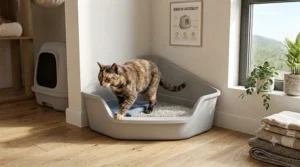
Corner Litter Box for Small Bathrooms
Bathrooms are the single most common placement for a corner litter box, and for good reason: they’re already the smallest room in most homes, and the corner behind a toilet or beside a vanity is otherwise permanently wasted space. A corner litter box tucked there keeps the box out of the primary walking path while staying close enough to water for easy litter-mat rinsing.
The catch is ventilation. Small bathrooms trap odor more aggressively than open living spaces simply because there’s less air volume to dilute it, which is exactly why hooded or antimicrobial options like the Nature’s Miracle tend to outperform open pans in this specific placement. If your bathroom doesn’t have a window or working exhaust fan, factor that into which of the seven boxes above you choose — an open pan that would be perfectly fine in a bedroom corner can become a genuine odor problem in an unventilated half-bath.
Maximizing Space Efficiency in Room Corners
Room corners are, statistically, some of the most underused real estate in any home — furniture rarely sits flush against two walls at once, which leaves a triangular dead zone that a rectangular litter box simply can’t occupy without jutting awkwardly into the room. Space efficiency in this context isn’t just about the box’s own footprint; it’s about what that reclaimed floor space lets you do with the rest of the room, whether that’s fitting a cat tree, a second piece of furniture, or just clearer walking paths.
The efficiency gain is largest in rooms with limited unbroken wall space — think studio apartments, laundry closets, or narrow home-office nooks — and smallest in already-spacious rooms where a rectangular box wasn’t really in anyone’s way to begin with. Before assuming a corner box is the automatic space-efficiency win, measure both your available corner and a rectangular alternative side by side; sometimes the actual square-footage difference is smaller than the visual impression suggests.
Common Mistakes When Buying a Corner Fit Litter Pan
The single most common mistake is buying based on the outer dimensions listed in a product description without accounting for the taper. A corner fit litter pan’s usable interior is always smaller than its footprint suggests, and skipping this math is how owners end up with a box too cramped for their cat’s actual size.
A second frequent misstep is assuming every cat will tolerate a triangular shape simply because it’s marketed as “space-saving.” Some cats show a genuine preference for square corners to dig into, and a tapered interior can feel restrictive enough that a cat avoids the box entirely — a costly mistake to discover after purchase. Finally, buyers regularly underestimate placement logistics: a corner fit litter pan that looks perfect in a showroom photo may not clear a baseboard heater, a door swing, or a cabinet hinge in your actual home. Measure twice, and check for obstructions at both floor level and up to the box’s full height before ordering.
Long-Term Cost & Maintenance
Sticker price only tells part of the story. Open pans like the Van Ness or SmartCat carry no recurring costs beyond litter itself, making them the cheapest option over a multi-year ownership window even though hooded boxes look comparable at checkout. Hooded and antimicrobial designs, by contrast, add filter replacement costs every one to three months — a real expense that compounds over a cat’s lifetime and should factor into any value comparison.
The Modkat XL sits at the opposite end: a higher upfront cost offset partly by reusable liners that replace the need for disposable litter box liners entirely, each rated for roughly three months of use. Over several years, that liner reuse meaningfully narrows the total cost gap between the Modkat and a cheaper box that requires frequent disposable liner purchases. Whichever style you choose, most veterinary behaviorists suggest replacing a plastic litter box entirely every one to two years regardless of how well it’s cleaned, since microscopic surface scratches eventually harbor odor no amount of washing will fully remove.
Safety, Hygiene, and Litter Box Placement
Litter box hygiene isn’t just about smell — it’s a genuine public health consideration for specific groups. The CDC notes that toxoplasmosis is most commonly transmitted to humans through handling the feces of infected cats in a litter box, and pregnant individuals or people with compromised immune systems are specifically advised to have someone else handle litter box cleaning duties when possible, or to wear gloves and wash hands thoroughly afterward if no one else is available.
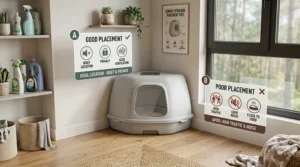
This is one more reason daily scooping matters beyond odor control: the parasite responsible for toxoplasmosis doesn’t become infectious until roughly one to five days after it’s shed in feces, meaning consistent daily cleaning meaningfully reduces real transmission risk regardless of which corner litter box style you choose. Placement matters too — keep the box away from food and water dishes, since cats reliably avoid litter areas too close to where they eat, and avoid cramming a box into a corner so tight that thorough cleaning becomes physically difficult.
Features That Actually Matter (And Those That Don’t)
Interior floor space, wall height relative to your cat’s spray pattern, and entry accessibility are the three specs worth actually comparing across corner litter box models — everything else is largely secondary. Antimicrobial plastic treatments and charcoal filters genuinely help with odor, but they supplement good scooping habits rather than replace them; no filter fully compensates for a box that only gets cleaned twice a week.
On the other hand, decorative color options, “designer” branding, and marginal weight differences between plastic grades rarely affect real-world performance enough to justify a price premium on their own. A recent peer-reviewed study on litter box size and litter type preferences reinforces this: functional dimensions and litter substrate consistently mattered more to feline behavior outcomes than cosmetic or branding factors. If you’re choosing between two similarly sized corner boxes and one costs noticeably more purely for aesthetics, that premium is buying you very little in practice.
Frequently Asked Questions
❓ Do cats like corner litter boxes?
❓ How big should a corner litter box be for a large cat?
❓ Are hooded corner litter boxes better than open ones?
❓ Where is the best place to put a corner litter box?
❓ Can a corner litter box fit behind a toilet?
Conclusion
A corner litter box won’t fix every space problem in a small home, but for the specific problem of a wasted triangular dead zone, it’s one of the few products that genuinely delivers on its promise. The right pick really does depend on what you’re solving for: the Van Ness or SmartCat if you just need the cheapest legitimate corner fit, the Frisco or Nature’s Miracle if odor control is the priority, and the Modkat XL if litter tracking is the real enemy in your home.
Whatever you choose, the fundamentals don’t change — measure your corner honestly, size the interior to your actual cat rather than an average one, and commit to daily scooping regardless of how advanced the filter or antimicrobial coating claims to be. That combination matters more than any single feature on the spec sheet.
Recommended for You
- 7 Best Hidden Litter Box Furniture Picks for a Fresh Home (2026)
- High-Sided Litter Box: 7 Best Picks for Messy Cats (2026)
- Extra Large Litter Box Guide: 7 Best Picks for Big Cats (2026)
Disclaimer: This article contains affiliate links. As an Amazon Associate, I earn from qualifying purchases. If you purchase products through these links, we may earn a small commission at no additional cost to you.
✨ Found this helpful? Share it with your friends! 💬🤗
