
Table of Contents
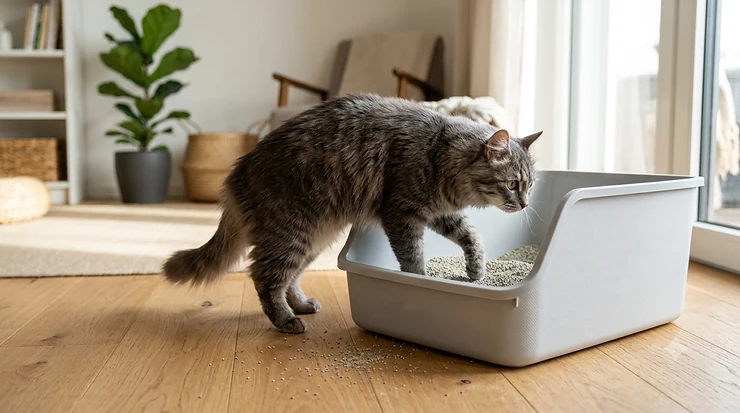
If you’ve ever walked into the laundry room and found a ring of litter pellets fanned out three feet from the box — or worse, a streak of pee on the wall behind it — you already know why a high-sided litter box exists. A regular shallow pan simply wasn’t built for a cat who digs like she’s prospecting for gold or a tomcat who pees standing up.
A high-sided litter box is exactly what it sounds like: a litter pan with walls tall enough (usually 8 to 17 inches) to catch kicked litter and upward urine spray before it ever reaches your floor. Some are open-top pans with a removable shield on three sides; others are fully enclosed stainless-steel or plastic units with a lid. Either way, the goal is the same — keep the mess inside the box.
We pulled together seven real, currently listed products on Amazon — from $17 plastic pans to a $150+ designer unit — and broke down who each one actually fits. We’re not going to pretend every box works for every cat. A senior cat with stiff hips needs a low entry point regardless of how tall the back wall is, and a 16-pound Maine Coon needs floor space a “large” box simply doesn’t have. So instead of a generic “best overall” badge, you’ll get a clear use-case match for each pick, plus the buying mistakes that send people back to Amazon for a return label.
One quick note before we dive in: according to the ASPCA, an undersized or uncomfortable litter box is one of the most common — and most preventable — causes of cats eliminating outside the box. Size and shape matter just as much as wall height, so keep your cat’s actual body length in mind as you read through these options.
Quick Comparison Table
| Product | Type | Dimensions (L x W x H) | Best For | Price Range |
|---|---|---|---|---|
| Van Ness Giant High Sides Pan | Plastic, open top | 21.25″ x 17.6″ x 9″ | Tight budgets | Under $20 |
| Arm & Hammer Rimmed w/ Microban | Plastic, open top | 18.7″ x 15.5″ x 10.6″ | Odor control on a budget | Under $20 |
| Amazon Basics Large High Sides | Plastic, open top | 19″ x 15″ x 11.75″ | Seniors & easy access | Under $20 |
| IRIS USA Open Top w/ Shield (L) | Plastic + scatter shield | 19″ x 15″ x 11.75″ | Best all-around value | $20–$30 range |
| IRIS USA XX-Large Open Top | Plastic + scatter shield | 30″ x 20″ x 14″ | Multi-cat & big breeds | $30–$45 range |
| Tevila XL Stainless Steel | Stainless steel, open top | 22.8″ x 15″ x 10.2″ | Odor-prone, multi-cat homes | Mid-$50s–$70s range |
| Modkat XL | Premium, top/front entry | 21″ x 16.5″ x 17″ | Design-conscious owners | $130–$180 range |
A quick read of this table tells you most of what you need to know before scrolling further: the four plastic open-top pans (Van Ness, Arm & Hammer, Amazon Basics, and IRIS Large) all sit in roughly the same price tier, so the real differentiator between them is wall height and whether a removable shield is included. Step up to stainless steel and you’re paying for odor resistance and long-term durability rather than extra size. The Modkat XL is the outlier — it’s not competing on price, it’s competing on design and configurability for owners who want a litter box that doesn’t look like a litter box.
💬 Just one click — help others make better buying decisions too!😊
✨ Don’t Miss These Exclusive Deals!
🔍 Ready to stop scrubbing pee off the baseboards? Click on any highlighted pick below to check current Amazon pricing and availability. A few minutes of comparison now can save you months of cleanup later!
Top 7 High-Sided Litter Boxes: Expert Analysis
1. Van Ness Giant High Sides Cat Litter Pan (CP3HS)
The Van Ness Giant High Sides Cat Litter Pan is about as no-frills as a high-sided box gets — and that’s the point. Measuring 21.25″ x 17.6″ x 9″, it’s a single-piece molded plastic pan with no center seam, which matters more than it sounds: seams are where dried urine and litter dust collect over time and start smelling no matter how often you wipe the box down. The high-polish surface resists staining and contains roughly 20% recycled resin.
This is the box for someone who just needs more height than a standard pan without paying for extras. What it won’t do is replace a scatter shield — at 9 inches, the walls are the shortest in this lineup, so a cat who sprays in a full upright stance can still clear them. Reviewers on Amazon and elsewhere consistently describe it as sturdy for the price, with the most common complaint being that the interior dimensions run a bit smaller than the exterior measurements suggest because of the angled sides.
✅ Pros: Budget-friendly; seamless one-piece construction; recycled materials
❌ Cons: Shortest walls of the group; no add-on shield option
Best for: Cats who scatter litter but don’t spray high. Price sits comfortably under $20, and for that price, it’s hard to argue with the value.
2. Arm & Hammer Rimmed Cat Litter Box with Microban
If odor — not mess — is your main complaint, the Arm & Hammer Rimmed Cat Litter Box earns its spot here through built-in Microban antimicrobial protection baked into the plastic itself, not just sprayed on as a coating. At 18.7″ x 15.5″ x 10.6″, the reinforced rim does double duty: it adds wall height and it’s specifically shaped to grip litter liners so they don’t slip down mid-scoop, which is a small thing that saves real annoyance.
What the spec sheet doesn’t spell out clearly is that Microban’s effectiveness fades with wear, which is why Arm & Hammer itself recommends replacing the box roughly every 12 months — worth factoring into your cost math if you’re comparing this to a stainless option that could last five years or more.
✅ Pros: Active odor-fighting plastic; built-in handles for easy carrying; affordable
❌ Cons: Manufacturer-recommended 12-month replacement cycle; sides shorter than the IRIS or Tevila picks
Best for: Apartment dwellers or anyone with the litter box in a small room where smell is the bigger battle than spray. Priced under $20.
3. Amazon Basics Large Cat Litter Box with High Sides
The Amazon Basics Large High Sides box (19″ x 15″ x 11.75″) is built around one priority: easy in-and-out access. The front wall is intentionally lowered while the back and sides stay tall, which is the exact shape veterinary behaviorists recommend for senior cats or anyone managing arthritis — high enough at the back to block scatter, low enough at the front that climbing in doesn’t become a daily ordeal.
It ships with a scoop that clips onto the rim so it’s never floating around loose in a junk drawer. The BPA-free recyclable plastic is nothing special, but it doesn’t need to be — this box is solving an accessibility problem, not an odor or spray-control problem, and it does that job at a genuinely low price point.
✅ Pros: Lowered front entry ideal for seniors/kittens; included on-box scoop storage; widely available
❌ Cons: No scatter shield; standard plastic with no odor-resistant treatment
Best for: Older cats, kittens, or any household where the same box needs to serve multiple ages and mobility levels. Priced under $20.
4. IRIS USA Open Top Cat Litter Box with Shield (Large)
This is the pick most people should start with. The IRIS USA Open Top with Shield (19″ x 15″ x 11.75″) uses a removable scatter shield across three sides that effectively raises the usable wall height well beyond the base pan’s measurements — without sealing the cat inside a hood the way a covered box would. That distinction matters: cats that refuse hooded boxes because they feel trapped will often still accept this design, since the front stays open and low for entry.
Molded-in feet and a recessed base keep the unit from sliding on tile or hardwood, and the included scoop clips directly into the pan. The most common feedback pattern across owner reviews is that the size, height, and overall build quality outperform the price, with the main gripe being that interior corners can develop small “dead zones” that are slightly harder to scoop into cleanly.
✅ Pros: Removable shield raises effective wall height; open-front design cats actually accept; made in the USA
❌ Cons: Shield must come off for a full deep-clean; rounded interior corners can trap waste in tight spots
Best for: Most single-cat households dealing with moderate scatter or spray. This is the best all-around value in the lineup, typically in the $20–$30 range.
5. IRIS USA XX-Large Open Top with High Sided Walls
Take everything that works about the standard IRIS shield design and scale it up to 30″ x 20″ x 14″, and you get the box built specifically for large-breed cats and multi-cat households. At this footprint, it comfortably clears the often-cited “1.5 times body length” sizing rule for big breeds like Maine Coons or Ragdolls, whose body length alone can run 18–20 inches.
The trade-off is obvious: this is a large piece of furniture in your bathroom or laundry room, not a discreet corner unit. But if you’re currently squeezing a 30-pound Maine Coon into a standard 19-inch pan, the cramped fit is very likely contributing to scatter and missed coverage in the first place — a bigger box often solves the mess problem better than a taller one does.
✅ Pros: Genuinely large interior for big breeds or 2 cats sharing; scatter shield + scoop included; same reliable IRIS build quality
❌ Cons: Significant floor-space commitment; costs more than the standard Large
Best for: Multi-cat homes and large breeds. Expect to pay in the $30–$45 range.
6. Tevila XL Stainless Steel Litter Box with High Sides Shield
Plastic litter boxes have one structural weakness no amount of cleaning fully solves: microscopic claw scratches that trap bacteria and odor over months of use. The Tevila XL Stainless Steel box (22.8″ x 15″ x 10.2″) sidesteps that entirely with a non-porous metal pan that doesn’t absorb urine smell the way aging plastic does, paired with a detachable scatter shield for adjustable height.
The 20-liter capacity gives a reasonable litter depth for digging without needing constant refilling, and it ships with four non-slip pads so the lighter-gauge steel doesn’t skate across tile when a cat jumps in. The honest downside: stainless steel is colder and noisier underfoot than plastic, so cats accustomed to a quiet, warm pan may need a short adjustment period.
✅ Pros: Won’t absorb odor the way plastic eventually does; scratch-resistant for the long haul; detachable shield
❌ Cons: Heavier and louder than plastic; higher upfront cost than the budget picks
Best for: Multi-cat households or anyone who’s fought a losing battle with smell in an aging plastic box. Typically priced in the mid-$50s to $70s range — more upfront, but it’s a box you likely won’t be replacing in a year.
7. Modkat XL Litter Box
The Modkat XL is the only entry here that isn’t really competing on “high sides” alone — it’s solving the spray problem with a full-height seamless base (21″ x 16.5″ x 17″ in top-entry mode) instead of a removable shield, which eliminates the side-seam leak point entirely. It converts between top-entry and front-entry configurations, so you can test which one your cat tolerates without buying two separate products.
The swivel lid doubles as a walk-off mat that catches litter on a cat’s paws before it ever reaches your floor, and the reusable liner system (rated for up to three months of use) cuts down on ongoing liner costs compared to disposable bags. This is unmistakably a design-forward purchase — it looks like a piece of furniture, not a litter pan — and the price tag reflects that positioning rather than reflecting raw plastic or steel costs.
✅ Pros: Seamless base stops leaks at the source; configurable top or front entry; reusable liners reduce long-term waste
❌ Cons: Highest price point by a wide margin; top-entry mode isn’t accepted by every cat
Best for: Owners prioritizing design and willing to pay a premium for a leak-proof, configurable system. Sits in the $130–$180 range, well above every other pick on this list.
Real-World Scenarios: Matching the Right Box to Your Cat
Specs only tell half the story — the right box depends heavily on the actual cat and household using it.
The senior cat with stiff joints: A 14-year-old cat with mild arthritis doesn’t need 17-inch walls; she needs a low, wide entry point she can step into without jumping. The Amazon Basics Large High Sides box, with its intentionally lowered front, is built for exactly this case, and it costs little enough that replacing it as needs change isn’t a big financial decision.
The three-cat apartment with an odor problem: When litter boxes share space with a living room, smell control usually outranks everything else. Either the Arm & Hammer Rimmed box (budget odor control) or the Tevila Stainless Steel pan (longer-term odor resistance, since steel doesn’t absorb urine the way plastic eventually does) solves this better than a plain plastic pan ever will.
The Maine Coon who can barely turn around: Large-breed cats squeezed into standard-sized pans tend to hang their hindquarters over the edge when they eliminate — which looks like “missing the box” but is really a sizing problem. The IRIS USA XX-Large gives a 30-inch-long cat the room the AAHA feline life-stage guidelines recommend, and that extra room often resolves “accidents” that owners had assumed were behavioral.
Common High-Sided Litter Box Problems (And How to Fix Them)
Problem: Litter still ends up on the floor despite tall sides. This usually means the walls are tall in the back but the cat is digging or spraying near the lowered front entry, where most high-sided boxes intentionally dip down for access. A removable shield insert (like the one on the IRIS USA picks) that wraps around three sides — leaving only the entry point open — solves this without sealing the cat into a full hood.
Problem: The box smells within days of cleaning. Plastic is porous at a microscopic level, and scratches from digging create grooves that trap bacteria no amount of scrubbing fully reaches. If you’re scooping daily and washing weekly and it still smells, the box material itself — not your cleaning routine — is usually the culprit. This is the exact problem stainless steel and Microban-treated plastic are designed to solve.
Problem: My cat won’t get in at all. According to Cornell Feline Health Center research, an aversion to the box itself — not a behavioral “spite” issue — is one of the most common causes of house soiling. If a cat that previously used a standard pan refuses a new high-sided box, the entry height is the first thing to check; even an inch or two of extra step-over height can be enough to trigger avoidance, especially in kittens, seniors, or larger-bodied cats.
✨ Don’t Miss These Exclusive Deals!
🔍 Take your litter box setup to the next level with one of the picks above. Click any product to check current pricing — your floors (and your nose) will thank you!
How to Choose a High-Sided Litter Box: 6 Things That Actually Matter
- Measure your cat first, not the box. Take your cat’s nose-to-tail-base length and aim for a box at least 1.5 times that length — a rule the ASPCA and most veterinary behaviorists point to consistently.
- Match wall height to the actual problem. Scatter from digging needs roughly 8–10 inches of wall. Upward urine spray from a cat that pees standing up usually needs 13 inches or more, or a shield insert that adds height without fully enclosing the box.
- Check the entry height, not just the wall height. A box with 14-inch walls and a 14-inch entry is a box your senior cat or kitten won’t use. Look specifically for a lowered front cutout.
- Decide if you want a shield or a full hood. Shields (three-sided, open front) tend to be better accepted by cats than full hoods, which trap odor and can feel like a trap to a nervous cat.
- Pick a material based on your actual pain point. Plastic is cheaper and lighter; stainless steel costs more upfront but resists the odor buildup plastic develops after months of scratches.
- Budget for one box per cat, plus one extra. This is a near-universal veterinary recommendation, and it matters more than any single product feature — even the best box will get avoided if it’s the only one in a three-cat household.
Common Mistakes When Buying a High-Sided Litter Box
The single most common mistake is buying based on wall height alone and ignoring interior floor space. A box can have 14-inch walls and still be too cramped for a 12-pound cat to turn around in comfortably, which paradoxically increases scatter because the cat ends up digging right at the edge.
The second mistake is assuming “high-sided” means “enclosed.” Many shoppers picture a hooded box when they search this term, then return an open-top pan expecting a lid that was never advertised. If full odor containment is the goal, you want a hooded or top-entry design (like the Modkat XL), not an open shield pan.
The third mistake is underestimating cleaning effort. Shield inserts and stainless trays generally require lifting out a removable piece for a deep clean — a five-minute task, but one people occasionally don’t realize is necessary before buying.
High-Sided vs. Hooded Litter Boxes: Which Wins for Spraying Cats?
| Factor | High-Sided Open Top | Hooded/Covered |
|---|---|---|
| Odor containment | Moderate — escapes when open | Strong — fully enclosed |
| Cat acceptance | Generally high | Lower; some cats avoid hoods |
| Spray containment | Good with tall walls/shield | Excellent, fully sealed sides |
| Monitoring health/habits | Easy — visible at a glance | Harder — must lift the lid |
| Cleaning ease | Quick, no lid to remove | Extra step to access |
The data in this table reflects a real trade-off, not a clear winner. Hooded boxes contain spray and odor more completely simply because there’s no open top for either to escape through, but that same enclosure is exactly why some cats refuse to use them — feeling “trapped” while eliminating is a documented driver of litter box avoidance. High-sided open-top boxes, particularly ones with a three-sided shield like the IRIS USA picks, tend to split the difference: most of the spray containment of a hood, without the psychological barrier of a fully enclosed space.
Features That Actually Matter (And Marketing Hype You Can Skip)
Actually matters: Interior floor space relative to your cat’s size, entry height, and wall height matched to the specific mess problem (digging vs. spraying).
Matters less than the marketing suggests: built-in “odor filters” on open-top boxes, since odor escapes through the open top regardless of any filter cartridge tucked into a corner — that feature earns its keep on hooded or top-entry designs like the Modkat XL, where airflow is actually controlled, but it’s mostly decorative on an open pan.
Color and finish are pure preference and have zero impact on function — pick whatever blends into your bathroom. Stackable “bonus” scoops are nice but rarely the deciding factor; if a box you otherwise like ships without one, a universal metal scoop costs a few dollars separately.
Long-Term Cost & Maintenance: What These Boxes Really Cost You
The sticker price is only part of the real cost. A $17 plastic pan that needs replacing every 12 months because of odor buildup or cracking effectively costs more over three years than a $60 stainless steel box that lasts five-plus years with the same care. Liner-based systems like the Modkat XL shift cost differently — the box itself is expensive, but reusable liners rated for three months of use can reduce ongoing litter-bag spending compared to fully disposable setups.
A practical way to think about it: budget plastic pans (Van Ness, Arm & Hammer, Amazon Basics) make sense if you don’t mind replacing the box annually or if you’re testing whether your cat accepts a high-sided design at all before investing more. Stainless steel and premium configurable units make more sense once you know your cat tolerates the format and you’re optimizing for years of use rather than testing the concept cheaply.
High-Sided Litter Boxes for Different Types of Cats
Kittens and small cats generally do better with shorter walls (8–10 inches) and a low entry — most of the budget plastic pans on this list fit that need without overspending on size they won’t use yet. Senior cats prioritize entry height above almost everything else; the lowered-front design on the Amazon Basics pick exists specifically for this group. Large-breed cats need floor space first and wall height second — the IRIS USA XX-Large is built around that priority. And cats with a documented spraying habit benefit most from either a tall shield insert or a fully sealed, seamless base like the Modkat XL’s, since that design closes off the side-seam gap where spray typically escapes a standard pan.
FAQ
❓ What is a high-sided litter box?
❓ How tall should a high-sided litter box be for a cat that sprays?
❓ Are high-sided litter boxes good for senior cats?
❓ Stainless steel vs. plastic high-sided litter box — which is better?
❓ How often should you replace a high-sided litter box?
Conclusion
There isn’t a single “best” high-sided litter box — there’s a best one for your specific cat, your budget, and the exact problem you’re solving. If you want the safest starting point, the IRIS USA Open Top with Shield balances price, wall height, and cat acceptance well enough to work for most single-cat households. If odor is the real enemy, the Tevila Stainless Steel pan earns back its higher price over time. And if you’ve got a large breed or multiple cats sharing space, sizing up to the IRIS USA XX-Large will likely fix more “behavioral” accidents than any spray-control feature could.
Whatever you choose, remember the sizing math matters more than any single feature on the box: a cat that’s cramped will scatter and miss the box no matter how tall the walls are.
✨ Found the right fit?
💬 Check current pricing on any of the seven picks above and give your floors a break tonight.
Recommended for You
- Extra Large Litter Box Guide: 7 Best Picks for Big Cats (2026)
- 7 Best Top Entry Litter Boxes in 2026
- Covered Litter Box: 7 Best Picks for 2026, Tested & Reviewed
Disclaimer: This article contains affiliate links. As an Amazon Associate, I earn from qualifying purchases. If you purchase products through these links, we may earn a small commission at no additional cost to you.
✨ Found this helpful? Share it with your friends! 💬🤗
