
Table of Contents
In 1947, a Michigan woman named Kay Draper walked over to ask her neighbor for some sand. Her cat kept tracking ashes through the house, and she’d had enough. Her neighbor, a clay salesman named Edward Lowe, handed her a bag of absorbent clay instead — mostly because his sand pile was frozen solid that week. Two weeks later, she came back for more. So did her friends. Lowe named the stuff Kitty Litter, and according to his Wikipedia entry, he spent the next four decades turning that frozen-sand accident into a company worth roughly half a billion dollars. Cats had been doing their business in boxes of dirt and ash for a while already — Lowe’s clay is just what made the indoor litter box a normal feature of American life.
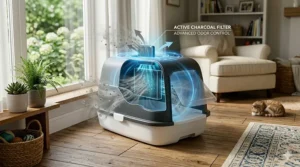
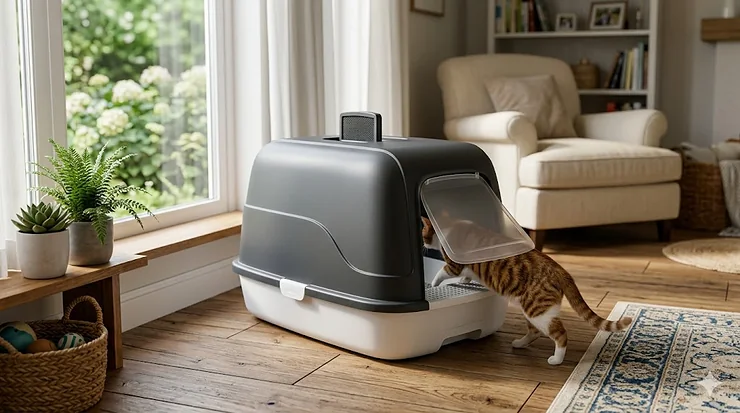
Eighty-some years later, we’ve gone from “dirt in a bag” to plastic enclosures with carbon filters, swivel lids, and design awards. A covered litter box is exactly what it sounds like: a litter pan enclosed by a hood, dome, or lid that gives a cat privacy, blocks the view from the rest of the room, and — in theory — keeps litter and odor contained inside the box instead of scattered across your floor. Whether that theory holds up in practice depends entirely on which box you buy, and that’s the part nobody mentions on the product page.
I went looking for real options currently sold on Amazon — the kind with thousands of verified reviews instead of zero — and narrowed the field down to seven that earn their spot for genuinely different reasons. One’s the best all-around buy. One’s built to survive a multi-cat household. One costs less than a fancy coffee order and still works. Here’s what’s actually worth your money, plus what the “cats hate covered boxes” warnings get right and what they get wrong.
Quick Comparison: 7 Covered Litter Boxes at a Glance
| Product | Best For | Price Range | Entry Style | Standout Feature |
|---|---|---|---|---|
| Catit Jumbo Hooded Cat Pan | Best overall | $28–$38 | Front swinging door | Roomy interior + carbon filter |
| Modkat Flip Litter Box | Best premium pick | $70–$100 | Front, 3-position lid | Seamless, leak-proof base |
| IRIS USA Top Entry Litter Box | Best scatter control | $25–$35 | Top entry | Litter-catching lid grooves |
| Frisco Multi-Function Covered Litter Box | Best for large/multi-cat homes | $65–$80 | Low-profile front | 29-inch jumbo footprint |
| Van Ness Pets Odor Control Enclosed Cat Pan | Best budget odor control | $20–$30 | Front swinging door | Zeolite air filter |
| Nature’s Miracle Hooded Flip Top Litter Box | Best budget pick | $25–$35 | Front flip-top | Low-profile, kitten-friendly |
| Amazon Basics No-Mess Hooded Litter Box | Best value | $20–$38 | Front swinging door | Two sizes, no brand markup |
Prices reflect typical ranges as of mid-2026 and shift constantly — always check the current Amazon listing before buying.
If you only read one paragraph of this guide, make it this one. For most single-cat households, the Catit Jumbo Hooded Cat Pan hits the best balance of size, filtration, and price — it’s the one I’d grab if someone handed me $30 and said “go.” If your cat is the type who hesitates at the doorway or circles twice before committing (a real sign the box feels too small, more on that below), skip straight to the Frisco Multi-Function box or the Modkat Flip — both give large or multiple cats room to actually turn around inside. And if odor is your single biggest complaint, don’t assume “covered” automatically means “odor-free.” The filter chemistry matters more than the hood itself, which is exactly why the budget-priced Van Ness box, with its zeolite filter, punches well above its price tag.
💬 Just one click — help others make better buying decisions too! 😊
✨ Ready to Stop Smelling Your Living Room?
🔍 Tap any product below to check current pricing, color options, and availability on Amazon before your favorite sells out.
Top 7 Covered Litter Boxes: Expert Analysis
1. Catit Jumbo Hooded Cat Pan — Best Overall
The standout feature here is sheer interior real estate paired with genuinely effective odor control, which is a rarer combination at this price than you’d think. The pan measures roughly 22.4″ long by 19.7″ wide by 18.3″ tall in the jumbo size, with a carbon-impregnated filter built into the hood and a swinging flap door up front. In practice, that footprint means even a chunky 15-pound cat can turn a full circle without bumping the walls — something a lot of “large” covered boxes only claim on paper.
What most buyers overlook about this one is the hardware, not the size. The locking tabs that hold the hood to the base are notoriously fussy; more than one owner has given up trying to get them to click and instead just rests the lid on snugly. That’s a minor annoyance, not a dealbreaker, but it’s worth knowing before you’re standing in your bathroom at 11pm fighting with plastic tabs. Reviewers consistently praise the carbon filter’s actual odor-trapping performance and the convenience of bag anchors that hold liners in place during cleanup, while a recurring complaint involves a small gap at the bottom of the swinging door that lets a few stray granules escape.
✅ Large enough for big or multiple cats
✅ Effective carbon filter, genuinely cuts odor
✅ Built-in handle and bag anchors for easy cleanup
❌ Locking tabs can be unreliable
❌ Handle isn’t rated to carry a full, litter-loaded box
At around $28–$38, this is the box I’d recommend to someone buying their very first covered litter box. It’s not flashy, but it does the fundamentals better than almost anything else in its price tier.
2. Modkat Flip Litter Box — Best Premium Pick
The Modkat Flip earned Wirecutter’s Upgrade Pick recognition in 2025, and the reason becomes obvious the moment you set one up: it’s built around a single seamless, full-height base with no side seams to leak through. That sounds like a small detail until you remember that side-leaking is the actual failure mode of cheaper snap-together boxes — urine works its way into the seam, the plastic absorbs the smell, and no amount of scrubbing fully fixes it. Modkat designed that problem out entirely.
The 3-position flip-top lid is the other genuinely clever bit. You can run it fully open while your cat adjusts, half-open for ventilation, or fully closed for maximum privacy and odor containment — which makes this one of the few boxes that can transition with your cat rather than forcing an all-or-nothing switch on day one. It ships with two bamboo charcoal filters and a reusable liner that’s tailored to fit, secured by interior hooks, and rated to last around three months before replacement.
✅ Leak-proof seamless base, a real engineering upgrade
✅ Flexible 3-position lid eases the covered-box transition
✅ Reusable liner cuts down on ongoing litter-bag waste
❌ Premium price tag, roughly double most boxes on this list
❌ Liners take a short adjustment period for some cats
Expect to pay somewhere in the $70–$100 range depending on configuration. It’s not cheap, but if you’ve cycled through three flimsy boxes already, this is the one that’s actually designed to be the last box you buy for a while.
3. IRIS USA Top Entry Litter Box — Best for Scatter Control
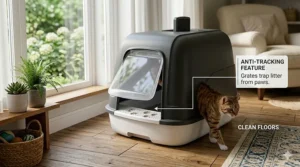
This one solves a different problem entirely: litter tracked across your floor on cat paws. Instead of a side door, your cat climbs in through a hole in the top of the lid, and small grooves cut into that same lid comb litter particles off their paws on the way out — so what would normally end up on your hallway rug stays in the box. It’s a genuinely smart bit of design, and it shows in the numbers: this box has racked up an average of 4.4 stars across more than 68,000 Amazon ratings, which is not a small sample size to be wrong about.
The catch is the entry method itself isn’t universally loved. Reviewers split fairly evenly between “my cat adapted instantly” and “my cat refuses to climb through a hole to use the bathroom.” One recurring complaint involves the two lid tabs not seating securely, which can let the lid wobble or, in rarer cases, collapse slightly under a cat’s weight — worth a quick check after assembly. It’s also genuinely not the right call for senior or arthritic cats, since climbing up and over a tall opening is a real mobility ask.
✅ Best-in-class litter scatter and tracking prevention
✅ Comes with a scoop included
✅ Strong long-term review average across tens of thousands of buyers
❌ Top-entry design isn’t loved by every cat
❌ Poor fit for senior, arthritic, or extra-large cats
At roughly $25–$35, it’s an easy recommendation for younger, agile, average-sized cats in households where tracked litter is the #1 daily annoyance.
4. Frisco Multi-Function Covered Litter Box — Best for Large Cats & Multi-Cat Homes
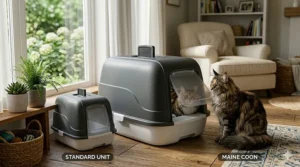
At nearly 30 inches long, this is the box to reach for when “large” covered litter boxes still feel cramped. The internal dimensions run close to 26 inches by 14 inches, which is enough room for genuinely big breeds — Maine Coons, Ragdolls, that category of cat — to turn around without their tail brushing the hood on the way through, a real complaint with smaller covered designs. It comes in two configurations: one with a snap-in inner tray sized to the box, and one without, so multi-cat households can simply fill the entire footprint with litter if that suits their cats better.
The low-profile front entrance is the detail that makes this work for a wider range of cats than most jumbo boxes: instead of a tall step-over wall, there’s a wide, low opening that even less athletic cats can walk through comfortably. Reviewers consistently highlight how well it contains spray and odor for its size, with the main recurring gripe being that the wide front opening — while easy to walk through — still allows more scatter than a true top-entry design.
✅ Among the roomiest covered options actually sold on Amazon
✅ Low-profile entry works for cats of varying mobility
✅ Configurable with or without an inner tray
❌ Pricier than basic hooded boxes
❌ Wide front opening allows more scatter than top-entry styles
Budget around $65–$80. If you’re running a two- or three-cat household and tired of buying multiple smaller boxes, this single jumbo box may genuinely replace two standard ones.
5. Van Ness Pets Odor Control Enclosed Cat Pan — Best Budget Odor Control
What most people miss about this box is the filter chemistry, not the price. Most cheap covered boxes either skip a filter entirely or use a basic carbon insert; this one uses a zeolite air filter, a mineral structure that physically traps ammonia molecules rather than just masking them, which is a meaningfully different (and more effective) approach to litter box smell. Pair that with a high-polish, stain-resistant interior finish, and you get odor performance that genuinely outpunches the price tag, with both Large (CP6) and Extra Large (CP7) sizes available depending on your cat’s footprint.
The honest tradeoff is build quality. The two-way swinging odor door is the box’s weak link — playful or younger cats can knock it loose from its hinge — and the top handle, while convenient for lifting the lid to clean, isn’t built to support the weight of a full box if you try to carry it loaded. One longtime reviewer summed it up about as fairly as possible: solid odor control for the price, with hardware that feels a notch below premium.
✅ Zeolite filter genuinely outperforms basic carbon at this price
✅ Two sizes (Large and Extra Large) to match different cats
✅ Backed by a brand with 70-plus years in pet products
❌ Swinging door hardware can come loose with playful cats
❌ Handle and hood feel less sturdy than pricier alternatives
This is consistently one of the cheapest filtered covered boxes on Amazon, typically $20–$30. If odor control matters more to you than premium build quality, it’s hard to beat.
6. Nature’s Miracle Hooded Flip Top Litter Box — Best Budget Pick
The defining feature here is height — or rather, the lack of it. At roughly 11.75 inches tall, this is noticeably shorter than most hooded boxes, which makes a real difference for kittens, small cats, or any cat transitioning from an open box who isn’t ready to duck under a tall hood yet. You still get full coverage and a built-in charcoal filter; you just get it without the cave-like feel some taller covered boxes have.
In practice, that lower profile is also the box’s limitation: it’s a comfortable fit for small-to-average cats, but a 15-pound cat is going to feel the ceiling. The flip-top front opening and four snap latches make cleaning genuinely simple — no fighting with stubborn locking tabs here — and the brand’s decades of recognition in pet odor and stain removal lend some real credibility to its odor-control claims specifically.
✅ Low entry height, ideal for kittens and smaller cats
✅ Simple flip-top latch system, easy to clean
✅ Trusted, established odor-control brand
❌ Less interior headroom for larger cats
❌ Fewer premium touches than pricier hooded boxes
Typically priced $25–$35, this is a smart pick as either a primary box for a smaller cat or a second box in a multi-box household — which, per the math we’ll cover below, you probably need anyway.
7. Amazon Basics No-Mess Hooded Litter Box — Best Value
There’s nothing flashy about this one, and that’s sort of the point. It’s the no-frills version of the classic swinging-door hooded format: a pre-installed carbon filter, a stain- and odor-resistant plastic shell, and a carrying handle, available in both a Standard (21″ x 16″ x 15″) and Large (24″ x 18″ x 17″) size. You’re paying for the format, not the brand name stitched onto the box — which, in a category where brand recognition often adds $10–$20 to the price tag for no functional difference, is exactly the appeal.
The honest read: this box does everything the Catit and Van Ness models do, just without the design extras like bag anchors or zeolite filtration. The swinging door has the same basic failure mode as other entry-level boxes — younger cats can occasionally nudge it off track — but for the price, that’s a fair tradeoff most owners are happy to accept.
✅ Two size options to fit different cats and spaces
✅ Lowest price-to-size ratio of any name-brand box on this list
✅ Pre-installed carbon filter included
❌ No premium hardware (no zeolite filter, no reusable liner)
❌ Basic swinging door, same wear issues as other entry-level boxes
Expect to pay roughly $20–$28 for the Standard size and $28–$38 for Large. If your goal is simply “covered box that works, without paying for a name,” this is it.
Do Cats Actually Prefer Covered Litter Boxes? What the Research Says
Here’s where conventional wisdom and actual data part ways. For years, the standard advice — repeated in pamphlets, vet visits, and basically every cat blog — was that cats prefer open litter boxes because hoods feel like ambush traps. It’s intuitive advice. It’s also not what the controlled research found.
In a 2012 study published in the Journal of Feline Medicine and Surgery and later archived on PMC, the National Institutes of Health’s public research database, researchers at Ross University School of Veterinary Medicine gave 28 cats a genuine choice between a covered box and an uncovered box, then measured which one actually got used by tracking waste weight over time. The result: no statistically significant overall preference for either style. A small subset of individual cats did show a personal preference — some for covered, some for open — but most cats simply didn’t care, as long as both boxes were kept reasonably clean.
That doesn’t mean hoods are risk-free for every cat, though. The Cornell Feline Health Center — one of the most respected feline-specific research centers in the country — notes that a cat already prone to nervousness or living in a household with social tension between pets may genuinely benefit from an open box that gives them a 360-degree view and more than one escape route, since a hood blocks exactly the kind of early-warning sightline a skittish cat relies on. In other words: the research says hoods are fine for most cats, but if your specific cat seems jumpy, hides excessively, or has started avoiding the box since you switched, that’s the signal to swap back to open, not a sign you need a fancier covered model.
Covered vs. Open Litter Boxes: Quick Comparison
| Factor | Covered Box | Open Box |
|---|---|---|
| Privacy from household view | High | None |
| Odor containment | Better, with a filter | Relies entirely on room ventilation |
| Litter scatter control | Better (especially top-entry) | Minimal |
| Visibility/escape routes for nervous cats | Limited | Full 360° |
| Cleaning visibility (spotting waste/illness) | Lower, requires lifting hood | Immediate, at a glance |
| Best for | Privacy-focused homes, odor-sensitive rooms | Senior, anxious, or multi-pet households |
The honest takeaway from this table is that neither style is objectively “better” — they’re solving different problems. Covered boxes win decisively on privacy and odor containment, which matters most if the box lives in a small bathroom, bedroom, or open-concept living space. Open boxes win on visibility, both for your cat’s sense of security and for you, since spotting a sudden change in litter clumps (a possible early sign of a urinary issue) is much easier without a hood in the way.
How to Choose a Covered Litter Box: 6 Things That Actually Matter
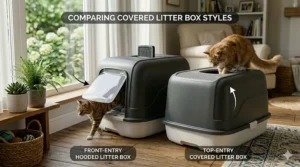
- Interior size relative to your cat’s actual body length. The general rule of thumb among veterinary behaviorists is that a box should be at least 1.5 times your cat’s nose-to-tail-base length. A covered box that looked roomy in the product photo can feel like a phone booth once the hood is on, so check interior dimensions, not just the overall box size printed on the listing.
- Entry style matched to age and mobility. Top-entry boxes like the IRIS USA model are excellent for scatter control but genuinely difficult for senior or arthritic cats. Front-entry, low-profile designs like the Frisco box are the safer default if you’re unsure.
- Odor control mechanism. Carbon filters (Catit, Amazon Basics, Nature’s Miracle) are the standard. Zeolite filters (Van Ness) trap ammonia at a molecular level rather than just absorbing general odor, which often performs better for the price. Either beats no filter at all.
- Hardware durability. Locking tabs, swinging doors, and hood latches are the first thing to fail on any covered box. If you have a strong, playful, or simply heavy cat, prioritize models with simple flip-latches (Nature’s Miracle) over fiddly tab systems.
- Ease of cleaning. A lid that lifts off in one motion saves you real time, twice a day, every day, for years. Seamless single-piece bases (Modkat) also eliminate the seam-leak problem that causes most long-term odor buildup in cheaper boxes.
- Multi-cat math. Cornell’s Feline Health Center and the broader veterinary behaviorist community both point to the same baseline: one litter box per cat, plus one extra (the “n+1” rule). Two cats means three boxes, not two — skipping this is one of the most common, and most avoidable, causes of litter box avoidance in multi-cat homes.
Setting Up Your Covered Litter Box the Right Way
Getting a covered box right on day one prevents most of the avoidance problems people blame on the box itself. Start with placement: put it somewhere quiet, away from loud appliances, and with more than one way in or out of the room — cats genuinely dislike feeling cornered, hood or no hood.
For the actual transition, don’t swap an open box for a covered one overnight if your cat has never used one before. Place the new covered box next to the old one for a week with the hood removed or propped open, let your cat get used to the new shape and material first, then add the hood once they’re using it consistently. Skipping straight to a fully enclosed box is the single most common reason cats “reject” covered designs.
On maintenance: scoop daily regardless of box style, but covered boxes specifically need a full litter change every 1–2 weeks rather than the 2–3 weeks you might get away with on an open box, since trapped odor builds up faster inside an enclosed space. Wipe down the inside of the hood itself every couple of weeks — it’s easy to forget that ammonia condenses on the underside of the lid, not just in the litter.
Real-World Scenarios: Matching the Right Box to Your Household
The first-time single-cat owner: Start with the Catit Jumbo Hooded Cat Pan. It’s forgiving, roomy enough to grow into, and affordable enough that if your cat turns out to hate covered boxes entirely, you haven’t lost much.
The two-or-three-cat household: Run the math from the n+1 rule above, then split your boxes across the Frisco Multi-Function (for the largest or most senior cat) and a budget pick like the Amazon Basics or Nature’s Miracle for the others. Don’t put all of your eggs — or boxes — in one room; Cornell’s research specifically recommends distributing boxes across different areas of the home.
The design-conscious apartment dweller with one cat and no spare bathroom to hide it in: This is the Modkat Flip’s exact use case. It’s the only box on this list that looks intentional sitting in a living room corner, and the seamless base means you’re not gambling on long-term odor from hidden seam leaks in a space you can’t simply close the door on.
Common Mistakes People Make With Covered Litter Boxes
Buying based on the box’s outer dimensions, not the interior. A box advertised as “jumbo” can still have a cramped interior once you account for the thickness of the hood and walls. Always check the interior measurements specifically.
Assuming any hood equals odor control. A hood without a working filter just traps the smell inside until you open it — sometimes making the moment of opening worse than an open box would have been. Check that a filter is actually included, and replace it on schedule.
Skipping the transition period entirely. As covered above, this is the single biggest reason cats “refuse” a perfectly good box. Most rejection isn’t about the hood itself; it’s about the abrupt change.
Ignoring the n+1 rule in multi-cat homes. One covered box for three cats will eventually cause someone to go elsewhere in the house, and it’s rarely obvious which cat is the culprit until you’re already dealing with the consequences.
Placing the box somewhere convenient for you instead of safe-feeling for your cat. A covered box stuffed into a closet with a single exit recreates exactly the ambush scenario that makes some cats avoid hoods in the first place.
Frequently Asked Questions
❓ What is the best covered litter box for odor control?
❓ Are covered litter boxes bad for cats?
❓ How often should I clean a covered litter box?
❓ What size should a covered litter box be for a large cat?
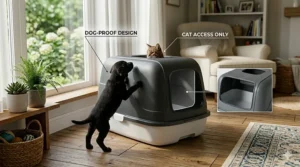
❓ Do covered litter boxes help with litter scatter?
Conclusion
There’s no single “best” covered litter box, just the best one for your specific cat, your specific space, and how much patience you have for fussy locking tabs at 11pm. If you want the safest first purchase, the Catit Jumbo Hooded Cat Pan is hard to beat. If your cat is large, elderly, or sharing space with two other cats, size and entry style matter more than price — go look at the Frisco or Modkat options again before you check out. And if you remember nothing else from this guide, remember the n+1 rule: it’s the cheapest, easiest fix for litter box problems that most multi-cat households never apply.
It’s a strange little legacy, when you think about it — that a frozen sandpile in 1947 eventually led to a $2.9 billion industry, as NPR noted on Kitty Litter’s 70th anniversary, and to you, right now, comparing the merits of a zeolite filter against a carbon one. Edward Lowe probably never imagined any of this. Your cat, for what it’s worth, definitely doesn’t care either way — they just want a clean box that doesn’t feel like a trap.
Recommended for You
- Self-Cleaning Litter Box for Multiple Cats: 7 Top Picks (2026)
- Best Automatic Litter Box Under $300: 7 Smart Picks for 2026
- 7 Best Self-Cleaning Litter Boxes 2026 – Honest Expert Reviews
Disclaimer: This article contains affiliate links. As an Amazon Associate, I earn from qualifying purchases. If you purchase products through these links, we may earn a small commission at no additional cost to you.
✨ Found this helpful? Share it with your friends! 💬🤗
