
Table of Contents
Let’s be real. You didn’t sign up for a daily ritual involving a plastic spoon, a cloud of litter dust, and the kind of smell that follows you into the kitchen. You signed up for a cat. A soft, purring, occasionally infuriating companion — not a full-time bathroom attendant job.
Here’s the thing about a self-cleaning litter box: it sounds like a luxury until the third time this week you’ve arrived home late, exhausted, only to find a gift waiting for you that can’t be ignored. Then it sounds like a necessity.
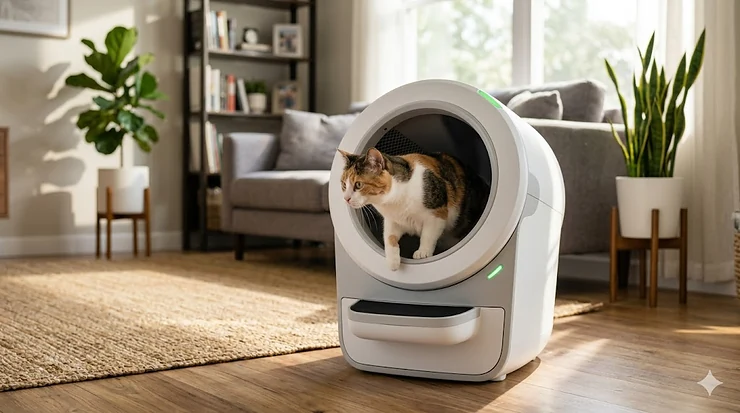
A self-cleaning litter box is an automated waste management system for cats that uses sensors, rotating mechanisms, or raking systems to separate clumped waste from clean litter, depositing it into a sealed compartment — automatically, usually within minutes of your cat’s exit. No scooping. No sniffing. No negotiating with your own gag reflex.
The market in 2026 has matured dramatically. We’re no longer talking about noisy, unreliable contraptions from five years ago. Today’s robot litter box options include AI cameras that recognize your individual cats by face, app-based health monitoring that can flag early signs of urinary issues, and whisper-quiet motors that won’t startle a nervous kitten. I’ve spent weeks digging into specs, user reviews, reliability data, and real-world performance to bring you this guide — because not all of these machines are created equal, and the wrong one will cost you real money and real frustration.
Whether you have one cat or four, a studio apartment or a sprawling home, a tight budget or a willingness to spend like it’s medical equipment — there’s a smart litter box here for your situation. Let’s find it.
Quick Comparison: 7 Best Self-Cleaning Litter Boxes at a Glance
| Product | Best For | Cleaning Mechanism | App | Price Range |
|---|---|---|---|---|
| Whisker Litter-Robot 4 | Overall winner / multi-cat | Globe rotation | ✅ Yes | $$$$ |
| Whisker Litter-Robot 5 Pro | Tech enthusiasts / AI features | Globe + dual AI cam | ✅ Yes | $$$$$ |
| PETKIT PuraMax 2 | Best value smart box | Drum rotation | ✅ Yes | $$$ |
| Neakasa M1 Plus | Open-top / skittish cats | Pull-wrap waste bag | ✅ Yes | $$$ |
| Casa Leo Leo’s Loo Too | Smart home integration | Globe rotation | ✅ Yes | $$$$ |
| PetSafe ScoopFree SmartSpin | Budget-conscious shoppers | Egg-globe rotation | ✅ Yes | $$ |
| PETKIT Purobot Max Pro 2 | Facial recognition / AI health | Drum + AI camera | ✅ Yes | $$$$ |
What the table tells you — and what it doesn’t: On paper, the PetSafe ScoopFree SmartSpin looks like a no-brainer for budget shoppers, and it genuinely is — but crystal litter dependency adds ongoing cost that the table can’t capture in a single cell. The Litter-Robot 4 and Leo’s Loo Too look similar in price and mechanism, but their app ecosystems are worlds apart. Before you click Buy Now, read the full breakdowns below.
💬 Just one click — help others make better buying decisions too! 😊
Top 7 Self-Cleaning Litter Boxes: Expert Analysis
1. Whisker Litter-Robot 4 — The Gold Standard
There’s a reason the Litter-Robot has been called the “Hermès of cat litter boxes” in industry circles — not because it’s overpriced vanity, but because it has genuinely earned its premium through years of proven engineering. The Litter-Robot 4 is the current flagship from Whisker, a brand that has dominated the automatic litter box space for over two decades, and it remains the most tested, most recommended unit in 2026.
The globe-rotation mechanism is the heart of the machine. After your cat exits, the sealed spherical chamber rotates slowly — taking about 2.5 minutes — sifting clumped waste through an internal grate into a drawer below. That drawer seals odors so effectively that multiple reviewers across CNN Underscored and Cats.com describe going several days without noticing any litter box smell in the room. The 4.5-star average from hundreds of verified purchasers holds up not just at launch, but over 12–24 months of ownership. That longevity in user satisfaction is rare in this category.
Who is this for? Multi-cat households of 2–4 cats that want to genuinely stop thinking about the litter box. The Litter-Robot 4 handles volume. It doesn’t jam, it doesn’t get confused by different cat sizes, and it works with any clumping litter — no proprietary bags or trays required. That last point matters more than you’d expect over a year of ownership.
What most buyers overlook: The app integration is legitimately excellent. Weight tracking, usage logs, health alerts — the Whisker app is clean, reliable, and subscription-free for core features, which distinguishes it from competitors that lock basic data behind paywalls.
Customers consistently praise the build quality and customer service, with many noting it’s the one appliance in their home they’ve never regretted buying.
✅ Works with any clumping litter
✅ Proven multi-cat reliability over years of use
✅ Subscription-free app with health monitoring
❌ Large footprint — this is not a discreet unit
❌ Premium price point that takes a moment to swallow
Price range: $$$$ (check current price on Amazon) — expensive upfront, but the total cost of ownership over 3–5 years beats replacing cheaper units.
2. Whisker Litter-Robot 5 Pro — The AI-Powered Upgrade
If the Litter-Robot 4 is the reliable workhorse, the Litter-Robot 5 Pro is what happens when you hand that workhorse a computer science degree. Released in late 2025 and now the brand’s pinnacle offering, the LR5 Pro adds dual AI cameras and a cat facial recognition system to the proven globe-rotation foundation. This isn’t a gimmick. The cameras actively differentiate between individual cats in multi-cat households, attributing each bathroom visit to the correct animal — which means the health monitoring data actually means something.
The spec sheet won’t tell you this, but facial recognition in an automatic litter box is a genuine breakthrough for proactive cat healthcare. Veterinarians know that changes in urination frequency or litter box duration are often the first signs of issues like kidney disease, diabetes, or urinary tract infections. With the LR5 Pro tracking each cat individually, those deviations get surfaced as alerts — not weeks later, but within days.
Who is this for? Tech-forward cat owners who treat pet health monitoring seriously, or anyone managing senior cats where early disease detection is genuinely valuable. Also for households where the question “was that Mochi or Bagel who just went three times in an hour?” actually matters medically.
The Whisker Plus subscription at $7.99/month unlocks trend analysis, video recording, and behavioral change monitoring. For most users, it’s worth it. For the rest, the base features alone justify the hardware.
Customers who’ve upgraded from the LR4 report the AI tracking as the feature they didn’t know they needed until they had it.
✅ Dual AI cameras with individual cat identification
✅ Proactive health monitoring per individual cat
✅ Same proven globe mechanism as LR4
❌ Highest price point in the category — this is a commitment
❌ Full features require Whisker Plus subscription
Price range: $$$$$ (check current price on Amazon) — the top of the market, and it earns its position.
3. PETKIT PuraMax 2 — The Smart Value Champion
The PETKIT PuraMax 2 sits in a fascinating position: it offers genuinely premium features at roughly 40% less than the Litter-Robot 4. That math is hard to argue with, and it’s why the PuraMax 2 appears on nearly every “best value” list in 2026. The drum-rotation mechanism is reliable, the low-entrance design is a thoughtful detail for senior cats or cats with joint issues, and the seven-layer safety sensor system is among the most comprehensive in this price tier.
The practical difference between the PuraMax 2 and the Litter-Robot 4 comes down to two things: reliability track record (the LR4 has years of data; the PuraMax 2 is newer to North America) and app ecosystem. The PETKIT app works well but has drawn some criticism for being cluttered with ads for other products, and full AI health features require a Care+ subscription at $7.99/month. For basic operation, though, everything you need is free.
Who is this for? Single-cat households or two-cat homes where budget matters but you still want app connectivity, health monitoring, and a machine that actually feels premium. The compact footprint also makes it ideal for apartment dwellers — it’s noticeably smaller than the LR4 without sacrificing interior space for the cat.
The leak-proof design is something that sounds minor until you’ve owned a cheaper unit that develops litter-damp floor moments. The PuraMax 2’s anti-leakage system is repeatedly praised in customer reviews as one of its strongest practical features.
✅ Excellent value vs. premium units
✅ Seven safety sensors + anti-leakage design
✅ Low entrance great for senior or arthritic cats
❌ Full AI features require Care+ subscription
❌ App can feel crowded with product promotions
Price range: $$$ (check current price on Amazon) — best dollars-to-features ratio in the category right now.
4. Neakasa M1 Plus — The Open-Top Rebel
The Neakasa M1 Plus exists because a substantial population of cats absolutely refuses to enter enclosed spaces. If you’ve ever watched your cat approach a hooded litter box, sniff it, and walk away with the dignity of someone who just rejected a bad Airbnb, the M1 Plus was designed specifically for your household.
The open-top design isn’t a compromise — it’s the point. Cat behaviorists consistently note that cats prefer spaces where they can see escape routes. The M1 Plus honors that instinct while still automating waste removal. The 360° rotary infrared sensor array — an upgrade from the earlier M1’s five direct infrared sensors to a 6-array system — means detection is more reliable at different cat positions and sizes. The pull-and-wrap waste bag system seals odor quickly, and the setup process is straightforward enough that most users have it running within 30 minutes.
Who is this for? Cats that have rejected other automatic litter boxes, large cats (the M1 Plus handles up to 33 lbs), or households where the cat’s acceptance rate is the primary concern. Neakasa claims an 87% adoption rate within one week — higher than enclosed competitors — and anecdotal user reports broadly support this.
The unit also connects to an app for basic tracking, making it more than a “dumb” machine while staying accessible. Multi-cat households will appreciate the capacity; the 17-inch opening doesn’t feel cramped even for larger breeds.
Customers frequently mention buying a second unit after the first worked so well — a reliable indicator of genuine satisfaction rather than first-impression novelty.
✅ Open-top design for cats that refuse enclosed boxes
✅ 33 lb weight capacity — excellent for large cats
✅ 360° sensor array with improved accuracy
❌ Open-top means slightly more litter scatter than enclosed units
❌ Less odor containment between cleaning cycles vs. fully enclosed models
Price range: $$$ (check current price on Amazon) — worth every dollar if your cat has rejected other automatic options.
5. Casa Leo Leo’s Loo Too — The Smart Home Enthusiast’s Pick
The Leo’s Loo Too doesn’t just connect to an app. It connects to everything — Alexa, Google Home, Wi-Fi, and a mobile app that lets you control the unit from literally anywhere in the world. If your smart home setup already includes voice control for your lights, thermostat, and appliances, the Leo’s Loo Too slots into that ecosystem more naturally than anything else in this category.
The globe-rotation mechanism operates at under 30 dB — genuinely whisper-quiet in a way that’s meaningful for placement in bedrooms or thin-walled apartments. The UV odor control system, combined with a carbon filter, handles the smell gap between cleaning cycles better than units relying on sealed drawers alone. The 9.5-liter waste drawer is claimed to be over 6% larger than leading competitors, which translates to less frequent emptying in multi-cat use.
Who is this for? Smart home enthusiasts who want their litter box to feel like a natural extension of their connected household, not an appliance bolted onto it awkwardly. The Alexa and Google Home integration is seamless and functional, not just a marketing bullet point — users report actually using voice commands to start manual cleaning cycles.
The safety sensor system is solid, with anti-pinch detection and weight sensors that prevent cycling while the cat is inside. Health monitoring through the free app tracks weight trends and usage frequency.
Customer reviews frequently highlight the unit’s aesthetics — it’s one of the better-looking automatic litter boxes available, which matters when it’s sitting in your living space rather than a utility closet.
✅ Alexa and Google Home voice control integration
✅ Under 30 dB — genuinely quiet operation
✅ UV + carbon filter odor control dual system
❌ Premium price for the smart home premium
❌ Globe mechanism, like LR4, requires more floor space than cylindrical designs
Price range: $$$$ (check current price on Amazon) — competitive with the Litter-Robot 4, with the edge in smart home integration.
6. PetSafe ScoopFree SmartSpin — The Budget-Smart Entry Point
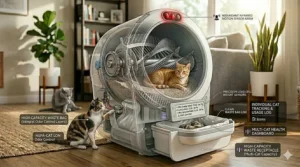
Getting into the self-cleaning litter box world doesn’t have to cost $500 or more, and the PetSafe ScoopFree SmartSpin makes the case convincingly. It uses an egg-shaped globe rotation design that’s visually cleaner than a rectangular litter box and offers more odor privacy than flat-tray designs, at a price point that puts it well below most competitors. The SmartSpin app tracks your cat’s bathroom visits and flags unusual patterns — functional health monitoring at a fraction of the premium-tier price.
The critical thing to understand before buying: the ScoopFree works with any litter, including standard clumping clay, which is a meaningful upgrade from older ScoopFree models that required proprietary crystal trays. That change removes the ongoing subscription cost concern that made earlier versions a harder sell. Up to two weeks of hands-free cleaning is the brand claim, and in single-cat households with light litter box traffic, that holds up reasonably well.
Who is this for? First-time buyers of automatic litter boxes, single-cat households on a budget, or skeptics who want to test the automatic litter box concept before committing to a $500+ unit. It’s not the most feature-rich machine here, but it’s a reliable, trustworthy entry point from a well-established pet brand.
What most buyers overlook: the SmartSpin’s smaller waste chamber means more frequent emptying in multi-cat homes — it’s genuinely designed for single-cat use and performs best in that context.
Customers praise the ease of setup and the significant lifestyle improvement even relative to premium alternatives, particularly those who were previously scooping twice daily.
✅ Most approachable price point in this roundup
✅ Works with any clumping litter (not just proprietary trays)
✅ App-based health monitoring included
❌ Smaller waste capacity — not ideal for multi-cat homes
❌ Fewer safety sensors than premium alternatives
Price range: $$ (check current price on Amazon) — the most accessible gateway into automatic litter box life.
7. PETKIT Purobot Max Pro 2 (2025 Edition) — The AI Camera Challenger
Released in late 2025, the Purobot Max Pro 2 is PETKIT’s most ambitious machine — and it’s the only unit in this roundup that genuinely challenges the Litter-Robot 5 Pro’s AI camera positioning at a lower price point. The 210° wide-angle lens with cat facial recognition is the headline feature, and it performs remarkably well for identifying individual cats in multi-cat households. The 5G WiFi connectivity means the app stays responsive even at a distance, without the lag that plagues some 2.4G-only units.
Here’s what the spec sheet won’t prepare you for: the app experience has some rough edges. Reviews note that the PETKIT app requires a Care+ subscription ($7.99/month) to access the full AI health monitoring suite, including cat identification between multiple animals. Without the subscription, some of the differentiating features become basic. The proprietary waste refill rings — roughly $33 per 3-pack — also add an ongoing cost layer that standard garbage bag–compatible units avoid. Over a full year, that’s a meaningful difference.
Who is this for? Tech-enthusiasts who want AI camera health monitoring at a lower price than the LR5 Pro, and who are comfortable with a subscription-dependent feature set. The extra-large opening and improved sealing (an upgrade over the first-generation Purobot) make it more practical for larger cats than some cylindrical competitors.
Users who’ve owned the first-generation Purobot Max report the 2025 edition as a meaningful improvement in both waste containment and app stability. Three years of reliability from the first version is a solid foundation for trust.
✅ AI facial recognition at a lower price than LR5 Pro
✅ 210° wide-angle camera — excellent room coverage
✅ Improved sealing and larger storage vs. first generation
❌ Full AI features require Care+ subscription
❌ Proprietary waste bags add ongoing costs
Price range: $$$$ (check current price on Amazon) — positioned between the PuraMax 2 and the Litter-Robot 5 Pro, with AI camera features that justify the step up.
How to Set Up Your Self-Cleaning Litter Box (And Not Make the Classic Mistakes)
Getting the hardware is the easy part. Getting your cat to actually use the new machine — and keeping it running optimally — is where most people stumble. Here’s what a smooth transition looks like.
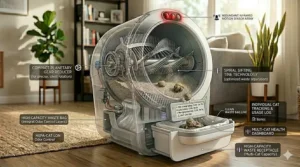
Days 1–3: Don’t turn it on. This sounds counterintuitive, but it’s one of the most consistent pieces of advice from cat behavior experts and long-term users alike. Place the unit near the old litter box with the power off. Let your cat investigate it as an inert object. Cats are threat-assessment machines, and a rotating, whirring appliance on day one is exactly the kind of threat they’ll reject. Add some litter from their existing box inside the new unit so the smell is familiar.
Days 4–7: Power on, but manually control cycles. Most units have a manual mode. Use it. Run a cleaning cycle while your cat is not in the room so they can observe the motion and sound at a safe distance. Repeat 2–3 times. The goal is desensitization, not surprise.
Day 7 onward: Switch to automatic mode. Remove or cover the old litter box gradually rather than abruptly. Give the cat one option. Most cats adapt within the first week once they’ve made a few successful visits.
Maintenance schedule that actually works:
- Empty waste drawer every 3–7 days (depending on cats and unit size)
- Wipe interior walls monthly with a pet-safe cleaner — litter dust and residue build up on sensors over time and cause false triggers
- Replace any carbon filters quarterly
- Check sensor cleanliness if the unit starts cycling with no cat present — dirty sensors are the number one cause of erratic behavior
The most common first-month mistake: Overfilling litter. Manufacturers recommend a specific fill line for a reason — too much litter and the mechanism can’t sift correctly, leading to clumps sticking to the walls. Less litter than you’d put in a manual box is almost always the right answer.
Which Cat Owner Are You? A Real-World Scenario Guide
Self-cleaning litter boxes aren’t one-size-fits-all. The “best” unit depends almost entirely on your specific household. Here’s how three real user profiles map to the products above.
The Busy Professional with One Cat and a Small Apartment You’re home maybe 10 hours on weekdays. Your single cat, probably a medium-sized domestic shorthair, uses the box 2–3 times a day. Odor control matters because your apartment is small. You want something that just works without becoming a side project. → PetSafe ScoopFree SmartSpin or PETKIT PuraMax 2. The SmartSpin gets you in at a lower price point and covers the basics beautifully. If you want app-based health alerts and better long-term build quality, the PuraMax 2 is worth the extra spend.
The Multi-Cat Household (3+ Cats) Who Has Tried Everything You’ve owned two other automatic litter boxes. One jammed constantly. One never convinced cat #3 to use it. You’ve spent more on batteries and replacement parts than a Litter-Robot would have cost. → Whisker Litter-Robot 4. This is specifically where the LR4’s multi-year reliability data and multi-cat performance separate it from the field. It handles volume, it doesn’t jam, and three cats using it daily won’t overwhelm it.
The Tech-Forward Cat Parent Who Wants Health Monitoring for a Senior Cat Your 11-year-old cat is showing early signs of kidney concerns. You want to know immediately if bathroom frequency changes. You’re already paying for a vet monitoring plan and this fits that mindset. → Whisker Litter-Robot 5 Pro or PETKIT Purobot Max Pro 2. The LR5 Pro’s dual AI cameras and per-cat health tracking are the most mature implementation; the Purobot Max Pro 2 offers similar AI camera capability at a lower upfront cost, with the trade-off of a subscription for full feature access.
The Cat Who Refuses Every Enclosed Box Ever Made There’s no delicate way to say this: some cats are just clause-phobic box haters. They will not enter a dome, a sphere, or anything with a door flap, regardless of how much organic cat grass you place inside it to lure them. → Neakasa M1 Plus. Full stop. The open-top design, combined with a large opening diameter, is the only automatic option that works reliably for this personality type.
How to Choose the Right Self-Cleaning Litter Box: 7 Criteria That Actually Matter
Walk into this decision with these seven filters and you’ll avoid the two most common regrets: overspending on features you don’t need, and underspending on a unit that fails within six months.
1. Number of cats. The single most important variable. One cat can live happily with a budget unit. Three cats need a larger waste drawer, a more robust mechanism, and — ideally — a longer proven track record. Units rated for “up to 3 cats” in manufacturer copy should realistically be considered 2-cat units for comfortable, low-maintenance operation.
2. Cat size and personality. Large cats (over 15 lbs) need units with generous interior dimensions. Anxious or previously box-resistant cats need open-top designs. Kittens under 3.3 lbs need a unit with a manual or kitten mode that disables auto-cycling until the weight threshold is met — otherwise the safety sensors won’t reliably detect them.
3. Mechanism type. Globe/drum rotation (Litter-Robot, PuraMax 2, Leo’s Loo Too, ScoopFree SmartSpin) works with any clumping litter. Rake systems are simpler but can jam on large clumps. Pull-and-wrap systems (Neakasa M1 Plus) bag waste efficiently but require compatible refill bags. Know what you’re buying.
4. App and connectivity. If health monitoring matters to you, verify what’s free vs. subscription-gated before purchasing. Some units charge monthly for basic data access; others include it. The Litter-Robot 4 offers core health monitoring free. The Purobot Max Pro 2 and PuraMax 2 gate advanced features behind Care+ at $7.99/month.
5. Litter compatibility. Most units work with any clumping clay litter. The older ScoopFree trays required proprietary crystal litter — the SmartSpin has resolved this. Avoid any unit that locks you into proprietary consumables unless you’ve verified the ongoing cost is acceptable.
6. Noise level. Under 30 dB is quiet enough for bedroom placement. The Leo’s Loo Too and Litter-Robot 4 both operate near this threshold. Noisier units (some budget models hit 45–50 dB) are better suited to laundry rooms or utility spaces away from sleeping areas.
7. Total cost of ownership. The upfront price is the headline, but the real number includes: litter bags or trays, any subscription fees, replacement filters, and the realistic lifespan of the mechanism. A $200 unit that fails in 18 months costs more over five years than a $550 unit that runs reliably for six. The American Veterinary Medical Association notes that consistent litter box hygiene has measurable effects on cat health — framing this as an investment in veterinary prevention, not just convenience, shifts the ROI calculation significantly.
Self-Cleaning Litter Boxes vs. Traditional Scooping: The Honest Comparison
| Factor | Traditional Litter Box | Self-Cleaning Litter Box |
|---|---|---|
| Daily time investment | 5–15 min/day | Near zero |
| Odor control | Depends on frequency | Consistent, immediate |
| Health monitoring | Visual only | App-based, data-driven |
| Upfront cost | $10–$50 | $150–$899 |
| Ongoing cost | Litter + bags | Litter + bags + (subscriptions) |
| Multi-cat performance | Requires 1 box/cat + 1 | 1–2 units covers 3–4 cats |
| Cat acceptance rate | 100% (it’s just a box) | 78–87% (adjustment period) |
The numbers tell a clear story, but the adjustment period deserves emphasis. Roughly 13–22% of cats resist automatic litter boxes beyond the first week, particularly with enclosed globe designs. Open-top units (Neakasa M1 Plus) have significantly higher acceptance rates. If your cat rejects the unit within the return window, use it — don’t write off automatic litter boxes entirely before trying an open-top alternative.
The long-term odor control advantage of automatic waste removal is well-documented. According to Cornell University’s College of Veterinary Medicine, cats are highly sensitive to litter box cleanliness and may avoid boxes that aren’t cleaned frequently enough — a behavioral reality that automatic litter boxes address more consistently than any human scooping schedule.
✨ Don’t Miss These Deals!
🔍 Ready to upgrade your cat’s bathroom experience — and reclaim yours? Click on any highlighted product above to check current pricing and availability. Your nose will thank you.
Common Buying Mistakes (And How to Avoid Them)
Buying the cheapest unit expecting premium results. Budget automatic litter boxes under $150 have a meaningful failure rate within the first year. The mechanism may jam, sensors may misfire, and the waste drawer may be too small for practical use. If price is the binding constraint, the PetSafe ScoopFree SmartSpin represents the floor of what’s worth buying — below that, reliability becomes a genuine concern.
Ignoring the litter type requirements. Clumping clay litter works in virtually all automatic units. Non-clumping, crystal (unless specified), or plant-based litters often don’t — they fail to form the firm clumps the mechanism needs to sift effectively. Double-check compatibility before changing litter brands.
Buying a single-cat-rated unit for a multi-cat home. Waste drawers fill up fast with three cats. A unit rated for “up to 3 cats” may realistically need emptying every 1–2 days rather than every week, defeating much of the convenience proposition. Size up.
Not reading the subscription terms. Three units in this guide offer genuinely useful free apps. Two others gate significant features behind a $7.99/month subscription. That’s roughly $96/year — worth knowing before you commit to the hardware.
Placing the unit near food and water. Cats instinctively avoid eliminating near their food sources. If the litter box is in the same room as their bowls, adoption and usage rates drop. The Humane Society of the United States recommends separate locations, ideally in different rooms or at minimum different corners. This applies doubly to automatic units during the adjustment period.
Long-Term Cost and Maintenance: The Real Numbers
Here’s the math that review sites rarely show you fully. Let’s compare two paths over three years: the PetSafe ScoopFree SmartSpin (budget entry) vs. the Litter-Robot 4 (premium), both for a single-cat household.
| Cost Factor | ScoopFree SmartSpin (3 yrs) | Litter-Robot 4 (3 yrs) |
|---|---|---|
| Unit purchase | ~$340–$400 | ~$549–$599 |
| Clumping litter | ~$180 ($5/month) | ~$180 ($5/month) |
| Waste bags/liners | ~$72 ($2/month) | ~$72 ($2/month) |
| Subscription (if any) | Free core features | Free core features |
| Replacement parts | ~$40–$80 | ~$20–$50 |
| Estimated 3-year total | ~$632–$732 | ~$821–$901 |
The gap over three years is roughly $170–$200 — less than $5 per week. For a machine you interact with every single day of your life, the reliability and feature difference between them is worth considerably more than $5/week to most buyers. For households with two or more cats, the gap closes further because the LR4’s superior waste capacity means fewer empty-drawer trips.
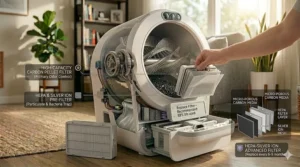
Maintenance matters more than most buyers anticipate. The number one cause of automatic litter box failure is neglected sensor cleaning. Litter dust coats infrared sensors over time, causing false triggers, missed detections, and erratic cycling. A two-minute sensor wipe-down with a dry cloth once a month prevents the majority of service issues across all units in this guide. It’s the litter box equivalent of cleaning your robot vacuum’s brush — obvious in retrospect, easy to forget until the problem arrives.
FAQ: Self-Cleaning Litter Boxes
❓ How often does a self-cleaning litter box need to be emptied?
❓ Are self-cleaning litter boxes safe for kittens?
❓ Can a self-cleaning litter box work with multiple cats?
❓ What type of litter works in an automatic litter box?
❓ Is a robot litter box worth the cost compared to traditional scooping?
Conclusion: Stop Negotiating with Your Nose
The best self-cleaning litter box for you isn’t the one with the longest spec sheet or the most impressive AI camera — it’s the one that fits your cats, your space, and your daily reality. For most households, that means the Whisker Litter-Robot 4: proven, reliable, genuinely multi-cat capable, with a free app that delivers real health insights without a paywall. It’s expensive. It’s also the last litter box you’ll likely ever buy.
For value-minded buyers, the PETKIT PuraMax 2 delivers premium features at a fraction of the premium price — and that’s not a compromise, it’s an honest calculation. For cats that hate enclosed spaces, the Neakasa M1 Plus is the machine that finally makes automatic litter boxes possible in your household. And for the tech-forward cat parent tracking an aging cat’s health, the Litter-Robot 5 Pro is the only unit that provides the per-cat, AI-driven health data that actually changes how you monitor your animal.
Whatever you choose, the calculus is simple: you spend somewhere between 30 minutes and an hour a week scooping. Over the life of a cat, that’s weeks of your time. An automatic litter box gives that time back while keeping the litter box cleaner than any human scooping schedule realistically achieves — which matters for your cat’s health and willingness to use it consistently.
Your cat didn’t choose the litter box chore. Neither should you.
✨ Ready to upgrade? Browse current pricing on the units above and check availability at Amazon. Your future self — the one who hasn’t scooped in six months — will send you a thank-you note.
Recommended for You
- 7 Best Cat Tunnel Beds in 2026: Cozy Hideouts Your Cat Will Love
- 7 Best Outdoor Cat Tunnels of 2026: Safe, Fun & Weatherproof Picks
- 7 Best 3-Way Cat Tunnels in 2026
Disclaimer: This article contains affiliate links. As an Amazon Associate, I earn from qualifying purchases. If you purchase products through these links, we may earn a small commission at no additional cost to you.
✨ Found this helpful? Share it with your cat-loving friends! 💬🤗
