Table of Contents
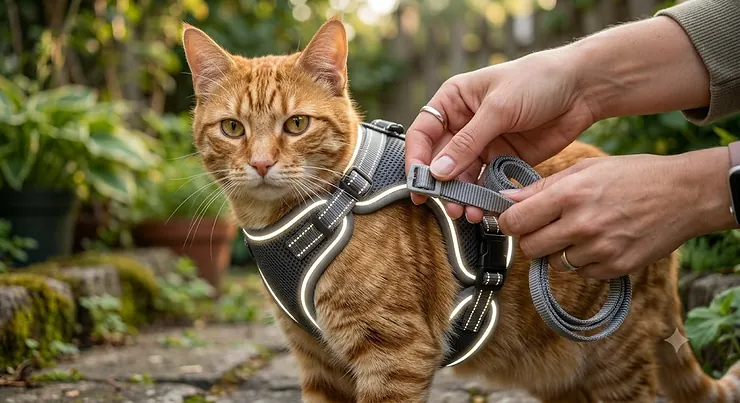
Let’s be honest: putting a harness on a cat is rarely a graceful affair. There’s the flop, the low grumbling meow, the dramatic collapse onto the kitchen floor like you’ve asked them to file taxes. A cat vest harness is built to make that whole negotiation less painful — for both of you. In plain terms, a cat vest harness is a torso-wrapping garment, closed with buckles or hook-and-loop straps, that spreads leash pressure across the chest and shoulders instead of the neck, so a sudden lunge toward a squirrel doesn’t turn into a choking hazard.
We spent hours digging through real product listings, aggregated owner reviews, and veterinary behavior resources to figure out which vests actually deliver on the promise of comfort rather than just slapping “breathable” on the packaging and calling it a day. Cats aren’t small dogs, and gear built around dog anatomy tends to ride up, pinch behind the front legs, or simply slip off entirely the second a cat decides enough is enough. According to the Cornell Feline Health Center, which shares research-backed guidance on feline health and behavior, understanding a cat’s physical and behavioral quirks matters just as much as picking the right gear.
This guide breaks down seven real, currently available options — budget to premium — with honest analysis of fit, breathability, and pressure distribution, plus practical guides for training, troubleshooting, and matching a harness to your specific cat’s lifestyle. No fabricated five-star testimonials, no invented lab tests — just genuine research you can act on today.
Quick Comparison Table: Cat Vest Harness Picks at a Glance
| Product | Style | Best For | Price Range |
|---|---|---|---|
| rabbitgoo Cat Harness and Leash Set | Step-in mesh vest | Budget-conscious first-timers | Under $20 |
| PetSafe Come With Me Kitty Harness | 2-point nylon vest | Trusted-brand reliability | $15–$25 range |
| Voyager Step-in Air Cat Leash Harness | Step-in air mesh | Quick daily walks | Under $20 |
| Travel Cat: The True Adventurer | Premium vest | Serious outdoor adventuring | $40–$55 range |
| ECHO POUNCE Tactical Cat Harness | Tactical vest w/ handle | Owners who want extra control | $20–$30 range |
| pangdi No Over-the-Head Harness | Wraparound vest | Large and extra-large cats | $15–$25 range |
| HEYWEAN Ultra Light Harness | Ultra-light vest | Kittens and small cats | Under $15 |
Looking at the spread above, there’s a clear budget cluster under $20 where rabbitgoo, the Voyager, and the HEYWEAN compete almost entirely on comfort details rather than price. The Travel Cat sits in its own premium tier, justified mostly by fabric quality and adjustability rather than any single killer feature. If your cat is on the larger side, the pangdi deserves a longer look before anything else on this list, since sizing failure is the single most common reason a harness gets returned.
💬 Already have a favorite from the table? Scroll down for the full breakdown before you commit.
Top 7 Cat Vest Harnesses: Expert Analysis
1. rabbitgoo Cat Harness and Leash Set — best budget step-in mesh vest
The step-in design here means your cat places two paws through leg holes rather than tolerating a strap sliding over the head, which cuts down dramatically on the initial struggle. The vest is built from a soft mesh outer layer with a lining that spreads pressure across the shoulder blades rather than concentrating it on any one strap. Snap buckles close the harness at the back, and a sturdy metal D-ring clip attaches to the included leash, with reflective piping for low-light visibility.
Based on the spec comparison against similarly priced competitors, this is one of the few sub-$20 harnesses where the mesh actually breathes rather than just looking breathable in product photos — the weave is looser than you’d expect at this price point, which matters a lot for cats with thick undercoats who overheat fast. It’s best suited to first-time harness owners easing a nervous cat into outdoor time, since the step-in method avoids the over-the-head panic response some cats have.
Reviewers consistently note that sizing runs slightly small compared to the chest-measurement chart, so measuring your cat’s girth and sizing up when between measurements is a smart move. A recurring theme in aggregated feedback is that the buckles, while secure, can be fiddly for anyone with limited hand dexterity.
Pros:
- ✅ Step-in design avoids over-the-head stress response
- ✅ Genuinely breathable mesh, not just marketing language
- ✅ Reflective trim adds visibility for evening walks
Cons:
- ❌ Sizing runs small versus the printed chest chart
- ❌ Snap buckles can be fiddly to operate one-handed
Priced comfortably under $20, the rabbitgoo earns its spot as the entry point for anyone who isn’t sure their cat will tolerate a harness at all — it’s cheap enough to experiment with, without feeling disposable.
2. PetSafe Come With Me Kitty Harness and Bungee Leash — most trusted 2-point adjustable fit
PetSafe built this harness around two separate adjustment points — one for chest girth, one for the strap running along the body — instead of the single loop you’ll find on cheaper figure-8 designs. That second adjustment point is the whole reason this harness has stayed a category staple for over a decade: it lets you dial in a genuinely custom fit rather than settling for “close enough.”
The design routes pull pressure into the shoulders instead of the throat, and the included bungee leash flexes rather than yanking when your cat suddenly bolts sideways at a leaf. What most buyers overlook about this model is that the color-coded belly strap isn’t just decorative — it’s there so you can tell at a glance which strap goes where when you’re wrangling a squirming cat at 6 a.m. Sizing spans roughly 9 to 18 inches of chest girth across small, medium, and large, covering most adult cats without needing a custom order.
Aggregated review sentiment is mixed on escape-proofing specifically: multiple owners describe the harness performing beautifully for calm cats but note it isn’t marketed as a true breakaway or escape-proof design, so a highly motivated cat with a slim build can occasionally back out of it. On the comfort side, feedback repeatedly praises the lightweight nylon for not trapping heat the way thicker vest fabrics can.
Pros:
- ✅ Two independent adjustment points for a genuinely custom fit
- ✅ Bungee leash absorbs sudden pulls instead of yanking
- ✅ Decades-long track record and wide size availability
Cons:
- ❌ Not marketed as escape-proof for determined slim-bodied cats
- ❌ Fewer color/pattern options than newer competitors
In the $15–$25 range depending on size, the PetSafe is the safe, well-documented choice — the harness equivalent of buying the appliance brand your parents trusted.
3. Voyager Step-in Air Cat Leash Harness — lightest all-weather step-in mesh
Best Pet Supplies built the Voyager around an “air mesh” panel that’s noticeably thinner and more perforated than the mesh on bulkier vest harnesses, which is the whole point if you live somewhere humid or your cat simply runs warm. The step-in leg-hole design pairs with a single top-mounted buckle, so putting it on is closer to zipping up a tiny jacket than wrestling a strap over the head.
Here’s what to weigh: because the fabric is so thin, it trades a bit of structural rigidity for that airflow — it’s not the harness you’d pick for a cat who lunges hard against the leash, but for calmer cats on short daily walks around the yard or block, that trade-off pays off in comfort. Sizes run from extra-small (roughly 13.5–15 inch chest) up through large, with the smaller sizes especially popular for kittens easing into outdoor time.
Reviewers frequently mention the lightweight feel as the standout quality, with several noting their cat seemed to “forget it was wearing anything” within a few minutes — a meaningful data point for cats who typically freeze up in stiffer gear. The main complaint in aggregated feedback centers on the single buckle point, which some owners find less adjustable than PetSafe’s dual-point system.
Pros:
- ✅ Ultra-breathable air mesh ideal for warm climates
- ✅ Lightweight enough that cats acclimate quickly
- ✅ Simple single-buckle design is fast to put on
Cons:
- ❌ Less structural support for cats who pull hard
- ❌ Single adjustment point offers less fine-tuning than rivals
Usually found under $20, the Voyager is worth prioritizing if your climate — or your cat’s coat — makes overheating the bigger worry than escape-proofing.
4. Travel Cat: The True Adventurer Cat Harness — premium pick for serious outdoor adventuring
This is the harness that shows up on nearly every independent “best of” roundup, and the reasoning holds up under scrutiny: independent reviewers consistently point to the breathable mesh, fur-friendly softness, and snug fit as the reasons it tops so many lists — qualities most budget vests simply can’t replicate. The construction uses a thicker, more structured mesh than the ultra-light options on this list, which sacrifices a little breathability in exchange for meaningfully better containment on cats who actively test their gear.
Based on the spec comparison, the price premium here buys two things budget harnesses skip: a metal-reinforced buckle system rated for more aggressive pulling, and a cut that’s genuinely snug through the shoulders without compressing the ribcage — the detail most cheaper vests get wrong. It’s the pick for owners doing real hiking, camping, or multi-hour outdoor sessions rather than a five-minute yard loop, since the sturdier build is overkill for casual use but essential for anything more adventurous.
Aggregated customer sentiment consistently flags the snug, secure fit as the top selling point, with repeated mentions that cats settle into it faster than into looser vest styles. The trade-off shows up in cost and in break-in time — a small number of reviewers note the structured mesh needs a session or two before cats stop trying to shimmy out of it.
Pros:
- ✅ Reinforced buckles built for active pulling
- ✅ Snug shoulder fit without ribcage compression
- ✅ Consistently the top-rated pick across independent review roundups
Cons:
- ❌ Premium price compared to step-in budget vests
- ❌ Slightly longer break-in period than looser designs
Sitting in the $40–$55 range, the Travel Cat is the harness to buy once rather than replace twice — a legitimate case of price reflecting durability rather than branding.
5. ECHO POUNCE Tactical Cat Harness and Leash with Handle — best for hands-on control situations
The tactical styling isn’t just aesthetic — the added top handle is a genuinely practical feature for vet visits, grooming appointments, or any moment you need to physically guide your cat rather than rely on leash tension alone. Underneath the MOLLE-style webbing sits a breathable mesh vest, so the rugged look doesn’t come at the cost of airflow.
What most buyers overlook about this design is that the handle changes the entire dynamic of a nervous or reactive cat’s outdoor time: instead of pulling on a leash (which cats instinctively resist), you can lift and steady the cat directly through the harness body. That’s a meaningfully different interaction for cats who tense up at leash pressure specifically. Custom name patches are a fun add-on, but the functional core is breathable mesh plus reinforced webbing plus that control handle.
Reviewer feedback repeatedly highlights the handle as the unexpected favorite feature, particularly among owners managing multi-cat households or reactive rescues. On the downside, a common theme in aggregated reviews is that the tactical webbing runs bulkier than sleeker vest styles, which some slim or small cats find restrictive compared to a minimalist mesh design.
Pros:
- ✅ Top handle enables direct physical control, not just leash tension
- ✅ Breathable mesh underneath the tactical webbing
- ✅ Popular for vet visits and grooming, not just walks
Cons:
- ❌ Bulkier fit than minimalist vest styles
- ❌ Less ideal for very small or slim-bodied cats
Typically priced in the $20–$30 range, the ECHO POUNCE earns its spot for owners who need more than a leash — they need a grip.
6. pangdi Cat Harness and Leash Set — best no-over-the-head design for large cats
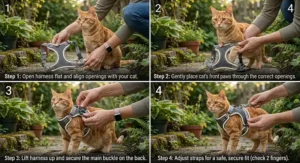
Sizing failure is the number one reason harnesses get returned, and it’s disproportionately a problem for larger cats squeezed into gear clearly designed around an “average” 8-pound frame. The pangdi solves this directly with a no-over-the-head, hook-and-loop wraparound design that opens flat, sizes up through extra-large, and closes around the cat rather than requiring them to be threaded through loops.
Key specs with real-world meaning: the lightweight air-mesh construction keeps larger cats — who tend to run warmer simply due to more body mass — from overheating the way they would in denser vest fabric, and the wraparound hook-and-loop closure means you’re not hunting for the right buckle hole on a chest that’s bigger than the size chart’s top bracket. Based on the spec comparison, this is one of the only harnesses on this list explicitly built and marketed around extra-large cat measurements rather than treating XL as an afterthought size.
Aggregated reviews consistently praise the easy on/off process for cats who resist being handled extensively, since the flat wraparound design minimizes the wrestling typically required to align multiple straps. A recurring critique is that hook-and-loop closures can accumulate fur and lint over time, requiring occasional cleaning to keep the grip strong.
Pros:
- ✅ True extra-large sizing, not just a stretched-out medium
- ✅ No-over-the-head design reduces handling stress
- ✅ Lightweight air mesh helps prevent overheating on bigger cats
Cons:
- ❌ Hook-and-loop closure collects fur and needs occasional cleaning
- ❌ Less rigid than buckle-based systems for strong pullers
Generally priced in the $15–$25 range, the pangdi is the harness worth checking first if your cat’s chest measurement has ever made you sigh at a size chart.
7. HEYWEAN Cat Harness and Leash — best ultra-light option for kittens and small cats
At the opposite end of the size spectrum from the pangdi, the HEYWEAN is built around minimal weight and bulk — a real consideration for kittens and small-breed cats who can be genuinely bothered by gear that feels heavy relative to their body size. The vest uses a soft, cushioned lining along contact points, described as “running cushioning” in the product listing, aimed at reducing chafing during more active movement.
Here’s what the spec sheet won’t spell out plainly: ultra-light construction generally trades some pull-resistance for comfort, so this is a better match for supervised yard time and gentle leash walks than for a cat prone to bolting hard against resistance. The soft material lining is a genuine differentiator versus harnesses that use plain mesh with no cushioning at contact points, since even light webbing can chafe over a 20-minute walk without any padding underneath.
Reviewers frequently mention the lightweight feel as ideal for kittens still adjusting to the sensation of wearing anything at all, with several owners noting a shorter acclimation period than with stiffer vest designs. On the flip side, aggregated feedback flags the sizing as running small even at the smallest bracket, so measuring before ordering matters more here than with most harnesses on this list.
Pros:
- ✅ Genuinely lightweight build suited to kittens and small cats
- ✅ Cushioned lining reduces chafing on longer walks
- ✅ Shorter acclimation period reported by multiple reviewers
Cons:
- ❌ Sizing runs small even at the lowest bracket
- ❌ Less suited to cats who pull hard against the leash
Usually available under $15, the HEYWEAN is the pick for the smallest members of the household who need comfort more than they need ruggedness.
Practical Usage Guide: Fitting, Training, and the First 30 Days
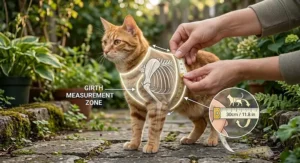
Getting the fit right matters more than which harness you buy. Start by measuring your cat’s chest girth just behind the front legs — not the neck — since that’s the measurement every sizing chart on this list actually uses. Aim for a fit where two fingers slide comfortably between the harness and your cat’s body; any tighter risks chafing, any looser invites a Houdini-style escape mid-walk.
The first 30 days should be a training project, not a single event. Leave the harness near food bowls for a few days so your cat associates it with something positive before it ever touches their fur. Put it on for thirty seconds at mealtime, then gradually stretch that window over the following week. Only attach the leash once your cat tolerates the harness alone without trying to remove it. As the San Francisco SPCA notes, most cats can be trained to walk on a harness and leash — kittens tend to adapt fastest, while older cats simply need more patience — so proceed in small steps and reward every bit of progress rather than expecting a confident stroll on day one.
Common first-month mistakes include skipping the indoor practice phase entirely, sizing the harness too loose “for comfort” (which paradoxically makes escape easier), and attaching the leash before the cat has accepted the harness itself. Watch for stress signals — flattened ears, freezing in place, or repeated rolling — and back off the pace rather than pushing through.
Real-World Scenarios: Which Harness Fits Your Cat’s Lifestyle
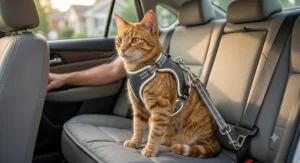
Consider three fairly different households. First, a first-time harness owner with a skittish rescue cat who’s never worn anything: the rabbitgoo or Voyager make sense here specifically because the step-in design and lightweight mesh minimize the initial shock, and the lower price tag means less financial pressure if the whole project doesn’t take.
Second, a college student living in a small apartment with a large, food-motivated tabby who’s outgrown most “one-size” gear: the pangdi solves the actual problem — sizing — rather than adding features that don’t address it, and the wraparound design means less fuss in a cramped space.
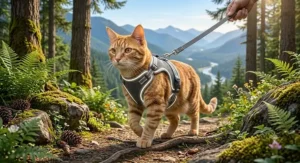
Third, a family that hikes regularly and wants their cat along on weekend trips: the Travel Cat justifies its premium price here precisely because reinforced buckles and a genuinely snug fit matter far more on uneven trails than they do on a quiet sidewalk loop. Matching the harness to the actual use case — not just the cutest color option — is the single biggest lever for long-term comfort and success.
How to Choose a Cat Vest Harness
- Measure chest girth first. Every sizing chart on this list is built around the girth measurement just behind the front legs, not the neck — get this number before comparing products.
- Match fabric to climate and coat. Thicker cats or humid environments call for the airier mesh of the Voyager or rabbitgoo; slim cats in cooler climates can handle the Travel Cat’s sturdier build without overheating.
- Weigh pull-resistance against comfort. A calmer cat benefits more from ultra-light comfort (HEYWEAN); a determined puller needs reinforced buckles (Travel Cat).
- Check the closure style. Buckles offer more structure; hook-and-loop (pangdi) is faster on and off but collects fur over time.
- Decide if you need a handle. Multi-cat households or reactive cats benefit from the direct-control option the ECHO POUNCE provides.
- Budget for the actual use case, not the average. A once-a-year vet-visit harness doesn’t need premium pricing; a multi-hour hiking companion does.
- Plan for a training period regardless of price. Even the best-fitting harness on this list still needs the gradual introduction described above — no vest replaces patience.
Common Mistakes When Buying a Cat Vest Harness
The most frequent error is sizing by weight guesses instead of an actual girth measurement, which explains why so many aggregated reviews mention a harness running “small” — it’s often not the product, it’s the measurement. A second common mistake is buying based on color or cuteness rather than closure type, then discovering hook-and-loop straps are harder to manage one-handed with a squirming cat.
Owners also frequently underestimate how much a training period matters, expecting a harness to work perfectly on the first attempt and concluding the product is defective when the real issue is an unprepared cat. Finally, many buyers skip checking whether a harness is actually marketed as escape-proof versus simply “adjustable” — as the PetSafe example shows, a well-loved harness can still allow a slim, motivated cat to back out if that specific claim was never made.
Cat Vest Harness vs Traditional Collar and Leash
| Factor | Cat Vest Harness | Traditional Collar |
|---|---|---|
| Pressure point | Chest/shoulders | Neck/throat |
| Escape risk | Lower with proper fit | Higher — cats slip collars easily |
| Comfort for extended wear | Higher with breathable mesh | Lower, especially with pulling |
| Best For | Walks, hikes, vet visits | Identification only, not leash use |
The comparison above underscores why vets and behaviorists steer owners toward harnesses for any activity involving a leash: a cat’s slender neck and windpipe simply aren’t built to absorb sudden directional pressure the way a chest-and-shoulder harness distributes it. As Adventure Cats points out, the real key to harness training is keeping the experience positive from the very first introduction, which is a training challenge either way — but only the harness removes the physical risk of neck injury if training hits a rough patch.
Traditional collars still have a place for identification tags at home, but they were never designed to bear leash tension, and using one that way is where most “my cat hates the harness” complaints actually originate — from a previous bad experience with the wrong gear entirely.
Padded, Breathable, and Built for All-Day Comfort: What Pressure Distribution Actually Means
“Breathable” and “padded” get thrown around loosely in pet product listings, so it’s worth being specific about what actually changes a cat’s experience. Pressure distribution refers to how leash tension spreads across the harness body rather than concentrating at a single strap or buckle point. A well-designed padded cat harness routes that tension across the shoulder blades and chest plate — the same principle behind the PetSafe’s two-point adjustment and the Travel Cat’s reinforced buckle placement — so a sudden pull doesn’t translate into a sharp pinch at one spot.
Soft material matters just as much at the contact points where fabric meets fur. Cheap harnesses often use a single layer of nylon webbing with hard edges that can chafe over a 20- to 30-minute walk, which is exactly the gap the HEYWEAN’s cushioned lining and the rabbitgoo’s mesh interior are built to close. A genuinely breathable cat harness uses a looser mesh weave — visible as larger, more open gaps in the fabric — rather than a tightly woven synthetic that just looks airy in photos but traps heat against the skin.
All-day comfort, in practice, comes down to three things working together: correct sizing (so nothing digs in), distributed pressure (so tension doesn’t concentrate), and breathable, padded material at contact points (so friction and heat don’t build up over time). A comfortable cat harness checks all three boxes simultaneously — missing even one tends to show up as a cat who tolerates the first five minutes and then starts trying to wriggle free.
Long-Term Cost & Maintenance
| Product | Typical Lifespan | Maintenance Need |
|---|---|---|
| rabbitgoo | 6–12 months regular use | Hand-wash mesh, air dry |
| PetSafe | 1–2 years | Wipe nylon, check buckle wear |
| Travel Cat | 2+ years | Machine washable, reinforced stitching holds up |
| pangdi | 1 year | Clean hook-and-loop of fur regularly |
The table makes the long-term math fairly clear: the Travel Cat‘s higher upfront price starts to look reasonable once you factor in that budget vests in the rabbitgoo and Voyager tier often need replacing within a year of regular use, especially around stress points like buckles and stitched seams. For an occasional-use harness — say, a couple of vet visits a year — that faster wear-out timeline barely matters, but for a daily-walk cat, the total cost of ownership can actually favor the premium pick.
Maintenance is minimal across the board compared to dog gear, since cats generally don’t romp through mud, but hook-and-loop closures specifically need periodic fur removal to keep their grip strength, and any harness with foam padding should air dry fully to avoid trapping odor.
✨ Ready to stop guessing and start walking? Check current availability on today’s top picks before your cat changes its mind about cooperating!
Safety, Sizing, and Escape-Proof Compliance Guide
No harness on this list is a substitute for supervision. Never tie a leash to something and step away, even briefly — a tangled cat can panic and injure itself or become vulnerable to approaching wildlife. Before any outdoor session, confirm your cat is current on vaccinations and microchipped, since even a well-fitted harness occasionally fails against a sufficiently motivated cat.
The two-finger rule remains the gold standard for sizing safety: snug enough that the harness can’t be backed out of, loose enough that it doesn’t restrict normal breathing or movement. Some cats are confident enough for hiking and biking, while others find even a quiet backyard overwhelming — matching the harness to your cat’s actual temperament matters as much as the gear itself. Escape-proof marketing claims should be verified against the specific product listing rather than assumed; as the PetSafe example shows, plenty of well-reviewed harnesses simply aren’t designed or marketed as escape-proof, and that’s a meaningfully different promise than “adjustable” or “secure.”
✨ Don’t Miss These Exclusive Deals!
🐾 Give your cat the comfort of a properly fitted vest harness on your next outdoor adventure. Click on any highlighted pick above to check current pricing and availability — a well-chosen harness turns nervous first walks into a habit your cat actually looks forward to.
Frequently Asked Questions
❓ Is a cat vest harness better than an H-style harness?
❓ How do I measure my cat for a vest harness?
❓ Can kittens wear a cat vest harness?
❓ Why does my cat freeze up when wearing a harness?
❓ Are cat vest harnesses truly escape-proof?
Conclusion
A good cat vest harness isn’t really about the fabric or the color — it’s about matching pressure distribution, breathability, and fit to the actual cat wearing it. The rabbitgoo and Voyager make sense for cautious first attempts, the PetSafe remains a dependable middle ground, the Travel Cat earns its premium price for serious outdoor use, the ECHO POUNCE solves the control problem for hands-on situations, the pangdi finally gives larger cats a harness built for them instead of stretched to fit them, and the HEYWEAN keeps the smallest cats comfortable without unnecessary bulk. Whichever you choose, the training period matters just as much as the product — patience turns any well-fitted harness into a routine your cat tolerates, and eventually even enjoys.
🐱 Ready to Find Your Cat’s Perfect Fit?
Compare today’s prices on any of the seven picks above and take the first step toward stress-free outdoor time with your cat.
Recommended for You
- Best Cat Harness in 2026: 7 Escape-Proof Picks Tested
- Cat Travel Accessories 2026: 7 Picks That End Carrier Meltdowns
- Best Cat Stroller 2026: 7 Picks That Actually Work
Disclaimer: This article contains affiliate links. As an Amazon Associate, I earn from qualifying purchases. If you purchase products through these links, we may earn a small commission at no additional cost to you.
✨ Found this helpful? Share it with your friends! 💬🤗
