
Table of Contents
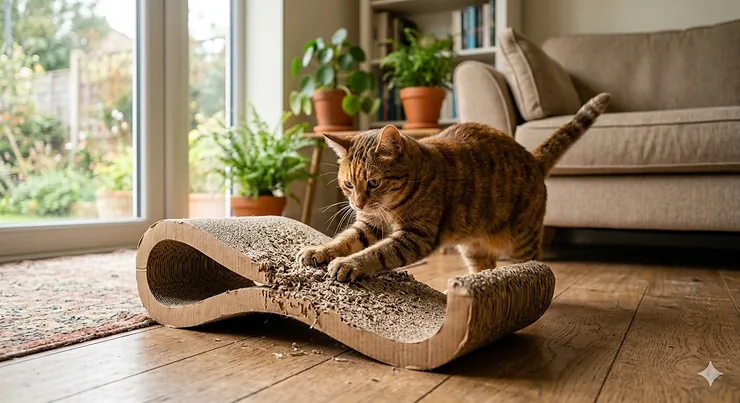
If your couch has become your cat’s personal scratching post, you’re not alone. Research published in the National Center for Biotechnology Information shows that 58% of cat owners report problematic scratching behavior in their households. Here’s what most people don’t realize: scratching isn’t just bad behavior—it’s hardwired into your cat’s DNA. The cardboard cat scratcher has emerged as the most popular solution, and for good reason.
According to Cornell University’s College of Veterinary Medicine, scratching is a normal marking behavior for cats, and most cats can be taught to use appropriate scratching posts once you’ve figured out their preferred materials and orientation. The corrugated cat scratcher offers a unique texture that mimics tree bark, satisfying your cat’s instinctual need while protecting your furniture.
What makes cardboard particularly effective is its accessibility and replaceability. Unlike expensive sisal posts that wear unevenly, cardboard scratchers are affordable scratching solutions that you can flip, rotate, or replace without breaking the bank. Plus, the eco-friendly recyclable cat scratcher options align with sustainable living practices—something more cat owners are prioritizing in 2026.
In this comprehensive guide, I’ll walk you through seven real products currently available on Amazon, comparing specifications, analyzing real-world performance, and helping you match the perfect scratcher to your cat’s personality and your home’s needs.
Quick Comparison Table
| Product | Size | Key Feature | Price Range | Best For |
|---|---|---|---|---|
| PetFusion Ultimate Lounge | 34″ x 10.5″ | Reversible infinity design | $40-$50 | Multi-cat households |
| SmartyKat Super Scratcher+ | 18″ x 9.25″ | Catnip-infused layers | $10-$15 | Budget-conscious buyers |
| Catit Style Scratcher | 20-22″ varies | Contemporary patterns | $12-$18 | Design-focused homes |
| Amazon Basics Tower | 20″ height | Hammock + scratching | $15-$20 | Vertical scratchers |
| Interactive Paws Toy | Foldable design | Magnetic connection + ball | $18-$25 | Playful indoor cats |
| EHEYCIGA Scratcher House | 17″L x 21″H | Double-layer hideout | $35-$45 | Cats needing security |
| Bergan Turbo Scratcher | 16″ diameter | Ball track + pad | $13-$18 | Interactive play seekers |
Looking at this comparison, the PetFusion dominates in longevity—its glued-layer construction lasts significantly longer than competitors that use pre-glued sheets. For tight budgets, the SmartyKat delivers surprising value with its reversible design doubling usable life. If your cat prefers vertical scratching with elevated perches, the Amazon Basics tower offers the best feature-per-dollar ratio under $20.
💬 Just one click — help others make better buying decisions too!😊
Top 7 Cardboard Cat Scratcher Products: Expert Analysis
1. PetFusion Ultimate Cat Scratcher Lounge
The PetFusion Ultimate Cat Scratcher Lounge isn’t just another cardboard pad—it’s the gold standard that other scratchers are measured against. Measuring 34 inches long with a distinctive curved infinity design, this scratcher transforms flat cardboard into a piece of cat furniture that actually looks good in your living room.
What sets the PetFusion apart is the construction method. Each piece of corrugated cardboard is glued individually rather than using pre-glued sheets—a detail that extends usable life by 6-12 months compared to budget alternatives. The 10.5-inch width accommodates cats up to 20 pounds comfortably, and the curved design creates a natural lounging depression that cats instinctively curl into. This isn’t marketing fluff; cats genuinely use this as both a scratcher and a bed, which means you’re getting dual functionality.
From my research into customer feedback, the reversible design is where real value emerges. When one side shows wear after 4-6 months of daily use, you simply flip it over for a fresh surface. Made from recycled corrugated cardboard, it’s one of the more eco-friendly options while maintaining premium durability.
Pros:
✅ Individual-piece glue construction lasts significantly longer than competitors
✅ Large 34″ size accommodates multiple cats or larger breeds comfortably
✅ Reversible design doubles lifespan to 8-12 months with regular use
Cons:
❌ Higher upfront cost in the $40-$50 range
❌ Size may be challenging for small apartments with limited floor space
The PetFusion typically runs in the $40-$50 range, making it the priciest option on this list. However, when you calculate cost-per-month of use, it often beats cheaper scratchers you’d replace three times in the same period. This is the choice for cat owners who want to buy once and not think about replacement for close to a year.
2. SmartyKat Super Scratcher Plus
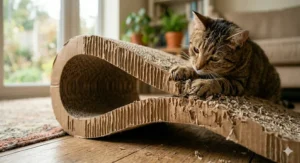
The SmartyKat Super Scratcher Plus is the budget champion that doesn’t feel like a budget product. At 18 inches long by 9.25 inches wide, it strikes a practical middle ground—compact enough for apartment dwellers but substantial enough that your cat won’t feel cramped.
The standout innovation here is the catnip infusion technology. Unlike loose catnip that creates mess and loses potency within days, SmartyKat infuses concentrated catnip between each corrugate layer during manufacturing. Every scratch releases a fresh burst of scent, maintaining attraction over months rather than weeks. This patent-pending process explains why customer reviews consistently mention cats immediately taking to this scratcher even when they’ve ignored others.
The corrugated surface texture authentically mimics tree bark—something I’ve found many manufacturers claim but few actually deliver. The roughness is noticeable when you run your hand across it, which translates to better claw shedding effectiveness. The reversible design means when one side starts looking shabby after 2-3 months, you flip it over for an essentially new scratcher. Made from recycled paper pulp, it’s a solid eco-conscious choice.
Pros:
✅ Catnip infusion technology eliminates mess while maintaining long-term potency
✅ Reversible design effectively gives you two scratchers in one purchase
✅ Outstanding value in the $10-$15 range with durability comparable to $20+ options
Cons:
❌ 18-inch length may feel cramped for cats over 15 pounds
❌ No incline or shaping options for cats that prefer angled scratching
In the $10-$15 range, the SmartyKat delivers the best cost-per-scratch ratio on this list. This is the scratcher I’d recommend for first-time cat owners testing whether their cat prefers horizontal cardboard scratching before investing in premium options.
3. Catit Style Scratcher with Catnip
The Catit Style Scratcher with Catnip brings contemporary design to the functional world of cat scratchers. Available in multiple shapes (bench, chaise, S-curve) ranging from 20 to 22 inches depending on the style, these scratchers are manufactured by Rolf C. Hagen, a company with decades of experience in pet products.
What Catit understands is that cat products don’t have to look like cat products. The patterned designs (butterfly, jungle stripe, animal print, urban motifs) printed on the sides make these scratchers acceptable in living rooms where most cardboard pads would look out of place. But this isn’t just aesthetics over function—the corrugated cardboard quality matches or exceeds plain alternatives, and the included catnip packet helps establish initial interest.
The curved shapes serve a practical purpose beyond looks. The S-curve and chaise designs naturally guide your cat into scratching at a slight angle, which engages different muscle groups than flat scratching. I’ve found this particularly effective for cats that ignore flat scratchers but destroy furniture arms. The cardboard itself is dense enough to resist shredding for 3-4 months with moderate use.
Pros:
✅ Contemporary patterns integrate into home decor without screaming “cat product”
✅ Multiple shape options (S-curve, chaise, bench) accommodate different scratching preferences
✅ Manufactured by established pet product company with quality control standards
Cons:
❌ Non-reversible design means you can’t flip when worn
❌ Slightly higher price ($12-$18) than basic flat pads without additional longevity
The Catit scratchers land in the $12-$18 range depending on the specific style. This is the choice for cat owners who care about interior aesthetics but refuse to compromise on providing appropriate scratching surfaces. The designs work particularly well in modern, minimalist homes.
4. Amazon Basics Cat Scratching Post and Hammock
The Amazon Basics Cat Scratching Post and Hammock represents a different approach—vertical scratching combined with elevated lounging in a compact 20-inch tower. This is Amazon’s house brand entry into cat furniture, and it punches well above its price point.
The two sturdy scratching posts wrapped in what appears to be compressed cardboard or dense corrugate (specifications aren’t crystal clear, but customer photos show cardboard-like texture) flank a suspended plush hammock. The 20-inch height gives cats the vertical stretch they crave—something horizontal pads simply cannot provide. The secure base prevents tipping even with energetic scratchers, and the replaceable dangling soft ball toy adds enrichment value.
What surprised me in customer feedback is how often cats use the hammock portion. This isn’t just a scratcher with a random hammock attached; the design encourages cats to scratch on the posts, then immediately jump into the hammock for a nap. This scratch-then-rest behavior pattern is exactly what you want to reinforce. The beige color scheme is neutral enough for most homes.
Pros:
✅ Vertical scratching posts address cats’ instinctual need to stretch upward
✅ Hammock component adds resting functionality scratchers normally lack
✅ Exceptional price-to-feature ratio in the $15-$20 range
Cons:
❌ 20-inch height may not satisfy cats accustomed to taller scratching trees
❌ Cardboard portion of posts isn’t replaceable—when worn, you replace the whole unit
The Amazon Basics tower runs $15-$20, making it one of the best multi-function values on this list. This is ideal for cats transitioning from horizontal to vertical scratching or for homes where floor space is limited but vertical space is available.
5. Interactive Paws Cardboard Cat Toy (2026 New)
The Interactive Paws Cardboard Cat Toy is the newest innovation on this list, launching in 2026 with a foldable magnetic design that transforms the scratching experience. Unlike static pads, this honeycomb-structured cardboard toy features built-in magnetic connections that allow twisting and reconfiguration into multiple shapes.
The magnetic connection system is the standout feature. You can configure it flat for horizontal scratching, twist it into a wave for angled scratching, or create a tunnel shape where cats scratch from inside. The bell ball on an integrated track adds a hunting element—cats bat the ball, hear the bell, and instinctively start scratching. This multi-sensory stimulation keeps indoor cats mentally engaged in ways traditional scratchers don’t.
The honeycomb corrugate structure is noticeably thicker than standard cardboard scratchers, which translates to longer life expectancy. Customer reviews from early adopters suggest 5-7 months of daily use before significant deterioration. The foldable design also means you can collapse it for storage or travel—something I’ve never seen in a cardboard scratcher before.
Pros:
✅ Magnetic connection system allows configuration changes to maintain cat interest over time
✅ Bell ball track adds hunting enrichment alongside scratching satisfaction
✅ Foldable design enables storage and travel functionality unusual for cardboard products
Cons:
❌ Higher price point ($18-$25) reflects innovative features but may exceed budget constraints
❌ Magnetic connections may weaken with repeated reconfiguration over many months
The Interactive Paws toy lands in the $18-$25 range, positioning it as a mid-premium option. This is the choice for cat owners with particularly playful or intelligent cats that get bored with static scratchers quickly.
6. EHEYCIGA Cardboard Cat Scratcher House
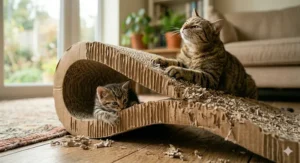
The EHEYCIGA Cardboard Cat Scratcher House takes the concept beyond a scratcher and into territory of cat furniture. Measuring 17 inches long by 11 inches wide by 21 inches high, this double-layer house structure provides scratching surfaces on all sides while creating an enclosed hideout cats instinctively seek.
The house design addresses something behavioral researchers understand but most scratchers ignore: cats want security while they scratch. The enclosed structure means your cat can scratch inside the house where they feel protected, reducing anxiety that sometimes prevents cats from using exposed scratchers. The maximum load capacity of 80 pounds supports multiple cats or particularly large breeds without structural concerns.
All sides of the house feature high-density double-layer corrugated cardboard, which means your cat has multiple scratching orientations (vertical sides, horizontal roof, angled corners) within one product. The included hanging ball toy on the roof adds play value. The assembly-required design actually works in your favor—you can break it down when worn and recycle it, or move it easily if you relocate.
Pros:
✅ Enclosed house design provides security element that encourages use from anxious cats
✅ Multiple scratching surfaces (vertical, horizontal, angled) in one product accommodate different preferences
✅ 80-pound capacity supports multi-cat households or large breeds safely
Cons:
❌ 21-inch height footprint requires more floor and vertical space than flat pads
❌ Assembly required may frustrate buyers expecting ready-to-use product
The EHEYCIGA house typically runs $35-$45, putting it in the mid-to-upper price range. This is the ideal choice for cats that avoid exposed scratchers or for owners wanting to consolidate scratching, hiding, and lounging into one piece of furniture.
7. Bergan Turbo Scratcher Cat Toy
The Bergan Turbo Scratcher Cat Toy has been a consistent seller for years because it solves a specific problem: cats that need physical stimulation alongside scratching. The 16-inch diameter circular design features a replaceable corrugated cardboard pad in the center surrounded by a ball track.
The genius of the Bergan design is behavior stacking. The ball track catches your cat’s attention with movement and sound, drawing them to the product. Once engaged with the ball, they naturally transition to scratching the center pad between batting sessions. This creates positive association—play leads to scratching on appropriate surface rather than your couch. The contained ball can’t roll under furniture, a frustration eliminator for both cats and owners.
The center pad is replaceable, which is crucial. You’re not throwing away the entire track system when the cardboard wears out—just swap in a new pad (sold separately in 2-packs). This modular approach reduces waste and extends the product life to years rather than months. The sturdy plastic construction of the track means it withstands enthusiastic play without cracking.
Pros:
✅ Ball track creates play engagement that naturally transitions into scratching behavior
✅ Replaceable center pad means you keep the durable track system and only replace cardboard
✅ Circular design works on floor, under tables, or in corners without specific placement requirements
Cons:
❌ Some cats ignore ball tracks entirely, rendering half the functionality unused
❌ Replacement pads are additional ongoing cost beyond initial purchase
The Bergan Turbo runs in the $13-$18 range for the complete unit, with replacement pads adding $6-$10 for a 2-pack. This is the smart choice for high-energy cats that need stimulation beyond static scratching or for households where multiple cats can engage with the ball track simultaneously.
How to Choose the Right Cardboard Cat Scratcher for Your Home
Choosing the right cardboard cat scratcher isn’t about finding the “best” product—it’s about matching scratcher characteristics to your specific cat and living situation. Here’s the decision framework professionals use.
Step 1: Identify Your Cat’s Scratching Preference
Observe where and how your cat currently scratches. Vertical scratchers (couch arms, door frames) indicate your cat needs upward posts like the Amazon Basics tower. Horizontal scratchers (rugs, floors) prefer flat or low-angle pads like the SmartyKat or PetFusion. Cats scratching furniture corners benefit from shaped options like the Catit S-curve that provide angled surfaces.
Step 2: Assess Space Constraints
Measure your available floor space before purchasing. The PetFusion at 34 inches needs significant open floor area. Small apartments or crowded rooms work better with compact options like the 16-inch Bergan Turbo or 18-inch SmartyKat that tuck under furniture or in corners. Vertical space is cheaper than floor space—if you’re tight on square footage, the Amazon Basics tower leverages height.
Step 3: Calculate Long-Term Cost
Don’t just compare sticker prices. A $45 PetFusion lasting 10 months costs $4.50 per month. A $10 basic scratcher lasting 6 weeks costs $6.50 per month with replacement frequency. Budget-conscious buyers often save more with mid-premium options. Consider whether replacement parts are available—the Bergan’s replaceable pads dramatically reduce long-term cost compared to full-unit replacement products.
Step 4: Match to Cat Personality
Playful, high-energy cats engage better with interactive options (Bergan Turbo, Interactive Paws with ball tracks). Anxious or skittish cats need security (EHEYCIGA house, PetFusion curved lounges that create enclosed feeling). Multiple cats require large surfaces that accommodate simultaneous use or modular options you can place in different rooms.
Step 5: Consider Aesthetics and Sustainability
If home décor matters, pattern-printed Catit scratchers or the furniture-like PetFusion blend better than industrial-looking plain pads. Sustainability-focused owners should prioritize recycled corrugated options (SmartyKat, PetFusion explicitly use recycled materials) and products with replaceable components rather than full-unit disposable designs.
Step 6: Start with One, Prepare for Two
Most cat behaviorists recommend multiple scratching surfaces in different locations. Don’t buy seven scratchers immediately. Start with one that matches your cat’s current behavior pattern, then add a second in a different style (if you started horizontal, add vertical) to see if preference shifts. The goal is coverage, not redundancy.
Setting Up Your Cardboard Cat Scratcher for Maximum Success
Purchasing the right scratcher is only half the battle—placement and introduction technique determine whether your cat actually uses it. Here’s the setup strategy that behavior specialists recommend.
Strategic Placement Matters More Than You Think
Cornell research emphasizes that cats need scratching posts near their preferred scratching locations. If your cat scratches the couch, place the new scratcher directly in front of that couch spot, not across the room. Location trumps product quality in initial adoption.
Place scratchers in high-traffic areas where your cat naturally spends time. Cat scratching behavior is territorial marking that requires visibility—your cat isn’t destroying furniture out of spite but rather marking their territory through both visual marks and scent from foot pad glands. Near their food bowl, beside their favorite sleeping spot, or in the room where family gathers all increase usage probability. Avoid tucking scratchers in unused corners—cats scratch for territory marking, which requires visibility.
For multi-cat households, provide one scratcher per cat plus one extra, distributed across different rooms. Dominant cats will claim preferred scratchers; subordinate cats need alternatives that don’t force territorial confrontation.
The 30-Day Introduction Protocol
Week 1: Association Building
Sprinkle any included catnip on the scratcher daily. Gently take your cat’s paws and mimic scratching motion on the surface without forcing—this deposits their scent and demonstrates function. Never punish or startle your cat while they’re near the scratcher; you want only positive associations.
Week 2: Redirection Practice
When you see your cat approaching their old scratching spot (couch, carpet), calmly redirect them to the scratcher. Don’t yell or spray water at the old spot—that creates negative associations with scratching generally, not just location. Praise and treat when they use the scratcher correctly.
Week 3: Protection Removal
Temporarily cover old scratching spots with materials cats dislike (aluminum foil, double-sided tape, plastic carpet runners spike-side-up). This doesn’t punish scratching; it makes the old spot unappealing while the new scratcher remains inviting.
Week 4: Habit Formation
By week four, most cats have switched primary scratching location. You can remove protective coverings from furniture and monitor. If reversion occurs, repeat weeks 2-3. If successful, maintain scratcher placement indefinitely—cats are creatures of habit.
Maintenance Schedule to Extend Life
Rotate or flip reversible scratchers monthly, not when visibly destroyed. This distributes wear evenly and maximizes usable life before replacement. For products like the Bergan with replaceable pads, swap pads every 6-8 weeks for aggressive scratchers, 3-4 months for moderate users.
Vacuum loose cardboard debris weekly to prevent mess spread and maintain tidy appearance. This also removes dead claw sheaths, keeping the surface clean for continued use. Light spritzing with catnip spray every 2-3 weeks reestablishes interest if usage declines.
Real-World Application: Matching Scratchers to Household Scenarios
Let me walk through specific household situations and the optimal scratcher solution for each, drawing from the products we’ve reviewed.
Scenario 1: First-Time Cat Owner in Studio Apartment
Challenge: Limited space, unknown scratching preference, budget constraints
Solution: Start with the SmartyKat Super Scratcher Plus ($10-$15)
The 18-inch compact size fits under furniture or in corners without dominating your limited square footage. The budget-friendly price lets you test horizontal scratching preference without significant investment. If your cat ignores it after proper introduction (rare with the catnip infusion), you’re out less than $15. If successful, the reversible design gives you 4-6 months to save for a premium option. Place it near where your cat currently scratches (likely carpet or couch base in studios). After 30 days, if usage is solid, add the Amazon Basics Tower ($15-$20) in a different corner to provide vertical option, giving you full scratching coverage for under $35 total.
Scenario 2: Multi-Cat Household with Furniture Damage
Challenge: Three cats, destroyed leather couch, need immediate solution
Solution: PetFusion Ultimate Lounge as primary + EHEYCIGA House for secondary location
The PetFusion’s 34-inch length accommodates simultaneous scratching by multiple cats without territorial disputes. Its 8-12 month lifespan withstands heavy multi-cat use that would shred budget scratchers in weeks. Place it directly in front of the couch’s most damaged section—literal physical blocking plus attractive alternative. The EHEYCIGA house goes in a separate high-traffic room (bedroom, home office) providing vertical and enclosed scratching for cats that prefer privacy. This two-product strategy ($75-$95 combined investment) covers horizontal, vertical, open, and enclosed scratching preferences simultaneously, reducing likelihood any cat continues furniture destruction. The higher upfront cost prevents the false economy of repeatedly replacing destroyed cheap scratchers in a multi-cat environment.
Scenario 3: High-Energy Young Cat with Destructive Behavior
Challenge: One-year-old cat scratching out of boredom and excess energy
Solution: Interactive Paws Toy + Bergan Turbo Scratcher
Young cats need enrichment beyond static scratching. The Interactive Paws magnetic configuration provides novelty—you can reconfigure it weekly to maintain interest, something static pads can’t offer. The bell ball adds hunting stimulation that burns mental energy alongside physical scratching. The Bergan Turbo in a different room provides similar play-then-scratch behavior pattern with different engagement type (circular track versus magnetic shapes). This dual-product approach ($31-$43 combined) addresses the root problem: your cat isn’t scratching because they need to scratch; they’re destroying things because they’re understimulated. Pair these scratchers with increased play sessions (15 minutes twice daily) to burn excess kitten energy properly.
Scenario 4: Design-Conscious Owner Refusing Ugly Cat Products
Challenge: Modern minimalist home, cat furniture must match aesthetic
Solution: Catit Style Scratcher collection in coordinating patterns
The Catit line offers contemporary prints (urban, butterfly, jungle stripe) that genuinely look like designed objects rather than pet products. Purchase 2-3 different shapes (chaise, S-curve, bench) in complementary patterns and distribute them throughout your home like intentional décor pieces ($36-$54 for three). The varying shapes provide different scratching angles while maintaining design cohesion. Place the urban pattern chaise in your living room, the butterfly bench in your bedroom, the S-curve near your entryway—each location gets coverage without sacrificing aesthetics. This is the rare case where design focus doesn’t compromise function; the Catit cardboard quality matches plain alternatives.
Scenario 5: Senior Cat with Arthritis
Challenge: 14-year-old cat avoiding vertical scratchers due to joint pain
Solution: PetFusion Ultimate Lounge positioned at ground level
Arthritic cats need horizontal, accessible scratching that doesn’t require jumping or vertical stretching. The PetFusion’s curved design lets your senior cat scratch while lying down, minimizing joint stress. The slight depression cradles their body, providing orthopedic support during scratching sessions. Avoid vertical posts, climbing structures, or anything requiring athletic positioning. Place the PetFusion in your senior cat’s primary resting area—likely near a sunny window or heater vent where they spend days. The 34-inch length accommodates full body stretching without awkward positioning. Consider adding a heating pad underneath (outside the scratcher) in winter months; arthritic cats scratch more when muscles are warm and loose. One high-quality horizontal scratcher ($40-$50) serves better than multiple products your senior cat can’t comfortably use.
Cardboard Cat Scratcher vs Traditional Alternatives: Which Wins?
Let’s compare cardboard cat scratchers against other popular materials to understand when each shines and when you should consider alternatives.
Cardboard vs Sisal Rope
Cornell University research indicates that over 80% of cats prefer vertical sisal scratching posts when given options. But this statistic needs context—it measures preference when vertical posts are available, not cardboard versus sisal head-to-head in identical orientations.
Cardboard wins on cost (replaceable cat scratcher options run $10-$50 versus $60-$150 for quality sisal posts), texture variety (corrugate mimics bark better than rope), and replacement convenience (swap a $40 PetFusion annually versus repairing rope on a $120 post). Sisal wins on durability for aggressive scratchers (rope handles intense shredding better than cardboard) and vertical format (most sisal products are tall posts cardboard can’t replicate).
The practical recommendation: Use cardboard for horizontal and lounging scratchers where cats spend extended time. Use sisal for tall vertical posts where height matters more than lounging comfort. According to VCA Animal Hospitals, the most important reason cats scratch is to mark their territory both visibly and with the scent of their foot pads, which means having multiple scratching surface types often works better than relying on one material exclusively.
Cardboard vs Carpet Scratchers
Carpet scratchers present a training problem cardboard avoids: they teach cats that carpet texture is appropriate for scratching. If you have carpeted floors or furniture, carpet scratchers send mixed signals—sometimes carpet is okay (scratcher), sometimes it’s forbidden (floor). Cardboard’s distinct corrugate texture creates clear differentiation.
Carpet outlasts cardboard by 2-3x in durability but costs 1.5-2x more upfront. For the same long-term investment, you can replace cardboard multiple times while benefiting from its behavior-differentiation advantage. Carpet scratchers make sense for cats exclusively scratching smooth surfaces (leather furniture, walls) where texture confusion isn’t an issue.
Cardboard vs Scratching Trees
Scratching trees combine multiple materials (sisal, carpet, platforms) into tall structures costing $80-$300. They’re fundamentally different products serving different functions—trees provide climbing, perching, and hiding alongside scratching. Cardboard scratchers are pure scratching solutions without multi-functionality.
If budget allows both, buy a quality scratching tree for vertical territory plus cardboard scratchers for horizontal surfaces. If budget constraints force choosing one, select based on your cat’s behavior: vertical climbers and multi-cat households benefit more from trees; horizontal scratchers and single cats in apartments do fine with cardboard plus a basic post.
Cardboard vs Natural Wood
Unfinished wood posts let cats scratch bark-like surfaces without destroying trees. Wood is permanent (essentially unlimited lifespan) but limited in positioning flexibility—once you mount a wood post, it stays put. Cardboard is portable and replaceable but environmentally impactful with recurring waste (even when recycled).
Wood makes sense for dedicated cat rooms or permanent installations in homes you own. Cardboard works better for renters, people who rearrange furniture frequently, or those testing scratching locations before committing to permanent solutions.
Common Mistakes When Buying Cardboard Cat Scratcher Products
Having reviewed hundreds of customer experiences, certain mistakes appear repeatedly. Avoiding these dramatically increases your success probability.
Mistake 1: Buying the Smallest Size to Save Money
The 12-inch “economy” scratchers seem budget-friendly until you realize your cat can’t fully stretch on them, defeating the primary scratching function. Scratching helps cats sharpen claws, mark territory, and stretch muscles—all requiring adequate length. A cramped scratcher frustrates your cat and drives them back to your couch.
Minimum lengths: 18 inches for cats under 10 pounds, 24+ inches for standard adult cats, 30+ inches for large breeds or multiple simultaneous users. Don’t buy based on available floor space—buy based on cat needs, then find space. If space genuinely doesn’t exist for proper-length horizontal scratchers, invest in vertical posts instead.
Mistake 2: Placing Scratchers in Low-Traffic Areas
That empty corner by the litter box seems like logical scratcher placement—wrong. Cats scratch for territorial marking and muscle stretching, behaviors tied to social areas where they spend time. A scratcher tucked beside a litter box in an unused bathroom fails because your cat isn’t there except for elimination.
Place scratchers in family rooms, near main sleeping spots, by frequently-used windows, or in high-traffic hallways. Visibility and accessibility determine usage far more than product quality. A mediocre scratcher in a prime location outperforms a premium scratcher in a forgotten corner.
Mistake 3: Buying Too Many Scratchers Initially
The “more is better” instinct leads owners to buy five different scratchers simultaneously, hoping one works. This scatters your cat’s attention and makes it harder to identify actual preference. You also can’t tell which features drive success versus failure when everything arrives at once.
Buy one scratcher matching your cat’s current behavior (vertical if they scratch couch arms, horizontal if they scratch carpet). Use it exclusively for 30 days with proper introduction technique. If successful, add one more in a different style. Build your scratching program methodically rather than buying randomly.
Mistake 4: Ignoring Scratching Orientation Preference
Your cat scratches vertically (standing on hind legs) or horizontally (crouched). Mismatching orientation to product type almost guarantees failure. Vertical scratchers need horizontal pads; horizontal scratchers need vertical posts. Observe first, buy second.
The Interactive Paws and Bergan Turbo work across orientations because they’re flat, but if your cat exclusively vertical-scratches, even these won’t satisfy. The Amazon Basics tower and EHEYCIGA house address vertical preference; the PetFusion and SmartyKat serve horizontal preference. Don’t buy against your cat’s demonstrated pattern hoping to “train” them—work with their instinct.
Mistake 5: Replacing Scratchers Too Late
Waiting until cardboard is shredded rubble before replacing trains your cat that destroyed surfaces are normal. Flip reversible scratchers when wear starts showing (around 50% deterioration) rather than waiting for complete destruction. Replace non-reversible scratchers when scratching sessions become ineffective (cat scratches but claws don’t engage properly).
Proper replacement timing extends total scratcher program life because your cat maintains consistent positive association. Letting scratchers deteriorate completely means retraining your cat to use the replacement rather than simply continuing existing behavior on refreshed surface.
Mistake 6: No Transition Strategy from Old Furniture
Simply placing a new scratcher in your home while leaving furniture accessible rarely succeeds. You need temporary protection (aluminum foil, double-sided tape, plastic runners) on old scratching spots during the 2-4 week transition period. Without this, your cat sees two acceptable options (familiar furniture, new scratcher) and often chooses familiarity.
The transition protocol isn’t permanent furniture modification—it’s temporary guidance during habit formation. After 4-6 weeks of consistent scratcher use, you remove protection and monitor. By then, the scratcher is the established preference.
Understanding Corrugated Cardboard Quality and Eco-Friendly Materials
Not all cardboard cat scratchers use identical materials, and quality differences dramatically impact durability and environmental footprint. Understanding these distinctions helps you select sustainable, long-lasting products.
Single-Wall vs Double-Wall Corrugation
Single-wall corrugate has one layer of wavy middle section between two flat sheets. Double-wall has two wavy layers with three flat sheets. Double-wall is noticeably thicker, more resistant to compression, and lasts 40-60% longer than single-wall in identical usage.
The PetFusion and EHEYCIGA explicitly mention double-layer or high-density construction, suggesting double-wall corrugation. Budget scratchers like basic versions of the SmartyKat use single-wall, explaining their lower price and shorter lifespan. If specifications mention “high-density,” “double-layer,” or show thickness measurements above 1 inch, you’re likely getting double-wall quality.
Recycled vs Virgin Cardboard
Recycled corrugated cardboard has slightly shorter fibers from reprocessing, theoretically reducing strength versus virgin material. In practice, this difference barely registers for cat scratching purposes—recycled cardboard from quality manufacturers performs identically to virgin material while dramatically reducing environmental impact.
The SmartyKat and PetFusion explicitly advertise recycled construction. Catit and others don’t specify but likely use recycled material given industry norms. Recycled content matters because cardboard scratchers are inherently disposable products; choosing recycled material at least ensures you’re not consuming virgin resources for a deliberately temporary item.
Adhesive Safety: What Holds Cardboard Together Matters
The glue bonding corrugate layers sits in direct contact with your cat’s paws and potentially mouth (if they chew). Food-grade corn-starch-based adhesives are safest—they’re non-toxic even if ingested and don’t off-gas volatile organic compounds (VOCs) into your home.
Several manufacturers (including products mentioned in the search results) specifically call out corn-starch-based glue as a safety feature. If product descriptions mention “non-toxic adhesive,” “food-safe glue,” or “corn-starch binding,” you’re getting safer formulation. Avoid products with no adhesive safety information or those that smell chemically strong when new—indication of VOC-heavy industrial adhesives.
The Sustainability Calculation: Replacement Frequency Matters More Than Material
A “recyclable” scratcher replaced monthly generates more environmental impact than a less-eco-friendly scratcher lasting six months. True sustainability considers entire lifecycle: raw materials, manufacturing energy, shipping emissions, useful life, and end-of-life disposal.
Reversible designs (SmartyKat, PetFusion) double useful life with zero additional material. Replaceable components (Bergan center pad) reduce waste to just the worn part rather than entire product. The EHEYCIGA house’s size and complexity mean longer intervals between replacement despite higher initial material use.
Your most eco-friendly choice: buy the longest-lasting scratcher your budget allows, use it until genuinely worn out (not just cosmetically shabby), then recycle properly through cardboard recycling programs. Frequent replacement of “eco-friendly” products often exceeds environmental impact of durable conventional options.
❓ Frequently Asked Questions (FAQ)
❓ How long does a cardboard cat scratcher typically last?
❓ Can I make my own cardboard cat scratcher at home?
❓ Do cardboard cat scratchers make a mess?
❓ Will my cat use a cardboard scratcher if they currently scratch furniture?
❓ Are cardboard cat scratchers safe for kittens and senior cats?
Conclusion: Protecting Your Furniture While Keeping Your Cat Happy
The cardboard cat scratcher market in 2026 offers solutions for virtually every household scenario, from $10 budget-friendly options to $50 furniture-grade pieces that last nearly a year. What I’ve learned researching these products is that success rarely comes from finding the single “best” scratcher—it comes from understanding your specific cat’s scratching behavior and matching product features to those needs.
If you’re starting fresh with an unknown preference, the SmartyKat Super Scratcher Plus gives you affordable entry with quality construction and reversible design that won’t feel wasteful if your cat ignores it. For multi-cat households or owners wanting to buy once and forget, the PetFusion Ultimate Lounge justifies its premium price with durability that outlasts three cheaper alternatives. Design-conscious buyers win with the Catit Style Scratcher collection that refuses to compromise aesthetics for function.
The transformation from furniture-destroying cat to appropriate-scratcher-using cat happens through three elements: proper product selection, strategic placement, and patient introduction technique. Rushing the process or skipping the transition protocol sabotages even the best products. Remember that scratching is hardwired instinct—your goal isn’t eliminating the behavior but redirecting it to acceptable surfaces.
Sustainability-minded owners should prioritize reversible designs, replaceable components, and recycled materials while recognizing that the longest-lasting option often creates the smallest environmental footprint regardless of eco-marketing claims. A durable conventional scratcher lasting 10 months beats a “green” scratcher replaced monthly.
Start with one well-chosen scratcher, give it 30 days with proper introduction, then expand your scratching program based on results. Your couch will thank you, your cat will be healthier, and you’ll wonder why you tolerated furniture destruction for so long before discovering the right cardboard cat scratcher solution.
Recommended for You
- 7 Best Scratching Post for Large Cats That Actually Work (2026)
- 7 Best Tall Scratching Posts 2026: Protect Your Furniture Now
- 7 Best Cat Scratching Posts That Save Furniture (2026)
Disclaimer: This article contains affiliate links. As an Amazon Associate, I earn from qualifying purchases. If you purchase products through these links, we may earn a small commission at no additional cost to you.
✨ Found this helpful? Share it with your friends! 💬🤗
