
Table of Contents
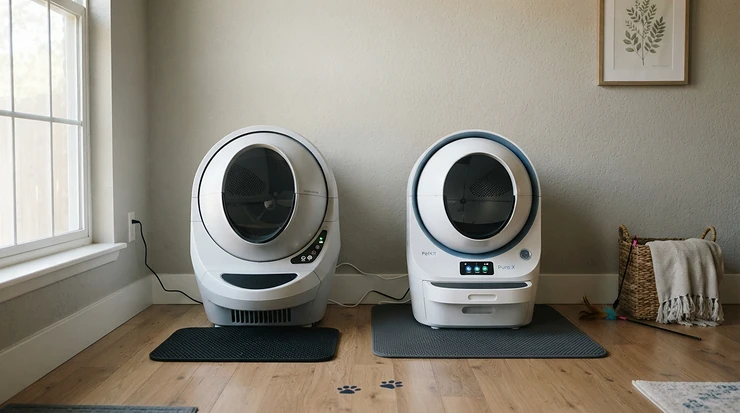
Somewhere around scoop number four thousand, most cat owners start Googling their way out of the problem. That’s usually how the litter robot vs petkit search begins — not out of curiosity, but out of sheer scooping fatigue. Both brands promise the same basic miracle: a box that cleans itself so you don’t have to touch, smell, or even think about cat waste more than once a week. But “self-cleaning” covers a surprisingly wide range of engineering, price points, and daily realities, and the two biggest names in the category solve the problem in genuinely different ways.
Litter-Robot, made by the Whisker, built its reputation on a spinning globe that sifts litter through gravity and a sieve. PetKit took a different route with a rotating cylinder, AI cameras, and an app ecosystem borrowed from its smart-feeder lineup. Neither approach is objectively “better” in a vacuum — it depends on how many cats you have, how much space you can spare, and whether you want your litter box quietly doing its job or actively reporting on your cat’s bathroom habits like a tiny, slightly nosy vet tech.
This guide breaks down seven real, currently sold automatic litter boxes — including both flagships plus a few worthy alternatives — with actual specs, price ranges, and honestly-sourced review sentiment instead of recycled marketing copy. By the end, you’ll know exactly which box fits your household, your budget, and your cat’s particular brand of pickiness.
What Is an Automatic Litter Box?
An automatic litter box is a self-cleaning device that detects when a cat leaves after using it, then sifts, separates, and stores the waste in a sealed compartment — no scooping required. Litter-Robot and PetKit are the two dominant brands, using rotating-globe and rotating-cylinder mechanisms respectively.
Before diving into all seven products, here’s the fast version for anyone comparing the two headline brands directly.
| Feature | Litter-Robot 4 | PetKit Purobot Max Pro 2 | Best For |
|---|---|---|---|
| Mechanism | Rotating globe + sifting screen | Rotating sealed cylinder | Households with 2+ cats |
| Litter compatibility | Any clumping litter | Clumping clay, tofu, mixed | Owners who don’t want to switch litter |
| Standout tech | Widest opening, WasteID on Pro models | AI camera, facial recognition | Health-conscious multi-cat homes |
| Price range | Around $650–$750 | Around $550–$650 | Mid-to-premium budgets |
| App maturity | Mature, widely reviewed | Newer, improving fast | Whisker for track record |
Based on the spec comparison alone, Litter-Robot 4 wins on litter flexibility and long-term ecosystem maturity, while PetKit Purobot Max Pro 2 edges ahead on camera-based health monitoring for a somewhat lower price. Neither is a universal “winner” — the right call depends on whether you value proven reliability or the newest health-tracking tech, a tension that shows up again and again once you look at all seven contenders below.
Ready to stop scooping for good? Keep reading — your perfect match might be #3 on this list.
Top 7 Self-Cleaning Litter Boxes: Expert Analysis
Every entry below is a real, currently available product. Prices are shown as ranges because Amazon and retailer pricing shifts constantly — always check current pricing before buying.
1. Litter-Robot 4 — best all-rounder for multi-cat households
Whisker’s flagship earns its reputation the boring way: it just works, over and over, for years. The dome-shaped globe rotates after each visit, sifting waste through a screen into a fully sealed drawer below, and the whole cycle is quiet enough to run while you sleep.
At 29 inches tall with a genuinely wide entrance, the Litter-Robot 4 comfortably fits large breeds and multi-cat rotations without anyone feeling cramped. It runs on any standard clumping litter — clay, tofu, or crystal — which matters more than it sounds like, because you’re not locked into buying a proprietary blend every month like you are with some rivals.
Based on the spec comparison, this is the pick for households that want an established, well-supported system rather than the newest gadget on the block. The sealed drawer needs emptying roughly once a week for two cats, which reviewers consistently describe as the single best quality-of-life upgrade over scooping by hand.
Aggregated review sentiment across major retailers skews strongly positive, with recurring praise for the tie-and-toss waste drawer and consistent criticism aimed at its footprint — it’s simply a big appliance, and finding floor space for it in a small apartment takes planning.
Pros:
- ✅ Works with almost any standard clumping litter, no proprietary refills
- ✅ Sealed waste drawer needs emptying only about once a week
- ✅ Wide, open entrance comfortably fits large or senior cats
Cons:
- ❌ Bulky 29-inch-tall footprint is tough in small apartments
- ❌ Premium price sits near the top of the category
In the $650–$750 range, the Litter-Robot 4 isn’t cheap, but for two-plus cats it’s one of the more defensible premium buys in this whole roundup — you’re paying for maturity, not novelty.
2. Litter-Robot 5 Pro — most advanced health monitoring
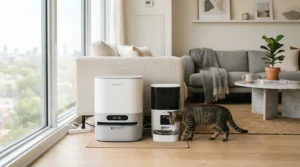
If the Litter-Robot 4 is the reliable family sedan, the Litter-Robot 5 Pro is the version with a built-in dashboard camera and a health-tracking obsession. It adds dual onboard cameras and WasteID, a system designed to distinguish urine clumps from solid waste for each individual cat.
That distinction matters more than a spec sheet lets on. Reviewers who tested it against rival smart boxes note that per-cat waste identification is genuinely useful in a multi-cat home, where figuring out which cat has a UTI or diarrhea usually means detective work with a flashlight. Here, the sensors and cameras do that guessing for you and log it in the app.
What most buyers overlook is the subscription layer sitting behind the hardware: full historical trends and extended notifications require a paid Whisker+ membership, while the base unit only surfaces about a week of visit history. That’s a meaningful asterisk on an otherwise best-in-class health-tracking pitch.
Aggregated sentiment praises the drawer capacity and quiet cycling inherited from the LR4 platform, while some owners flag occasional false alerts from the sensor suite — a minor but recurring theme in independent testing.
Pros:
- ✅ WasteID and dual camera separate urine from feces automatically
- ✅ Tracks each cat individually in multi-cat households
- ✅ Backed by Whisker’s mature app and 90-day in-home trial
Cons:
- ❌ Most expensive option in this entire roundup
- ❌ Full data history requires a paid Whisker+ subscription
At around $850–$950, the Litter-Robot 5 Pro is squarely for owners who see health monitoring as the whole point of automating litter duty, not a bonus feature.
3. PetKit Purobot Max Pro 2 — best AI camera rival at a lower price
PetKit’s answer to the Litter-Robot 5 Pro swaps the globe mechanism for a sealed rotating cylinder and adds something Whisker’s lineup only recently matched: a 210-degree wide-angle AI camera with facial recognition, built to identify which specific cat just used the box.
That facial-recognition layer is the standout feature here, and it’s not just marketing fluff — the camera pairs with weight sensors to build individual health profiles per cat, flagging changes in frequency or duration that can signal early urinary issues. One reviewer with feline-medicine experience noted this kind of early visual context can matter in exactly the situations where owners would otherwise miss subtle warning signs.
The spec sheet won’t tell you this, but user reports suggest the triple-layer odor system (a combination of an N60 cartridge and an N50 2.0 deodorizing add-on) genuinely holds up well in the 8-liter waste bin, which PetKit rates for roughly 17 days between changes for a single cat.
Because this is a newer entrant compared to Whisker’s decade-plus track record, its review base is thinner, and it’s worth being upfront that an in-home camera — even one aimed at a litter box — simply isn’t for every household’s comfort level.
Pros:
- ✅ AI camera with facial recognition tracks each cat separately
- ✅ 210° wide-angle night vision aids early health-issue detection
- ✅ Triple odor system keeps an 8-liter bin fresh for weeks
Cons:
- ❌ Smaller long-term review history than established Whisker models
- ❌ In-home camera won’t suit privacy-conscious households
Priced around $550–$650, the PetKit Purobot Max Pro 2 undercuts the Litter-Robot 5 Pro while matching much of its health-tracking ambition — a genuinely strong value angle if the camera doesn’t bother you.
4. PetKit PuraMax 2 — best value for budget-conscious owners
Strip away the camera and the AI branding, and you get the PetKit PuraMax 2 — the practical, automation-first sibling that just wants to clean the box and get out of the way. It uses the same sealed-cylinder rotation as its pricier stablemate, wrapped in a “ShieldBase” design meant to stop leaks at the seams.
Here’s what most buyers overlook: the 7-liter waste bin is rated for up to 15 days of single-cat use, which is a real convenience upgrade even without any of the flashier tech. Three selectable cleaning modes — automatic, scheduled, and manual — give you more granular control than a lot of boxes at this price actually offer.
Based on the spec comparison against its own sibling, the calculus is simple: pay more for facial recognition and camera-based tracking, or save meaningfully and get the same core mechanism without it. For a one- or two-cat household that just wants scooping gone, that trade often favors the cheaper box.
User reports flag one legitimate quirk worth knowing before setup — the sensor suite can misfire if the unit sits directly on carpet or a thick mat, so a hard-floor placement (or a thin mat) is the safer bet.
Pros:
- ✅ Sealed cylinder design resists leaks and odor escape
- ✅ 7-liter bin holds up to 15 days of waste for one cat
- ✅ Three cleaning modes give flexible scheduling control
Cons:
- ❌ No camera or facial-recognition health tracking
- ❌ Sensors can misfire if placed on carpet or thick mats
Typically priced in the $350–$500 range depending on promotions, the PetKit PuraMax 2 is arguably the single best value pick in this entire lineup.
5. Casa Leo Leo’s Loo Too — quietest cycle in its class
Casa Leo built its whole pitch around a specific complaint: automatic litter boxes that sound like a garbage disposal at 2 a.m. The Casa Leo Leo’s Loo Too cycles at roughly 30 decibels, quiet enough that most owners genuinely don’t notice it running from another room.
The 9.5-liter sealed waste drawer is one of the larger capacities in this comparison, and it pairs bamboo carbon filters with an EPA-certified UV-C light that treats the drawer after every visit — a slightly different odor-control philosophy than the crystal-litter or cartridge-based approaches used elsewhere on this list. It also supports a genuinely wide weight range, from roughly 1 to 20 pounds, which covers most kittens through large adult cats.
What the spec sheet won’t tell you is how that UV-C system plays out day to day: reviewers consistently credit it with noticeably reduced odor between drawer changes, often citing weekly liner swaps as sufficient even in busier households.
Its Alexa and Google Assistant integration is a nice touch for smart-home owners, though its overall app ecosystem is younger and less feature-dense than Whisker’s, and a handful of owners with long-haired or extra-large cats have noted the drum interior feels a bit snug.
Pros:
- ✅ One of the quietest cycles on the market at 30 dB
- ✅ EPA-certified UV-C light sanitizes the drawer after every visit
- ✅ Works with Alexa and Google Assistant for voice control
Cons:
- ❌ Some large or long-haired cats find the interior snug
- ❌ App ecosystem is less mature than Whisker’s
Sitting around $450–$550, the Casa Leo Leo’s Loo Too is the pick for noise-sensitive households, particularly anyone whose litter box shares a wall with a bedroom.

6. PetSafe ScoopFree Crystal Pro — most affordable true hands-off system
Not every household needs a robot with an app and a camera — sometimes the goal is simply to never touch waste again without spending $600 to do it. The PetSafe ScoopFree Crystal Pro takes the lowest-tech, lowest-cost route in this roundup: disposable crystal litter trays instead of a rotating mechanism.
The crystal litter itself is doing the heavy lifting here. It absorbs urine and dehydrates solid waste, and PetSafe’s own testing claims roughly five times better odor control than traditional clumping clay, while staying about 99% dust-free so it doesn’t track across your floors the way clay litter often does.
Based on the spec comparison against the rotating-mechanism boxes above, the trade-off is straightforward: you’re swapping mechanical complexity (and the repair costs that can come with it) for a recurring consumable cost — disposable trays that need replacing roughly every 20 to 30 days rather than a reusable drawer you empty yourself.
Aggregated sentiment is generally favorable on odor control and simplicity, with the most common complaint being the ongoing cost of proprietary trays, and the fact that the base model skips app connectivity and weight tracking entirely (that requires stepping up to PetSafe’s Smart-connected version).
Pros:
- ✅ Disposable crystal trays go up to 30 days with zero scooping
- ✅ Low-tracking crystals are 99% dust-free
- ✅ Lowest upfront price of any box in this roundup
Cons:
- ❌ Proprietary disposable trays add ongoing recurring cost
- ❌ Base model lacks app connectivity and weight tracking
At around $200–$260, the PetSafe ScoopFree Crystal Pro is the entry point for anyone testing whether automation is worth it before committing to a premium robot.
7. PetSnowy SNOW+ — best lesser-known alternative with fully-enclosed safety
Rounding out the list is a brand that doesn’t get nearly the search volume of Whisker or PetKit but deserves a spot on any serious shortlist. The PetSnowy SNOW+ uses a single-piece rotating drum rather than a globe or a sifting screen, a design choice the company frames as a safety advantage since there are fewer moving seams for a curious paw to get caught in.
Its TiO2 photocatalyst system, paired with UV sanitizing, is one of the more unusual odor-control approaches here — it’s designed to break down odor molecules rather than simply mask or absorb them. Independent testers have noted genuinely strong odor performance, alongside a 10-liter auto-sealing waste drawer that keeps things contained.
Here’s what most buyers overlook: the PetSnowy SNOW+ ships close to fully assembled, which is rare in a category where 20 to 30 minutes of setup is the norm. Its magnetic-assembly construction also means deep cleaning doesn’t require tools, just detaching a few panels by hand.
Reviewers are honest that this isn’t a budget product, and some report intermittent sensor glitches along with the cost of proprietary bags and deodorizer cartridges over time — real trade-offs for a design that otherwise punches above its brand recognition.
Pros:
- ✅ Single-piece rotating drum design adds a safety layer
- ✅ Ships nearly fully assembled, unlike most rivals
- ✅ Magnetic parts allow tool-free deep cleaning
Cons:
- ❌ Proprietary bags and cartridges cost more over time
- ❌ Some owners report intermittent sensor glitches
Typically priced around $500–$600, the PetSnowy SNOW+ is worth cross-shopping against the Litter-Robot 4 for anyone open to a less famous name at a similar price tier.
Full Spec Comparison: Litter Robot vs PetKit vs Casa Leo
| Product | Mechanism | Waste Capacity | Price Range | Best For |
|---|---|---|---|---|
| Litter-Robot 4 | Rotating globe | Sealed drawer, ~1 week | $650–$750 | Multi-cat, litter flexibility |
| Litter-Robot 5 Pro | Rotating globe + WasteID | Sealed drawer, ~1 week | $850–$950 | Health-tracking obsessives |
| PetKit Purobot Max Pro 2 | Rotating cylinder | 8L bin, ~17 days | $550–$650 | AI camera health monitoring |
| PetKit PuraMax 2 | Rotating cylinder | 7L bin, ~15 days | $350–$500 | Budget-conscious automation |
| Casa Leo Leo’s Loo Too | Rotating drum | 9.5L drawer | $450–$550 | Quiet homes, apartments |
| PetSafe ScoopFree Crystal Pro | Disposable trays | Tray, ~30 days | $200–$260 | Lowest upfront cost |
| PetSnowy SNOW+ | One-piece drum | 10L drawer | $500–$600 | Safety-focused alternative |
Looking at the table above, the Litter-Robot 4 and PetKit Purobot Max Pro 2 sit almost dead-center on price but solve the problem differently — litter flexibility versus AI-driven health data. Budget shoppers should note that the PetKit PuraMax 2 delivers most of the core automation at nearly half the cost of the premium options, while the PetSafe ScoopFree Crystal Pro remains the only true sub-$300 entry point into hands-off litter care.
Practical Usage Guide: Setup, Training & the First 30 Days
Getting an automatic litter box up and running smoothly is less about the manual and more about managing the transition period, since that’s when most returns and frustrated one-star reviews happen.
Start by placing the unit on a hard, level surface — carpet and thick mats can throw off weight sensors on cylinder-style boxes like the PetKit PuraMax 2, and an uneven floor can cause globe-style units like the Litter-Robot 4 to cycle unevenly. Fill litter only to the marked line; overfilling is the single most common cause of jammed cycles in the first week.
For the first few days, leave your cat’s old litter box sitting nearby rather than removing it immediately. Most cats investigate the new robot cautiously, and a sudden full swap can trigger litter box avoidance — a behavior problem the Cornell Feline Health Center notes is one of the most common issues cat owners report. Running the box in manual or semi-automatic mode initially, rather than full auto-cycle, tends to build trust faster for skittish cats.
Common first-30-day mistakes include placing the unit somewhere too noisy or high-traffic, skipping the calibration step on models like Casa Leo’s that require a weight reset, and forgetting to register the warranty before the return window closes. Once the routine settles, a weekly wipe-down and monthly deep clean is typically all any of these seven boxes need going forward.
Real-World Scenarios: Which Box Fits Your Household
Specs only tell half the story — matching a box to your actual living situation is where the decision usually gets made.
If you’re a college student in a 500-square-foot studio with one cat, the compact footprint and lower price of the PetKit PuraMax 2 or the PetSafe ScoopFree Crystal Pro make more sense than committing floor space and budget to something built for a four-cat household.
If you’re managing three cats in a family home and one has a history of urinary issues, the individual health tracking on the Litter-Robot 5 Pro or PetKit Purobot Max Pro 2 stops being a luxury and starts being genuinely useful — catching subtle changes in frequency or duration before they become an emergency vet visit.
If you’re a light sleeper with the litter box tucked in a bedroom-adjacent closet, the 30-decibel cycle on the Casa Leo Leo’s Loo Too solves a problem that louder rivals simply can’t. And if you’re testing whether automation is even worth it before spending big, starting with the PetSafe ScoopFree Crystal Pro lets you find out for under $260 rather than risking $700 on a robot you might return.
How to Choose Between Litter Robot and PetKit
Narrowing seven options down to one gets easier with a clear framework. Here’s how to work through the decision:
- Count your cats first. One or two cats can usually run comfortably on a smaller-capacity box; three or more strongly favors larger drawers like the Litter-Robot line or Casa Leo’s 9.5-liter option.
- Decide if litter flexibility matters. If you’re loyal to a specific litter brand, prioritize boxes that accept any clumping litter over ones requiring proprietary formulas.
- Weigh camera-based monitoring against privacy comfort. AI health tracking is genuinely useful, but an in-home camera isn’t the right trade-off for every household.
- Set a real budget ceiling, not an aspirational one. The gap between the cheapest and most expensive box here is over $700 — decide what tier you’re actually shopping in before falling for feature creep.
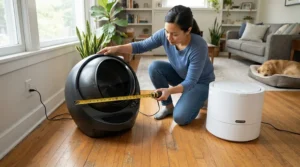
- Check your floor space and flooring type. Measure before buying; several of these units are nearly 30 inches tall and need a hard, level surface to function properly.
- Factor in recurring costs, not just sticker price. Disposable-tray systems and proprietary bag/cartridge boxes carry ongoing costs that reusable-drawer systems don’t.
- Read the warranty and trial period fine print. Whisker’s 90-day in-home trial, for example, is a meaningfully longer safety net than some competitors offer.
Litter Robot vs PetKit vs Casa Leo: The Robot Litter Showdown
Put head-to-head, these three brands represent three distinct philosophies rather than three versions of the same product.
Litter-Robot wins on sheer track record. It’s been refined across multiple generations, its app is the most feature-complete in the category, and its 90-day in-home trial removes most of the risk of buying sight-unseen. What most buyers overlook is that this maturity comes at a real price premium — you’re paying for a decade of iteration, not just the hardware in front of you.
PetKit wins on innovation-per-dollar. The camera-and-facial-recognition approach on the Purobot Max Pro 2 delivers health insights that used to be exclusive to Whisker’s most expensive tier, at a noticeably lower price point. The trade-off is a shorter public track record and, for some households, discomfort with an always-on camera near the litter box.
Casa Leo wins on noise and simplicity. It doesn’t try to out-spec either rival on AI features — it focuses on being the quietest, most straightforward option with strong UV-based odor control, which makes it the practical pick for apartment dwellers and noise-sensitive homes rather than data-obsessed cat parents.
Reviewers who’ve directly compared Whisker and PetSnowy models note that the price gap between top-tier Whisker and its closest rivals is narrower than it used to be, with independent testing showing the cheaper alternative closing the performance gap in areas like odor control and app usability, even if brand trust still tilts toward the more established name.
Automatic Box Features That Actually Matter (And Those That Don’t)
Marketing copy loves to list features, but not every spec moves the needle on daily life with the box.
Actually matters: sealed waste compartments (the difference between smelling nothing and smelling everything), wide entrances for large or senior cats, litter compatibility, and genuine safety sensors that pause a cycle the instant a cat approaches. These directly affect whether the box gets used consistently and whether it’s safe around curious pets or kids.
Doesn’t matter nearly as much as it’s marketed: app notification frequency beyond the basics, most “smart scent” or fragrance-release features (several reviewers note these can actually bother scent-sensitive cats), and marginal decibel differences below about 45 dB that most humans won’t consciously register anyway. Facial recognition and AI cameras sit in a genuine middle ground — valuable for multi-cat health monitoring, unnecessary if you have one cat and no history of urinary issues.
Common Mistakes When Buying an Automatic Litter Box
The most expensive mistake is buying based on price alone in either direction — the cheapest disposable-tray system will cost more over three years in consumables than buyers expect, while the priciest AI-camera box may deliver features a single-cat household never uses.
A second common mistake is skipping measurements. Several of these units, including the Litter-Robot 4 and PetSnowy SNOW+, are large appliances at nearly 30 inches tall, and “it looked smaller in the photos” is a frequent return reason across retailer reviews.
A third mistake is ignoring cat weight limits and mobility. Senior or arthritic cats can struggle with high-sided entrances regardless of brand, something worth checking against a vet’s guidance rather than assuming any automatic box works for every cat. And a fourth, more subtle mistake is under-provisioning boxes in multi-cat homes — veterinary guidance from the American Animal Hospital Association and American Association of Feline Practitioners generally recommends providing one litter box per cat, plus one extra, a rule that still applies even when the box is a self-cleaning robot.
Skip the scoop, not the research — compare specs one more time before you check out.
Price Comparison: What You’re Really Paying For
| Price Tier | Products | What You Get |
|---|---|---|
| Under $300 | PetSafe ScoopFree Crystal Pro | Zero scooping, no app, recurring tray cost |
| $350–$550 | PetKit PuraMax 2, Casa Leo Leo’s Loo Too | Reusable drawer, app basics, quiet operation |
| $550–$750 | Litter-Robot 4, PetKit Purobot Max Pro 2, PetSnowy SNOW+ | Mature ecosystem or AI camera monitoring |
| $850+ | Litter-Robot 5 Pro | Dual camera, per-cat waste identification |
The jump from the sub-$300 tier to the mid-range tier buys you a reusable waste drawer instead of ongoing disposable trays, which tends to pay for itself within roughly a year for most single-cat households. The jump from mid-range to premium buys ecosystem maturity or AI health data — genuinely useful, but arguably optional for anyone without a specific health-tracking need.
Long-Term Cost & Maintenance: True Cost of Ownership
Sticker price only tells part of the story. A disposable-tray system like the PetSafe ScoopFree Crystal Pro costs less upfront but requires recurring tray purchases roughly every 20 to 30 days, which can add up to a meaningful annual cost depending on how many cats are sharing the unit.
Reusable-drawer systems — the Litter-Robot line, both PetKit models, Casa Leo, and PetSnowy — trade a higher upfront price for lower ongoing costs, since you’re only buying standard clumping litter plus occasional liner bags and carbon filters or odor cartridges. Over a three-year ownership window, that gap tends to narrow the total cost between the cheapest and most expensive boxes on this list more than the initial price tags suggest.
Maintenance-wise, expect a weekly wipe-down across every model here, a full deep clean every one to three months, and periodic replacement of consumable parts like carbon filters, sensors, or motors as units age — accessory pages for both Whisker and Casa Leo publicly list replacement parts, which is itself a decent signal of how repairable a given system is likely to be down the road.
Safety, Regulations & Health Considerations
Automatic litter boxes are electrical appliances with moving parts around a pet, so safety sensors aren’t a nice-to-have — they’re the entire point. Every product in this roundup includes some form of weight, motion, or infrared sensing designed to pause the cleaning cycle the instant a cat enters the unit, and it’s worth testing that sensor personally during setup rather than assuming it works as advertised.
There’s also a human health angle worth taking seriously, particularly for pregnant individuals or anyone immunocompromised. The Centers for Disease Control and Prevention notes that cat feces can carry the parasite responsible for toxoplasmosis, and recommends that pregnant women avoid changing litter when possible, or wear gloves and wash hands thoroughly if no one else can do it. Since most automatic litter boxes still require periodic manual drawer or tray changes, that guidance applies here too — automation reduces exposure frequency, but it doesn’t eliminate it entirely.
For multi-cat homes, it’s also worth remembering that a single robot, however advanced, doesn’t automatically satisfy every cat’s territorial needs — feline behavior guidance still generally favors multiple accessible litter locations over consolidating everything into one high-tech box.
Frequently Asked Questions
❓ Is Litter-Robot or PetKit better for multiple cats?
❓ How often do you have to empty a self-cleaning litter box?
❓ Can automatic litter boxes use regular clumping litter?
❓ Are automatic litter boxes safe for kittens?
❓ Is PetKit as reliable as Litter-Robot long-term?
Conclusion
There’s no single correct answer to litter robot vs petkit — there’s only the answer that fits your household. If you want the most proven, litter-flexible option and don’t mind the premium, the Litter-Robot 4 remains a genuinely solid pick for most multi-cat homes. If you want AI-driven health insights without paying Whisker’s top-tier price, the PetKit Purobot Max Pro 2 is the more interesting value story in 2026. And if your budget or apartment size says otherwise, the PetKit PuraMax 2 and PetSafe ScoopFree Crystal Pro prove you don’t need to spend $700 to stop scooping altogether.
Whichever direction you go, the underlying math stays the same: every one of these boxes trades an upfront cost for years of a chore you’ll genuinely never miss. Measure your space, count your cats, decide how much health data actually matters to your situation, and pick accordingly — your nose (and your Saturday mornings) will thank you either way.
Recommended for You
- Cat Door for Large Cats: 7 Best Big Cat Flaps (2026)
- Interior Cat Door: 7 Best Picks for Litter Box Privacy 2026
- Window Cat Door 2026: 7 Top Picks Tested by Real Owners
Disclaimer: This article contains affiliate links. As an Amazon Associate, I earn from qualifying purchases. If you purchase products through these links, we may earn a small commission at no additional cost to you.
✨ Found this helpful? Share it with your friends! 💬🤗
