
Table of Contents
Somewhere between the junk drawer and the shelf of half-used candles, most of us are still feeding our cats out of a scratched-up plastic dish we grabbed on a Target run three years ago. It works, technically. But if you’ve noticed little black specks on your cat’s chin, or watched them paw food onto the floor instead of eating straight from the bowl, the dish itself might be the culprit. That’s usually the moment people start Googling ceramic vs stainless steel cat bowl comparisons at 11 p.m., half-convinced they’ve been unknowingly sabotaging their cat’s skin for years.
Here’s the good news: you probably have. But it’s an easy fix.
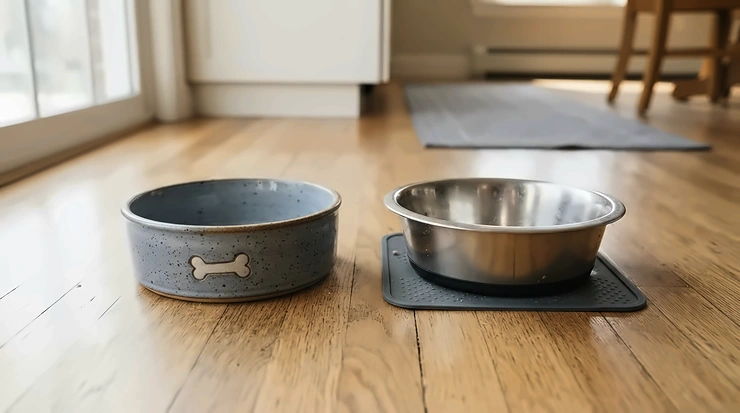
Both ceramic and stainless steel solve the core problem — a non-porous, easy-to-sanitize surface that doesn’t trap bacteria the way plastic does — but they solve it differently, and the “right” pick depends on your cat’s habits, your dishwasher routine, and whether you own a cat who treats every bowl as a hockey puck. This guide walks through seven real, current bowls spanning both materials, breaks down what actually separates them on safety, hygiene, and durability, and gives you a framework for picking the one that fits your household instead of just the one with the prettiest product photo.
Quick Comparison: Ceramic vs Stainless Steel Cat Bowl
| Factor | Ceramic | Stainless Steel |
|---|---|---|
| Weight & tip resistance | Heavy, hard for cats to flip | Lighter, can slide unless weighted or rubber-footed |
| Hygiene | Non-porous when glazed correctly; chips can trap bacteria | Non-porous, dishwasher-friendly, resists bacterial colonization |
| Durability | Can chip or shatter if dropped | Dents but rarely breaks; can last a decade |
| Price range | Budget to premium | Generally budget to mid-range |
| Best for | Single-cat homes, design-conscious owners | Multi-cat households, heavy dishwasher use |
At a glance, ceramic wins on stability and aesthetics, while stainless steel wins on shrug-it-off durability and consistent hygiene. Neither material is inherently “unsafe” the way plastic can be, but the fine print — glaze quality on ceramic, gauge and grade on steel — is where the real safety gap opens up. We’ll get into exactly what to check for on both sides in the sections below.
Found this comparison useful already? Bookmark this page — you’ll want to reference the table above when you’re actually shopping.
What Is the Best Material for a Cat Bowl?
The best material for a cat bowl is one that’s non-porous, chip- and scratch-resistant, and heavy or grippy enough to stay put during meals — which in practice narrows the field to high-fired ceramic and food-grade (304-grade) stainless steel. Both outperform plastic on hygiene and are considered safe for daily feeding when properly manufactured.
That “properly manufactured” clause matters more than most product listings let on. According to the FDA’s guidance on lead-glazed pottery, ceramic glazes can legally contain trace lead or cadmium as long as leaching stays under regulatory action levels — meaning “ceramic” alone doesn’t guarantee safety the way a lot of marketing copy implies. On the steel side, not all “stainless steel” is created equal either; food-contact grade 304 stainless resists corrosion and bacterial adhesion in a way that cheaper 200-series blends don’t always match. What most buyers overlook is that the safest choice isn’t really “ceramic or steel” — it’s “properly certified ceramic or properly graded steel,” and the products further down this list were chosen specifically because they document which side of that line they sit on.
Top 7 Ceramic and Stainless Steel Cat Bowls: Expert Analysis
We looked at real, currently available bowls across both materials and price tiers — budget, mid-range, and premium — to build a shortlist that actually reflects what’s worth buying in 2026, not just what’s heavily advertised.
1. Necoichi Raised Cat Food Bowl — budget ceramic pick with whisker relief built in
The Necoichi Raised Cat Food Bowl is a porcelain dish that pairs a shallow, whisker-friendly profile with a raised stand, and it’s become something of a cult favorite among cat owners chasing an affordable ceramic upgrade. At roughly 4.3 inches across and elevated a couple of inches off the floor, its footprint is compact enough for even the smallest kitchen corner.
The porcelain itself is manufactured lead- and cadmium-free and meets US, EU, and Japanese safety standards, which is a meaningfully higher bar than the vague “food safe” label you’ll see slapped on cheaper imports. Because it’s raised, cats with flat faces or arthritic necks get real relief compared to floor-level bowls — this is the kind of product that earns its price premium through design, not just marketing copy. It’s a strong fit for single-cat apartments, senior cats, or anyone testing whether an elevated ceramic setup helps with vomiting after meals, a common complaint with deep, floor-level dishes.
Aggregated customer feedback on major retail sites is largely positive on comfort and design, with owners frequently mentioning cats preferring it over their old bowl once they adjust. A recurring theme in reviews, though, is that the porcelain can crack under thermal shock — several owners reported hairline cracks or breakage after repeated dishwasher cycles, so hand-washing or a gentler dishwasher cycle is worth considering for longevity.
Pros:
- ✅ Lead- and cadmium-free porcelain meeting multiple safety standards
- ✅ Raised, whisker-friendly design reduces neck strain
- ✅ Compact footprint fits small kitchens and single-cat homes
Cons:
- ❌ Some owners report cracking after repeated dishwasher cycles
- ❌ Smaller capacity than many stainless steel alternatives
Expect to pay in the $15-$20 range at the time of research, prices may vary — for a ceramic bowl built around a genuine ergonomic idea rather than just a cute glaze pattern, that’s solid value.

2. Van Ness Lightweight Stainless Steel Dish — lightest steel option for effortless cleanup
The Van Ness Lightweight Stainless Steel Dish is about as no-frills as stainless steel gets: a wide, shallow, 64-ounce basin with no bells, no elevated stand, and no silicone base — just a durable metal bowl that’s been a pet-aisle staple for years.
Its stainless construction means it resists rust and corrosion far better than the coated metal bowls sometimes sold at similar price points, and the wide, shallow shape naturally reduces whisker contact even without a “whisker fatigue” label attached to the marketing. On paper this means less overhead — no plastic base to replace, no glaze to inspect for cracks — which is exactly why it’s such a common choice for multi-bowl households or anyone who just wants a reliable water station that survives a spill down the basement stairs.
Because it lacks the weighted base or rubber footing found on premium steel bowls, though, it’s genuinely a poor match for cats who like to bat their dish across the kitchen floor. Reviewers commonly note that it works best set inside a mat or non-slip tray rather than placed directly on hardwood or tile.
Pros:
- ✅ True stainless steel resists rust better than coated alternatives
- ✅ Wide, shallow profile naturally limits whisker contact
- ✅ Dishwasher-safe and essentially maintenance-free
Cons:
- ❌ Lightweight build slides easily without a mat underneath
- ❌ No elevated or tilted option for cats needing neck relief
At under $10 in most listings — check current price, as availability shifts — this is the bowl to buy in bulk if you’re setting up a multi-cat feeding station on a real budget.
3. Y YHY Tilted Ceramic Cat Bowl — best tilted angle for flat-faced breeds
The Y YHY Tilted Ceramic Cat Bowl takes the raised-bowl concept a step further by adding a deliberate tilt, angling food toward the front lip so cats don’t have to dig into a flat base to reach the last bites.
That tilt is the whole pitch here, and it’s a genuinely useful one for flat-faced breeds like Persians and Exotic Shorthairs, whose short muzzles make flat, deep bowls awkward to eat from. Based on the design logic, the combination of elevation and tilt reduces the amount of neck-craning and whisker-splaying a cat does per meal, which is the mechanism behind most vet-recommended “anti-vomiting” bowl designs — it’s not magic, it’s geometry. Ceramic also means this bowl sits solidly in place, which matters more with a tilted design since an unbalanced tilted bowl on a slippery floor is a recipe for spilled kibble.
Because it’s a niche design rather than a mass-market staple, verified aggregated review data is thinner than for the more established brands on this list — what’s confirmed is the ceramic composition and dishwasher/microwave compatibility, and buyers should independently verify current lead/cadmium certification claims on the specific listing before purchase, since third-party ceramic sourcing varies more than with established porcelain brands.
Pros:
- ✅ Tilt angle specifically helps flat-faced and senior cats
- ✅ Ceramic weight keeps it stable during eating
- ✅ Dishwasher and microwave compatible per manufacturer
Cons:
- ❌ Less established review history than major competitors
- ❌ Single bowl only — no matching water bowl included
Priced in the $12-$18 range at most retailers, it’s a reasonable bet if your cat’s flat face is the actual problem you’re solving for.
4. PetFusion Premium 304 Stainless Steel Bowl — mid-range steel with documented material testing
The PetFusion Premium 304 Stainless Steel Bowl is a shallow, brushed-finish dish built specifically to relieve whisker fatigue, and it’s one of the few bowls on this list where the manufacturer publishes actual material-sourcing reasoning rather than just a marketing bullet point.
It’s made from 304 food-grade stainless steel — the same grade referenced in FDA food-contact guidance — chosen, according to the brand, after evaluating corrosion resistance, impact strength, and weight rather than picking the cheapest metal that would pass. What most buyers overlook about the “brushed finish” detail is that it’s not purely cosmetic: a brushed surface hides minor food and water residue between washes better than a mirror-polished one, which matters if you’re not washing bowls after every single meal. The shallow, 13-to-24-ounce sizing options are also designed to slot directly into PetFusion’s elevated feeders, so it doubles as a replacement part if you already own one.
Reviewers and buyers consistently point to the finish quality and the fact that it’s tested for cobalt contamination — a lesser-known risk in recycled stainless steel — as reasons they trust the brand over unbranded imports. A commonly cited downside is that the lighter-gauge steel used in the smaller sizes can dent with rough handling over years of use, though this is cosmetic rather than a hygiene concern.
Pros:
- ✅ 304 food-grade steel with documented material testing
- ✅ Shallow design specifically built for whisker relief
- ✅ Compatible with PetFusion elevated feeder systems
Cons:
- ❌ Smaller sizes can dent with heavy daily use
- ❌ Priced above generic unbranded steel bowls
At around $15-$25 depending on size, it sits comfortably in the mid-range and earns that price through documented material choices most competitors don’t publish.
5. Necoichi Extra Wide Elevated Ceramic Cat Food Bowl — widest ceramic surface for messy multi-cat homes
The Necoichi Extra Wide Elevated Ceramic Cat Food Bowl scales up the brand’s original raised design into a roughly 2-cup capacity dish with a noticeably wider eating surface, aimed at bigger cats, multi-cat households, and anyone tired of refilling a tiny bowl twice a day.
Like its smaller sibling, it’s built from high-fired porcelain that’s manufactured lead- and cadmium-free, and the decorative patterns are baked-on decals fired at roughly 1,500°F rather than printed coatings that can wear off and expose raw ceramic underneath — a detail that matters because a worn decal is exactly the kind of surface imperfection that can start harboring bacteria over time. The wider bowl also includes a removable, non-slip silicone ring, which does double duty: it stabilizes the bowl on hard floors and makes the whole assembly easier to disassemble for a genuinely thorough cleaning, not just a quick rinse.
Here’s what the spec sheet won’t tell you, but real owners report: several buyers specifically chose this size after switching an elderly or ill cat from a floor-level bowl and noticed improved appetite, likely because less physical effort is required to reach food at a comfortable height. On the flip side, a few reviewers noted the wide, shallow shape doesn’t hold a full cup of liquid without risking spills, so it works better as a food bowl than a primary water source.
Pros:
- ✅ Wide surface comfortably fits larger cats and multi-cat use
- ✅ Baked-on decals resist wear better than printed coatings
- ✅ Removable silicone ring improves stability and cleaning
Cons:
- ❌ Not ideal as a full-capacity water bowl
- ❌ Heavier and bulkier than the standard-size model
Expect a price in the $20-$28 range, positioning it as a mid-to-upper ceramic option that earns its premium through genuine manufacturing detail rather than just size.
6. Bergan Stainless Steel Standard Bowl (17-Cup) — largest capacity for multi-cat feeding stations
The Bergan Stainless Steel Standard Bowl is a straightforward, large-capacity 136-ounce stainless dish built for households that need to feed several cats — or one very large one — without constant refilling.
Its wide opening and wide base are the whole design philosophy here: no elevation, no tilt, no whisker-relief marketing, just a big, stable stainless bowl that’s genuinely difficult to tip over given its footprint. Based on the spec comparison with smaller bowls on this list, the trade-off is obvious — you’re getting raw capacity and stability rather than ergonomic extras, which makes sense for a bowl explicitly designed to double as a dog bowl too. Stainless steel’s non-porous surface means bacteria has nowhere to colonize the way it can in scratched plastic, so even at this size, hygiene doesn’t degrade the way it would with a giant plastic tub.
Because it’s marketed across both dog and cat categories, dedicated cat-specific review data is limited, but the aggregated feedback that does exist consistently praises the accurate capacity measurements (a surprisingly common complaint with pet bowls generally understates true volume) and the fact that it’s genuinely dishwasher-safe without warping.
Pros:
- ✅ Large 17-cup capacity ideal for multi-cat households
- ✅ Wide, stable base resists tipping despite the size
- ✅ Rust-resistant stainless steel with accurate volume labeling
Cons:
- ❌ No whisker-relief or elevation features
- ❌ Oversized for single-cat households
At roughly $10-$18 at the time of research, this is genuinely one of the better value-per-ounce picks on the list if capacity is your priority.
7. CEEFU Extra Wide Elevated Ceramic Cat Bowl — premium ceramic built specifically for whisker fatigue relief
The CEEFU Extra Wide Elevated Ceramic Cat Bowl rounds out the list as the premium ceramic pick, combining a roughly 6.2-inch shallow dish with a 5-inch elevated stand and an explicit lead- and cadmium-free manufacturing claim on the product listing itself.
The extra-wide, extra-shallow dish shape is purpose-built to relieve whisker fatigue rather than treating it as a side benefit of an elevated design, and the taller stand height (compared to the Necoichi options above) makes it a better match for medium-to-large cats who still hunch uncomfortably over shorter raised bowls. What most buyers overlook when comparing elevated ceramic bowls is stand height relative to their specific cat’s shoulder height — a stand that’s perfect for a petite cat can still leave a larger cat straining, and this model’s taller profile addresses that gap directly.
Because it’s a newer entrant compared to established brands like Necoichi, its aggregated review base is smaller, but early buyer feedback consistently highlights the dish’s stability and the fact that the ceramic doesn’t show scratch marks the way some competitors’ glazes do after a few months of daily scooping.
Pros:
- ✅ Taller stand suits medium and large cats better
- ✅ Extra-wide shallow dish designed specifically for whisker relief
- ✅ Explicit lead- and cadmium-free manufacturing claim
Cons:
- ❌ Smaller review history than more established competitors
- ❌ Premium pricing relative to similarly sized ceramic bowls
Priced around $18-$25, it’s a reasonable premium pick if whisker fatigue is your cat’s specific, documented problem rather than a general “nice to have.”
Ready to compare all seven side by side before deciding? Scroll back up to the comparison table, or keep reading for the full breakdown of what actually matters.
Top 7 Products at a Glance
| Bowl | Material | Best For | Price Range |
|---|---|---|---|
| Necoichi Raised Cat Food Bowl | Ceramic (porcelain) | Single cats, small kitchens | $15-$20 |
| Van Ness Lightweight Stainless Steel Dish | Stainless steel | Budget multi-bowl setups | Under $10 |
| Y YHY Tilted Ceramic Cat Bowl | Ceramic | Flat-faced breeds | $12-$18 |
| PetFusion Premium 304 Stainless Steel Bowl | Stainless steel (304) | Whisker relief, documented materials | $15-$25 |
| Necoichi Extra Wide Elevated Ceramic Cat Food Bowl | Ceramic (porcelain) | Multi-cat, larger cats | $20-$28 |
| Bergan Stainless Steel Standard Bowl | Stainless steel | Multi-cat households needing capacity | $10-$18 |
| CEEFU Extra Wide Elevated Ceramic Cat Bowl | Ceramic | Medium/large cats with whisker fatigue | $18-$25 |
Lined up together, the split becomes obvious: ceramic dominates the elevated, whisker-relief category, while stainless steel wins on raw capacity and budget-friendly simplicity. If you’re outfitting a single pampered cat, the Necoichi Raised Cat Food Bowl or CEEFU Extra Wide Elevated Ceramic Cat Bowl make the most sense; if you’re running a multi-cat household on a budget, the Van Ness Lightweight Stainless Steel Dish and Bergan Stainless Steel Standard Bowl are the more practical picks.
Setting Up Your New Cat Bowl: A Practical Care Guide
Buying the right material only solves half the problem — how you set it up and maintain it determines whether it actually delivers the hygiene benefits you paid for. Start by washing any new bowl (ceramic or steel) with warm soapy water before first use, since manufacturing residue and packaging dust are more common than most listings admit. For elevated models like the Necoichi Raised Cat Food Bowl or CEEFU Extra Wide Elevated Ceramic Cat Bowl, check the stand’s stability on your actual floor surface before your cat eats their first meal — a wobble on tile that wasn’t obvious on carpet is a common first-week surprise.
For the first 30 days, resist the urge to switch bowls again if your cat seems hesitant; cats are notoriously slow to accept new feeding setups, and a week of adjustment is normal, not a sign of failure. Wash food bowls daily and water bowls every one to two days minimum — stainless steel options like the PetFusion Premium 304 Stainless Steel Bowl can go straight into a hot dishwasher cycle, while hand-washing is gentler on ceramic glazes long-term, particularly for bowls like the Necoichi Raised Cat Food Bowl where owners have reported dishwasher-related cracking. A common first-month mistake is placing food and water bowls directly next to each other; separating them by a few feet reduces cross-contamination and matches more natural feline feeding instincts.
Real-World Scenarios: Matching the Bowl to Your Cat’s Life
Consider a college student in a studio apartment with one indoor cat and a shared kitchen counter. Budget and counter space both matter more than capacity here, which points toward the compact Necoichi Raised Cat Food Bowl — it’s affordable, small enough to tuck against a wall, and its ceramic weight means a curious roommate’s dog can’t send it skidding across the floor.
Now picture a household running a four-cat feeding station in a converted mudroom. Capacity and tip-resistance dominate the decision, making the Bergan Stainless Steel Standard Bowl and multiple Van Ness Lightweight Stainless Steel Dish units a more sensible combination than several small ceramic bowls that would need constant refilling and washing.
Finally, think about a senior cat with mild arthritis and a flat-faced breed profile — a Persian mix, say, showing early signs of whisker fatigue. Elevation and a wide, shallow surface matter most here, which is exactly the case the CEEFU Extra Wide Elevated Ceramic Cat Bowl and the Y YHY Tilted Ceramic Cat Bowl were designed to solve, prioritizing comfort over raw capacity or price.
How to Choose Between Ceramic and Stainless Steel
- Check your cat’s face shape first. Flat-faced breeds benefit disproportionately from tilted or extra-shallow designs like the Y YHY Tilted Ceramic Cat Bowl, regardless of material.
- Count your cats. Multi-cat households generally do better with higher-capacity stainless steel like the Bergan Stainless Steel Standard Bowl rather than juggling several small ceramic dishes.
- Be honest about your dishwasher habits. If bowls sit dirty for days at a time, stainless steel’s resistance to bacterial colonization matters more than it would in a household washing bowls daily.
- Weigh your flooring. Hardwood and tile favor heavier ceramic or weighted steel bowls; carpeted areas are more forgiving of lightweight steel like the Van Ness Lightweight Stainless Steel Dish.
- Look for documented material sourcing. Brands that specify 304-grade steel or lead/cadmium-free ceramic, like the PetFusion Premium 304 Stainless Steel Bowl, are worth the small premium over unlabeled alternatives.
- Match elevation to your cat’s size and age. Taller stands like the one on the CEEFU Extra Wide Elevated Ceramic Cat Bowl suit larger or older cats better than shorter designs.
- Budget for a multi-bowl rotation, not just one dish — having a spare in the dishwasher while one is in use, as Purina’s cat bowl guide notes, keeps hygiene consistent regardless of which material you pick.
Ceramic vs Stainless Steel Cat Bowl: Which Wins in Each Scenario?
Neither material is a universal winner, and pretending otherwise is how people end up buying three bowls before finding the right one. Ceramic wins decisively on stability — its weight makes it nearly impossible for an average cat to flip, which matters a lot if you’ve got a food-flinger. It also tends to win on design variety, since glazed ceramic supports colors and patterns that plain steel simply can’t match, which is part of why bowls like the Necoichi Extra Wide Elevated Ceramic Cat Food Bowl sell as much on aesthetics as function.
Stainless steel, on the other hand, wins on resilience and long-term hygiene consistency. It doesn’t chip, it doesn’t develop the hairline cracks that ceramic can suffer under thermal shock, and grade-304 steel like the PetFusion Premium 304 Stainless Steel Bowl resists bacterial adhesion just as effectively as ceramic without the breakage risk. It also tends to win on raw value at scale — a Van Ness Lightweight Stainless Steel Dish costs a fraction of most ceramic options, making it the more economical choice for households needing several bowls at once.
Where ceramic clearly loses is drop-resistance — a chipped or cracked glaze can expose a rougher surface underneath that’s genuinely harder to sanitize, so a dropped ceramic bowl should generally be replaced rather than kept in rotation. Where stainless steel loses is stability and, for some cats, sound sensitivity — a few cats are audibly startled by the clink of a metal tag or collar against a steel bowl, which isn’t an issue with ceramic at all.
Safest Cat Bowl Material: A Safety and Material-Safety Deep Dive
When people ask what the safest cat bowl material actually is, they’re usually really asking two separate questions: does the material itself pose a chemical risk, and does its surface texture encourage bacterial growth. On the chemical side, both materials can be manufactured safely, but the burden of proof differs. Ceramic glazes fall under FDA compliance guides that set maximum leachable lead and cadmium levels rather than requiring zero heavy-metal content — meaning a bowl can legally be labeled “food safe” while still containing trace amounts under the threshold, a nuance most shoppers never see spelled out on a product page. Reputable brands like Necoichi explicitly advertise independent lead- and cadmium-free manufacturing rather than relying on the minimum legal bar, which is the real signal to look for rather than the word “ceramic” alone.
Food-grade 304 stainless steel avoids the glaze question entirely since there’s no coating to leach — its safety instead depends on chromium content forming a stable, corrosion-resistant oxide layer, a well-documented property of 304-grade stainless steel that’s why it’s the standard specified for food-contact surfaces across the pet bowl industry, not just by premium brands. On the bacterial side, both materials are non-porous when undamaged, meaning the real safety risk on either side isn’t the base material — it’s damage. A chipped ceramic glaze or a deeply scratched steel surface both create microscopic crevices bacteria can colonize, so “safest material” really means “material you’re inspecting and replacing when it’s damaged,” not a permanent property of the dish itself.
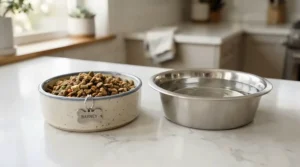
Hygiene Comparison: Bacteria, Biofilm, and Cleaning Ease
Hygiene is where the ceramic vs stainless steel cat bowl debate gets more nuanced than most buying guides admit. Veterinary literature on food bowl selection notes that stainless steel is broadly favored for its combination of durability and consistent non-porosity across the entire surface, since there’s no glaze layer that can wear unevenly over time — a point echoed in guidance for veterinary professionals counseling clients on pet bowl material selection. Interestingly, some research cited in that same professional guidance found ceramic dishes carried notably diverse bacterial populations in testing, a reminder that glaze quality and how thoroughly a bowl is cleaned matter just as much as the base material itself.
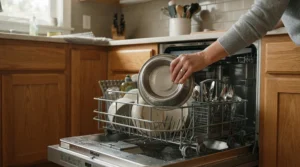
In practical terms, that means a PetFusion Premium 304 Stainless Steel Bowl run through a hot dishwasher cycle nightly will consistently out-hygiene a beautiful ceramic bowl that only gets a quick rinse — the material matters less than the routine built around it. Ceramic bowls like the Necoichi Raised Cat Food Bowl are dishwasher-safe too, but because they’re more vulnerable to thermal-shock cracking, owners often default to gentler hand-washing, which can leave more residue behind than a proper hot cycle would. If daily dishwasher use is your realistic routine, steel edges out ceramic on hygiene consistency; if you’re a diligent hand-washer, the gap narrows considerably.
Cat Bowl Durability: What Actually Wears Out First
Durability isn’t a single number — it’s a set of failure modes, and ceramic and steel fail differently. Ceramic bowls, including well-made options like the Necoichi Extra Wide Elevated Ceramic Cat Food Bowl, are essentially immune to scratching but vulnerable to sudden impact; drop one on tile and it can chip or shatter outright, which is a hard stop on that bowl’s usable life. Stainless steel bowls, by contrast, almost never break outright — the Bergan Stainless Steel Standard Bowl can survive years of daily use, dishwasher cycles, and the occasional drop with nothing worse than a cosmetic dent.
Where steel does wear is under sustained mechanical stress: lighter-gauge bowls like some sizes of the PetFusion Premium 304 Stainless Steel Bowl can develop shallow dents from years of a heavy-handed cat pushing the dish across tile, and while dents themselves aren’t a hygiene risk on intact steel, they’re worth inspecting periodically for any surface cracking at the dent site. Total cost of ownership tends to favor steel over a long enough timeline — a $10-$18 stainless bowl that lasts a decade works out cheaper per year than replacing a chipped $20 ceramic bowl every couple of years, even though ceramic’s higher per-unit price doesn’t always reflect that math upfront.
Common Mistakes When Buying a Cat Bowl
The single most common mistake is buying based on looks alone — a beautifully glazed ceramic bowl with an undocumented lead/cadmium status is a worse purchase than a plain stainless dish with published material specs, even if it’s less photogenic. A close second is ignoring bowl depth entirely; a gorgeous ceramic bowl that’s too deep will cause the exact whisker fatigue symptoms you were trying to avoid by upgrading from plastic in the first place.
Another frequent misstep is assuming all “elevated” bowls suit all cats — stand height genuinely matters, and a stand sized for a petite cat, as discussed earlier with the CEEFU Extra Wide Elevated Ceramic Cat Bowl‘s taller profile, can leave a bigger cat hunching just as much as a floor bowl would. Buyers also frequently underestimate how much a lightweight bowl like the Van Ness Lightweight Stainless Steel Dish will slide around without a mat, then blame the material for a mess that’s really a missing accessory. Finally, plenty of shoppers skip checking capacity against their cat’s actual portion sizes, ending up with a bowl that’s either comically oversized or requires awkward mid-meal refills.
Features That Actually Matter (And Those That Don’t)
Whisker-friendly shallow depth actually matters — it’s grounded in real feline sensory anatomy, not marketing fluff, and it’s the single feature most likely to visibly change a cat’s eating behavior. Documented material grade, whether that’s 304 stainless or certified lead/cadmium-free ceramic, also genuinely matters, since it’s the difference between a bowl that’s safe by design and one that’s merely safe by legal minimum. Stability, whether from ceramic’s natural weight or a steel bowl’s rubber base, matters practically every single day for anyone whose cat treats mealtime as a contact sport.
What doesn’t matter nearly as much as product photos suggest: decorative glaze patterns, novelty shapes that don’t affect depth or width, and “smart” branding claims that aren’t backed by any actual sensor or connectivity. A cute paw-print decal on the Necoichi Extra Wide Elevated Ceramic Cat Food Bowl doesn’t make it perform better than a plain white version of the same dish — it’s a purely aesthetic choice, and there’s nothing wrong with picking a bowl because you like how it looks, as long as you’re not paying a premium under the illusion that the pattern adds function it doesn’t have.
Frequently Asked Questions
❓ Is ceramic or stainless steel better for cats?
❓ Can ceramic cat bowls contain lead?
❓ Why do vets recommend stainless steel or ceramic over plastic?
❓ How often should I replace my cat's bowl?
❓ What size cat bowl is best for whisker fatigue?
Conclusion
Choosing between a ceramic vs stainless steel cat bowl really comes down to matching material properties to your actual household, not chasing whichever one shows up first in a search result. If your cat is a solo diner in a small space and you want something stable and good-looking, ceramic options like the Necoichi Raised Cat Food Bowl or CEEFU Extra Wide Elevated Ceramic Cat Bowl deliver real ergonomic benefits alongside the aesthetics. If you’re managing multiple cats, a busy dishwasher rotation, or a limited budget, stainless steel picks like the Van Ness Lightweight Stainless Steel Dish and Bergan Stainless Steel Standard Bowl offer durability and hygiene consistency that’s hard to beat for the price.
What matters more than the material label on the box is checking for documented safety — lead/cadmium-free certification on ceramic, or confirmed 304-grade sourcing on steel — and building a cleaning routine that actually matches the bowl you buy. Do that, and either material will genuinely outperform the scratched-up plastic dish you’re probably replacing.
Recommended for You
- Litter Robot vs PetKit: 7 Self-Cleaning Boxes Ranked 2026
- Cat Door for Large Cats: 7 Best Big Cat Flaps (2026)
- Interior Cat Door: 7 Best Picks for Litter Box Privacy 2026
Disclaimer: This article contains affiliate links. As an Amazon Associate, I earn from qualifying purchases. If you purchase products through these links, we may earn a small commission at no additional cost to you.
✨ Found this helpful? Share it with your friends! 💬🤗
