
Table of Contents
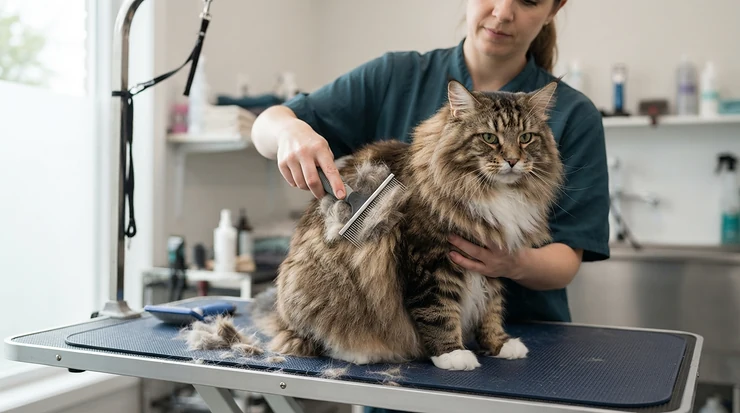
An undercoat rake for double-coated cats is a wide, long-pinned grooming tool that reaches beneath the glossy guard hairs to lift loose, woolly undercoat before it tangles. Unlike a surface brush, it works in the dense layer near the skin where mats begin. That makes it the core tool for fluffy breeds like Maine Coons and Norwegian Forest cats.
Picture a Maine Coon in April. The top coat looks like a silk cape, yet underneath, a felt of dead wool is quietly knitting itself into a mat behind the ears. A standard brush skates right over it. A well-chosen undercoat rake for double-coated cats goes where the trouble actually lives.
The breed world agrees that this coat type needs deliberate care. The Cat Fanciers’ Association describes Norwegian Forest Cats as double-coated, with a longer outercoat over a shorter, denser undercoat. It also points owners toward the classic mat zones: behind the ears, the armpits, the chest and between the back legs. It recommends extra grooming sessions during heavy shedding.
This guide covers seven real rakes, with specs translated into what they mean for a fluffy cat. It also covers tooth length and spacing, mat prevention, and how to handle a blowing coat. One honest note: everything here comes from published specs and aggregated reviewer sentiment, not from hands-on testing. Prices are ranges only, so check current price before you buy.
Quick Comparison: 7 Rakes at a Glance
| Rake | Tooth Design | Price Range | Best For |
|---|---|---|---|
| Maxpower Planet Original Pet Grooming Rake | 9 coarse + 17 fine teeth | Around $10-$15 | Maxpower Planet: first-time rake buyers |
| Safari Double Row Undercoat Rake | Two offset rows of blunt pins | $15-$25 range | Safari Double Row: touchy, easily overstimulated cats |
| JW Pet GripSoft Double Row Undercoat Rake | Two rows, cushioned handle | Under $25 | JW Pet GripSoft: long shed-season sessions |
| FURminator Grooming Rake | Rotating metal teeth | $15-$25 range | FURminator Grooming Rake: cats that hate tugging |
| Hertzko Undercoat Dematting Comb Rake | Long rounded serrated blades | $12-$20 range | Hertzko: mat-prone armpits and britches |
| Uproot Clean Deshedder | Claw-shaped skin-safe blades | $20-$30 range | Uproot Clean: bulk undercoat removal |
| Mars Coat King Double Wide 23-Blade | Coarse stainless stripping blades | Mid-$30s to low-$40s | Mars Coat King: heavy coats and finishing |
Looking at the comparison above, Maxpower Planet is the lowest-risk way to find out whether a rake suits your cat. Safari Double Row and FURminator Grooming Rake lean toward comfort. Mars Coat King is the premium pick for dense, mat-prone coats, but it asks more of your technique. Prices change often, so treat the ranges as a starting point.
💬 Just one click — help others make better buying decisions too!😊
Top 7 Undercoat Rakes for Double-Coated Cats: Expert Analysis
1. Maxpower Planet Original Pet Grooming Rake — best budget all-rounder
The standout feature is the two-sided layout: a 9-tooth coarse side for tangles and a 17-tooth fine side for thinning. Reviewer-reported dimensions put it near 6¾ inches long with a rake head about 2¾ inches wide, weighing roughly 4 ounces. That light weight matters during a 20-minute shed-season session. The wide head covers a Maine Coon’s flank in fewer passes, and the rounded tips avoid the needle-point scratch of cheaper pins.
Based on the spec comparison, this is the sensible first rake for a cat with a medium-to-thick coat. The coarse side suits ruffs and britches. The tighter side suits the back and sides. The spec sheet won’t mention one caution from roundups: forcing the 17-tooth side through a mat stresses the teeth.
Reviewers consistently report lots of loose undercoat coming out and a comfortable rubber handle. Across tens of thousands of ratings, the average sits around 4.6 out of 5 at the time of research. A recurring complaint is tugging on very dense coats, and some note it works best on shorter-furred cats.
Pros:
- ✅ Dual tooth density covers tangles and thinning
- ✅ Lightweight, non-slip rubber handle
- ✅ Huge review base and very low entry cost
Cons:
- ❌ Can tug on very dense, long coats
- ❌ Fine side clogs quickly mid-shed
Price: around $10-$15, a strong value for a first rake. Check current price.
2. Safari Double Row Undercoat Rake — gentlest option for a brush-averse cat
Safari, a Coastal Pet line, uses two offset rows of dull-tipped pins. One published review describes the tines as thick enough to glide over the topcoat while catching undercoat. It credits the offset two-row version with better loose-hair removal, citing VCA Animal Hospital. In practice, two rows mean more pins contact the coat per stroke, so you finish in fewer passes.
The blunt pins are the point for sensitive cats. That reviewer reports a cat prone to overstimulation tolerated the rake and that the pins stayed straight after three years. On paper, this suits a Norwegian Forest cat with a moderate coat who objects to anything sharp.
Reviewer sentiment is warm. Retailer listings show a rating around 4.7 on a modest sample, and the long-term durability comment stands out. Because the pins are blunt, expect it to lift loose coat rather than slice through an established mat, and choose the smaller size for most cats.
Pros:
- ✅ Blunt pins suit sensitive, twitchy cats
- ✅ Two rows reduce the number of passes
- ✅ Reported durability over years of use
Cons:
- ❌ Won’t cut through tight existing mats
- ❌ Sized mainly for dogs, so choose carefully
Price: $15-$25 range. A fair value if gentleness is your priority.
3. JW Pet GripSoft Double Row Undercoat Rake — comfort handle for long sessions
The GripSoft name signals the angle: a cushioned handle for the 15-to-20-minute sessions a fluffy cat’s shed season demands. The double row is the spec that matters. A Chewy shopper describes it working much better on double-coated dogs than single-row rakes, and Chewy’s own Q&A says it can be used daily or as needed on dogs and cats.
Here is the honest analysis: this is a dog-first design with proven cat tolerance. One reviewer used it on a heavy-coated German Shepherd and called it gentle enough for their cats. That makes it a practical pick for mixed households. Reliable tooth-length measurements weren’t available, so compare listing photos against your cat’s coat depth before buying.
Retailer ratings sit around 4.6 out of 5 across a few hundred reviews. Reviewers describe it as tough, durable and effective. The main trade-off is that a larger head can feel bulky around a cat’s armpits and belly.
Pros:
- ✅ Cushioned grip reduces hand fatigue
- ✅ Double row speeds up each pass
- ✅ Safe for daily maintenance use
Cons:
- ❌ Head may feel bulky on small cats
- ❌ Not built for cutting through mats
Price: typically under $25. Good value for multi-pet homes.
4. FURminator Grooming Rake — rotating teeth that glide instead of snag
The hook is the rotating metal teeth. The brand says they remove loose undercoat and help prevent tangles in thick or double coats. In theory, a tooth that turns when it meets resistance tugs less than a fixed pin. FURminator also lists a nonslip handle, wet or dry use, and sessions of about 5-10 minutes.
One reviewer noted that the inner teeth sit closer together and are shorter, while the outer teeth are wider and longer. If that holds for your version, you get a built-in fine/coarse split. For a cat that squeaks at every tangle, that smoother feel is the main appeal.
Reviewers describe a smooth, “hot knife through butter” glide with fewer complaints from brush-hating cats. A current star average couldn’t be verified, so none is quoted here. Moving parts mean more places for fur to lodge, and rotation won’t help with a tight mat.
Pros:
- ✅ Rotating teeth reduce tugging on tangles
- ✅ Safe on wet or dry fur
- ✅ Brand guidance includes short session lengths
Cons:
- ❌ Rotating parts trap fur and need cleaning
- ❌ Not designed to cut established mats
Price: $15-$25 range. Worthwhile for sensitive cats.
5. Hertzko Undercoat Dematting Comb Rake — long rounded blades for mat-prone zones
The standout is the long blade design with rounded safety edges. Listing language describes serrated stainless teeth near 2.5 inches, though wording varies, so confirm on the product page. The serration is meant to saw gently through tangles rather than yank them. On a Maine Coon, that reach matters in the dense britches and armpits.
Reviewers are mixed, which is useful information. One cat owner said it cut a mat away quickly without upsetting the cat. Another found it “awesome at breaking mats” but not a bulk-shedding champion. A roundup also notes that Hertzko’s long-blade cat dematter moves in one direction and suits squirmy cats poorly. The average sits around 4.4 across roughly 1,400 ratings at the time of research.
Treat this as a spot tool for tangles, not the main rake for a full blowing coat. Reviewers advise keeping the blades turned away from the cat.
Pros:
- ✅ Long blades reach deep into thick coats
- ✅ Rounded safety edges protect the skin
- ✅ Cat owners report clean mat breakup
Cons:
- ❌ Slower than rakes at bulk undercoat removal
- ❌ Awkward on squirmy or restless cats
Price: $12-$20 range. Good value as a second tool.

6. Uproot Clean Deshedder — claw-shaped teeth for gentle bulk removal
Uproot Clean’s pitch is soft, claw-like teeth with skin-safe blades to detangle, demat and deshed. Petco lists it at about 9.38 inches long. The brand claims up to 94% less shedding, which is a marketing figure rather than independent data. Review roundups describe a dual 9-and-17 curved-tooth layout and a removable head, but listings vary, so verify the details.
Curved teeth should follow a cat’s body contour, which helps on the ribs and haunches. A removable head, where offered, makes cleanup quicker. That matters because a rake clogged with fur stops working.
Petco shows roughly 260 reviews, with cat owners saying it removes fur without pulling and feels gentle on the skin. One called it a “kitty knot remover.” Roundups note the wide head can feel bulky on smaller animals.
Pros:
- ✅ Gentle, non-pulling feel in cat owner reports
- ✅ Curved teeth follow the body’s shape
- ✅ Strong shed-season removal volume
Cons:
- ❌ Costs more than generic double-sided rakes
- ❌ Wide head can feel bulky on small cats
Price: $20-$30 range. Fair value if gentleness matters.
7. Mars Coat King Double Wide 23-Blade — pro-style stripper for stubborn coats
The Coat King is a professional groomer’s staple with German-engineered stainless blades and a wooden handle. By the maker’s sizing, the Double Wide 23-blade shares spacing with the original 12-blade, which is a coarse setting. Groomer guidance says coarse styles comb out undercoat and fine styles finish. Retailer copy adds that knots pull harder against the blade section and get cut like a mat breaker.
One buyer who switched to the double-wide sizes called them “night-and-day” better than the small original, but “not miracle workers.” Another reported it only pulled ear fur on severe matting. A Norwegian Forest cat owner said the jury was out on spring mats under the front legs. The rating averages about 4.7 across several thousand reviews at the time of research.
A roundup cautions that heavy pressure can cut skin, so use light strokes.
Pros:
- ✅ Coarse spacing suits dense double coats
- ✅ Blades thin and break up small tangles
- ✅ Very high rating across thousands of reviews
Cons:
- ❌ Steeper learning curve and skin-cut risk
- ❌ Won’t fix severe, long-standing mats
Price: mid-$30s to low-$40s. Worth it for a heavy-coat household with patience.
Side-by-Side Specs, Ratings and Value
| Rake | Spacing / Style | Reported Rating* | Price Range | Best For |
|---|---|---|---|---|
| Maxpower Planet | 9/17 dual density | About 4.6 (tens of thousands) | Around $10-$15 | Maxpower Planet: budget starters |
| Safari Double Row | Two offset rows, blunt | About 4.7 (small sample) | $15-$25 | Safari Double Row: sensitive cats |
| JW Pet GripSoft | Two rows, soft grip | About 4.6 (hundreds) | Under $25 | JW Pet GripSoft: long sessions |
| FURminator Grooming Rake | Rotating teeth | Not verified | $15-$25 | FURminator Grooming Rake: tug-averse cats |
| Hertzko | Long serrated blades | About 4.4 (~1,400) | $12-$20 | Hertzko: spot mat work |
| Uproot Clean | Curved skin-safe blades | Positive (~260 reviews) | $20-$30 | Uproot Clean: bulk shedding |
| Mars Coat King | Coarse stainless blades | About 4.7 (thousands) | Mid-$30s to low-$40s | Mars Coat King: dense coats |
*Ratings reflect retailer listings at the time of research and change often.
Reading across the table, ratings are strong everywhere, but the review samples differ wildly in size. Maxpower Planet and Mars Coat King have the deepest pools, while Safari Double Row rests on a smaller one. For most owners, one affordable rake plus one finishing tool covers both shedding and tangles.
✨ Don’t Miss These Carefully Selected Picks!
🔍 Take your grooming routine to the next level with these researched rakes. Click on any highlighted item to check current pricing and availability. The right tool will help you build a calmer, mat-free coat routine your cat will actually tolerate!
Practical Usage Guide: How to Rake a Double-Coated Cat Safely
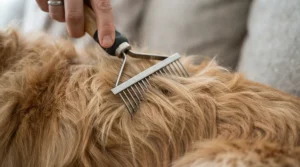
Even the best undercoat rake for double-coated cats fails in clumsy hands. The goal is to lift loose undercoat, not to scrape the skin.
- Pick a calm moment. After a meal or nap works best. Keep the first sessions to about 5 minutes, in line with FURminator’s own 5-10 minute guidance.
- Hand-check first. Run your fingers through the coat and feel for tight spots behind the ears, under the armpits, along the chest and between the hind legs.
- Start light. Use the coarse side, or the widest-spaced rake you own. Make short strokes in the direction of hair growth, with the teeth skimming through the coat rather than pressing into the skin.
- Work in layers. Part the coat with your free hand and rake section by section, from the tail forward.
- Empty the teeth often. A clogged rake just drags hair.
- Finish with a comb. This catches whatever the rake missed.
The reason all this matters is mechanical. As PetMD explains, mats form when loose hair tangles and clumps. Shedding undercoat trapped in the outer coat is a common cause, and friction zones are another. Removing that loose hair early is the whole trick.
Real-World Scenarios: Matching a Rake to Your Cat
Spec sheets get abstract fast, so here are three realistic profiles.
Scenario 1: The first-time Maine Coon owner. A 6-month-old kitten is growing into a thick coat, and the owner wants to spend under $20. Maxpower Planet makes sense. The wide head handles the growing ruff, and weekly sessions of about 10 minutes keep ahead of the first tangles. Use the fine side gently while the kitten is still learning.
Scenario 2: The spring-shedding Norwegian Forest cat. A cat with outdoor access arrives every spring with mats under the front legs. The owner can spend up to the low $40s. Pair Mars Coat King Double Wide 23-Blade for the stubborn spots with Safari Double Row for routine passes. Do three short sessions a week through the shed, then taper.
Scenario 3: The brush-hater. A rescue cat tolerates about three minutes before flicking her tail. FURminator Grooming Rake or Safari Double Row is the better call, since smooth glide beats power for a cat who bolts. Rake daily in micro-sessions and stop while she’s still calm. Success here means the cat comes back for session two.
Problem → Solution Guide: Common Rake Headaches
Problem 1: The rake clogs after five strokes. Fur-clogged teeth are a tooth-spacing signal. Switch to a coarser side, or pick a wider-spaced model like Mars Coat King. Clear the teeth often during heavy shed.
Problem 2: Your cat flinches or bites. Reduce pressure, shorten sessions, and consider blunt-pin options like Safari Double Row or rotating teeth like FURminator Grooming Rake. Stop before irritation starts.
Problem 3: A mat has formed already. Hold the coat near the skin and work the edge of the mat with a long-blade tool like Hertzko, using short, gentle strokes. If it’s tight, close to the skin, or the cat protests, skip the home fix.
Problem 4: The rake tugs. Dense coats can punish a fine-tooth side. Use the wider-spaced side first, then finish with the finer side on hair that’s already loose. Maxpower Planet reviewers report this on dense coats.
Problem 5: Fur flies everywhere. Rake over a towel or in a bathroom with a closed door, and keep the session short.
How to Choose an Undercoat Rake for Double-Coated Cats
Here is a quick framework for choosing an undercoat rake for double-coated cats:
- Match the tooth length to the coat depth. Teeth must reach the undercoat, not just the guard hairs.
- Check the spacing. Dense coats clog tightly packed teeth fast, so wider gaps suit thick coats.
- Insist on rounded or blunt tips. They protect the skin during the repeated passes a fluffy coat needs.
- Pick the right handle. A grip that stays secure matters during 15-to-20-minute sessions.
- Consider dual-density heads. Two spacings in one tool let you progress from tangles to finishing.
- Weigh cleaning ease. A rake you can empty in one swipe is a rake you’ll actually use.
- Judge your cat’s temperament. Sensitive cats need gentler designs, which usually means blunt pins or rotating teeth.
Reasoning through these steps usually narrows seven rakes to two or three. Start with temperament and coat density, then let budget settle the final choice.
Tooth Length and Spacing: The Spec That Decides Everything
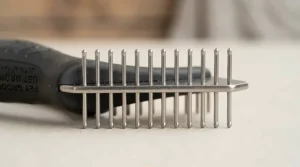
Of every spec on a listing, tooth length and spacing does the most to predict whether a rake works on a fluffy cat. Manufacturers rarely publish tooth length in millimeters, so many details must be inferred from photos and reviewer notes.
Here is how to read it. Long teeth can pass through the topcoat and reach the undercoat; short teeth just groom the surface. Wide spacing lets dense undercoat pass through and pulls out loose wool. Tight spacing grabs small amounts and clogs fast. Roundups on Maine Coon brushes warn that closely packed teeth clog immediately in a dense undercoat, which makes grooming unpleasant for the cat.
That explains why dual-density tools like Maxpower Planet have caught on: coarse for the first pass, fine for finishing. It also explains the Mars Coat King guidance that coarse spacing combs out undercoat while fine spacing finishes soft coats. The softer the coat, the finer the gap you want.
A practical rule: begin with wider spacing, then move to finer spacing only when the coat is already loose. Since specs are often vague, check customer photos, and buy from sellers with clear return options.
Undercoat Rake for Maine Coons: What to Expect
An undercoat rake for Maine Coons faces a demanding coat. Roundups describe it as a dense, water-resistant layer of guard hairs over a soft, woolly undercoat that sheds heavily with the seasons. The CFA notes the coat grows in layers, which is why it looks shaggy even when healthy.
What does that mean for rake choice? First, wide heads save time on a big cat, which favors Maxpower Planet and JW Pet GripSoft. Second, the britches, belly and chest are the trouble spots, so a long-blade tool like Hertzko can earn a place in the kit. Third, Maine Coons often accept grooming well when sessions are short and consistent.
Expect the first session to pull out more fur than you thought possible. That’s normal for a cat that hasn’t been raked before. After a few weeks, volume per session drops, which is a good sign.
For Maine Coon kittens, a roundup advises soft tools first and dematting blades only sparingly. Save the aggressive rakes for the adult coat.
Undercoat Brush for Norwegian Forest Cats: Seasonal Surprises
An undercoat brush for Norwegian Forest cats has to cope with a coat built for harsh winters. Breed guides describe a long, glossy topcoat over a woolly undercoat that is fuller in winter. They also describe a dramatic spring “coat blow” when the winter undercoat sheds.
According to Catster’s vet-verified grooming guide, brushing at least two or three times a week is necessary for coat and skin health. Daily brushing is beneficial, though not an absolute requirement. The same source recommends wire-bristle brushes or metal combs, which is a polite way of saying that a rake’s metal teeth suit the breed.
For a Norwegian Forest cat, the practical move is to keep a gentle rake, such as Safari Double Row, for routine weeks. Add a finisher like Mars Coat King for the spring blowout. During heavy shedding, small daily sessions beat one marathon.
Pay attention to the armpits and chest, where one owner reports recurring spring mats.
Blowing Coat Season: How to Survive It
A blowing coat is the seasonal release of dense undercoat, usually in spring and often in fall too. For double-coated cats the volume can be startling, and it’s the period when mats form fastest.
Why? Loose undercoat doesn’t always fall free. PetMD notes that shedding undercoat can become trapped in the outer coat and tangle there. During a blowing coat, there’s simply more of it to trap.
Here is a practical shed-season plan:
- Increase frequency. Move from two or three sessions a week to short daily ones. The CFA recommends extra sessions during this time to reduce dead-hair buildup.
- Shorten sessions. Five calm minutes beat fifteen tense ones.
- Work high-friction zones first. Behind the ears, armpits, chest and hind legs.
- Empty the rake often. The teeth will fill fast.
- Rotate tools. A wide rake for bulk, then a comb for finishing.
Expect the heaviest weeks to last several days to a few weeks. When the fur coming off dwindles, return to your regular schedule. If the coat looks unusually patchy or the skin looks irritated, ask your vet.
Mat Prevention: A Weekly Routine That Works
Mat prevention is easier than mat removal, and the economics are brutal: five minutes now saves a painful grooming appointment later. The ASPCA, as summarized by Rover, recommends brushing a cat once or twice weekly to prevent matting. Fluffy double-coated breeds need more.
Here’s a simple weekly rhythm:
- Two or three rake sessions of 5-10 minutes each, focused on friction zones.
- A weekly hand-check of every mat-prone spot.
- A finishing comb pass after raking.
- Extra sessions during shed season.
One firm rule: never cut mats out with scissors. The ASPCA warns that a cat can jerk unexpectedly, causing a severe laceration or puncture. PetMD echoes this, since mats often sit very close to the skin.
If a mat is large, tight, or your cat is in pain, see a vet or professional groomer. In severe cases, sedation may be needed. A rake supports prevention. It isn’t a substitute for professional care.
Undercoat Rake vs Other Cat Brushes
| Tool | Reach | Mat Handling | Skin Comfort | Best For |
|---|---|---|---|---|
| Undercoat rake (e.g., Maxpower Planet) | Deep, into undercoat | Moderate | Good with rounded tips | Double-coated cats in shed season |
| Slicker brush | Surface to mid-coat | Light | Fair, can scratch | Daily detangling and finishing |
| Steel comb | Full length if long-toothed | Spot work | Good | Final check for tangles |
| Rubber brush | Surface | None | Very good | Massage and loose-fur pickup |
Looking at the comparison above, an undercoat rake wins on reach, which is the one thing a double-coated cat needs. One roundup warns that a slicker smooths the topcoat but won’t extract the deep undercoat a Maine Coon sheds.
Slickers and combs still have a place. A comb confirms your rake did its job, and a slicker or rubber brush polishes the finish. Think of the rake as the heavy lifter and the rest as the supporting cast.
FAQ: Undercoat Rakes for Double-Coated Cats
❓ What is the best undercoat rake for Maine Coons on a budget?
❓ How often should I use a double-coat cat rake during a blowing coat?
❓ Is a rotating-tooth rake better than a fixed-pin rake?
❓ Can I use a dog undercoat rake for double-coated cats?
❓ Are cheap rakes good enough, or should I pay more?
Conclusion: Choosing the Right Undercoat Rake for Double-Coated Cats
The best undercoat rake for double-coated cats is the one your cat tolerates and you will actually use. For most owners that means a wide, rounded-tooth rake with sensible spacing. Maxpower Planet wins on value, Safari Double Row and FURminator Grooming Rake win on comfort, and JW Pet GripSoft wins on grip. Hertzko helps with spot mats, Uproot Clean handles bulk shedding, and Mars Coat King suits dense coats that need pro-style thinning.
Whatever you buy, remember the fundamentals. Check tooth length and spacing against your cat’s coat depth. Rake in short, gentle sessions. Pay extra attention to the ears, armpits, chest and hind legs during a blowing coat. Make mat prevention a habit, and never reach for scissors. Whether you own a Maine Coon or a Norwegian Forest cat, a good routine keeps that magnificent coat comfortable and tangle-free.
Recommended for You
- Grooming Glove For Cats Who Hate Brushes: 7 Gentle Picks (2026)
- Quiet Cat Hair Clippers For Matted Fur: 7 Stress-Free Picks 2026
- Slicker Brush For Long-Haired Cats With Mats: 7 Proven Picks (2026)
Disclaimer: This article contains affiliate links. As an Amazon Associate, I earn from qualifying purchases. If you purchase products through these links, we may earn a small commission at no additional cost to you.
✨ Found this helpful? Share it with your friends! 💬🤗
