
Table of Contents
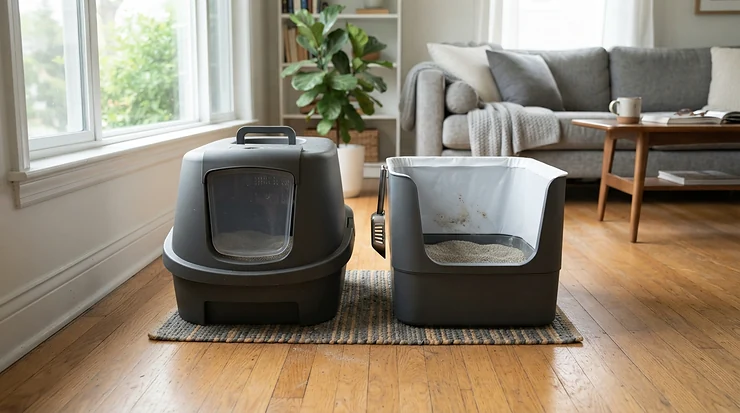
Somewhere in your house right now, there’s a plastic box full of clumped sand, and it is quietly running your life. Where you put it, how often you clean it, whether your cat will actually use it — the covered vs open litter box question sits underneath all of that, and most people pick one or the other based on a vague hunch rather than anything resembling evidence. So let’s fix that. A covered litter box hides the mess behind a hood and (in theory) traps the smell inside it; an open litter box skips the roof entirely and just lets a cat do its business in full view, for better or worse. Both styles have loyal fans, both have real drawbacks, and — spoiler — the research on what cats actually prefer is more surprising than either camp expects. This guide breaks down seven genuinely good, currently-sold products across both styles, walks through the odor control and cleaning-ease trade-offs in plain language, and helps you figure out which litter box is better for your specific cat, your specific nose, and your specific living room.
Quick Comparison Table: Covered vs Open Litter Box at a Glance
| Factor | Covered (Hooded) | Open (Uncovered) | Best For |
|---|---|---|---|
| Odor containment | Traps smell inside the hood between cleanings | Smell disperses into the room immediately | Covered = shared spaces; Open = well-ventilated rooms |
| Litter scatter | Contains most kicked litter | Litter sprays over the rim | Covered = carpeted homes |
| Cat comfort | Can feel cramped or ambush-prone to some cats | Full visibility and easy escape routes | Open = multi-cat or nervous cats |
| Cleaning ease | Requires lifting/removing a hood to scoop | Fully open access, scoop in seconds | Open = anyone short on time |
| Price range | Around $20-$50 for most models | Around $12-$40 for most models | Open = tightest budgets |
Neither style wins outright, and that’s really the whole plot of this article. A covered box buys you a tidier-looking room at the cost of trapping ammonia near your cat’s face if you skip a day of scooping, while an open box trades that visual mess for genuinely superior airflow and a faster daily cleaning routine. The right pick usually comes down to your cat’s size, your household’s tolerance for visible litter, and how religiously you’re willing to scoop.
📣 Which side are you already leaning toward? Keep that in mind as we break down seven real options below.
Top 7 Covered and Open Litter Boxes: Expert Analysis
We looked at current Amazon listings, aggregated review data from major pet retailers, and independent buying guides to land on seven boxes that earn their spot for genuinely different reasons — three open, four covered, spanning budget to premium. Prices shift constantly on Amazon, so treat every figure below as a range at the time of research, not a locked-in number.
1. Frisco Multi-Function Covered Cat Litter Box — most flexible interior for mixed-size households
The name undersells it a little: this is essentially a large, low-walled tub with a removable hood, which means you can run it fully covered, fully open, or as a smaller inner tray nested inside a bigger footprint. That flexibility matters more than it sounds like on paper. The interior measures close to 30 inches long and 17.5 inches wide, which is enough room for a genuinely big cat to turn around without brushing the hood, a common complaint with smaller covered designs on the market.
Based on the spec comparison, the low-profile front entrance is the detail that makes this workable for kittens and older cats alike, since it skips the awkward high step-over that plagues stricter hooded boxes. Reviewers aggregated across retail platforms consistently describe it as easy to carry thanks to molded cut-out handles, and note that it does a solid job containing urine spray, though some litter still escapes through the open front cutout during vigorous digging — a fair trade most owners accept.
Pros:
- ✅ Spacious enough for large-breed cats to turn around freely
- ✅ Flip-up lid design speeds up daily scooping
- ✅ Low-profile entrance suits kittens and senior cats
Cons:
- ❌ Litter can still scatter through the front opening
- ❌ Full footprint takes up more floor space than basic pans
At around $25-$35, the Frisco Multi-Function Covered Cat Litter Box lands as one of the better value picks in the covered category — you’re paying for interior volume rather than gadgetry.
2. Catit Jumbo Hooded Cat Pan — best overall for households wanting one dependable covered box
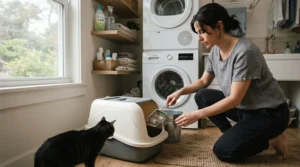
If you only read one paragraph about covered litter boxes, let it be this one, because the Catit Jumbo Hooded Cat Pan is the box independent reviewers keep landing on as their top overall covered pick, and the reasoning holds up. Its jumbo interior accommodates most adult cats without the cramped, elbows-in feeling that smaller hooded pans create, and built-in bag anchors keep a trash bag liner locked in place while you scoop — a small mechanical detail that saves real frustration on cleaning day.
What most buyers overlook about anchor systems like this is that they solve a problem you don’t notice until it’s gone: no more bag slipping sideways mid-scoop and dumping clumps back into the pan. On the downside, any hooded design concentrates ammonia near the litter surface between cleanings, and the Catit is no exception, so it rewards owners who scoop daily rather than every other day. Aggregated retail reviews describe it as a reliable, no-surprises pick rather than an exciting one, which for a litter box is arguably the highest compliment available.
Pros:
- ✅ Jumbo interior fits most adult cat breeds comfortably
- ✅ Bag anchors prevent liner slipping during scooping
- ✅ Established brand with widely available replacement parts
Cons:
- ❌ Hood traps odor faster without daily scooping
- ❌ Bulkier footprint than open-top alternatives
Expect to pay in the $30-$45 range, which is reasonable for what reviewers treat as the safest default pick if you want exactly one covered box and don’t want to shop around further.
3. IRIS USA Top Entry Cat Litter Box, Hooded Privacy — best scatter control for carpeted homes
Top-entry boxes are the extreme end of the covered spectrum: instead of a front door, your cat climbs in through a hole in the roof, which is either brilliant or a dealbreaker depending on the cat. The IRIS USA Top Entry Cat Litter Box leans into that design specifically to create what the brand calls a “dog-free zone” — a real perk in households where a food-motivated dog treats the litter box like a snack bar.
Here’s what the spec sheet won’t tell you, but independent buying guides note clearly: top-entry boxes are excellent for scatter control because a cat has to climb back out through the same narrow hole, knocking most loose litter off its paws before it ever touches your floor. The trade-off is real, though — that same narrow entry hole is genuinely difficult for senior or arthritic cats to navigate, so this is not the box to buy for an aging cat or one with mobility issues. Reviewers who own large or younger cats report near-total litter tracking control as the main win.
Pros:
- ✅ Near-total litter tracking control thanks to top-entry design
- ✅ Effectively keeps dogs and toddlers out of the litter
- ✅ Sturdy dual-latch lid resists accidental pop-open
Cons:
- ❌ Entry hole is difficult for senior or overweight cats
- ❌ Interior corners are harder to reach while scooping
Priced roughly $35-$50, the IRIS USA Top Entry Cat Litter Box is the specialist pick here — outstanding for the right household, wrong for a mobility-limited cat.
4. Tidy Cats Breeze Hooded Cat Litter Box System — best for cutting daily scooping to almost nothing
This one works differently enough from the other covered boxes that it deserves its own category. The Tidy Cats Breeze Hooded Cat Litter Box System pairs a hooded pan with non-absorbing pellets on top and a liquid-catching pad underneath, so urine drains through instead of clumping, and solid waste gets scooped off the pellet surface in seconds. Based on the spec comparison, this system genuinely changes the maintenance math: instead of scooping clumped litter daily and doing a full dump-and-refill weekly, you’re mostly just swapping a pad every few days and topping off pellets occasionally.
Reviewers consistently note that odor control is noticeably better than standard clumping litter in a hooded box, since the pad seals urine away from the air rather than leaving it sitting in exposed litter. The catch, and it’s a meaningful one, is that you’re locked into proprietary pellets and pads going forward, which adds an ongoing cost that a basic litter box doesn’t carry, and some cats need a week or two to accept the unfamiliar pellet texture underfoot.
Pros:
- ✅ Dramatically reduces daily scooping compared to clumping litter
- ✅ Pad system traps urine odor more effectively than exposed litter
- ✅ Pellets produce far less tracking dust than clay clumping litter
Cons:
- ❌ Requires ongoing purchases of proprietary pellets and pads
- ❌ Some cats resist the unfamiliar pellet texture at first
At around $25-$40 for the base system before ongoing pellet/pad costs, the Tidy Cats Breeze Hooded Cat Litter Box System is the premium-tier pick for anyone who values time saved over sticker price.
5. Amazon Basics Large Cat Litter Box with High Sides, Open Top — most affordable open box that still works
Sometimes the honest answer to “what should I buy” is the box that costs less than a fancy coffee order and still does the job, and that’s exactly the lane the Amazon Basics Large Cat Litter Box occupies. It’s a straightforward open-top pan measuring roughly 19 by 15 by 11.75 inches, with high sides that do real work catching kicked litter even without a hood overhead — a detail that matters more than people expect, since a good chunk of scatter comes from the sides, not the top.
Here’s what most buyers overlook about open-top designs generally: the airflow advantage isn’t marketing fluff. Ammonia disperses into the room instead of concentrating around your cat’s face, which matters for cats prone to litter box avoidance tied to smell. It includes a basic plastic scoop, and the open-top access works for cats of any size or age, with zero climbing or squeezing required. The obvious trade-off is thinner plastic than pricier competitors and, being fully open, no odor containment at all beyond what the room itself provides.
Pros:
- ✅ Lowest price point in this entire roundup
- ✅ High sides limit scatter despite the open top
- ✅ Works for kittens, seniors, and large cats alike
Cons:
- ❌ No odor containment beyond normal room airflow
- ❌ Thinner plastic than premium open-top competitors
At roughly $15-$25, this is the box to start with if you’re not sure your cat will even accept a new box yet — low financial risk, easy resale or donation if it’s a miss.
6. iPrimio Stainless Steel Litter Box — best long-term value for odor and durability
Plastic litter boxes are porous at a microscopic level, which means urine odor slowly works its way into the material itself over months of use — something no amount of scrubbing fully reverses. The iPrimio Stainless Steel Litter Box sidesteps that problem entirely with a rust-resistant steel construction and a non-stick coating that keeps dried litter and waste from clinging to corners. Reviewers frequently comment on how easy it is to simply wipe or rinse the entire pan clean, and the sizing runs generous without tipping into unwieldy.
What the spec sheet won’t tell you, but long-term owners note, is that steel’s non-porous surface is the real driver of its odor advantage over years of use, not any single feature you can point to on day one. It’s available with or without a removable plastic enclosure, so you can run it as a true open box or add partial coverage later. The one accessibility note worth flagging: the larger XL sizes have taller sides, which can be a real obstacle for senior cats or those with joint issues climbing in and out.
Pros:
- ✅ Non-porous steel resists long-term odor absorption
- ✅ Wipes or rinses clean in seconds, unlike scratched plastic
- ✅ Rust-resistant construction holds up for years of daily use
Cons:
- ❌ Higher upfront price than comparable plastic pans
- ❌ Tall sides on XL sizes can challenge senior cats
Expect to pay in the $60-$90 range depending on size — a genuine premium, but one that pays off in years of service rather than a replacement every season.
7. Arm & Hammer Rimmed Open Cat Litter Box, Wave with High Sides — best middle-ground open design for multi-cat homes
Between the bare-bones Amazon Basics pan and a full hood sits a clever middle option: a rimmed open box. The Arm & Hammer Rimmed Open Cat Litter Box keeps the fully open top that makes cats feel secure and lets odor disperse naturally, but adds a wave-shaped rim around the edge that catches litter as a cat kicks it, before it ever reaches your floor.
Based on the spec comparison, this rim design is doing double duty most single-feature boxes can’t manage — you get the airflow and easy-entry benefits of an open box alongside meaningfully reduced tracking, without asking a cat to squeeze through a hood opening. It’s made in the USA, and its wide opening comfortably accommodates multiple cats using the same box in sequence throughout the day, a genuine plus for two-or-more-cat households where a narrow hooded entrance becomes a bottleneck. The trade-off is that the rim itself needs regular wiping to prevent buildup, and being fully open, it offers zero visual or odor-blocking cover if that matters to you.
Pros:
- ✅ Wave rim catches scattered litter without a hood
- ✅ Wide opening suits multi-cat households well
- ✅ Made-in-USA build with sturdy, thick-walled plastic
Cons:
- ❌ Rim needs regular wiping to prevent litter buildup
- ❌ No cover for owners who want visual or odor privacy
Priced around $20-$30, the Arm & Hammer Rimmed Open Cat Litter Box is the option worth considering if you like the idea of an open box but have been burned by scatter in the past.
Which Litter Box Is Better? How to Choose Between Covered and Open
There’s no universal winner here, but there is a fast way to figure out which litter box is better for your actual situation. Work through these in order:
- Check your cat’s size and mobility first. A senior or overweight cat struggling to climb into a top-entry hood will avoid the box entirely, which defeats the purpose regardless of how good the odor control is.
- Be honest about your scooping habits. Covered boxes concentrate odor between cleanings, so if you scoop every two or three days rather than daily, an open box will smell less in your living space even though it looks messier.
- Count your cats. In multi-cat homes, a covered box can become an ambush point where one cat corners another near the entrance — wide-opening open boxes reduce that risk.
- Consider your flooring. Carpeted rooms benefit more from a covered or rimmed design, since scattered litter grinds into fibers far more than it does on hard flooring.
- Think about where the box lives. A covered box in a small closet or bathroom with no airflow will trap ammonia regardless of how well-reviewed it is; an open box in the same spot will still smell, just less concentrated.
- Weigh your own tolerance for visible mess against your cat’s apparent stress signals — hesitating at the entrance, scratching outside the box instead of in it, or refusing to bury waste are all signs the current style isn’t working.
- Introduce any new style gradually, keeping the old box available for at least a week so your cat isn’t forced into an all-or-nothing switch.
🐾 Still torn between two of these seven? Scroll back up and compare the ones on your shortlist side by side.
Cat Preference: What the Research Actually Shows
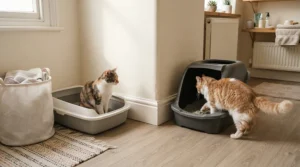
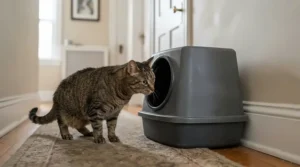
Most of the internet will tell you cats hate covered boxes. The actual research on covered versus uncovered box preference says something far less dramatic: when researchers gave 28 cats a genuine side-by-side choice between a covered and uncovered box for two weeks, there was no statistically significant overall preference for one style over the other. A small minority of individual cats did show a personal preference, split almost evenly between covered and uncovered, and the rest simply used whichever box was closer or cleaner at the time. What most buyers overlook about this finding is that it reframes the entire debate: the style of box matters far less than box size, cleanliness, and litter type, all of which had a much bigger measurable effect on usage in follow-up commentary from feline behavior researchers. That doesn’t mean style is irrelevant — a cramped covered box that’s genuinely too small for a large cat will get avoided regardless of what the label promises — but it does mean you shouldn’t assume your cat secretly hates a covered box just because internet folklore says so. Watch your own cat’s actual behavior over the research finding.
Odor Control: Hooded vs Uncovered Litter Box Compared
Odor control is where the covered-versus-open debate gets genuinely complicated, because “better odor control” depends entirely on what you’re measuring. A hooded box traps smell inside its own enclosure, which means the room around it stays fresher for longer between cleanings — right up until you lift the hood, at which point all that trapped ammonia and moisture releases at once, often as a stronger burst than an open box ever produces. An uncovered box does the opposite: odor starts dispersing into the room immediately, so there’s no dramatic release moment, but the room itself carries a faint smell more continuously. Reviewers and buying guides consistently note that hooded boxes also create a more humid microclimate inside the enclosure, which can encourage odor-causing bacteria to multiply faster than in an open pan exposed to normal room air. The practical upshot: if you go covered, plan on scooping daily rather than every other day, and make sure the box sits somewhere with actual air movement rather than a sealed closet or bathroom corner — ventilation doesn’t reduce how much ammonia gets produced, but it drastically reduces how much accumulates in your cat’s breathing zone. If you go open, you trade that trapped-smell risk for a lower peak intensity but a more constant baseline smell in the room.
Cleaning Ease: Hooded vs Uncovered Litter Box Compared
This is the category where open boxes have an almost unfair advantage. Scooping an uncovered pan takes seconds — you can see the whole surface, spot every clump, and get in and out without removing or lifting anything. A hooded box adds at least one extra step every single time: unclipping or lifting the hood, sometimes maneuvering around a snap-in inner tray, and occasionally dealing with a liner bag that’s slipped out of position mid-scoop. Multiply that extra 15-20 seconds by two scoops a day, 365 days a year, and it adds up to real cumulative time, even if any single scoop feels trivial. Weekly deep cleans favor open boxes for the same reason — fewer parts to disassemble, rinse, and dry before refilling. That said, covered boxes with well-designed features, like the bag anchors on the Catit Jumbo Hooded Cat Pan, close much of that gap by solving the specific friction points that make hooded cleaning annoying in cheaper models. If cleaning speed is your top priority and you’re not attached to a tidy-looking room, an open or rimmed-open design like the Arm & Hammer Rimmed Open Cat Litter Box will save you real time over a year of daily use.
Hooded vs Uncovered Litter Box: Full Feature Comparison
| Feature | Hooded (Covered) | Uncovered (Open) | Winner |
|---|---|---|---|
| Visual privacy | Fully hides mess from view | Mess is visible at all times | Covered |
| Airflow / odor dispersal | Traps ammonia between cleanings | Disperses smell continuously | Open |
| Scooping speed | Requires lifting/removing hood | Instant, unobstructed access | Open |
| Litter tracking | Best containment, especially top-entry | More scatter over open sides | Covered |
| Accessibility for senior cats | Can be difficult, especially top-entry | Generally easiest to enter/exit | Open |
| Multi-cat suitability | Risk of ambush at single entrance | Wide, unrestricted access | Open |
Looking at the table, neither style sweeps the category, which is exactly why the “best” box is really a best-for-your-cat box. The IRIS USA Top Entry Cat Litter Box dominates on tracking control specifically because it makes the trade-off explicit — maximum containment in exchange for accessibility — while the Amazon Basics Large Cat Litter Box wins on nothing flashy but loses nothing important either, which is its own kind of victory for a budget pick.
Common Mistakes When Buying a Litter Box
Even careful shoppers trip over the same handful of errors, and expert commentary across veterinary behavior sources points to the same patterns repeatedly.
- Sizing the box to the room instead of the cat. A box should be roughly 1.5 times your cat’s length from nose to tail base — a compact box that looks proportionate in a small bathroom can be genuinely too cramped for the cat using it.
- Assuming scented litter and covered boxes solve odor together. Combining a hooded design with heavily scented litter often backfires, concentrating a chemical smell that some cats find more aversive than plain ammonia.
- Buying a top-entry box for an older or overweight cat without testing accessibility first — the climbing motion required is a real barrier that specs sheets rarely mention.
- Underestimating the “one box per cat plus one” guideline in multi-cat homes, regardless of style, which prevents both style and cleanliness complaints from compounding.
- Switching styles abruptly instead of introducing a new box alongside the old one for a transition period, which is the single most common cause of a cat rejecting an otherwise well-chosen upgrade.
Setting Up Your New Litter Box: The First 30 Days
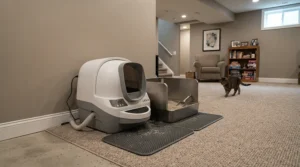
Getting a new box right in the first month prevents most long-term behavior problems. Start by placing it in a quiet, low-traffic spot with at least two accessible entry paths, since a cat cornered near its litter box by another pet or a slamming door will often avoid the location entirely afterward. For the first week, keep the old box available alongside the new one — don’t remove it — so your cat has the option to choose rather than being forced. Scoop twice daily during this transition window even if your normal routine is lighter, since a new box that smells stale immediately gets flagged as unacceptable. If you’ve chosen a covered or top-entry style, prop the hood open or remove it for the first several days so your cat can build a positive association with the pan itself before dealing with the enclosure. Around week two, watch for hesitation at the entrance, scratching at the floor instead of the litter, or shortened visits — all early warning signs worth addressing before they become an established aversion. By week three or four, most cats have either fully adopted the new box or shown a clear preference you should respect rather than fight. One frequent first-month mistake worth flagging: switching litter brand and box style simultaneously, which makes it impossible to know which change, if either, is causing hesitation.
Real-World Scenarios: Matching the Box to Your Household
The studio apartment with one indoor cat. Space is tight, and a hooded box helps the room look tidier without a big footprint. The Frisco Multi-Function Covered Cat Litter Box works well here because its flexible hood can come off entirely if the cat resists, without needing to buy a second box.
The multi-cat household with three or more cats. Bottlenecked single-entrance covered boxes create real tension in this setup. A wide-mouth open design like the Arm & Hammer Rimmed Open Cat Litter Box, multiplied across enough units to satisfy the one-per-cat-plus-one rule, reduces resource-guarding behavior around the litter area.
The busy professional who travels often. Minimizing daily maintenance matters more than aesthetics. The Tidy Cats Breeze Hooded Cat Litter Box System stretches the interval between full cleanings furthest of anything in this roundup, which matters when a pet sitter is only stopping by once a day.
The senior cat with mild arthritis. Low entry and stability matter far more than odor containment. The Amazon Basics Large Cat Litter Box or the low-profile Frisco Multi-Function Covered Cat Litter Box both avoid the climbing demands of a top-entry design.
Problem → Solution: Fixing Common Litter Box Complaints
- Problem: the whole room smells within a day of scooping. Solution: check ventilation first — a covered box like the Catit Jumbo Hooded Cat Pan in a closed bathroom will trap odor regardless of how good the product is; move it somewhere with airflow before assuming the box itself has failed.
- Problem: litter is tracked across the house. Solution: a top-entry design like the IRIS USA Top Entry Cat Litter Box knocks loose litter off paws during exit far more effectively than any mat alone.
- Problem: a senior cat has started avoiding the box. Solution: switch to a lower-entry open design such as the Amazon Basics Large Cat Litter Box and rule out medical causes with a vet visit, since sudden avoidance often signals pain rather than a style preference.
- Problem: daily scooping feels unmanageable with a busy schedule. Solution: the Tidy Cats Breeze Hooded Cat Litter Box System shifts the routine from daily scooping to periodic pad swaps.
- Problem: the box looks and smells worn out within a year. Solution: switch to non-porous stainless steel, like the iPrimio Stainless Steel Litter Box, which doesn’t absorb odor into the material the way plastic eventually does.
Safety, Regulations & Health Considerations
Litter box hygiene isn’t just about smell — it has genuine health implications worth understanding regardless of which style you choose. According to the Cornell Feline Health Center, house soiling is the most common feline behavior complaint reported by owners, and it frequently traces back to a medical issue, litter box aversion, or a location or substrate preference rather than a “bad cat” problem — a distinction worth remembering before blaming the box style itself. There’s also a human health angle worth flagging honestly: the CDC’s guidance on toxoplasmosis prevention recommends that pregnant individuals avoid changing litter themselves when possible, and that anyone handling litter change it daily and wash hands thoroughly afterward, since the parasite that causes toxoplasmosis doesn’t become infectious until one to five days after being shed. This applies to covered and open boxes equally — the enclosure style has no bearing on toxoplasmosis risk, only cleaning frequency does. Whichever box you choose, daily scooping is doing double duty: it’s the single biggest lever for odor control and the primary safeguard against this specific health risk.
Long-Term Cost & Maintenance
The sticker price on a litter box is a small fraction of its true cost of ownership once you factor in litter, liners, and replacement frequency. A basic open plastic pan like the Amazon Basics Large Cat Litter Box costs the least upfront, but standard plastic gradually absorbs odor at a microscopic level and typically needs replacing every one to two years for hygiene reasons alone. The iPrimio Stainless Steel Litter Box costs two to three times as much initially, but its non-porous surface means it can realistically last many years longer, which changes the total cost of ownership math considerably over a five-year window. Systems like the Tidy Cats Breeze Hooded Cat Litter Box System shift cost differently — a moderate upfront price followed by an ongoing subscription-style expense for proprietary pellets and pads, which some owners find worthwhile purely for the time saved, and others find frustrating compared to the flat, predictable cost of clumping litter in a standard pan. When you run the numbers, a $70 stainless steel box that lasts six years often beats a $20 plastic pan replaced three times over the same period, even before factoring in the smell difference.
Frequently Asked Questions
❓ Is a covered or open litter box better for cats?
❓ Do covered litter boxes trap more odor than open ones?
❓ How often should you clean a covered litter box?
❓ Are top-entry litter boxes good for senior cats?
❓ What size should a litter box be for a large cat?
Conclusion
If you’ve made it this far hoping for a clean, universal verdict on covered vs open litter box, here’s the honest one: there isn’t one, and the research backs that up. What actually moves the needle is size, cleanliness, and ventilation, with style acting more like a preference layered on top than a make-or-break factor. If you want a tidier-looking room and don’t mind scooping daily, something like the Catit Jumbo Hooded Cat Pan or the Tidy Cats Breeze Hooded Cat Litter Box System will serve you well. If speed, airflow, and multi-cat accessibility matter more to you, the Arm & Hammer Rimmed Open Cat Litter Box or the durable iPrimio Stainless Steel Litter Box are hard to beat. Whatever you land on, watch your own cat’s behavior over any internet consensus — that’s the actual data set that matters in your house. Start with one solid pick, give it a fair month-long trial, and adjust from there.
Recommended for You
- Ceramic vs Stainless Steel Cat Bowl: 7 Genuinely Safe Picks for 2026
- Litter Robot vs PetKit: 7 Self-Cleaning Boxes Ranked 2026
- Cat Door for Large Cats: 7 Best Big Cat Flaps (2026)
Disclaimer: This article contains affiliate links. As an Amazon Associate, I earn from qualifying purchases. If you purchase products through these links, we may earn a small commission at no additional cost to you.
✨ Found this helpful? Share it with your friends! 💬🤗
