
Table of Contents
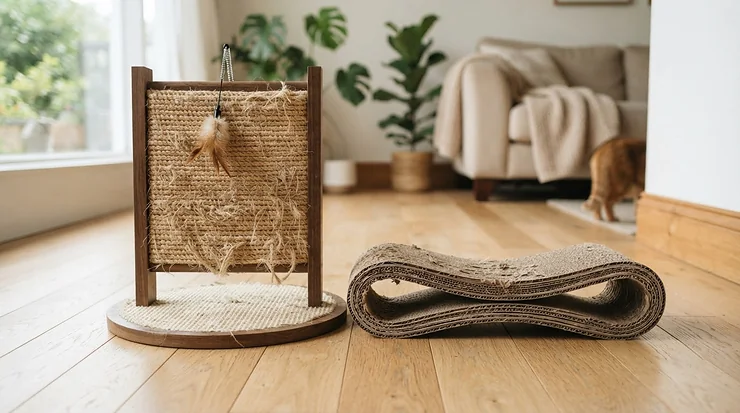
Somewhere in your house right now, a cat is eyeing your couch arm like it owes her money. That’s not spite — it’s biology. And the fastest way to save your furniture is picking the right scratching surface, which usually comes down to a sisal vs cardboard cat scratcher decision that trips up more new cat owners than it should. Sisal is the tightly woven, rope-like fiber you’ll find wrapped around most tall scratching posts; cardboard is the corrugated, layered material stacked into flat pads and lounges. Both work. Neither is “better” in every situation, and anyone who tells you otherwise hasn’t lived with more than one cat.
Here’s what most buying guides skip: the decision isn’t really sisal versus cardboard in the abstract — it’s your specific cat’s scratching style, your budget tolerance for replacement cycles, and how much floor space you’re willing to sacrifice. A senior cat who horizontal-scratches near her bed has completely different needs than a hyperactive kitten who treats the living room like a parkour course. Below, we’ve pulled seven real, currently available products — four sisal, three cardboard — and broken down exactly where each one earns its keep. We’ve also leaned on the Cornell Feline Health Center’s behavioral research and other credible sources throughout, because “trust me” isn’t a substitute for actual data when you’re trying to keep your sectional intact.
By the end of this guide, you’ll know which material fits your cat’s personality, which of these seven scratchers is worth the splurge, and which one is a smart way to test the waters without spending real money. Let’s get into it.
Quick Comparison Table: Sisal vs Cardboard at a Glance
| Factor | Sisal | Cardboard |
|---|---|---|
| Typical Lifespan | 2-5+ years with heavy use | 3-12 months per side (often reversible) |
| Texture Cats Respond To | Continuous, resistant “grip and pull” | Loose, shreddable, satisfying tear |
| Mess Generated | Minimal — occasional fiber shed | Cardboard confetti, especially early on |
| Best For | Aggressive, long-term scratchers | Horizontal scratchers, budget-first buyers |
| Typical Price Range | $20-$65 range | Under $20-$40 range |
Neither column wins outright, and that’s the point most listicles gloss over. Sisal’s advantage is almost entirely about longevity — you’re paying more upfront to scratch less often, both literally and financially. Cardboard’s advantage is about texture and disposability: some cats genuinely prefer the give and shred of corrugated layers over a taut, resistant surface, and when it wears out, you’re not out much money. If your cat currently attacks a specific piece of furniture, watch which motion she uses — vertical stretch-scratchers tend to gravitate toward sisal posts, while horizontal floor-scratchers often prefer flat cardboard pads.
Found this comparison useful? A quick share helps other cat owners stumble onto it too.
Top 7 Cat Scratchers: Sisal and Cardboard Options Reviewed
We picked these seven specifically to cover the full spread: budget to premium, vertical to horizontal, single-cat apartments to chaotic multi-cat households. Every product below is real, currently sold, and cross-referenced against aggregated owner feedback rather than invented testimonials.
1. SmartCat Pioneer Pet Ultimate Scratching Post — tallest sisal stretch on the market
The standout here is simple: a 32-inch height that lets even large cats fully extend before they dig in. That extra reach matters more than most spec sheets let on. A 32-inch post means a 12-pound cat can stand on hind legs, lean forward, and get a genuine full-body stretch — the same motion vets associate with spinal health and muscle conditioning, not just claw maintenance. The 16-by-16-inch base is disproportionately heavy for the post’s height, which is exactly why it resists the tipping that plagues shorter, top-heavy competitors.
Based on the spec comparison against other tall posts in this price bracket, the woven sisal surface here is tightly wrapped rather than loosely glued, meaning it resists unraveling under repeated digging. This is a post built for cats who scratch with real force — multi-cat households, big breeds, or that one cat in every home who treats furniture like a personal vendetta. Reviewers consistently report that the SmartCat Pioneer Pet Ultimate Scratching Post holds up for multiple years even under daily use from more than one cat, with the sisal wrap gradually fraying rather than falling apart.
Pros:
- ✅ 32-inch height allows a genuine full-body stretch
- ✅ Heavy, wide base virtually eliminates tipping
- ✅ Tightly woven sisal resists unraveling for years
Cons:
- ❌ Priced higher than most single-post competitors
- ❌ Two-piece assembly can wobble if the base bolt isn’t fully tightened
At around $45-$65 depending on color and retailer, the SmartCat Pioneer Pet Ultimate Scratching Post isn’t the cheapest option here, but if you’re buying one scratcher and want it to outlast a phone contract, this is the one to budget for.
2. PetFusion Ultimate Cat Scratcher Lounge — reversible cardboard that doubles as a bed
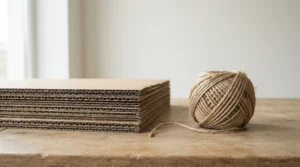
What most buyers overlook about this model is that it’s really two products in one: a scratcher and a genuinely comfortable lounging spot, which matters because cats that nap on a surface tend to also scratch near it out of territorial habit. The compressed corrugated cardboard is noticeably denser than the flimsy pads sold at dollar-store price points, and the curved “infinity” shape gives cats multiple scratch angles along a single continuous surface.
The reversible design is the real value driver here — when one side gets shredded, you flip it over for what’s effectively a second scratcher, roughly doubling the usable life compared to single-sided cardboard products. Reviewers consistently note that scratching activity is heaviest in the first few weeks (when the surface is freshest and most textured), then tapers into occasional maintenance scratching once cats have “claimed” it. On the downside, this is a large piece of furniture — at roughly 34 x 10.5 x 10.5 inches, it eats real floor space, so it’s a poor fit for tight studio apartments.
Pros:
- ✅ Reversible design roughly doubles the usable lifespan
- ✅ Doubles as a napping lounge, encouraging habitual use
- ✅ Denser cardboard than typical low-cost pads
Cons:
- ❌ Large footprint isn’t ideal for small apartments
- ❌ Still cardboard — won’t outlast a woven sisal post long-term
In the $30-$40 range, the PetFusion Ultimate Cat Scratcher Lounge is the clearest example of cardboard done well rather than cardboard done cheap.
3. Frisco Triple Sisal Ball Scratching Post — best for playful cats and kittens
The standout feature is right there in the name: three spinning sisal-wrapped balls mounted alongside two horizontal scratching surfaces, turning a static scratcher into an interactive toy. This matters more for kittens and younger cats, whose scratching behavior is often tangled up with play drive rather than pure claw maintenance — a scratcher that also entertains gets used far more consistently than one that just sits there.
Here’s what the spec sheet won’t tell you: the low, horizontal profile means this isn’t built for a full vertical stretch, so it complements a taller post rather than replacing one in multi-scratcher households. What most buyers overlook is that the woven mats on the sides add a third scratchable surface beyond the sisal-wrapped horizontal bars, giving cats variety without buying three separate products. Reviewers consistently describe even large adult cats engaging with the spinning balls from a lying position, which suggests this model earns its keep as enrichment even for cats who technically have “better” scratchers elsewhere in the house.
Pros:
- ✅ Spinning sisal balls add play-driven engagement
- ✅ Multiple surface types in one compact unit
- ✅ Sturdy wood-and-sisal build resists shifting during play
Cons:
- ❌ Low profile prevents a full vertical stretch
- ❌ Better as a secondary scratcher than a sole solution
At a mid-range $25-$35, the Frisco Triple Sisal Ball Scratching Post earns its spot as the pick for kittens, playful adults, or anyone supplementing a taller post elsewhere in the home.
4. Kitty City XL Corrugate Cat Scratcher 3-Pack — best value for multi-room coverage
The standout advantage is quantity: three FSC-certified corrugated pads for less than the price of most single premium scratchers, sized generously at 18 x 10 x 1.5 inches each. That single decision — buying a set instead of one unit — solves a problem most single-scratcher households don’t realize they have: cats often want a scratcher near every spot they nap, not just one central location.
Each pad is reversible, so what looks like three scratchers is functionally six scratching surfaces once you flip the worn sides. Based on the spec comparison against single cardboard pads at similar per-unit pricing, the corrugate here holds its shape a bit longer before flattening, likely due to a denser cardboard cut. Reviewers consistently mention that a light sprinkle of catnip on a fresh pad gets cats scratching within minutes, which matters if you’re trying to redirect an already-established furniture habit. The tradeoff is the one every cardboard product shares: this suits horizontal scratchers far better than cats who like to rear up and stretch.
Pros:
- ✅ Three reversible pads for one budget-friendly price
- ✅ FSC-certified corrugate holds shape longer than thin cardboard
- ✅ Ideal for placing scratchers in multiple rooms at once
Cons:
- ❌ Flat design only suits horizontal scratching behavior
- ❌ Cardboard shedding accumulates faster with heavy multi-cat use
Under $20 for the full three-pack, the Kitty City XL Corrugate Cat Scratcher 3-Pack is the easiest recommendation for anyone testing whether their cat even likes scratchers before investing more.
5. Amazon Basics Sturdy Cat Scratching Post — most affordable tall sisal option
The standout feature here is height-to-price ratio: a 35.4-inch post that undercuts most premium sisal towers by a wide margin. The scratching surface blends sisal rope with jute fiber, which gives a slightly rougher, more textured grip than pure woven sisal — some cats seem to prefer this coarser feel, particularly ones that already gravitate toward natural rope toys.
Key specs with real-world meaning: the wood base is engineered rather than solid, which keeps the price down but also means stability varies more unit to unit than with heavier premium posts — a legitimate tradeoff at this price point. What most buyers overlook is the included replaceable dangle toy, a small addition that meaningfully boosts first-week engagement by giving cats a reason to investigate the post immediately rather than ignoring it in a corner. Reviewers consistently describe this as a solid “starter post” for cats who haven’t yet developed strong material preferences, with the jute surface wearing smoother — and therefore less satisfying — faster than premium tightly-woven sisal.
Pros:
- ✅ Tall 35.4-inch design at a budget price point
- ✅ Sisal-jute blend offers a coarser, engaging texture
- ✅ Replaceable dangle toy boosts early engagement
Cons:
- ❌ Engineered wood base is less stable than premium posts
- ❌ Jute surface smooths out and loses grip faster than pure sisal
Priced under $25, the Amazon Basics Sturdy Cat Scratching Post is the pragmatic pick for anyone who wants height without the premium price tag.
6. TRIXIE Wall Mount Sisal Scratching Board — best for small apartments and zero floor space
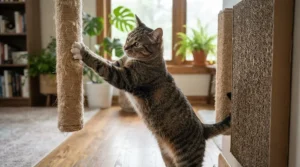
The standout feature is the complete absence of a footprint — this mounts directly to a wall or corner stud, which matters enormously for renters and small-space dwellers who can’t dedicate floor real estate to a traditional post. The extra-thick sisal covering is noticeably denser than what you’d find wrapped around a budget post, which helps offset the durability disadvantage that usually comes with flat, non-post scratching surfaces.
Here’s what the spec sheet won’t tell you: because it’s wall-mounted, it inherently caters to cats who prefer to scratch at an angle near eye level rather than crouching down to a floor pad — a scratching orientation that’s often overlooked in buying guides that assume every cat wants a vertical post. The included catnip packet helps with initial adoption, a smart inclusion given that wall-mounted scratchers sometimes get ignored simply because cats haven’t noticed them yet. Reviewers consistently flag that proper stud mounting is non-negotiable; mounted into drywall alone, the board can pull loose under vigorous scratching, so plan for a stud finder before installation.
Pros:
- ✅ Zero floor footprint — ideal for small apartments
- ✅ Extra-thick sisal resists shredding longer than thin coverings
- ✅ Includes catnip to speed up first-use adoption
Cons:
- ❌ Requires secure stud mounting for real stability
- ❌ Single flat plane won’t suit cats who prefer wraparound posts
At under $20, the TRIXIE Wall Mount Sisal Scratching Board solves a space problem that most scratchers on this list simply can’t.
7. Necoichi Cozy Cat Scratcher Bowl/Tower — most comfortable dual-purpose design
The standout feature is the concave “bowl” shape, which invites cats to curl up and nap directly in the same surface they scratch — a clever bit of design that turns two competing cat instincts (resting and clawing) into one product. Made from recycled cardboard with plant-based cornstarch adhesive, it’s positioned as a premium alternative to the flat pads dominating the cardboard category.
Key specs with real-world meaning: the reversible, replaceable inserts mean the tower’s wooden-effect frame lasts indefinitely even after the cardboard bowl itself wears down, which is a meaningfully different value proposition than fully disposable cardboard products — you’re really only replacing a $10-15 insert rather than the whole unit. Reviewers consistently mention immediate scratching interest right out of the box, often within the first thirty seconds of exposure, along with noticeably less loose cardboard debris scattered on the floor compared to competing flat pads. The tradeoff shows up with larger or heavier cats, where some owners report the bowl shape flexing or feeling less sturdy underfoot than a rigid flat pad.
Pros:
- ✅ Dual-purpose bowl doubles as a scratcher and a nap spot
- ✅ Replaceable inserts mean you don’t discard the whole frame
- ✅ Noticeably less cardboard debris than typical flat pads
Cons:
- ❌ Bowl shape can flex or wobble under larger cats
- ❌ Inserts don’t match the raw longevity of woven sisal
In the $25-$35 range for the standalone bowl (towers run higher), the Necoichi Cozy Cat Scratcher Bowl/Tower is the pick for owners who want their cardboard scratcher to look and feel like actual furniture.
Real-World Scenarios: Which Scratcher Fits Your Cat
If you’re a college student in a 400-square-foot studio with a single indoor cat, the TRIXIE Wall Mount Sisal Scratching Board solves your actual problem — zero floor space sacrificed, and the sisal covering will outlast a semester without needing replacement. Budget matters here too, and at under $20, it’s an easy add to a move-in shopping list.
If you’re managing a multi-cat household with at least one aggressive scratcher — the kind of cat who’s already put visible grooves in a doorframe — the SmartCat Pioneer Pet Ultimate Scratching Post is worth the higher upfront cost. Multiple cats sharing one scratcher means accelerated wear, and a $50 post that lasts three years works out cheaper per year than replacing a $15 cardboard pad every two months under that kind of traffic.
If you’re a first-time cat owner who genuinely doesn’t know your cat’s scratching preference yet, start with the Kitty City XL Corrugate Cat Scratcher 3-Pack. Spreading three low-cost pads around the house — near the couch, by the bed, in the office — lets you observe which locations and orientations actually get used before you spend real money on a premium post you’re guessing will fit.
Problem → Solution: Fixing Common Scratching Complaints
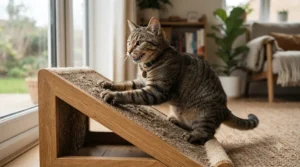
Problem: My cat ignores the scratcher and keeps attacking the couch. Location usually beats material here — move the scratcher directly next to the targeted furniture first, then gradually relocate it once the habit shifts, per Cornell’s behavior guidance on identifying scratching preferences.
Problem: The cardboard scratcher is destroyed within a week. This typically signals an aggressive scratcher who needs sisal’s added resistance, not more cardboard. Try the SmartCat Pioneer Pet Ultimate Scratching Post or Amazon Basics Sturdy Cat Scratching Post instead.
Problem: My cat won’t use a tall post at all. Some cats are exclusively horizontal scratchers. Skip the vertical posts entirely and try the Necoichi Cozy Cat Scratcher Bowl/Tower or Kitty City XL Corrugate Cat Scratcher 3-Pack.
Problem: There’s cardboard confetti everywhere. Place a cheap mat or tray underneath any cardboard product, and consider the denser PetFusion Ultimate Cat Scratcher Lounge, which sheds noticeably less than thin dollar-store pads.
Problem: The post keeps tipping over mid-scratch. A tipping post gets abandoned fast — check that the base is proportional to the height, and re-torque any bolted base like the one on the SmartCat Pioneer Pet Ultimate Scratching Post after the first week of use.
What Is a Sisal vs Cardboard Cat Scratcher?
A sisal vs cardboard cat scratcher comparison refers to the two dominant scratching-surface materials sold today: sisal, a tough plant-fiber rope woven around vertical posts, and cardboard, layered corrugated paper cut into flat pads or lounges. Sisal favors durability and vertical stretching; cardboard favors affordability and shreddable texture. Most households eventually use both.
How to Choose Between Sisal and Cardboard
- Watch your cat’s current scratching motion. Vertical scratchers (couch arms, doorframes) usually prefer sisal posts; horizontal scratchers (rugs, floor mats) usually prefer cardboard pads.
- Set a realistic replacement budget. Sisal costs more upfront but less over multiple years; cardboard costs less upfront but needs replacing every few months under heavy use.
- Measure your available floor space. Small apartments benefit from wall-mounted sisal boards; larger homes can accommodate freestanding cardboard lounges.
- Consider the number of cats using it. Multi-cat households wear down any single scratcher faster, favoring sisal’s added resistance.
- Factor in mess tolerance. Cardboard sheds more debris, especially in the first few weeks of use.
- Test before committing fully. A cheap cardboard multi-pack is a low-risk way to gauge material preference before buying a premium sisal post.
- Plan for placement, not just material. Even the best scratcher gets ignored if it’s not near where your cat already wants to scratch.
Material Longevity: How Long Each Surface Actually Lasts
Material longevity is where sisal and cardboard diverge most sharply, and the gap is bigger than most product descriptions admit. A well-constructed sisal post — like the SmartCat Pioneer Pet Ultimate Scratching Post — can realistically last two to five years under regular use before the wrap needs replacing, because the fiber is woven tightly enough to resist unraveling strand by strand. Cardboard, by contrast, is a consumable in the truest sense: even a dense, reversible option like the PetFusion Ultimate Cat Scratcher Lounge is realistically a three-to-twelve-month product per side, meaning six to twenty-four months total before full replacement.
That said, longevity isn’t purely about material — it’s also about how the cat uses it. A cat who lightly maintains her claws on a cardboard pad a few times a day will get more mileage than a cat who treats a sisal post like a full-body workout twice daily. The Wikipedia entry on scratching posts notes that stability and full-body extension matter as much as surface material in determining whether a post gets used consistently — an unstable post gets abandoned regardless of what it’s covered in, which resets the longevity math entirely. If your goal is minimizing how often you’re shopping for replacements, weight your decision toward sisal; if your goal is minimizing sunk cost when your cat’s preferences change, cardboard’s disposability is actually a feature.
Cat Preference: What the Research Says Cats Actually Want
Cat preference research consistently points toward texture, not brand or price, as the deciding factor. Veterinary behaviorists note that cats gravitate toward materials that most closely mimic tree bark and rough natural wood — the substrate their scratching instinct evolved around in the first place. In practice, that means tightly-woven sisal and dense corrugated cardboard both perform well because they offer resistance the claw can dig into, while smoother surfaces like tightly-looped carpet often get ignored or, worse, teach cats that carpet in general is fair game.
Individual preference still varies enormously cat to cat, which is why identifying your specific cat’s habits matters more than any general ranking. Some cats show a strong preference for surfaces that are already partially shredded and worn-looking, because a visibly used post doubles as a more effective scent-and-visual territory marker — which is part of why experts advise against replacing a scratcher the moment it looks ragged. If you’re unsure where your cat lands, the Frisco Triple Sisal Ball Scratching Post and Kitty City XL Corrugate Cat Scratcher 3-Pack are both low-commitment ways to test sisal against cardboard side by side in the same room.
Value Comparison: Cost Per Year, Not Just Sticker Price
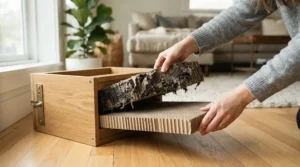
A proper value comparison has to account for replacement frequency, not just the price tag on day one. A $55 sisal post that lasts three years works out to roughly $18 per year. A $15 cardboard pad that needs replacing every four months works out to roughly $45 per year under the same usage pattern — nearly triple the annual cost, despite looking cheaper at checkout. That math flips, though, for light scratchers or households testing a new cat’s preferences, where a $15 pad that never gets fully worn out might last well over a year.
The real lesson here is that “cheaper” and “better value” aren’t the same thing once you factor in your cat’s actual scratching intensity. Heavy scratchers and multi-cat homes should lean toward sisal’s higher upfront cost, since the annualized math favors durability. Light scratchers, single-cat apartments, or anyone still figuring out their cat’s preferences get better value from cardboard’s low buy-in cost and zero risk if the cat ignores it entirely.
Cat Scratcher Comparison: Sisal vs Cardboard vs Carpet
| Material | Durability | Texture Cats Like | Cost Over 2 Years | Best For |
|---|---|---|---|---|
| Sisal | High | Firm, continuous grip | Lower (fewer replacements) | Aggressive/multi-cat households |
| Cardboard | Low-Moderate | Loose, shreddable | Moderate-High (frequent replacement) | Horizontal scratchers, budget-first buyers |
| Carpet | Moderate | Ribbed, snaggable | Moderate | Cats who already scratch carpeted stairs |
Carpet deserves a mention here because it’s the third material most owners consider, even though it’s not part of the core sisal vs cardboard cat scratcher debate. The risk with carpet-covered posts is that cats can’t distinguish “scratcher carpet” from “living room carpet,” which occasionally backfires by reinforcing the exact behavior you’re trying to redirect. Between the two main contenders, sisal wins on pure durability while cardboard wins on upfront affordability and shreddable satisfaction — neither wins on every axis, which is exactly why this list includes both.
Durable vs Disposable Scratcher: Which One Actually Wins Long-Term
Framing this as durable vs disposable scratcher rather than sisal vs cardboard reframes the real decision: are you optimizing for fewer purchases over time, or lower risk per purchase? A durable option like the SmartCat Pioneer Pet Ultimate Scratching Post wins if your cat’s preference is already established and consistent — you’re not gambling on a $55 investment your cat might ignore. A disposable option like the Kitty City XL Corrugate Cat Scratcher 3-Pack wins when preferences are still unknown, when you have kittens whose habits haven’t settled, or when you simply don’t want a large piece of furniture-scale sisal post in a small space.
There’s also a middle path worth naming: hybrid households running both. Many multi-cat homes end up with a durable sisal post as the “anchor” scratcher near the main living space, supplemented by cheap, disposable cardboard pads scattered in bedrooms or home offices. This isn’t indecision — it’s matching the durable-vs-disposable tradeoff to different rooms and different cats’ habits rather than forcing one material to cover every scenario in the house.
Common Mistakes When Buying a Cat Scratcher
The most frequent mistake is buying based on how a scratcher looks in a living room rather than how it functions for an actual cat — a sleek, short post might match your decor and still go completely unused if it’s too short for a full stretch. A close second is placing a brand-new scratcher somewhere out of the way, like a spare room, rather than near the furniture the cat is already targeting; proximity to the “crime scene” matters enormously in the first few weeks.
Owners also frequently underestimate how much scratching intensity varies by cat, buying a flimsy cardboard pad for a cat who needs sisal-level resistance, then concluding “my cat doesn’t like scratchers” when really the material just couldn’t hold up. And per the ASPCA’s position on destructive scratching, replacing a scratcher the moment it starts looking worn is itself a mistake — cats often prefer a surface that’s already partially shredded, since it functions as a more visible territorial mark, so resist the urge to swap it out too early.
Frequently Asked Questions
❓ Is sisal or cardboard better for cats?
❓ How long does a sisal scratching post last?
❓ Why does my cat prefer cardboard over sisal?
❓ Do cardboard scratchers make a mess?
❓ Can I use both sisal and cardboard scratchers at the same time?
Conclusion
The sisal vs cardboard cat scratcher decision ultimately comes down to your cat’s specific habits, not a universal “best” material. Sisal wins on raw durability and is worth the higher price tag for aggressive or multi-cat households, while cardboard wins on affordability and shreddable texture that plenty of cats genuinely prefer. Of the seven options covered here, the SmartCat Pioneer Pet Ultimate Scratching Post stands out as the premium sisal pick for cats who need serious durability, while the PetFusion Ultimate Cat Scratcher Lounge leads the cardboard field for owners who want longevity without going full sisal.
If you’re still unsure which way your own cat will lean, there’s no shame in starting cheap — a multi-pack like the Kitty City XL Corrugate Cat Scratcher 3-Pack costs less than a dinner out and tells you almost everything you need to know within the first week. From there, upgrading to a premium post or lounge becomes a much more confident purchase rather than a guess. Whichever material you land on, the real win isn’t the scratcher itself — it’s the furniture it saves.
Recommended for You
- Hard-Sided vs Soft-Sided Cat Carrier: 7 Best Picks For 2026
- Covered vs Open Litter Box: 7 Best Picks Ranked (2026)
- Ceramic vs Stainless Steel Cat Bowl: 7 Genuinely Safe Picks for 2026
Disclaimer: This article contains affiliate links. As an Amazon Associate, I earn from qualifying purchases. If you purchase products through these links, we may earn a small commission at no additional cost to you.
✨ Found this helpful? Share it with your friends! 💬🤗
