
Table of Contents
Somewhere between your morning coffee and your evening scroll, your cat quietly turned your sofa arm into confetti. It happens fast — a few exploratory claws today, a full-blown upholstery crime scene by next month. A cat scratch furniture protector is a physical barrier — usually clear vinyl tape, adhesive sheets, or pinned guards — placed over vulnerable furniture surfaces to make scratching there unrewarding, redirecting your cat toward a scratching post instead. It doesn’t fight biology; it works with it.
And that distinction matters, because scratching isn’t a behavior problem you can scold away. It’s claw maintenance, territory marking, and stress release all rolled into one instinct, and it’s not going anywhere. What you can control is where it happens. That’s the whole premise behind every couch protector from cats on this list: give the cat a reason to look elsewhere, and your furniture gets to live another day.
This guide breaks down seven real, currently available options — from no-frills starter kits to whole-home bundles — with honest analysis of who each one actually suits. We’ll also cover sofa corner protector strategies for that one high-traffic spot every cat seems to target, plus practical installation tricks, common buying mistakes, and a decision framework so you’re not guessing. According to the ASPCA’s guidance on destructive scratching, redirection — not punishment — is the only strategy that actually sticks long-term, and furniture protectors are a cornerstone of that redirection approach.
Quick Comparison Table
| Product | Best For | Format | Price Range |
|---|---|---|---|
| FixZilla Anti Cat Scratch Furniture Protector | First-time cat owners | Sheets + corner guards + pins | Budget-mid |
| TOOSOFT Clear Vinyl Furniture Protector | Maximum durability | Roll tape (cut-to-fit) | Mid-range |
| Panther Armor Matte Sheets | Cats sensitive to sticky textures | Non-sticky barrier sheets | Mid-range |
| Polamg Clear Sofa Guards | Tight budgets | Sheets, 2 sizes | Budget |
| Lovinch Thicken Vinyl Tape | Curved sofa arms | Flexible roll tape | Mid-range |
| Secopad Large Protector Pack | Big sectionals | XL sheets | Mid-premium |
| FTSTC Whole-Home Bundle | Multi-room households | 12-pack sheets + pins | Premium |
Looking at the table, the split really comes down to format and coverage area. Sheet-and-pin kits like FixZilla and Polamg suit anyone who wants precise, targeted coverage on specific cushions or corners, while roll tapes like TOOSOFT and Lovinch are better when you’re wrapping an entire armrest or a curved chaise edge in one continuous piece. If you’ve got a sprawling sectional or scratching happening in three rooms at once, the larger-format packs from Secopad and FTSTC stretch your budget further per square inch.
💬 Already leaning toward one? Scroll down for the full breakdown before you decide — the details matter more than the price tag here.
Top 7 Cat Scratch Furniture Protectors: Expert Analysis
1. FixZilla Anti Cat Scratch Furniture Protector — best all-around starter kit
The FixZilla 10-pack is the one most people land on first, and there’s a good reason for that: it doesn’t force you to choose between flat sheets and corner coverage, it gives you both in one box. The set combines large matte-clear sheets with dedicated corner-shaped guards, plus 50 twist pins for surfaces where adhesive alone won’t hold in high-traffic zones like armrests. That’s a meaningfully different design decision than most single-format tapes on the market.
In practice, the twist pins matter more than they sound like they should. Adhesive-only protectors can peel at the edges once a cat starts working a corner obsessively, but a pinned protector stays anchored through repeated clawing sessions. That makes this a strong pick for households where scratching is already an established, aggressive habit rather than a new one. Reviewers consistently report that the corner-shaped pieces are the most-used component in the set, since sofa and chair corners are where cats tend to concentrate their attention. On the downside, some buyers note the matte finish is more visible against dark or patterned upholstery than fully transparent tape would be, and it’s explicitly not recommended for leather, faux leather, or velvet — apply it to the wrong material and you risk peeling the finish when you remove it.
Pros:
- ✅ Combines flat sheets and corner-shaped guards in one kit
- ✅ Twist pins add hold in high-scratch zones adhesive can’t manage
- ✅ Reviewers say it’s easy for first-timers to apply correctly
Cons:
- ❌ Matte finish is more visible than clear vinyl on light fabric
- ❌ Not safe for leather, faux leather, or velvet surfaces
At around the budget-to-mid price range for a 10-piece kit, this is a sensible first purchase — you’re not committing to a single format, and you’ll quickly learn whether your cat responds better to flat coverage or corner-specific guards before buying anything more specialized.
2. TOOSOFT Clear Vinyl Furniture Protector — thickest clear vinyl for maximum durability
The TOOSOFT roll is built differently from most protectors on this list: instead of pre-cut sheets, you get a massive 196.9-inch by 16.5-inch continuous roll of 0.1mm vinyl, which the manufacturer states is nearly double the thickness of the standard 0.06mm tape used by many competitors. That extra thickness translates into real-world durability — thinner vinyl tends to tear or crease at stress points where a cat repeatedly digs in, while thicker stock holds its shape and stays intact through months of daily scratching attempts.
Because it’s sold as a roll rather than fixed-size sheets, this is the pick for anyone dealing with an oddly shaped piece of furniture — a curved chaise arm, an ottoman edge, or a stair banister a cat has decided is fair game. You measure, cut, and stick, so there’s no wasted material and no gaps between pieces. Aggregated customer sentiment points to two consistent themes: people appreciate that it removes without leaving adhesive residue, and several buyers specifically mention using it on doors and cabinet edges beyond just sofas. As with nearly every vinyl-tape protector, it’s marked as unsuitable for leather or faux leather, so check your upholstery type before applying it anywhere.
Pros:
- ✅ Nearly twice the thickness of standard-grade competitor tape
- ✅ Continuous roll fits irregular or curved furniture shapes
- ✅ Peels off without leaving sticky residue behind
Cons:
- ❌ Requires manual cutting and measuring — no pre-shaped pieces
- ❌ Not rated for leather, faux leather, or delicate finishes
Priced in the mid-range for the sheer coverage you get, the cost-per-square-inch actually beats most pre-cut sheet kits, which makes it a smart pick if you’re protecting a large or unusually shaped piece.
3. Panther Armor Cat Furniture Protector — best non-sticky solid barrier shield
Most furniture protectors work by being unpleasant to touch — sticky, tacky, uncomfortable underclaw. Panther Armor takes the opposite approach: it’s marketed explicitly as a solid barrier shield rather than a sticky deterrent, using a smooth matte surface that simply gives claws nothing satisfying to dig into, rather than repelling them with texture. The set includes six XL sheets and six large sheets, secured with twist pins for a stable hold.
This distinction matters more than it might seem. Some cats are genuinely undeterred by sticky tape — a subset will tolerate the tacky feel or work around the edges of it — but almost no cat enjoys clawing at a firm, slick surface that offers zero traction and no satisfying “catch.” If you’ve already tried a sticky tape and your cat seemed unbothered by it, a barrier-style shield like this is worth trying next, since it’s solving the problem through a different mechanical principle rather than repeating the same approach. Reviewers who mention switching from adhesive tape to a barrier-style product often report better results specifically with clawing-heavy cats, though the trade-off is that this style relies more heavily on the twist pins for security since there’s less adhesive tack holding it in place.
Pros:
- ✅ Works on cats that tolerate sticky tape without issue
- ✅ No adhesive means zero residue risk on delicate fabric
- ✅ XL and large sheet sizes cover bigger cushions in fewer pieces
Cons:
- ❌ Relies more on twist pins than adhesive for hold
- ❌ Less discreet than fully clear vinyl on some fabrics
At a comparable mid-range price to the FixZilla kit, this earns its spot specifically as the answer for households where sticky tape alone hasn’t solved the problem.
4. Polamg Cat Scratch Furniture Protector — most budget-friendly multi-size pack
If you just want to try furniture protection without a big financial commitment, Polamg‘s 12-pack of clear sheets is the entry point. It ships with two different sheet sizes plus 52 twist pins, giving you enough variety to cover a couch, an armchair, and a couple of doorframes without buying multiple kits. The sheets are self-adhesive and fully cuttable, so oddly sized spots aren’t a dealbreaker.
What makes this genuinely useful rather than just cheap is the sheer piece count relative to price — 12 sheets is enough to outfit an entire living room’s worth of vulnerable corners in one purchase, which is rare at this price point. The trade-off, and it’s a real one, shows up in thickness: budget-tier vinyl sheets in this category tend to be thinner than premium options like the TOOSOFT roll, meaning they may need replacing sooner under sustained, aggressive scratching from a determined cat. Reviewers generally describe the clarity as genuinely see-through rather than the slightly hazy finish some cheaper competitors have, which matters if you care about keeping your furniture looking normal.
Pros:
- ✅ Highest piece count per dollar of any option on this list
- ✅ Two sheet sizes cover both large and small target areas
- ✅ Genuinely transparent finish, not hazy or cloudy
Cons:
- ❌ Thinner vinyl than premium picks, may wear faster
- ❌ Not ideal for cats with unusually aggressive, sustained clawing
For anyone testing the furniture-protector concept for the first time on a tight budget, this is the lowest-risk entry point in the roundup.
5. Lovinch Thicken Vinyl Anti Cat Scratch Tape — best flexible tape for curved sofa arms
Straight edges are easy. Curved, rolled sofa arms — the kind common on modern mid-century and rounded-back designs — are where most rigid protectors struggle to lie flat. Lovinch‘s 160-inch by 12.4-inch thickened vinyl roll is designed with flexibility as the priority, meaning it conforms to rounded surfaces without buckling or leaving lifted edges that a cat can then pick at and peel.
That flexibility is the whole value proposition here. A protector that lifts at the edges is worse than no protector at all in one specific way: it gives a determined cat something new and interesting to claw at (the loose edge itself), which can actually increase scratching in that exact spot. Lovinch’s thicker, more pliable vinyl formulation is built to hug curves and stay adhered through the kind of repetitive flexing that a cat leaning into a scratch session creates. Aggregated reviews frequently mention this specific use case — rounded arms and corners — as the reason buyers chose it over flatter competitor tapes, alongside general agreement that it holds its seal well over weeks of use.
Pros:
- ✅ Purpose-built flexibility for curved and rounded furniture edges
- ✅ Thicker vinyl resists lifting at edges during scratching
- ✅ Roll format means no wasted material on odd shapes
Cons:
- ❌ Slightly narrower width than some competing rolls
- ❌ Still unsuitable for leather or faux leather upholstery
Priced similarly to the TOOSOFT roll, the deciding factor between the two really is furniture shape: flat panels lean TOOSOFT, curves and rounded arms lean Lovinch.
6. Secopad 18 PCS Large Cat Scratch Furniture Protector — best large-format pack for big sectionals
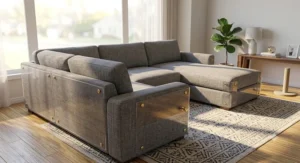
Sectionals are a different problem entirely. You’re not protecting one armrest — you’re protecting four or five distinct scratch-prone zones across a piece of furniture that might span an entire wall. Secopad‘s 18-piece set of large, transparent, self-adhesive sheets is built for exactly that scale, giving you enough coverage to wrap an entire sectional’s exposed corners and arms without running out mid-project or needing a second order.
The math here actually works in your favor. Buying two smaller 10- or 12-packs to cover a large sectional often costs more per usable sheet than one larger-format pack does, and you avoid the annoyance of mismatched leftover pieces from two different product batches. What most buyers overlook when shopping by piece-count alone is that “large” sheets in this set genuinely mean larger surface area per piece, not just a bigger box — which is the detail that actually determines whether you’ll have enough material for a big piece of furniture. The trade-off is that a materials-heavy pack like this is overkill, and a worse value, if you’re only protecting a single chair or one corner.
Pros:
- ✅ 18 pieces at genuinely large dimensions, not just a bigger count
- ✅ Cost-per-square-inch beats buying multiple smaller kits
- ✅ Transparent finish stays discreet across large visible areas
Cons:
- ❌ Overkill and poor value for single-chair or small-area jobs
- ❌ Larger sheets are harder to apply smoothly solo on big curves
In the mid-to-premium price bracket, this earns its cost specifically through scale — it’s the practical choice once your protection project spans more than one or two furniture pieces.
7. FTSTC Anti Cat Scratch Furniture Protector — best whole-home bundle for multi-room coverage
When scratching isn’t confined to the living room — when it’s the sofa and the bedroom doorframe and the hallway console table — you need a kit built around whole-home logic, not single-furniture logic. FTSTC‘s 12-pack is positioned exactly there, generously sized so a single order can realistically cover sofa arms, couch corners, chair legs, and door frames simultaneously, with 52 twist pins included for anywhere adhesive alone won’t hold.
The honest sell here isn’t that this material is dramatically different from other clear vinyl sheets on this list — the film chemistry across most of these products is broadly similar — it’s that the quantity-to-coverage-area ratio is calibrated for a household managing scratching in multiple rooms at once rather than one problem spot. That’s a genuinely different buying scenario than a single-sofa household, and it changes what “value” means: you’re not comparing price-per-sheet in isolation, you’re comparing whether one order solves the whole-house problem or leaves you needing three separate purchases. Reviewers frequently describe using leftover pieces from a 12-pack on secondary furniture weeks after the initial installation, which speaks to genuine surplus capacity rather than a tight fit to a single piece.
Pros:
- ✅ Piece count and sizing calibrated for multi-room coverage
- ✅ Removes cleanly with no residue, staining, or fabric pull
- ✅ Twist pins included for anywhere adhesive alone struggles
Cons:
- ❌ Premium pricing relative to single-sofa-focused kits
- ❌ More material than needed if you only have one problem area
At the premium end of this roundup, the value case rests entirely on scope — if scratching is a whole-house issue, this is priced to solve it in one purchase rather than three separate ones.
Installing and Maintaining Your Cat Scratch Furniture Protector
Getting a protector to actually work long-term is less about which product you buy and more about how you install it. Start by cleaning the target surface with a dry cloth — any dust or fabric fuzz under the adhesive weakens the bond from day one. Press firmly along every edge, especially corners, since lifted edges are the number-one reason protectors fail early; a cat that finds a loose flap will treat it as a new toy rather than a deterrent. For sheet-based kits, overlap adjoining pieces by roughly half an inch rather than butting them edge to edge, which prevents a visible seam your cat’s claws can catch on.
In the first 30 days, expect some testing behavior — most cats will investigate the new texture once or twice before deciding it’s not worth the effort, and that’s normal, not a sign the product has failed. Check pinned areas weekly for the first month, since twist pins can loosen slightly as fabric flexes under daily use. A common mistake is removing the protector too soon once scratching stops; most behaviorists recommend leaving guards in place for at least six to eight weeks so the new habit of using a scratching post instead has time to fully set before you test removal.
Real-World Scenarios: Matching the Right Protector to Your Situation
Consider a college student in a small apartment with one indoor cat and a single hand-me-down sofa that came with the lease. Budget matters more than coverage area here, so a compact kit like Polamg or FixZilla makes sense — enough pieces to protect the two or three spots the cat actually targets, without overspending on a product built for a house-sized problem.
Now picture a family with two cats, a toddler, and a large sectional in an open living-room layout. Research on unwanted scratching behavior notes that homes with children report measurably higher rates of destructive scratching, likely tied to elevated activity and stress levels — which means this household needs broader, more durable coverage. A large-format pack like Secopad, paired with pinned corner guards in the highest-traffic zones, is a better structural fit than a small starter kit that will run out of material fast.
Finally, think about a remote worker with a home office, a bedroom, and a living room all seeing regular cat traffic throughout the day. That’s the multi-room scenario FTSTC‘s whole-home bundle was built for — one purchase, several rooms, no mid-project reorder.
Problem → Solution: Common Cat Scratch Guard Headaches
Problem: The protector keeps peeling at the corners. This is almost always an application issue rather than a product-quality one. Re-clean the surface, press firmly along every edge for a full ten seconds, and consider adding a twist pin at the most-flexed corner if your kit includes them.
Problem: My cat just moves to the spot right next to the protector. This is a sign the protector is working — the cat still wants to scratch there, just not on the shielded surface. Extend your coverage a few inches further, or place a scratching post directly beside the newly protected zone so the redirection has somewhere to land.
Problem: The tape leaves marks when removed. Most quality vinyl tapes are engineered for clean removal, but leaving any adhesive-backed product on for many months in direct sun or near a heat vent can bake residue into some fabrics. Remove and reposition guards every few months rather than leaving one piece in place indefinitely.
Problem: It looks bad on my furniture. Clear vinyl options like TOOSOFT or Lovinch are far less visible than matte sheets, so if aesthetics matter more than raw durability, prioritize transparency over thickness.
Problem: One protector doesn’t seem to be enough scratching deterrent. Combine physical barriers with a genuinely appealing scratching post placed nearby — the barrier alone removes the bad option, but a good post gives the good option somewhere to go, which the ASPCA specifically recommends as the more effective combined approach.
How to Choose a Cat Scratch Furniture Protector
- Identify your furniture material first. Leather, faux leather, and velvet are largely off-limits for adhesive-based protectors — check your upholstery before buying anything sticky.
- Measure your actual scratch zones. Corners, arm fronts, and cushion edges are the usual targets; measuring first prevents buying a kit with the wrong piece size or count.
- Decide between sheets and rolls. Flat, uniform areas suit pre-cut sheets; curved or irregular furniture suits continuous roll tape you cut to fit.
- Factor in your cat’s determination level. A mildly curious cat may respond to any sticky tape; a persistent clawer may need a pinned barrier-style product like Panther Armor or FixZilla.
- Match pack size to scope. One sofa needs a small kit; a whole house needs a bundle like FTSTC — buying too small just means a second order later.
- Check for residue-free removal claims. You’ll eventually want to remove or reposition the protector, and residue left behind can be harder to deal with than the original scratching.
- Budget for replacement, not just purchase. Most protectors need refreshing every few months in high-traffic zones, so treat the ongoing cost as part of your total furniture-preservation budget, not a one-time expense.
Cat Scratch Furniture Protector vs Sofa Corner Protector vs Cat Scratch Guard
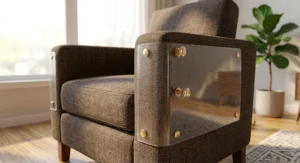
These three terms get used almost interchangeably in product listings, but they describe slightly different use cases worth understanding before you buy. A general cat scratch furniture protector is the broad category — any physical barrier applied to upholstery, and most of the products in this roundup fall under that umbrella. A sofa corner protector is a subset built specifically for the corner shape, often pre-cut into an L or curved profile rather than a flat rectangle, which is why kits like FixZilla and Panther Armor bundle dedicated corner pieces alongside flat sheets — corners take a disproportionate share of scratching damage because they’re where a cat naturally braces to stretch.
A cat scratch guard, meanwhile, is often used as a catch-all marketing term but sometimes specifically refers to non-adhesive barrier products, like the matte shield style Panther Armor uses, as opposed to sticky tape. Understanding this distinction actually matters when you’re comparison-shopping, because a listing titled “scratch guard” might ship you a completely different mechanism than one titled “scratch tape,” even though both promise to solve the same problem. When in doubt, read the material description rather than the product name alone.
Common Mistakes When Buying a Cat Scratch Furniture Protector
The most frequent mistake is buying based on price-per-sheet without checking actual sheet dimensions — a cheaper 12-pack with small sheets can end up costing more per usable square inch than a pricier pack with genuinely large pieces, which is exactly the trap a piece-count-only comparison creates. The second common error is applying adhesive tape to leather or faux leather despite label warnings, which risks peeling the surface finish on removal — an expensive mistake that’s entirely avoidable by checking material compatibility first.
A third mistake is under-buying for the scope of the problem: purchasing a single small kit for a household with scratching happening across multiple rooms almost guarantees a frustrating follow-up order within weeks. And a subtler mistake is expecting a protector alone to solve the behavior — a barrier without an appealing scratching-post alternative nearby just relocates the problem to the nearest unprotected surface rather than resolving it.
What to Expect: Real-World Performance
On paper, every protector in this roundup does the same basic job: make one surface unappealing to claw. In practice, performance plays out differently depending on your cat’s specific scratching style. Cats that scratch primarily for claw maintenance — short, repetitive sessions in the same one or two spots — tend to respond quickly to almost any barrier product, often abandoning the spot within the first week or two. Cats scratching more for territorial marking or stress relief, on the other hand, may test multiple nearby surfaces before settling on an unprotected alternative, which is exactly why pairing a protector with a well-placed scratching post matters so much for that behavioral profile.
Expect a visible “testing period” in the first several days — sniffing, occasional light scratching at the edge, sometimes an irritated look in your direction — before the behavior shift actually settles in. This is normal and not a sign the product isn’t working. What the spec sheet won’t tell you, but aggregated reviewer experience consistently suggests, is that consistency across the household matters: if one family member keeps letting the cat scratch an unprotected chair “just this once,” the redirection signal gets muddled and takes longer to stick.
Cat Scratch Furniture Protector for Renters and Multi-Cat Homes
Renters have a specific version of this problem: furniture damage doesn’t just cost money, it can threaten a security deposit or violate a lease clause about pet damage. For that audience, residue-free removal isn’t a nice-to-have, it’s the entire point — products like TOOSOFT and FTSTC that explicitly advertise clean removal are the safer bet, since leaving sticky residue or a fabric imprint on a rented sofa creates a new problem in place of the old one.
Multi-cat households face a different challenge: more claws, more competing territorial instincts, and often more scratching overall, since cats in multi-pet homes frequently use scratching partly to communicate with each other, not just with their environment. That points toward broader coverage from the start — a large-format or whole-home kit like Secopad or FTSTC — rather than a small single-spot kit that will get outpaced by multiple cats testing multiple surfaces simultaneously.
Long-Term Cost & Furniture Preservation
It’s worth running the actual numbers here, because furniture preservation is fundamentally a cost-avoidance exercise. A mid-range sofa reupholstery job or professional leather repair routinely runs into the hundreds of dollars, while even the most premium furniture protector kit on this list costs a small fraction of that for a full round of coverage. Treated as an ongoing cost rather than a one-time purchase — replacing worn pieces every few months in the highest-traffic zones — the total annual spend on scratch prevention still comes in dramatically below a single reupholstery or furniture-replacement bill.
The math shifts slightly based on which format you choose. Roll tapes like TOOSOFT and Lovinch tend to have a lower cost-per-square-inch at scale, which favors large or multiple pieces of furniture, while pre-cut sheet kits like Polamg and FixZilla are more cost-efficient when you’re targeting a handful of specific, well-defined trouble spots rather than blanket coverage.
Features That Actually Matter (And Those That Don’t)
Thickness and clean-removal claims actually matter — they directly affect durability and whether you risk fabric damage down the line. Twist-pin inclusion matters for high-traffic corners where adhesive alone tends to lift. Genuine transparency matters if the protector will be visible on light-colored furniture for months at a time.
What matters far less than marketing copy suggests: scent claims on purely physical barrier products (a clear vinyl sheet doesn’t have a “cat-repelling scent,” it’s a texture-and-traction play, not an olfactory one), and exaggerated “lifetime” durability claims on adhesive products that, by their nature, degrade with UV exposure and repeated flexing regardless of brand. Read past the headline claims on the listing and focus on material thickness, pin inclusion, and stated removal behavior — those three details predict real-world performance far better than star ratings alone.
Sofa Protection Beyond Tape: Covers, Sprays, and Training
Sofa protection doesn’t have to mean a single method. A washable, water-resistant sofa cover adds a second layer of defense — even if a determined cat gets past a corner guard occasionally, a cover absorbs the impact rather than the cushion fabric itself, and it’s a practical option for households dealing with both scratching and general wear. Deterrent sprays using citrus or other scents cats generally dislike can reinforce a physical barrier, though results vary significantly by individual cat, and sprays alone rarely outperform a physical barrier used consistently.
The most durable long-term solution combines methods: a physical protector on the specific target zone, a genuinely appealing scratching post placed nearby, and positive reinforcement — a treat or praise — when the cat uses the post instead. According to International Cat Care’s guidance on furniture scratching, matching the scratching surface material and orientation (vertical versus horizontal) to your specific cat’s preference dramatically improves how quickly redirection actually works.
Benefits vs Traditional Alternatives
| Approach | Upfront Cost | Effectiveness | Furniture Impact |
|---|---|---|---|
| Furniture protector tape/sheets | Low | High with consistent use | None — fully reversible |
| Declawing | High (vet procedure) | Not a scratching solution | Permanent, medically discouraged |
| Nail caps | Low-mid, recurring | Moderate, requires reapplication | None |
| Ignoring the behavior | None | Low | Cumulative, often severe |
The comparison here isn’t close on the metric that matters most: furniture protectors and nail caps are reversible, low-risk interventions, while declawing is a surgical procedure that a growing number of veterinary bodies discourage on welfare grounds and that doesn’t even address the underlying instinct to scratch. A study published via the National Center for Biotechnology Information on unwanted scratching management found that owners overwhelmingly preferred providing additional appropriate scratching surfaces over more permanent interventions — reinforcing that a barrier-plus-post combination is both the most humane and most commonly recommended path.
✨ Ready to stop the shredding for good? Compare current pricing on the picks above before your next scratching session does more damage.
FAQ
❓ Does cat scratch furniture protector tape actually work?
❓ Will a furniture protector damage my sofa when removed?
❓ How long should I leave a cat scratch guard on my couch?
❓ Can I use a cat scratch furniture protector on leather furniture?
❓ What's the difference between a sofa corner protector and a full couch guard?
Conclusion
Cat scratching isn’t a flaw to correct — it’s a fixed part of who your cat is, and fighting it head-on rarely works. What does work is making the right choice easy: block the couch, and make the scratching post next to it genuinely appealing. Across the seven products in this roundup, the right pick really comes down to your specific setup — a single sofa favors a compact kit like Polamg or FixZilla, curved or irregular furniture favors roll tape like TOOSOFT or Lovinch, and multi-room or multi-cat households are better served by larger packs like Secopad or FTSTC.
Whichever you choose, pair it with consistent household rules and a scratching post your cat actually likes, and give the transition a few weeks to fully take hold. Your furniture — and your cat’s very normal, very unstoppable instinct to scratch — can both come out of this just fine.
✨ Don’t Miss These Exclusive Deals!
🔍 Take your furniture-preservation game to the next level with these carefully selected protectors. Click on any highlighted item to check current pricing and availability. These picks will help you keep a scratch-free home your whole family — cats included — will love!
Recommended for You
- Cute Cat Collar: 7 Adorable Picks That Won’t Sacrifice Safety (2026)
- Cat Collar With Bell: 7 Best Picks to Protect Birds in 2026
- Cat ID Tag 2026: 7 Best Picks to Keep Your Cat Safe
isclaimer: This article contains affiliate links. As an Amazon Associate, I earn from qualifying purchases. If you purchase products through these links, we may earn a small commission at no additional cost to you.
✨ Found this helpful? Share it with your friends! 💬🤗
