
Table of Contents
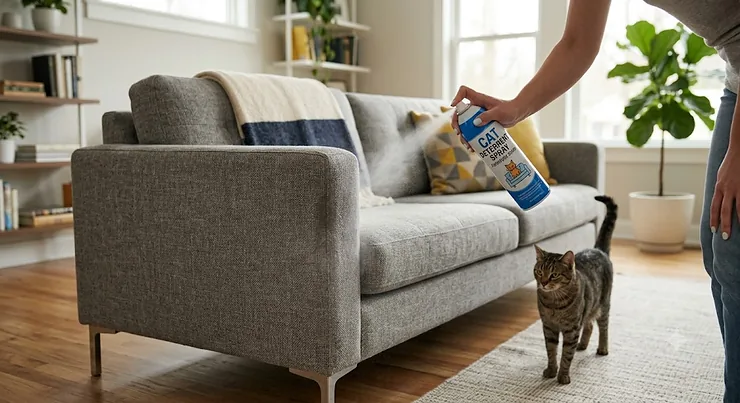
Your couch has claw marks that tell a story, and it’s not a flattering one. If you’ve landed here, you’ve probably already tried yelling “no,” squirting a water bottle, or just accepting defeat and draping a beach towel over your favorite armchair. A cat deterrent spray is a scent- or motion-based product formulated to make a specific surface unpleasant enough that a cat chooses to avoid it, without causing pain or physical harm. That’s the textbook definition, and it matters because the good sprays work with your cat’s nose and instincts, while the bad ones just smell bad and get ignored.

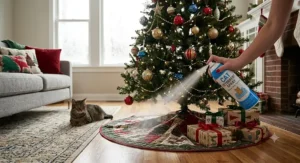
Here’s the thing nobody tells you at the pet store: cat deterrent spray isn’t a magic wand you point at a scratched cushion. It’s one tool in a bigger toolkit, and which bottle you grab depends heavily on whether you’re dealing with a scratching post refusenik, a counter-surfing menace, or a cat who’s decided the Christmas tree is a personal jungle gym. Scratching itself is completely normal — cats do it to shed old claw sheaths, stretch their spine, and mark territory with scent glands in their paws, as the Cornell Feline Health Center explains, so the goal isn’t to punish the behavior but to redirect it.
Below, we’ve dug into seven real cat deterrent spray products currently sold on Amazon, spanning motion-activated devices, pheromone-and-sound combos, and old-school citrus formulas. We’ll walk through what each one actually does, who genuinely reviews it well, where it falls short, and how to combine it with the training tricks that make any spray more effective. No fluff, no invented five-star testimonials — just what the specs and the aggregated review data actually say.
Quick Comparison Table
Before we get into the weeds, here’s the fast version for anyone standing in the pet aisle with a cart full of other errands.
| Product | Type | Best For | Price Range |
|---|---|---|---|
| PetSafe SSSCAT | Motion-activated device | Unattended furniture protection | $40-$55 |
| Sentry Stop That! | Sound + pheromone spray | Multi-cat households | $15-$20 |
| Nature’s Miracle Advanced Platinum | Essential-oil manual spray | Budget indoor training | $10-$15 |
| Four Paws Keep Off | Manual spray | Classic all-purpose deterrent | $10-$14 |
| Nature’s Mace Cat Mace | Large-format outdoor spray | Yards and gardens | $20-$28 |
| Petlinks Scratch Stop | Lemon-eucalyptus manual spray | Sensitive-nosed households | $10-$15 |
| VICSOM Natural Cat Deterrent | Alcohol-free manual spray | Kittens and reactive cats | $10-$14 |
Looking at this lineup, the split really comes down to effort versus automation: the PetSafe SSSCAT costs more up front because it does the spraying for you, while everything else asks you to be the one holding the bottle several times a day. If your cat only misbehaves when you’re not home, that difference in price stops looking like a splurge and starts looking like the whole point.
Found a favorite already? Save yourself the scratched armrest and check current pricing before it changes again! 🐾
Top 7 Cat Deterrent Spray Picks: Expert Analysis
We picked these seven because they cover the real range of what’s on Amazon right now: a motion-sensor device, a hybrid pheromone-and-noise spray, several manual botanical formulas, and one large-format outdoor option. Budget, mid-range, and premium are all represented, along with a kitten-safe pick for households with reactive or very young cats.
1. PetSafe SSSCAT — sprays automatically when you’re not home
The standout feature here is right in the name: SSSCAT uses an infrared motion sensor to detect a cat approaching within about three feet, then fires a burst of compressed air and scent without you lifting a finger. That’s a genuinely different category from every other product on this list, because it doesn’t require you to catch your cat in the act.
The canister delivers an odorless, non-staining spray triggered by motion, with an adjustable nozzle that caps out at roughly a three-foot range. In practice, that means it can guard a countertop, a specific cushion, or a doorway while you’re at work, which solves the classic “she only does it when I leave” problem. The infrared sensor and burst mechanism replace your physical presence, and for cats that clearly know the difference between supervised and unsupervised territory, that’s the whole ballgame.
This is best suited for owners who’ve already tried manual sprays and hit a wall because the cat simply waits them out. Reviewers consistently report that the sudden hiss and puff genuinely startle cats away from a spot within days, though a noticeable slice of feedback flags the motion sensor as occasionally too sensitive or, less often, unresponsive. A smaller number of buyers mention the sprayer misfiring as a stream instead of a fine mist.
Pros:
- ✅ Works automatically without supervision
- ✅ Odorless formula won’t stain furniture
- ✅ Startle response works fast for most cats
Cons:
- ❌ Sensor sensitivity is inconsistent across units
- ❌ Refill canisters add to long-term cost
In the $40-$55 range at the time of research, this sits at the premium end of our list, but for anyone who has already burned through three bottles of manual spray with no results, the price buys back your evenings.
2. Sentry Stop That! Noise and Pheromone Cat Spray — startles first, then calms with pheromones
What makes this one different is the one-two combination baked into a single trigger pull: a sharp sound to interrupt the behavior, followed by a lavender-chamomile pheromone release meant to settle the cat down afterward. Most sprays only do the first half of that job.
The active mechanism relies on an audible burst that redirects attention away from the couch or counter mid-scratch, while the synthetic pheromone component is designed to reduce the anxiety that often drives repeat marking. That combination matters in multi-cat households, where territorial tension is frequently what’s fueling the scratching in the first place, not boredom.
This is a strong match for households juggling two or more cats where stress-related marking overlaps with plain claw maintenance, since it addresses the emotional trigger as well as the physical habit. Aggregated reviewer sentiment is largely positive on effectiveness — most customers report a real drop in furniture scratching — though a recurring theme is frustration that Sentry doesn’t fully disclose the synthetic fragrance ingredients behind the “pheromone” label.
Pros:
- ✅ Dual sound-and-pheromone approach
- ✅ Well-suited to multi-cat tension
- ✅ Positive reviewer consensus on scratching reduction
Cons:
- ❌ Cannot be sprayed directly on the cat
- ❌ Ingredient transparency is limited
Priced in the mid-teens to around $20, it’s a reasonable mid-range pick, especially for anyone who suspects the scratching is really about cat-to-cat friction rather than a dull scratching post.
3. Nature’s Miracle Advanced Platinum Pet Block — budget-friendly essential-oil training aid
The standout here is simple: it’s one of the most widely available indoor training sprays at a genuinely low price point, made by a brand best known for stain and odor removal rather than deterrents specifically.
The formula leans on essential oils to create an unpleasant scent barrier on treated surfaces, which is the classic scent-deterrent mechanism — cats have a far more sensitive nose than we do, so a smell that’s barely noticeable to a human can be a real no-go zone for a cat. Application is straightforward: spray, let it dry, reapply as the scent fades.
This is best for owners testing the waters with their first cat deterrent spray before investing in a device like the SSSCAT, or for spot-treating a single problem cushion rather than an entire room. Reviewer sentiment is mixed but leans positive for cats that respond to scent-based cues at all — a meaningful subset of owners report their cat simply ignored it entirely, which lines up with the broader pattern that scent deterrents work better on some cats than others.
Pros:
- ✅ Low price point for first-time buyers
- ✅ Easy trigger-spray application
- ✅ Widely stocked and easy to reorder
Cons:
- ❌ Effectiveness varies significantly by cat
- ❌ Scent fades and needs frequent reapplication
At around $10-$15, this is the low-risk entry point on our list, and honestly, that’s exactly the role it should play — a cheap first experiment, not a guaranteed fix.
4. Four Paws Keep Off — the long-running classic multi-surface spray
The standout feature is versatility: this one is formulated to work on both dogs and cats, indoors and outdoors, which makes it a practical single-bottle solution if your household deterrent needs span more than one species or more than one room.
Its citrus-forward scent profile taps into a genuinely well-documented aversion — cats and citrus notes tend not to mix — while the formula is designed not to damage fabric, wood, or plants when used as directed. That dual indoor-outdoor claim is useful if you’re trying to keep a cat off a specific porch chair as well as an indoor windowsill.
This suits households with mixed pets or mixed problem zones, since you’re not buying a separate bottle for the yard and another for the living room. What most buyers overlook about a long-running product like this is that its familiarity comes with a real, extensive review history — it’s been reformulated over the years, so older reviews referencing a different scent may not reflect the current formula. Current buyers report reasonably consistent results on scratching deterrence, with the most common complaint being that reapplication is needed more often outdoors due to weather exposure.
Pros:
- ✅ Works for both cats and dogs
- ✅ Rated for indoor and outdoor use
- ✅ Long track record and easy availability
Cons:
- ❌ Outdoor use requires frequent reapplication
- ❌ Scent formulation has changed over product generations
At roughly $10-$14, it’s one of the more affordable multi-purpose options, and the two-species claim alone can save a shopping trip.
5. Nature’s Mace Cat Mace Repellent — large-format spray built for yards and gardens
The standout advantage is sheer volume: at 40 ounces, this is designed for spraying entire garden beds, fence lines, or flower borders rather than a single cushion, which changes the math on cost-per-use considerably for outdoor problems.
The formula is built around a blend the manufacturer markets as effective against urine marking and general territorial scratching outdoors, aimed at keeping neighborhood or outdoor cats away from planting beds and yard furniture rather than training an indoor pet. Because it’s outdoor-rated, it’s meant to hold up better against rain and sun than an indoor-formulated spray would.
This is the right call for anyone dealing with outdoor or stray cats treating a garden as their personal litter box or scratching post, rather than an indoor cat scratching the sofa. Based on the spec comparison with smaller indoor bottles, the per-ounce cost here is actually lower, which matters if you’re covering a large perimeter rather than one armchair — reviewers who use it at that scale report needing to reapply every few days to weeks depending on rainfall.
Pros:
- ✅ Large 40-ounce size covers more ground
- ✅ Formulated specifically for outdoor durability
- ✅ Lower cost-per-ounce than smaller bottles
Cons:
- ❌ Overkill for a single piece of indoor furniture
- ❌ Rain and watering wash away protection faster
At around $20-$28, it’s priced higher than the small indoor bottles, but the value math favors it heavily once you’re covering more than a few square feet.
6. Petlinks Scratch Stop Deterrent Training Spray — lemon-eucalyptus formula for sensitive noses
The standout feature is the specific scent pairing: lemon and eucalyptus rather than the harsher chemical smell that some competing sprays carry, which matters if you’re the one who has to live with the spray, not just the cat who’s supposed to avoid it.
The formula is marketed as safe for furniture, carpet, wood, and painted surfaces, though the manufacturer does recommend a spot test on painted or varnished areas before full application, since pigment and finish reactions can vary. It’s positioned specifically as a scratching deterrent rather than a general repellent, so the scent strength is tuned toward claw-prone furniture zones like couch arms and corners.
This is a solid pick for households where a harsh chemical smell is a dealbreaker — apartment living, sensitive allergies, or simply a preference for a spray that doesn’t make the room smell like a hospital. Reviewers who are happy with it tend to be happy specifically because of the milder scent; the recurring complaint, unsurprisingly, is that some cats shrug off milder formulas entirely, and the product is explicitly designed for adult cats rather than kittens.
Pros:
- ✅ Milder lemon-eucalyptus scent profile
- ✅ Safe for multiple furniture and fabric types
- ✅ More affordable than several premium competitors
Cons:
- ❌ Not recommended for kittens
- ❌ Milder scent means some cats ignore it
Sitting around $10-$15, this is a fair mid-tier value pick if scent tolerance in your own household is as much a factor as your cat’s behavior.
7. VICSOM Natural Cat Deterrent Spray — alcohol-free formula built for sensitive and young cats
The standout advantage is right there in the “alcohol-free” claim, which sounds like a minor detail until you remember that alcohol-based sprays can sting or irritate a cat’s nose and paw pads on contact, making this a gentler option for kittens or skittish cats.
The natural, non-toxic formulation is designed for use across sofas, rugs, curtains, and plants both indoors and outdoors, and the no-alcohol claim is specifically aimed at reducing irritation risk during the repeated daily applications that most manual sprays require in the first few weeks. That gentleness is the entire selling proposition — this isn’t the strongest-smelling option on the list, it’s the softest.
This is best matched to households with kittens under a year old, senior cats with sensitive respiratory systems, or any cat that’s reacted poorly to a stronger spray in the past. Aggregated feedback trends positive for gentleness and lack of irritation, with the tradeoff being that gentler formulas generally require more consistent, frequent reapplication to hold their ground compared to stronger competitors.
Pros:
- ✅ Alcohol-free formula reduces irritation risk
- ✅ Safe positioning for kittens and sensitive cats
- ✅ Multi-surface indoor and outdoor use
Cons:
- ❌ Gentler formula may need more frequent reapplication
- ❌ Less effective against especially stubborn scratchers
At around $10-$14, it’s priced competitively with the other budget manual sprays, and it earns its spot specifically for households where gentleness is non-negotiable.
Practical Usage Guide: Getting Your Cat Deterrent Spray Routine Right
Buying the bottle is the easy part. The first thirty days are where most people either build a habit that sticks or give up and shove the spray in a cabinet. Start by cleaning the target area with an enzymatic cleaner first — leftover scent marks from previous scratching sessions can actually compete with your new spray and undermine it, since scent, not stain, is what’s drawing your cat back.
Apply consistently, typically two to four times daily for the first one to two weeks, then taper as you observe reduced interest in the treated area. A common first-month mistake is spraying once, seeing no immediate change, and assuming the product doesn’t work — most sprays need repeated exposure to build the association, not a single dramatic reaction. Always test a small hidden patch on fabric or finished wood 24 hours before full application, since some formulas can leave faint marks on certain materials despite manufacturer claims of being non-staining.
Pair the spray with an appealing alternative nearby. Placing a scratching post or pad directly next to the treated furniture gives your cat somewhere to redirect that instinct rather than just removing an option with nothing offered in return. That pairing is genuinely the difference between a spray that “stops scratching” and one that “moves scratching somewhere better,” and only the second version actually solves the underlying need.
Real-World Scenarios: Which Cat Repellent Spray Fits Your Household
If you’re a college student in a studio apartment with one indoor cat clawing the arm of a secondhand couch, a budget cat repellent spray like the Nature’s Miracle Advanced Platinum or VICSOM Natural Cat Deterrent makes sense — low commitment, low cost, and you’re around often enough to reapply daily without much hassle.
If you’re managing a two-cat household where the scratching seems to spike whenever the cats have a spat, the Sentry Stop That! spray’s combined sound-and-pheromone approach directly targets that anxiety-driven marking pattern rather than treating it as pure claw maintenance.
If you work long hours and your cat only misbehaves while you’re gone, manual sprays are fighting an uphill battle by definition — you can’t reapply what you’re not there to see fail. The PetSafe SSSCAT motion-activated device solves that specific timing problem, delivering consequences whether or not you’re home to catch the moment.
And if you’re a renter or homeowner dealing with neighborhood cats treating your flower beds as a litter box, none of the indoor-focused sprays above are the right tool — that’s squarely Nature’s Mace Cat Mace Repellent territory, built and priced for coverage over volume.
Problem → Solution: Using Spray to Keep Cats Away From Off-Limits Zones
Problem: Cat keeps returning to a specific scratched cushion. Clean the area with an enzymatic cleaner, then apply a manual spray like Petlinks Scratch Stop two to three times daily for the first week, placing a scratching post directly adjacent.
Problem: Cat scratches only when you’re not home. A manual keep cats away spray can’t intervene when you’re at work, so a motion-activated option like the PetSafe SSSCAT closes that gap by triggering automatically.
Problem: Household has a kitten and an adult cat with different tolerances. Use a gentler, alcohol-free option such as VICSOM Natural Cat Deterrent for shared zones, since kitten skin and respiratory systems are more reactive to harsher formulas.
Problem: Outdoor cats are digging up garden beds. Indoor sprays won’t hold up to rain and sun exposure, so a larger outdoor-rated product like Nature’s Mace Cat Mace Repellent is built for that specific exposure and coverage need.
Problem: Spray seems to have stopped working after initial success. Scent-based deterrents fade, and cats can also habituate to a static smell over time — rotating between two different scent profiles, like switching from a citrus formula to a lemon-eucalyptus one such as Petlinks Scratch Stop, often restores effectiveness.
How to Choose a Cat Deterrent Spray
- Identify whether the problem is timing-dependent. If scratching only happens unsupervised, a motion-activated device like PetSafe SSSCAT solves a problem that manual sprays structurally can’t.
- Match scent strength to your cat’s age and sensitivity. Kittens and older cats generally do better with gentler, alcohol-free formulas such as VICSOM Natural Cat Deterrent.
- Check the indoor-versus-outdoor rating. Outdoor conditions demand a more weather-resistant, larger-volume product like Nature’s Mace Cat Mace Repellent rather than a delicate indoor spray.
- Factor in your own scent tolerance, not just your cat’s. You’ll be smelling this too, so a milder lemon-eucalyptus option can matter as much for you as for your cat.
- Consider multi-cat dynamics. If more than one cat is involved and tension seems to be part of the trigger, a pheromone-inclusive product like Sentry Stop That! addresses more than pure scent aversion.
- Calculate true cost-per-use, not just sticker price. A cheaper small bottle used four times daily may cost more over a month than a pricier device requiring less frequent attention.
- Always pair the spray with a redirect option. No spray on this list works as well in isolation as it does alongside a scratching post placed where the cat already wants to be.
Furniture Cat Spray: Protecting Problem Areas Room by Room
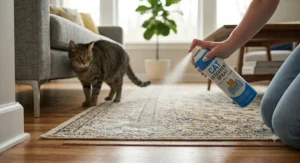
Not every piece of furniture needs the same approach. Couch arms and corners take the brunt of scratching because they’re at the perfect height for a full-body stretch, which means a furniture cat spray applied there needs frequent reapplication in exactly that zone rather than a light misting across the whole cushion. Dining chairs and headboards, by contrast, are usually secondary targets driven more by proximity to a favorite napping spot than by texture preference.
For fabric upholstery, a manual spray like Petlinks Scratch Stop works well because the lemon-eucalyptus scent dissipates gradually rather than leaving a lingering chemical note in soft materials that absorb odor easily. For wood furniture — table legs, bed frames, banisters — always spot-test first, since finished wood can react differently to essential-oil formulas than fabric does, and a few sprays on this list explicitly flag painted or varnished surfaces as needing caution.
Curtains and drapes present their own wrinkle: cats often climb rather than scratch these, so a spray alone rarely solves a climbing habit — pairing it with a nearby cat tree that satisfies the vertical-climbing instinct tends to outperform spray-only approaches by a wide margin.
The Science of Scent Deterrent: Why Certain Smells Work
A cat’s nose has vastly more scent receptors than ours, which is exactly why a scent deterrent that’s barely detectable to a human can be genuinely off-putting to a cat. Citrus, lemon, eucalyptus, and rosemary notes recur across nearly every product on this list precisely because cats show a consistent aversion pattern to these particular scent families, unlike, say, lavender, which many cats tolerate or even seem drawn to.
What the spec sheet won’t tell you, but reviewers note across dozens of products, is that individual cats vary enormously in how strongly they respond to any given scent deterrent — some cats avoid a treated surface within a day, others seem entirely unbothered regardless of formula. That variability is one reason honest reviews so often split down the middle on the exact same bottle: it’s not that the product is inconsistent, it’s that cat noses are.
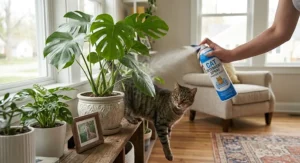
It’s worth noting that “natural” doesn’t automatically mean “safe to apply liberally.” Several essential oils marketed in pet products, including some citrus and eucalyptus derivatives, appear on the ASPCA’s list of essential oils that pose a risk to cats when concentrated or ingested in quantity. Commercial deterrent sprays are formulated at safe dilutions for surface application, but it underscores why spraying furniture — not your cat directly — is always the correct method.
Cat Deterrent Spray vs Physical Barriers and Training Tools
| Approach | How It Works | Best For | Drawback |
|---|---|---|---|
| Cat deterrent spray | Scent, sound, or motion-triggered aversion | Flexible, ongoing multi-surface protection | Needs reapplication and patience |
| Sticky/double-sided tape | Physical texture aversion | Small, specific target zones | Visible, can lose stickiness over time |
| Physical shields (vinyl/plastic) | Blocks claw contact entirely | Corners and arms of furniture | Alters furniture’s look and feel |
| Scratching post redirection | Provides an approved alternative surface | Long-term behavior change | Doesn’t stop access to the original target alone |
The clearest takeaway from this comparison is that spray and physical barriers solve different halves of the same problem — sprays discourage a specific spot, while physical shields prevent damage even if the cat ignores the deterrent entirely. Combining a Petlinks Scratch Stop application with a redirect post tends to outperform either method alone, because the cat isn’t just blocked from the couch — it’s actively guided somewhere better.
✨ Ready to stop the scratching for good? Compare today’s picks and grab the one that fits your home! 🐱
Behavior Modification: Making the Spray Part of a Long-Term Plan
Cat deterrent spray works best as one piece of a broader behavior modification approach rather than a standalone fix, and that distinction matters more than most product labels let on. VCA Animal Hospitals notes that synthetic facial pheromone products can help reduce marking when applied to problem spots, which reinforces a pattern seen across the sprays on our list: scent-based products work in tandem with, not instead of, environmental changes like scratching post placement and consistent positive reinforcement.
Positive reinforcement outperforms punishment here by a wide margin. Yelling or physically correcting a cat after the fact tends to build fear or wariness of you specifically, without actually reducing the unwanted scratching when you’re not around to enforce it — which circles right back to why timing-independent tools like motion-activated sprays exist in the first place. Rewarding a cat immediately after it uses an approved scratching surface, even with something as simple as a treat or attention, reinforces the behavior you actually want far more effectively than any spray discourages the one you don’t.
Consistency across the household matters too. If one household member sprays diligently and another lets the cat scratch the “forbidden” chair unsupervised, the mixed signals slow progress considerably — cats build associations based on patterns, and an inconsistent pattern is a weak one.
Safe Repellent Use: Ingredients and Practices to Avoid
Not every deterrent marketed for cats is actually formulated with cats in mind, and this is one area where checking the label matters more than trusting the packaging. Never spray a deterrent directly onto your cat’s fur or skin — every product on our list is designed for surface application only, and applying any scented product straight to a cat risks skin or respiratory irritation regardless of how “natural” the ingredient list looks.
Essential oils deserve particular caution here. Cats process certain compounds differently than humans or dogs do, and veterinary toxicologists have long warned that concentrated essential oils can cause everything from stomach upset to more serious liver strain in cats if ingested in real quantity. That’s specifically a concern with concentrated, undiluted oils rather than properly formulated commercial sprays, but it’s exactly why grooming behavior matters: a cat that licks a heavily treated surface repeatedly could ingest more of a scent compound than intended, so lighter, more targeted application beats heavy dousing every time.
A genuinely safe repellent routine means applying to inanimate surfaces only, choosing alcohol-free formulas around kittens and seniors, spot-testing new products, and keeping the original bottle’s ingredient list on hand in case a vet ever needs it. When in doubt about a specific formula, a quick call to your veterinarian costs nothing and settles the question for good.
Long-Term Cost & Maintenance
Manual sprays look cheap at $10-$15 a bottle, but the real cost shows up in reapplication frequency. A bottle used four times daily during an intensive first month can be gone within two to three weeks, meaning the effective monthly cost of a “budget” option can quietly rival a pricier device that requires far less attention. The PetSafe SSSCAT, despite its higher upfront price, shifts cost toward periodic refill canisters rather than daily bottle turnover, which tends to even out over six months of ownership for households with a persistent scratcher.
Outdoor sprays like Nature’s Mace Cat Mace Repellent actually offer the best cost-per-ounce on this list at scale, since covering a garden bed with a small indoor bottle would require multiple purchases anyway. Maintenance-wise, expect any scent-based product to need reapplication after rain, cleaning, or simply time — scent deterrents fade, that’s simply how they work, and budgeting for that ongoing cost from day one avoids the surprise of “it stopped working” a month in.
Frequently Asked Questions
❓ Does cat deterrent spray actually work?
❓ How often should I apply cat repellent spray?
❓ Is cat deterrent spray safe around kittens?
❓ What's the difference between a scent deterrent and a motion-activated spray?
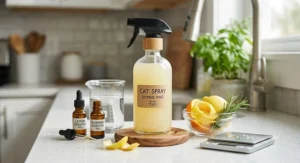
❓ Can I make my own cat repellent spray at home?
Conclusion
There’s no single best cat deterrent spray for every household — there’s only the best one for your specific scratching problem, your cat’s sensitivity, and how much daily attention you can realistically give it. If timing is your issue, the PetSafe SSSCAT solves what no manual spray can. If multi-cat tension is driving the behavior, Sentry Stop That! tackles the emotional trigger alongside the scent. And if you’re just testing the waters on a budget, Nature’s Miracle Advanced Platinum or VICSOM Natural Cat Deterrent offer a low-risk starting point.
Whichever bottle ends up on your shelf, remember that spray alone rarely finishes the job. Pairing it with a scratching post, consistent reapplication, and positive reinforcement for good behavior turns a temporary deterrent into an actual, lasting habit change — for further reading on why scratching happens in the first place, UC Davis veterinary researchers break down the full behavioral picture, which is worth remembering the next time your cat eyes that armchair.
Recommended for You
- Cat Scratch Tape 2026: 7 Picks That Actually Save Your Sofa
- Cat Scratch Furniture Protector: 7 Best Picks to Save Your Sofa (2026)
- Cute Cat Collar: 7 Adorable Picks That Won’t Sacrifice Safety (2026)
Disclaimer: This article contains affiliate links. As an Amazon Associate, I earn from qualifying purchases. If you purchase products through these links, we may earn a small commission at no additional cost to you.
✨ Found this helpful? Share it with a fellow cat owner still fighting the furniture wars! 💬🐾
