
Table of Contents
Cat supplies for multiple cats are the gear — litter boxes, feeders, water stations, scratchers, and calming tools — engineered so two or more cats can eat, drink, and eliminate without competing for the same scarce resource. That’s the whole ballgame, honestly. One cat is a houseguest. Two or more cats are a small, furry economy, and economies run on supply. Skimp on supply and you get hoarding, guarding, and a hallway that smells like regret.
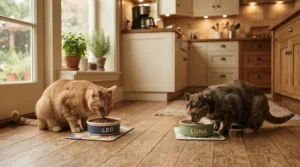
If you’ve ever watched your “sweet” tabby body-block a littermate from the food bowl, you already know the stakes. Multi-cat households don’t fail because the cats hate each other — they fail because the setup forces conflict where none needs to exist. The fix isn’t more love. It’s more stuff, placed smarter.
This guide walks through seven real, currently available products that solve the actual friction points of multi-cat living: shared litter, resource guarding, vertical territory, and inter-cat tension. We’ll compare them head-to-head, dig into who each one is really for, and hand you a practical setup plan — the kind built on species-specific environmental needs guidelines that veterinary behaviorists actually publish, not marketing copy.
Quick Comparison Table: Best Cat Supplies for Multiple Cats
| Product | Category | Price Range | Best For |
|---|---|---|---|
| Litter-Robot 4 | Self-cleaning litter box | Premium, around $700 | Eliminating scooping wars in 2-3 cat homes |
| Neakasa M1 Plus | Budget automatic litter box | Mid-range, $200-$300 | First-time automatic box buyers, up to 3 cats |
| SureFeed Microchip Pet Feeder | Selective feeder | Mid-range, $150-$250 | Stopping food stealing between cats |
| Veken 108oz Stainless Steel Fountain | Water fountain | Budget, under $60 | Hydration for 2-4 cats sharing one water source |
| Feandrea 81.1-Inch Cat Tree | Vertical territory | Mid-range, $150-$250 | Homes needing more climbing space than floor space |
| FELIWAY MultiCat Starter Kit | Pheromone diffuser | Budget, under $35 | Reducing tension between cats that don’t quite get along |
| Upgraded Elevated Cat Bowls with Mat | Feeding station | Budget, under $25 | Side-by-side feeding without whisker fatigue |
Here’s the pattern worth noticing: nothing on this list is a luxury item. Every single one exists to remove a specific point of friction — the fought-over box, the stolen kibble, the one water bowl three cats eye like it’s the last well in the desert. Buy for the friction you actually have, not the friction Instagram says you should have. A two-cat apartment doesn’t need the same setup as a five-cat rescue foster home, and the table above sorts roughly cheapest-to-priciest so you can build a system around your actual budget rather than someone else’s flex.
💬 Found a product here that solved a problem you didn’t know had a name? Share this guide with another multi-cat household — future-you’s carpet will thank you.
Multi-Cat Household Essentials: What Actually Matters
Every multi-cat household essentials list eventually converges on the same five categories: litter, food, water, vertical space, and stress management. Skip that boring wording for a second and think about it from the cat’s point of view. A cat entering a multi-cat home isn’t thinking “I live with roommates.” It’s thinking in resources and territory — full stop. Nothing about domestication erased forty million years of solitary-hunter wiring.
What most first-time multi-cat owners overlook is that the number of items matters less than the spacing. Three litter boxes lined up against one wall functions, socially, like one giant litter box — a dominant cat can guard the entire row from six feet away. The American Association of Feline Practitioners frames this directly: cats need multiple and separated key environmental resources — food, water, toileting, scratching, play, and resting areas — each in its own location, away from the others, with at least two options per resource type. That single principle, more than any specific product, determines whether your home feels calm or like a pressure cooker with fur.
The essentials, then, aren’t really “things.” They’re systems: enough litter capacity spread across enough rooms, enough feeding stations that no cat can see and guard another’s bowl, enough vertical real estate that a nervous cat has somewhere to go that isn’t a fight. The seven products below are simply the physical tools for building that system — pick based on which resource is currently causing the most friction in your specific home, not which one looks best in a listing photo.
Top 7 Cat Supplies for Multiple Cats: Expert Analysis
1. Litter-Robot 4 — self-cleaning box that ends scooping wars
The Litter-Robot 4 is the one product on this list most owners mention unprompted when asked what actually changed their multi-cat household. The standout feature is its sensor-triggered cleaning cycle, which sifts waste into a sealed bin minutes after each use rather than waiting for your evening scoop.
That timing matters more in multi-cat homes than single-cat ones. A soiled box left uncleaned for hours becomes a resource one confident cat can claim simply by lingering nearby, and a cat that’s genuinely clean-conscious will often refuse a dirty box outright and eliminate elsewhere. The Litter-Robot 4‘s 7-cat weight capacity and self-leveling globe mean the surface stays consistently clean between cats, not just between your own cleanings. Based on the spec comparison with older Litter-Robot generations, the 4’s quieter motor and app-based waste-level tracking are the real upgrades — the core sifting mechanism itself is largely unchanged because it already worked.
Reviewers consistently report that the biggest adjustment period is training skittish cats to trust the moving globe; Whisker’s night-light ring and “quiet mode” delay help, but a cat with severe noise sensitivity may need a slower introduction than the manual suggests.
Pros:
- ✅ Sifts waste within minutes, so no cat claims a dirty box as guarded territory
- ✅ App tracking lets you spot which cat is under- or over-using the box
- ✅ Rated for up to 7 cats per unit, reducing how many units a large household needs
Cons:
- ❌ Higher upfront cost than two or three manual boxes combined
- ❌ Some cats need a multi-week adjustment period before trusting it fully
Priced in the premium range around $700, the Litter-Robot 4 earns its cost back in scooping time saved and reduced house-soiling incidents — worth it if litter box guarding is your household’s main flashpoint.

2. Neakasa M1 Plus — open-top budget pick for up to 3 cats
The Neakasa M1 Plus leads with an open-top design, which sounds like a minor detail until you realize enclosed automatic boxes intimidate a meaningful share of cats. That open layout means no cat has to commit to a tunnel entrance where a housemate could ambush them.
Its six infrared sensors track presence and prevent the cleaning cycle from running while a cat is inside or nearby — a real safety feature, not filler. What most buyers overlook about this model is the 11.2-liter waste bin size relative to its price point; it’s smaller than the Litter-Robot’s, which means more frequent bin changes in a genuinely busy 3-cat household, but it also keeps the unit’s footprint compact enough for apartments where floor space for multiple boxes is the real constraint.
Reviewers consistently note the value angle here: this is the automatic litter box people buy when they want to test whether self-cleaning tech is worth it before committing to a premium unit. Aggregated feedback flags occasional app-connectivity hiccups, though most describe the physical hardware as reliable.
Pros:
- ✅ Open-top layout reduces ambush anxiety in tense multi-cat homes
- ✅ Six sensors keep the cycle from running near an occupying cat
- ✅ Compact footprint fits small apartments better than bulkier rivals
Cons:
- ❌ Smaller waste bin needs more frequent emptying with 3 active cats
- ❌ App connectivity is reported as inconsistent by some owners
In the $200-$300 range, the Neakasa M1 Plus is the sensible entry point if you’re testing automatic litter for the first time.
3. SureFeed Microchip Pet Feeder — stops food stealing between cats
Food stealing is arguably the single most common multi-cat complaint, and the SureFeed Microchip Pet Feeder solves it at the mechanism level rather than the training level. The lid unlocks only when it reads a specific cat’s existing microchip or an included RFID collar tag — no new hardware implant required, since it activates from a microchip your cat likely already has.
In practice, this means a dominant cat physically cannot muscle a subordinate cat off its bowl, because the feeder simply won’t open for the wrong cat. That’s a bigger deal than it sounds — resource guarding around food is one of the most reliable predictors of chronic multi-cat stress, and removing the possibility of theft does more than any behavioral correction ever will. The feeder can also store up to 32 pet profiles and switch between wet and dry food, which matters if your cats are on different prescription diets.
What the spec sheet won’t tell you, but reviewers note, is that a small minority of cats — particularly nervous ones — need a week or two of training mode (lid propped open) before they trust the mechanism enough to approach confidently.
Pros:
- ✅ Physically prevents food theft via microchip or RFID recognition
- ✅ Supports both wet and dry food for cats on different diets
- ✅ Stores multiple pet profiles without needing to reprogram after battery swaps
Cons:
- ❌ Some cats require a training period before using it confidently
- ❌ Battery-only operation means no direct power option
Mid-range at roughly $150-$250, the SureFeed Microchip Pet Feeder pays for itself the first time it prevents a cat’s prescription diet from becoming someone else’s snack.
4. Veken 108oz Stainless Steel Cat Water Fountain — hydration without the queue
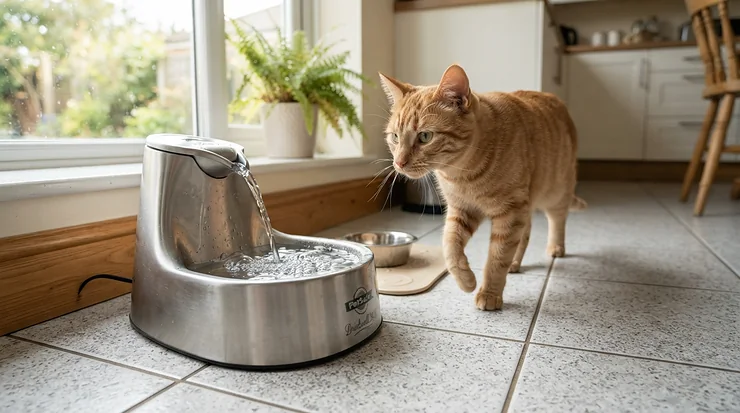
Cats are famously bad at self-monitoring thirst, a leftover trait from their desert-dwelling ancestors, and a single small water bowl in a multi-cat home often means the boldest cat drinks first and most while a timid housemate waits — or worse, doesn’t bother. The Veken 108oz Stainless Steel Cat Water Fountain addresses this with genuine scale: a wide drinking surface lets two cats access water simultaneously rather than queuing, and the 3.2-liter reservoir means the household’s most confident drinker can’t empty it before everyone else gets a turn.
The 304 stainless steel construction is a meaningful upgrade over plastic alternatives — stainless resists the microscopic scratching that traps bacteria and can contribute to feline chin acne, a common but under-discussed skin issue in multi-cat plastic-bowl households. At a reported 25-decibel pump, it’s quiet enough that noise-sensitive cats don’t avoid it, which matters because cats hesitate around fountains with loud motors, and quieter models see more consistent use across timid and confident personalities alike.
Aggregated review sentiment is strong on capacity and build quality, with the main recurring complaint being filter replacement cost over the long run — a real ongoing expense worth budgeting for rather than a dealbreaker.
Pros:
- ✅ Wide surface lets two cats drink at once, cutting queue-related stress
- ✅ 304 stainless steel resists bacterial buildup better than plastic
- ✅ Quiet 25dB pump doesn’t spook noise-sensitive cats
Cons:
- ❌ Ongoing filter replacement adds a small recurring cost
- ❌ 3.2L capacity may need topping off in very hot climates with 4+ cats
Budget-friendly under $60, the Veken 108oz Stainless Steel Cat Water Fountain is the cheapest fix on this list for a genuinely common multi-cat problem.
5. Feandrea 81.1-Inch Cat Tree — the tallest vertical territory on the market
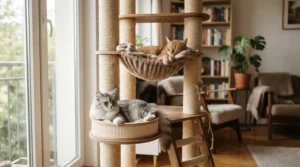
Floor space in a multi-cat home is finite and contested; vertical space, mostly, isn’t. The Feandrea 81.1-Inch Cat Tree leans hard into that math, standing tall enough to create genuinely distinct height zones rather than just one more surface to compete over.
Here’s what most buyers get wrong about vertical furniture: taller isn’t automatically better, but more distinct levels almost always is. Multiple perches at different heights let a dominant cat claim the top platform while a more anxious cat settles into a mid-level condo without feeling cornered — cats naturally sort themselves by elevation when given the option, which is precisely why a single 81-inch tower with several separate zones often defuses more tension than three shorter, single-perch scratchers scattered around a room. The enclosed condo section doubles as a hideout, giving a stressed cat somewhere private to retreat that isn’t a closet or under the bed.
Reviewers consistently flag assembly time as the main friction point — this is a multi-hour build, not a five-minute unbox — but describe the finished structure as notably stable even with multiple cats jumping between levels simultaneously, which is the whole point.
Pros:
- ✅ 81.1-inch height creates multiple distinct vertical territory zones
- ✅ Enclosed condo offers a private retreat for anxious or subordinate cats
- ✅ Sturdy base holds up to simultaneous multi-cat use
Cons:
- ❌ Long, involved assembly process
- ❌ Requires meaningful floor footprint despite the vertical design
At $150-$250, the Feandrea 81.1-Inch Cat Tree is the single best territory-management purchase on this list for homes where cats currently have nowhere to escape a housemate.
6. FELIWAY MultiCat 30-Day Starter Kit — pheromone-based harmony in a plug
Not every multi-cat conflict is about a physical resource — some of it is pure social tension, and that’s the gap the FELIWAY MultiCat 30-Day Starter Kit is built to close. The diffuser releases a synthetic copy of the feline “appeasing pheromone,” the same chemical signal a mother cat naturally produces to create calm among her kittens, dispersed continuously across roughly 700 square feet of living space.
This is honest-analysis territory, not hype: pheromone therapy isn’t a guaranteed fix, and the manufacturer itself frames it as one layer of a larger environmental strategy rather than a standalone cure. Reviewers consistently note noticeable improvement in blocking, staring, and chasing behaviors within one to three weeks of continuous use, alongside a smaller but real minority who report no detectable change at all. The ASPCA’s own multi-cat guidance backs the category generally, recommending pheromone therapy such as Feliway Multi-Cat as part of a well-designed home environment with plenty of access to resources — notably, as a complement to good resource setup, not a substitute for it.
It’s unscented to humans, requires zero daily effort beyond a monthly refill swap, and covers enough square footage for most apartments and mid-sized homes on a single unit.
Pros:
- ✅ Mimics natural calming pheromones with no daily effort required
- ✅ Covers roughly 700 sq ft of living space per diffuser
- ✅ Backed by ASPCA-referenced use in multi-cat introduction protocols
Cons:
- ❌ Results vary — a minority of cats show no measurable change
- ❌ Refills add a recurring monthly cost
Under $35 to start, the FELIWAY MultiCat 30-Day Starter Kit is worth trying before anything more drastic if your cats tolerate but don’t quite trust each other.
7. Upgraded Elevated Cat Bowls with Food Mat — side-by-side feeding without the stress
Rounding out the list at the budget end, the Upgraded Elevated Cat Bowls with Food Mat tackles a smaller but surprisingly common friction point: whisker fatigue combined with awkward, competitive feeding posture. The 15-degree tilted, shallow bowl design keeps whiskers from brushing bowl walls during eating — a real sensory stressor for some cats — while the raised stand reduces the neck strain of floor-level bowls.
For multi-cat households specifically, the practical win is enabling comfortable side-by-side feeding stations rather than one central bowl everyone circles. Reviewers consistently note the included non-slip food mat as a genuine value-add most competitors skip, catching spills and keeping the stand from sliding during enthusiastic eaters. What most buyers overlook: this isn’t a resource-guarding solution the way the SureFeed feeder is — it’s a comfort-and-posture upgrade that works best paired with enough physical bowl stations that no cat has to eat within lunging distance of another.
Aggregated feedback flags the plastic stand as needing more careful cleaning than an all-metal alternative, and the mat can shift on very smooth flooring.
Pros:
- ✅ 15-degree tilt and shallow shape reduce whisker fatigue
- ✅ Included non-slip mat catches spills and stabilizes the stand
- ✅ Affordable way to add multiple separated feeding stations
Cons:
- ❌ Plastic stand requires more diligent cleaning than metal options
- ❌ Mat can slide on very smooth flooring
Under $25, the Upgraded Elevated Cat Bowls with Food Mat is the cheapest way to add another separated feeding station to your setup.
Top 7 Products: Full Specification Comparison
| Product | Type | Capacity/Rating | Price Range | Best For |
|---|---|---|---|---|
| Litter-Robot 4 | Self-cleaning box | Up to 7 cats | ~$700 | Ending litter box guarding |
| Neakasa M1 Plus | Automatic box | Up to 3 cats | $200-$300 | First automatic box buyers |
| SureFeed Microchip Pet Feeder | Selective feeder | 32 pet profiles | $150-$250 | Stopping food theft |
| Veken 108oz Fountain | Water fountain | 3.2L / 108oz | Under $60 | 2-4 cat hydration |
| Feandrea 81.1″ Cat Tree | Vertical furniture | Multi-level | $150-$250 | Territory management |
| FELIWAY MultiCat Kit | Pheromone diffuser | ~700 sq ft | Under $35 | Household harmony |
| Elevated Bowls with Mat | Feeding station | 2-bowl set | Under $25 | Whisker-friendly feeding |
Looking at the comparison above, the Litter-Robot 4 and Feandrea 81.1-Inch Cat Tree represent the biggest single-purchase impact on daily household tension, but they’re also the priciest entries here. If your budget is tight, start with the FELIWAY MultiCat Starter Kit and Elevated Bowls with Mat — both under $35 combined — and reassess after a month. Households with three or more cats sharing tight square footage should prioritize the Neakasa M1 Plus over a single premium box, since two mid-range units spread across rooms beat one expensive unit cats have to queue for.
💬 Just one tap — share this comparison with a fellow cat parent who’s still Googling “why do my cats fight over food” at 2am!😊
Practical Usage Guide: Your Multi-Cat Home Setup in the First 30 Days
Getting a multi-cat home setup right isn’t about buying everything at once — it’s about sequencing. Week one, focus purely on litter and water: place boxes and fountains in at least two separate rooms, never side by side, and never near a noisy appliance. This single change resolves more house-soiling incidents than any product swap.
Week two, introduce feeding stations. If you’re adding a SureFeed Microchip Pet Feeder, run it in training mode with the lid propped for several days before locking it to microchip recognition — rushing this step is the most common setup mistake, and it can make a cat permanently wary of the unit. Space bowls out of each cat’s sightline from one another; cats that can see a housemate’s bowl often can’t relax enough to eat well even without physical guarding.
Week three, add vertical territory. Introduce a cat tree gradually — treats on the lower platforms first, working upward over several days — rather than expecting cats to explore a towering new structure unprompted. Week four, layer in a pheromone diffuser if tension persists, and start a simple maintenance rhythm: scoop or empty automatic litter bins daily, wipe feeding stations every two to three days, and swap fountain filters on the manufacturer’s schedule rather than “when it looks bad.” Common first-30-day mistakes include consolidating all resources into one room for convenience (defeats the entire purpose) and introducing every new product simultaneously, which overwhelms cats and makes it impossible to tell which change actually helped.
Real-World Scenarios: Matching Products for 2+ Cats to Your Household
Picking products for 2+ cats gets easier once you see your household as a specific scenario rather than a generic “multi-cat” category. Consider three common profiles.
The apartment pair. Two bonded cats in a 700-square-foot apartment, limited floor space, moderate budget. This household should prioritize the Feandrea 81.1-Inch Cat Tree for vertical rather than horizontal territory gain, paired with the Neakasa M1 Plus for its compact footprint. Skip the premium Litter-Robot 4 here — with only two cats and close bonding, the cost-to-benefit ratio favors a cheaper automatic unit.
The blended-family trio. Three cats from two previously separate households, still working out hierarchy, occasional hissing at meals. This is the textbook case for the SureFeed Microchip Pet Feeder plus the FELIWAY MultiCat Starter Kit running simultaneously — resource security and pheromone calming address different halves of the same tension.
The large multi-cat rescue foster home. Four or more cats, high turnover as fosters rotate through, tight cleaning schedule. Here, the Litter-Robot 4‘s 7-cat capacity and reduced daily scooping earns back its premium price in saved labor, and the Veken 108oz Fountain‘s large reservoir reduces refill frequency during busy weeks.
Resource Sharing 101: The N+1 Rule and Beyond
Resource sharing in multi-cat homes has one foundational guideline every source agrees on: have one litter box per cat, plus one extra, spread across separate locations rather than clustered. Three cats means four boxes minimum — not four boxes in one bathroom, but four boxes in four different areas of the home.
The same logic scales to food and water, though with more nuance. Feline behaviorist guidance suggests each cat should have access to their own resources where possible, with at least two options for each resource type in any multi-cat household. In practice this means: don’t rely on one water source, don’t rely on one feeding station, and definitely don’t place a litter box directly next to a food bowl — cats instinctively avoid eliminating near where they eat, and forcing proximity creates avoidance behaviors that look like “bad manners” but are actually just sound feline hygiene instinct. One counterintuitive wrinkle some feline specialists raise: in unusually cohesive, well-bonded households, cats sometimes prefer fewer, well-maintained shared resources over the maximum recommended count — so treat the N+1 rule as a strong starting default, not an inflexible law, and adjust based on what your specific cats actually use.
Territory Management: Vertical Space, Traffic Flow, and Escape Routes
Territory management is the piece most owners discover only after something’s already gone wrong — usually a fight in a hallway with no escape route. Cats resolve tension far more often through avoidance than confrontation, but avoidance requires physical options: multiple paths through a room, elevated perches that let a subordinate cat observe without engaging, and hiding spots that don’t dead-end.
This is where the Feandrea 81.1-Inch Cat Tree earns its keep beyond simple entertainment value — it’s functionally a piece of conflict-management infrastructure. Position it, and any secondary perches or shelves, so cats have at least two different routes to reach them; a single-access perch can become a trap if a rival waits at its base. Litter boxes and feeding stations deserve the same traffic-flow thinking: never place either in a dead-end room with one entrance, since a cornered cat under stress has nowhere left to go but toward confrontation.
Harmony Products: Do Pheromones and Calming Tools Actually Work?
Harmony products like the FELIWAY MultiCat Starter Kit occupy a middle ground in multi-cat gear — not a miracle, not snake oil either. The pheromone itself is a well-studied synthetic analogue of a naturally occurring feline signal, and manufacturer-cited data suggests meaningful conflict reduction within a few weeks for many households.
Honest framing matters here: pheromone therapy performs best as a supplement to a properly resourced environment, not a replacement for one. A household with only one litter box and one food bowl for three cats will see limited benefit from a diffuser alone, because the underlying resource competition hasn’t actually gone away — the pheromone just dampens the emotional volume slightly. Combine it with adequate resource sharing and territory management, and reviewers consistently describe noticeably calmer body language: less staring, less blocking of doorways and hallways, fewer overt chases.

How to Choose Cat Supplies for Multiple Cats
- Count your cats, then count your resources. Apply the N+1 rule to litter boxes as a baseline, and aim for at least two feeding and two water stations regardless of cat count.
- Identify your actual friction point first. Don’t buy a pheromone diffuser for a food-guarding problem — match the product to the specific conflict you’re observing.
- Prioritize placement over product quality. A cheap litter box in the right spot beats an expensive one crammed into a closet with one exit.
- Budget for recurring costs, not just upfront price. Filters, refills, and waste liners add up over a year more than the initial purchase does.
- Introduce new gear gradually. Cats are neophobic; a new feeder or tree introduced all at once often gets ignored or avoided for weeks.
- Watch, don’t assume, hierarchy. The cat you think is dominant may not be the one guarding resources — observe actual behavior before rearranging your setup.
- Reassess every few months. Cat dynamics shift with age, new arrivals, and seasons — a setup that worked at month one may need adjusting by month six.
Common Mistakes When Buying Cat Supplies for Multiple Cats
The most expensive mistake is buying one premium item instead of several modest ones. A single $700 self-cleaning litter box sounds efficient, but if your three cats are spread across a large home, two mid-range automatic boxes in separate rooms will reduce conflict more effectively than one excellent box in a single hallway.
The second common error is clustering resources for the owner’s convenience rather than the cats’ comfort — one “pet corner” with food, water, and litter all together looks tidy but functions, socially, as a single contested zone. Third, owners frequently skip the training period on selective feeders and automatic litter boxes, assuming cats will adapt instantly; rushed introductions are the leading cause of cats avoiding new equipment entirely. Finally, many buyers treat calming products like the FELIWAY MultiCat Starter Kit as a first resort rather than a complement — pheromones work best layered onto a properly resourced home, not as a substitute for one.
Multi-Cat Setup vs Single-Cat Setup: What Really Changes
| Factor | Single-Cat Setup | Multi-Cat Setup |
|---|---|---|
| Litter boxes | 1 box sufficient | N+1 rule, spread across rooms |
| Feeding | 1 bowl, no guarding risk | 2+ stations or selective feeder |
| Water | 1 fountain adequate | Wider or multiple fountains |
| Vertical space | Nice-to-have | Functional conflict-management tool |
| Behavioral tools | Rarely needed | Pheromone diffusers often valuable |
The core shift isn’t really about more — it’s about distribution. A single-cat home can centralize everything for convenience with zero social cost. A multi-cat home pays a real behavioral price for that same centralization, because every shared resource becomes a potential guarding point. Budgeting for a multi-cat setup means budgeting for redundancy and space, not just for individually nicer products.
Long-Term Cost & Maintenance for Multi-Cat Homes
Total cost of ownership for multi-cat supplies skews heavily toward recurring expenses rather than upfront purchases. A Litter-Robot 4 costs more initially than two manual boxes, but manual boxes require ongoing litter purchases at a volume that scales directly with cat count — a 3-4 cat household can burn through 40+ pounds of litter monthly regardless of box type. Automatic units reduce labor but don’t eliminate the litter cost itself.
Filter and refill costs matter too: the Veken 108oz Fountain‘s filters need periodic replacement, and the FELIWAY MultiCat Starter Kit requires a new refill roughly every 30 days for continuous coverage. Budget these as ongoing line items rather than one-time purchases, especially in households with four or more cats where consumption of everything — litter, food, filters, refills — scales up proportionally.
Problem → Solution: Fixing Common Multi-Cat Headaches
Problem: One cat guards the litter box. Solution: add a second box in a different room immediately — guarding usually resolves once the guarded resource is no longer the only option.
Problem: A cat is eating another’s prescription food. Solution: a SureFeed Microchip Pet Feeder solves this at the mechanical level rather than relying on supervision.
Problem: Cats avoid drinking enough water. Solution: add a second fountain in a separate room — cats often wait for a dominant cat to finish rather than approach a single shared source.
Problem: Persistent low-level tension without outright fighting. Solution: layer a FELIWAY MultiCat Starter Kit onto an already well-resourced setup rather than swapping products.
Problem: No vertical escape routes during conflict. Solution: a tall, multi-level tree like the Feandrea 81.1-Inch Cat Tree gives subordinate cats somewhere to go that isn’t a fight.

FAQ: Cat Supplies for Multiple Cats
❓ How many litter boxes do I need for 3 cats?
❓ Do multi-cat water fountains actually reduce competition?
❓ Is a microchip feeder worth it for two cats?
❓ Does Feliway MultiCat really work?
❓ How tall should a cat tree be for multiple cats?
Conclusion
Multi-cat households run on distribution, not devotion. Your cats aren’t fighting because they dislike each other — more often, they’re negotiating over a resource system that was built for one cat and never updated. The seven products here each solve a specific, common friction point: the Litter-Robot 4 and Neakasa M1 Plus end scooping and guarding battles, the SureFeed Microchip Pet Feeder stops food theft outright, the Veken 108oz Fountain and Upgraded Elevated Cat Bowls with Food Mat remove competition around eating and drinking, the Feandrea 81.1-Inch Cat Tree gives cats somewhere to go besides a confrontation, and the FELIWAY MultiCat Starter Kit smooths over the tension that lingers even after everything else is fixed.
You don’t need all seven on day one. Start with whatever’s causing the most visible friction right now, apply the N+1 rule to litter, spread your resources across rooms instead of corners, and reassess in a month. Multi-cat harmony isn’t a single purchase — it’s an ongoing, adjustable system, and now you’ve got the actual tools to build it.
Recommended for You
- Cat Supplies For Small Apartments: 7 Genius Picks (2026)
- Cat Supplies For Kittens: 7 Must-Have Picks For 2026
- Cat Supplies For Senior Cats: 7 Must-Haves That Really Help (2026)
Disclaimer: This article contains affiliate links. As an Amazon Associate, I earn from qualifying purchases. If you purchase products through these links, we may earn a small commission at no additional cost to you.
✨ Found this helpful? Share it with another cat parent who needs it! 💬🤗
