
Table of Contents
Somewhere around year eleven or twelve, your cat quietly renegotiates the terms of the relationship. The bookshelf perch goes unclaimed. The three-second sprint to the food bowl becomes a slow, deliberate amble. She still headbutts your shin at 6 a.m., but the leap onto the bed now involves a pause, a recalculation, and sometimes a resigned trip to the floor instead. That’s not laziness. That’s a body renegotiating what it can do. Shopping for cat supplies for senior cats means shopping for that new body — not the kitten-shaped memory you’re still carrying around in your head.
What is cat supplies for senior cats, exactly? It’s the category of gear — beds, litter boxes, ramps, hydration tools, and joint supplements — engineered around the physical realities of feline aging: stiffer joints, weaker hind legs, reduced thirst drive, and a lower tolerance for cold. Around 90% of cats over 12 show radiographic evidence of degenerative joint disease, according to a Cornell Feline Health Center review of X-ray studies on middle-aged and older cats — a number that surprises most owners, because cats are notoriously good at hiding pain. So this guide isn’t about pampering. It’s about closing the gap between what your cat’s body needs now and what your house was built for when she was two.
Below, you’ll find seven real, vetted products spanning elderly cat essentials, mobility assistance, and comfort items — plus the reasoning behind each pick, because a spec sheet without context is just marketing.
Quick Comparison Table
| Product | Category | Price Range | Best For |
|---|---|---|---|
| K&H Pet Products Thermo-Pet Sofa Heated Cat Bed | Comfort | $40-$60 | Cats who chase sunbeams and radiators |
| Frisco Quilted Orthopedic Pillow Lounger | Comfort | $20-$45 | Sprawlers who dislike bolstered walls |
| KittyGoHere Senior Cat Litter Box | Mobility | $60-$90 | Arthritic hips and a low-step entry |
| Pet Gear Bi-Fold Carpeted Pet Ramp | Mobility | $50-$70 | Couch and low-bed access |
| Tresbro 6-Level Adjustable Pet Ramp | Mobility | $70-$100 | Tall beds and multi-height furniture |
| Nutramax Cosequin for Cats | Geriatric Care | $20-$35 | Daily joint maintenance |
| PetSafe Multi-Tier Pet Fountain | Hydration | $30-$45 | Cats prone to kidney strain |
Looking at the table, the split is intentional: two comfort items solve the “where does she sleep now” problem, two mobility products solve the “how does she get up there” problem, and hydration plus supplementation cover what’s happening inside the body, not just around it. Nutramax Cosequin for Cats is the cheapest single item here, but it’s arguably doing the most long-term work, since joint deterioration is progressive and cumulative. If you can only buy one thing this month, the comparison above should nudge you toward whichever column matches the specific behavior change you’ve actually noticed in your cat.
💬 Found a product here your cat needs? Tap through and check today’s price before it changes.
Top 7 Cat Supplies for Senior Cats: Expert Analysis
1. K&H Pet Products Thermo-Pet Sofa Heated Cat Bed — thermostatically controlled warmth for cats who run cold
Older cats lose the ability to regulate body temperature as efficiently as they once did, and this bed answers that directly with a low-wattage heating element built into an orthopedic-style base. The thermostat keeps the surface at a gentle, cat-safe temperature rather than cycling hot and cold, and the sofa-style shape gives a senior cat side support without a bolster tall enough to make entry painful.
Real-world testing referenced in senior-cat bed roundups found that the model earned an outsized share of five-star reviews specifically because owners could leave it plugged in continuously without worry, thanks to its safety certification. Reviewers consistently report that cats who had stopped using cat trees or window perches gravitated straight to this bed and stayed there for most of the day, which is the exact behavior shift you want to see in a cat that’s deprioritizing cold, hard-to-reach napping spots.
A few owners noted the base runs warm on hardwood floors, so a thin towel underneath solves that easily, and the roughly five-foot cord means outlet placement matters. For a cat with diagnosed arthritis or one who simply seeks out the dryer vent every laundry day, this is one of the more targeted comfort items on this list.
Pros:
- ✅ Thermostatically regulated, so no overheating risk
- ✅ Low-profile entry needs no jumping or climbing
- ✅ Removable, machine-washable cover for accidents
Cons:
- ❌ Cord length may not reach every outlet
- ❌ Base can feel warm on bare hardwood floors
Priced in the $40-$60 range, this bed earns its spot for any household with a cat who visibly seeks warmth; skip it only if your cat has never shown interest in heat sources.
2. Frisco Quilted Orthopedic Pillow Lounger — memory foam support for cats who sprawl rather than curl
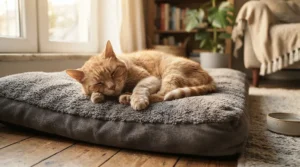
This is a flat, low-walled lounger rather than a nest bed, and that distinction matters more than it sounds like it should. The memory foam base gives an aging cat’s joints and back extra support while she’s stretched out, without forcing her to lift a leg over a tall bolster to get in. It comes in a full range of sizes, from compact to extra-large, so it accommodates everything from a petite tabby to a full-grown Maine Coon who still wants to sunbathe in full sprawl.
The lack of enclosing walls is a feature here, not an oversight — cats who dislike feeling boxed in, or who have started avoiding donut beds altogether, tend to use a flat lounger far more consistently. Based on the design comparison against bolstered beds, the trade-off is straightforward: less perceived security, but dramatically easier entry and exit for a cat whose hips no longer love bending sharply. The cover is machine washable, which matters for senior cats managing incontinence or occasional litter box misses.
What most buyers overlook about this style is that placement matters as much as the bed itself — put it in a sunny patch of floor rather than a corner, and use rates climb noticeably.
Pros:
- ✅ Zero-lift entry suits stiff hips and knees
- ✅ Memory foam cushions pressure points while sprawled
- ✅ Fits window sills, sofas, and floor spots alike
Cons:
- ❌ Minimal side support for cats who like enclosure
- ❌ Foam compresses faster than firmer orthopedic bases
At $20-$45 depending on size, it’s one of the more affordable senior cat must-haves on this list, and a smart starter purchase before investing in a heated model.
3. KittyGoHere Senior Cat Litter Box — a genuinely low entry point built for arthritic hips
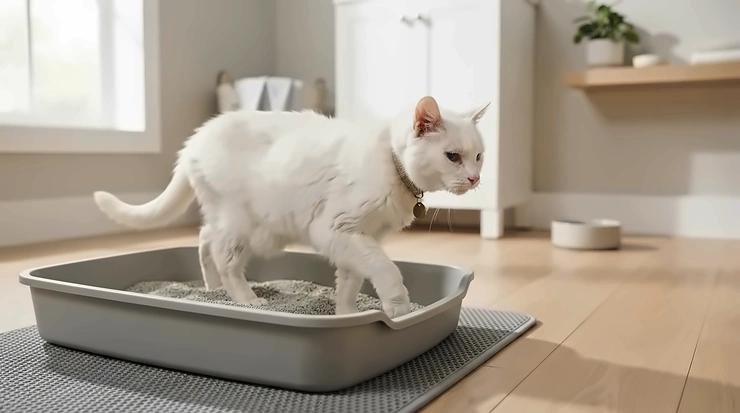
Litter box avoidance is one of the clearest, most heartbreaking signs of feline joint pain, because a cat associating discomfort with the box will simply stop using it — often choosing the rug instead, which owners then misread as a behavior problem rather than a pain signal. This box solves that with a genuinely low front entrance while keeping the sides and back tall enough to contain urine and litter if an unsteady cat shifts mid-squat.
That asymmetry is the entire point: most “senior” litter boxes just shrink every wall, which contains almost nothing. Veterinary-adjacent buying guides note that entry height under roughly four inches is the threshold that actually reduces joint strain for a cat with diagnosed osteoarthritis, and this model was purpose-built around that number. Reviewers frequently mention it’s the box that finally stopped an older cat from missing entirely or refusing the litter room altogether, and the higher price tag reflects genuinely different tooling, not just a “senior” label slapped on a standard pan.
Owners with multi-cat households often keep one standard box and one KittyGoHere so an arthritic cat always has a pain-free option available.
Pros:
- ✅ Ultra-low front entry reduces joint strain
- ✅ Tall back and side walls still contain mess
- ✅ Large interior lets stiff cats turn comfortably
Cons:
- ❌ Premium price for a single litter pan
- ❌ No lid, so odor control needs more scooping
At $60-$90, this is the single highest-leverage purchase on this list if your cat has started hesitating at the litter box door — a behavior change worth taking seriously rather than waiting out.
4. Pet Gear Bi-Fold Carpeted Pet Ramp — a compact, foldable ramp for couches and low beds
At 42 inches long, this ramp is built for furniture around 20 inches or lower — couches, low platform beds, car seats — and it folds flat in half for storage between uses, which matters if your living room can’t permanently host a ramp. The carpeted surface with removable fabric grips gives arthritic paws real traction, addressing a failure point that hard plastic ramps consistently struggle with: slippery footing that makes cats hesitate halfway up.
Based on the spec comparison against fixed wooden ramps, the appeal here is flexibility — you can angle it against the couch for movie nights and tuck it away before guests arrive. It’s rated to support up to 150 lbs, so weight capacity is a non-issue for essentially any cat. One reviewer specifically noted switching to this ramp after trying several other options for a senior cat, which lines up with the broader pattern in mobility-product reviews: cats abandon ramps that feel unstable underfoot far more readily than ramps that are simply steep.
The rubber foot grips on the base keep it from sliding on hardwood or tile, a detail cheaper ramps frequently skip.
Pros:
- ✅ Folds flat for easy storage between uses
- ✅ Carpeted traction reduces paw slippage
- ✅ Lightweight enough to reposition around furniture
Cons:
- ❌ Best suited to furniture 20 inches or lower
- ❌ Fabric grips need occasional re-securing
In the $50-$70 range, this is the practical mid-tier pick for one specific piece of furniture rather than a whole-house mobility solution.
5. Tresbro 6-Level Adjustable Pet Ramp — height-adjustable access for tall beds and shifting furniture
Where the Pet Gear ramp solves one low piece of furniture, this one solves the taller, trickier spots — a platform bed, a high dresser your cat used to launch onto, a car with a high back seat. The six-level adjustable design means you’re not locked into one slope angle; you can lower it for a particularly stiff morning or extend it fully for a tall bed frame, which is a meaningfully different value proposition than a fixed-angle ramp.
Buying guides describe it as an ultra-stable, premium option built specifically for senior or mobility-challenged cats needing a smooth path rather than a compromise. The wider deck reduces the wobble that makes nervous senior cats freeze partway up a ramp, and a non-slip walking surface runs the full length rather than stopping at the edges.
What the spec sheet won’t tell you, but owner reports suggest, is that introducing an adjustable ramp gradually — starting at the lowest, gentlest setting for the first week — dramatically improves adoption versus setting it at full height immediately and expecting an arthritic cat to trust it on day one.
Pros:
- ✅ Six height settings adapt to different furniture
- ✅ Wide, stable deck reduces wobble and hesitation
- ✅ Full-length non-slip surface for confident footing
Cons:
- ❌ Bulkier footprint than fixed-height ramps
- ❌ Higher price reflects the adjustable mechanism
At $70-$100, it’s the premium mobility pick here — worth it specifically for households with tall furniture and a cat who’s clearly still trying, just struggling with the vertical distance.

6. Nutramax Cosequin for Cats — the vet-recommended baseline for daily joint maintenance
Cosequin’s sprinkle-capsule format is built around a simple insight: senior cats won’t reliably take pills, but they’ll eat food with an odorless powder mixed in without noticing. Formulated with a track record spanning decades, the core formula combines glucosamine and chondroitin, the two building blocks most consistently linked to cartilage support in feline joint research.
This isn’t a fast-acting painkiller — reasoning grounded in how cartilage-support supplements work generally suggests measurable mobility change takes several weeks of consistent daily use, not days. Nutramax markets it as appropriate for cats of any age, but its real value shows up in cats already exhibiting stiffness, reduced jumping, or overgrooming around the hips — a self-soothing behavior vets flag as an early pain indicator.
Reviewers and vet-adjacent sources describe it as the closest thing to a gold-standard baseline in this category, the product other joint supplements get benchmarked against rather than the flashiest option on the shelf. For cats with more advanced arthritis, this is often the entry point before stepping up to a stronger formula under a veterinarian’s guidance.
Pros:
- ✅ Easy-open capsules sprinkle invisibly over food
- ✅ Long clinical track record and vet familiarity
- ✅ Supports cartilage function, not just pain masking
Cons:
- ❌ Effects build gradually over several weeks
- ❌ Not a substitute for vet-diagnosed pain management
At $20-$35 for a supply that typically lasts one to two months, it’s the lowest-cost, highest-frequency item on this list — genuinely a senior cat must-have rather than a luxury add-on.
7. PetSafe Multi-Tier Pet Fountain — flowing water at two heights for changing mobility
Dehydration compounds nearly every other senior cat health issue, from kidney strain to constipation, and cats are famously bad at drinking enough from a static bowl. This fountain’s dual-level design accommodates cats with varying mobility, while its roughly 100-ounce capacity cuts down how often you need to refill it — a small but real convenience for anyone managing multiple senior-pet routines.
The two drinking heights matter more than they sound like they should: a cat with neck or spine stiffness may prefer the higher tier on bad days and the lower basin on good ones, rather than being locked into one fixed bowl height that assumes consistent flexibility. Reviewers highlight that the moving water noticeably increases how often reluctant drinkers approach the fountain compared to a still bowl, which tracks with the broader case for fountains in cats prone to urinary or kidney issues.
The pump runs quietly enough that noise-sensitive seniors, who are often more sound-reactive than younger cats, don’t avoid it. Filter changes are straightforward, and the basin is wide enough that whisker-sensitive cats don’t have to press their face against narrow walls to drink.
Pros:
- ✅ Two drinking heights fit changing flexibility
- ✅ Large capacity means fewer refills
- ✅ Quiet pump doesn’t spook sound-sensitive cats
Cons:
- ❌ Filter cartridges require ongoing replacement cost
- ❌ Larger footprint than a standard water bowl
Priced around $30-$45, this fountain is a small daily investment against some of the more serious downstream conditions senior cats face, making it one of the more quietly important products for older cats on this list.
Practical Setup Guide: The First 30 Days With New Senior Gear
Buying the right gear is only half the job — introducing it wrong can mean an expensive ramp gathering dust in the garage. Start by placing new items exactly where your cat already spends time, not where they’d look best in your living room; a heated bed shoved in an unused corner will be ignored regardless of quality. For ramps and stairs, resist the urge to place them at full height immediately. Set them low, let your cat associate the surface with a reward — a few treats scattered along the incline works well — and raise the angle gradually over a week or two. For a new litter box, keep the old one available alongside it for at least ten days; cats are creatures of habit, and a sudden cold-turkey swap is the single most common reason a perfectly good low-entry box gets ignored.
A common early mistake is introducing three or four new items simultaneously, which overwhelms cats already navigating physical changes they don’t fully understand. Stagger new products by roughly a week each. Watch specifically for hesitation cues — sniffing and retreating, circling without committing, or vocalizing near the new item — since these signal the pace needs to slow down, not that the product is wrong. Maintenance matters just as much as introduction: wash bed covers weekly, wipe down ramp traction surfaces to prevent litter buildup, and replace fountain filters on schedule, since a fountain running on a spent filter can actually discourage drinking due to off tastes older cats are surprisingly sensitive to.
Real-World Scenarios: Matching Products to Your Cat’s Situation
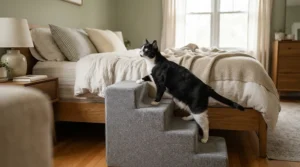
The cat who’s stopped jumping onto the bed. If your 13-year-old orange tabby used to sleep against your legs every night and now waits at the foot of the bed frame looking mildly betrayed, a ramp is the immediate fix — the Tresbro 6-Level Adjustable Pet Ramp if your bed frame runs tall, or the Pet Gear Bi-Fold Carpeted Pet Ramp for anything lower. Pair it with a consistent bedtime routine so the ramp becomes part of the nightly pattern rather than an occasional option.
The cat avoiding the litter box. A senior cat suddenly eliminating just outside the box, or crying while using it, is showing you pain, not defiance. The KittyGoHere Senior Cat Litter Box addresses this directly, and pairing it with Nutramax Cosequin for Cats tackles the root joint issue rather than just the symptom.
The cat who seems perpetually cold. An indoor cat who’s started sleeping pressed against radiators, heating vents, or sunbeams for hours at a stretch is signaling reduced ability to self-regulate temperature. The K&H Pet Products Thermo-Pet Sofa Heated Cat Bed solves this precisely, and placing it in that already-favored warm spot dramatically speeds adoption.
How to Choose Cat Supplies for Senior Cats: 6 Decision Criteria
- Start with entry height, not looks. Any product your cat has to climb over, jump into, or step high to reach works against you, regardless of how attractive it is.
- Prioritize traction on every mobility product. A ramp or stair without real grip creates hesitation, and hesitation compounds into avoidance.
- Match warmth features to observed behavior. Only invest in heated products if your cat already seeks out warm spots; not every senior cat runs cold.
- Treat joint supplements as a long game. Judge them on a six-to-eight-week timeline, not a one-week trial.
- Choose washable covers everywhere possible. Senior cats have a higher likelihood of occasional accidents, and machine-washable materials save real frustration.
- Weigh capacity against your routine. Larger fountains and litter boxes mean less frequent maintenance, which matters more the more pets or people are in your household.
- Introduce one product at a time. Overloading a senior cat with simultaneous environmental changes slows adoption of everything.
Mobility Assistance vs. Traditional Furniture Access
| Factor | Traditional Jumping | Ramp/Stair Assistance |
|---|---|---|
| Joint impact | High repeated landing force | Near-zero, gradual incline |
| Success rate for arthritic cats | Declines with age and pain | Consistent regardless of stiffness |
| Owner peace of mind | Low — falls and missed jumps happen | High — supported, predictable movement |
| Best For | Younger, fully mobile cats | Senior and arthritic cats |
The comparison here isn’t close once arthritis enters the picture: repeated jumping is one of the most common aggravators of feline degenerative joint disease, while a properly angled ramp removes that impact almost entirely. Cats who lose confidence in their jumping ability often stop trying altogether rather than risk a fall, which shrinks their world to floor level — a ramp restores access without asking joints to absorb any landing force. For households debating whether mobility assistance is really necessary, the honest answer is that it’s preventative as much as corrective; introducing a ramp before jumping becomes visibly painful protects joints longer than waiting for an obvious limp.
Common Mistakes When Buying for Senior Cats
The most frequent misstep is buying based on what looks impressive in product photos rather than what an individual cat’s mobility actually requires — a tall, elaborate cat tree with senior-friendly steps does nothing if the steps themselves are still too steep. A close second is assuming every senior cat needs heat; plenty of older cats are perfectly comfortable at room temperature, and forcing a heated bed on a cat who doesn’t seek warmth just wastes money. Owners also frequently underestimate litter box entry height, buying a box labeled “senior” without checking the actual measurement, when the real threshold that matters is under roughly four inches. Another common error is treating joint supplements as optional rather than foundational — waiting until a cat is visibly limping means starting supplementation well after joint damage has already progressed. Finally, many owners buy a single mobility product and stop there, when most senior cats benefit from a combination: a ramp plus a low-entry litter box plus a joint supplement working together, rather than any one item carrying the whole burden alone.
Long-Term Cost and Value Analysis
Judged purely on upfront price, a basic cardboard litter tray and a folded towel cost almost nothing compared to the roughly $250-$350 an owner might spend outfitting a home with all seven items above. But that comparison misses the actual cost driver for senior cats: veterinary bills tied to untreated mobility decline, urinary issues from chronic under-hydration, and accidents from painful litter box access tend to run far higher than the supplies that prevent them. A single vet visit for suspected arthritis pain, imaging, and pain management often exceeds the cost of a ramp and a bottle of joint supplement combined. Framed as cost-per-day rather than cost-per-purchase, a bottle of Nutramax Cosequin for Cats works out to roughly a dollar a week — genuinely negligible against the quality-of-life return for a cat gaining back confident movement. The highest-value items on this list, dollar for dollar, are the ones addressing daily repeated stress: the litter box and the joint supplement, since both intervene in actions a cat performs multiple times daily rather than an occasional comfort upgrade.
Safety Considerations for Geriatric Care Products
Heated beds should always carry a stated safety certification and a cord management plan, since senior cats sleep for longer uninterrupted stretches and won’t necessarily move off a malfunctioning unit the way a younger, more restless cat might. When positioning ramps, check that the base won’t slide on hardwood or tile — a shifting ramp is more dangerous than no ramp at all, since it can startle a cat mid-climb and cause a fall from height. Before starting any joint supplement, a quick check-in with your vet is worthwhile, particularly for cats already managing kidney or liver conditions, since supplement dosing sometimes needs adjustment around other medications. Litter boxes with genuinely low walls trade off some containment, so placing a washable mat underneath catches any overshoot without adding cleanup stress. The American Association of Feline Practitioners’ senior care guidelines note that regular pain management screening and mobility assessment should be part of routine senior wellness visits, which is worth bringing up proactively rather than waiting for your vet to ask.
Frequently Asked Questions
❓ What age is considered senior for a cat?
❓ How do I know if my cat has arthritis?
❓ Are ramps or stairs better for senior cats?
❓ Do senior cats really need a special litter box?
❓ How long until joint supplements show results?
Conclusion
None of this gear reverses aging — nothing does. What the right cat supplies for senior cats actually accomplish is smaller and more honest: they close the distance between what your cat’s body can still do and what your house currently demands of it. A ramp doesn’t heal a hip; it just stops asking that hip to do something it can no longer do safely. A low-entry litter box doesn’t cure arthritis; it removes one daily source of pain from a cat who otherwise has no way to ask for help. Start with whichever change matches what you’re actually seeing — the hesitation at the bed, the cry near the litter box, the extra time spent pressed against the radiator — rather than trying to solve everything at once. Senior cats are remarkably adaptable when the environment meets them partway, and that adaptability is really what you’re buying here: a few more comfortable, confident years with a cat who’s been patient with you for a long time already.
Recommended for You
- Cat Supplies For Maine Coon: 7 Genius Picks For 2026
- Sisal vs Cardboard Cat Scratcher: 7 Picks That Actually Work (2026)
- Hard-Sided vs Soft-Sided Cat Carrier: 7 Best Picks For 2026
Disclaimer: This article contains affiliate links. As an Amazon Associate, I earn from qualifying purchases. If you purchase products through these links, we may earn a small commission at no additional cost to you.
✨ Found this helpful? Share it with a fellow cat parent! 💬🐱
