Table of Contents
Here’s the thing nobody tells you before you bring home a Maine Coon kitten: that fuzzy little potato is lying to you. Give it eighteen months, and it will be a 15-to-20-pound tufted-eared linebacker casually knocking your “large” litter box across the bathroom floor like it’s nothing. Shopping for cat supplies for maine coon cats isn’t really shopping for cat stuff at all — it’s shopping for small-dog stuff wearing a cat costume, and most owners figure this out the hard way, usually around the third time a standard litter pan gets abandoned mid-use because there simply wasn’t enough room to turn around.

Cat supplies for maine coon cats are, at their core, standard pet products engineered or upsized specifically to handle a breed that can measure over three feet long, tip the scale past 20 pounds, and shed enough undercoat to reupholster a couch. That means reinforced cat trees, litter boxes with real square footage, carriers rated for actual weight limits instead of marketing fluff, and grooming tools tough enough for a double coat.
This guide skips the padding and gets straight to seven real, currently available products — vetted against actual specs, aggregated owner review patterns, and the physical realities of owning the largest domesticated cat breed, according to the Maine Coon’s own breed history. Whether you’re outfitting a nine-month-old “gentle giant in training” or finally replacing gear your adult cat has visibly outgrown, you’ll find honest breakdowns of what’s worth buying, what to skip, and how to avoid the sizing mistakes almost every new Maine Coon owner makes at least once.
Quick Comparison Table: Cat Supplies for Maine Coon at a Glance
Before the deep dive, here’s the 30-second version. This table pulls the seven picks into one scannable snapshot so you can jump straight to whichever category is currently causing you grief.
| Product | Category | Price Range | Best For |
|---|---|---|---|
| Frisco High Sided Cat Litter Box | Litter Box | around $25-$40 | Budget-conscious owners needing real floor space |
| Feandrea Large Cat Tree (UPCT614W01) | Cat Tree | $100-$160 range | Big jumpers who need a stable landing platform |
| SturdiBag Extra Large Pet Carrier | Carrier | $90-$130 range | Air travel and anxious vet-visit cats |
| Best Friends by Sheri Deep Dish Cuddler (Jumbo) | Cat Bed | $40-$70 range | Cats who like to curl up rather than sprawl |
| Rabbitgoo Adjustable Cat Harness & Leash Set | Harness | under $25 | Supervised outdoor walks and enrichment |
| PetSafe Drinkwell 360 Pet Fountain | Water Fountain | $50-$70 range | Multi-cat homes and heavy drinkers |
| FURminator Long Hair deShedding Tool | Grooming | $30-$45 range | Taming a thick double coat |
Looking at the spread above, notice that the cheapest item on this list (the Rabbitgoo Adjustable Cat Harness & Leash Set) and the priciest (the SturdiBag Extra Large Pet Carrier) solve completely different problems, so price alone shouldn’t drive your first purchase. Instead, buy in order of what’s actually failing in your home right now — a wobbly cat tree or an overflowing litter box is a more urgent fix than a fountain your cat already tolerates. Prices for all products may vary and should be confirmed at checkout, since retailers adjust them frequently.
💬 Found a size mismatch in your own home already? Scroll to the product that matches your headache first — you don’t have to read this top to bottom.
Top 7 Cat Supplies for Maine Coon: Expert Analysis
Maine Coons aren’t just bigger versions of an average house cat — they’re built differently, structurally and behaviorally, which is why so many “large” products on Amazon still fall short. The picks below cover the seven categories where undersized gear causes the most real-world friction: bathroom habits, climbing and scratching, travel, sleep, walking, hydration, and coat maintenance.
1. Frisco High Sided Cat Litter Box — biggest bang-for-buck litter pan
If you’ve ever watched a Maine Coon back its rear end out over the edge of a “large” litter box because there simply wasn’t room to turn around, the standout feature here is straightforward: this pan is one of the largest commercially available litter boxes that doesn’t require a specialty retailer or a four-figure price tag. Measuring well beyond the 18-20 inch length of standard boxes, it gives a 20-inch-long Maine Coon actual room to dig, turn, and posture without hanging off the rim — which matters because veterinary behaviorists generally recommend a litter box at least 1.5 times a cat’s nose-to-tail-base length. The three high sides plus one lowered entry point strike a reasonable balance between containment and accessibility for cats of all ages, including seniors with stiffer hips.
Based on the spec comparison against typical “jumbo” boxes, the BPA-free, recyclable plastic construction here holds up better than the ultra-thin pans that crack under a heavier cat’s repeated digging. What most buyers overlook is that a bigger pan doesn’t automatically mean less mess — it means less mess if you also fill it with adequate litter depth, since a large surface with shallow litter just means more exposed plastic for paws to scatter. Reviewers consistently note that this is a strong fit for single-Maine-Coon households and a workable, if not perfect, option for cats who tend to spray or pee while standing, since the sides help but don’t fully contain high aiming.
Aggregated owner sentiment across multiple pet-product review roundups is generally positive on the space-to-price ratio, with the most common complaint being that a lightweight design can shift or tip if a cat steps directly on the rim rather than climbing fully inside. This is a known trade-off of open-pan, high-sided designs generally, not a defect unique to this model.
Pros:
- ✅ Genuinely large footprint most 20-pound cats can turn around in
- ✅ Recyclable, BPA-free plastic holds up to repeated scratching
- ✅ Noticeably lower price than XXL stainless-steel alternatives
Cons:
- ❌ Lightweight base can shift if a cat steps on the rim
- ❌ High-siding doesn’t fully stop urine spray from very tall cats
At around $25-$40, this is the value anchor of the entire list — it solves the single most common Maine Coon supply complaint (litter box overflow) for less than the cost of a nice cat toy haul, making it the easiest first upgrade for any big-cat household.
2. Feandrea Large Cat Tree (UPCT614W01) — sturdiest perch for big jumpers
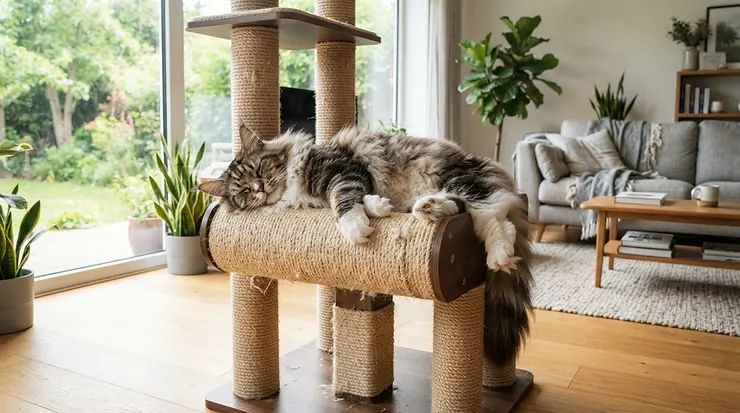
The standout feature on this tower is the top platform, which measures roughly 26.8 by 18.9 inches — large enough for a full-grown Maine Coon to actually stretch out flat rather than balance on a glorified dinner plate, which is the single most common complaint about undersized cat trees. Rated to support cats up to 44 pounds combined weight and standing around 40.6 inches tall, it prioritizes a wide, low-slung stability over sheer height, which in practice means it barely wobbles even without wall anchoring.
Here’s what to weigh: a taller tower looks more impressive in photos, but a shorter, wider one is almost always the smarter buy for a breed known for launching itself at furniture with real force. The two enclosed cat caves have separate entry points, a small design choice that reviewers report actually gets both used instead of one becoming the “good” cave and the other becoming a dust collector. The sisal-wrapped posts are the scratching surface that matters most here, since a Maine Coon’s claws can shred cheap carpet-wrapped posts within a season.
Reviewers consistently report that the weight capacity claims hold up under real daily use by large-breed cats, and this model has accumulated a substantial volume of reviews specifically from owners of Maine Coons and similarly oversized breeds. The most repeated critique in aggregated feedback is that assembly takes longer than expected and benefits from a second set of hands, particularly when securing the base plate.
Pros:
- ✅ Top platform large enough for a Maine Coon to fully stretch out
- ✅ Wide, low base resists tipping without wall anchoring
- ✅ Rated weight capacity realistically covers adult Maine Coons
Cons:
- ❌ Assembly is time-consuming and easier with two people
- ❌ Shorter overall height than some premium XXL towers
Priced in the $100-$160 range, this sits squarely in the mid-tier, and the value case is strong: you’re paying for engineering (a base that won’t tip) rather than height for height’s sake, which is exactly the trade-off a heavy climber needs.
3. SturdiBag Extra Large Flexible Height Pet Carrier — best for stress-free vet trips and flights
The defining feature is right in the name: flexible height. Unlike rigid carriers that force a Maine Coon into a crouch, this soft-sided bag expands so a cat can stand fully upright inside, which noticeably reduces the panicked scrambling that happens when a big cat feels physically compressed. Built from 600-denier polyester with seatbelt-compatible straps and reinforced zipper security clips, it’s designed to double as both an under-seat airline carrier and a secured back-seat car carrier.
What most buyers overlook about soft-sided carriers generally is that “extra large” labeling varies wildly between brands — this is one of the few in its category actually built around large-breed dimensions rather than simply relabeling a medium carrier. The retractable privacy flaps over the mesh windows are a small but meaningful detail: an anxious cat that wants to hide during a car ride can have that option without losing ventilation. Any airline travel plans should still be double-checked against the current USDA guidance on air travel with pets, since carrier and kennel requirements can vary by airline and destination.
Reviewers consistently note the seatbelt security straps as a standout safety feature compared to competitors that only offer a shoulder strap, and multiple aggregated sources single this bag out specifically for professional handlers and frequent fliers with large cats. The main friction point in owner feedback is that, while the fabric shell is light, it offers less structural rigidity than a hard-sided crate, which matters if your cat is a determined escape artist rather than a nervous hider.
Pros:
- ✅ Height-flexible design lets large cats stand fully upright
- ✅ Seatbelt-compatible straps for genuine car-ride security
- ✅ Retractable privacy flaps balance airflow with hiding options
Cons:
- ❌ Soft sides offer less rigidity than hard-shell alternatives
- ❌ Premium pricing compared to basic zip-top carriers
At $90-$130 range, this is the most expensive item on the list, and the value verdict depends entirely on frequency of use: for occasional local vet trips, it may be more carrier than you need, but for anyone flying or regularly transporting a large, anxious cat, the extra room and security straps justify the cost.
4. Best Friends by Sheri Deep Dish Cuddler (Jumbo) — coziest oversized nap spot
The standout here is the bolstered, deep-dish shape combined with a genuinely oversized jumbo option — roughly 35 inches across — built specifically because standard 15-to-16-inch bolster beds are comically undersized for a breed that can stretch past 38 inches nose to tail. The vegan faux-shag fur lining and high bolster walls create what behaviorists sometimes describe as a “nesting” effect, mimicking the security of being pressed against a parent cat’s body, which can be genuinely calming for anxious or newly rehomed cats.
On paper this means less about pure floor space (a flat mat technically holds more surface area) and more about psychological comfort for cats that prefer to curl rather than sprawl — a preference that varies cat to cat, so this bed suits nesters better than “starfish” sleepers who like to stretch flat. Here’s what to weigh: if your Maine Coon already sleeps stretched out on the tile floor in summer, a bolstered cuddler may get ignored seasonally, which is a legitimate consideration before buying the jumbo size specifically for a cat that runs warm.
Aggregated review sentiment describes the jumbo size as roomy enough for large-breed cats without the bed itself becoming disproportionately bulky for a living room, and the machine-washable cover is repeatedly cited as a practical win given how much loose Maine Coon fur ends up embedded in bedding. A commonly reported drawback is limited color and pattern variety in the largest size specifically, since jumbo often ships in fewer finishes than smaller sizes.
Pros:
- ✅ Jumbo sizing actually fits a full-grown Maine Coon comfortably
- ✅ High bolster walls provide a secure, nest-like sleeping spot
- ✅ Machine-washable cover handles heavy shedding realistically
Cons:
- ❌ Less ideal for cats who prefer sprawling flat to curling up
- ❌ Fewer color options available in the largest size
In the $40-$70 range, this bed represents solid mid-tier value, especially for owners of cats that already gravitate toward nesting behavior — buying the correct jumbo size the first time also avoids the wasted spend of re-purchasing after a standard bed is quickly outgrown.
5. Rabbitgoo Adjustable Cat Harness & Leash Set — safest escape-resistant walks
The standout feature is the four-point adjustable strap system combined with a vest-style build that distributes pressure across the chest and shoulders instead of concentrating it on the neck — a meaningfully safer design for a breed with the broad chest and muscular build Maine Coons are known for. Reviewers and veterinary behaviorists alike generally favor harnesses over collars for supervised outdoor access, and the AAFP and ISFM feline environmental needs guidelines specifically list safe outdoor access as one of a cat’s core environmental needs.
Here’s what to weigh: this particular harness was originally designed with dogs in mind, and its available sizing range comfortably fits the 19-to-23-inch chest girth typical of an adult Maine Coon — a detail that matters, because many cat-specific harnesses simply don’t size up far enough. Reflective stitching adds a genuine safety benefit for evening walks, and the breathable mesh panel matters more than it sounds for a breed already carrying a thick double coat that doesn’t need extra heat trapped against the skin.
Aggregated owner feedback consistently flags fit as the single biggest factor in success or failure with any cat harness — a properly measured Maine Coon rarely slips free, while a harness bought by guesswork on sizing almost always does. The most common complaint in review patterns is that the leash included in these bundled sets is often shorter or thinner than dedicated leash buyers would prefer, which is a minor but fixable gap.
Pros:
- ✅ Four adjustment points fit a Maine Coon’s broad chest properly
- ✅ Vest design spreads pressure instead of pulling on the neck
- ✅ Reflective trim adds real visibility for evening walks
Cons:
- ❌ Bundled leash is thinner than many dedicated leash options
- ❌ Requires careful measuring — sizing mistakes are the top complaint
At under $25, this is the most affordable item on the list, and the value case is almost unbeatable if fitted correctly: it’s a low-cost way to add safe outdoor enrichment, provided you actually measure your cat’s chest and neck before ordering rather than guessing based on weight alone.
6. PetSafe Drinkwell 360 Pet Fountain — steadiest hydration station for big drinkers
The defining feature is a heavy-duty, weighted base specifically built to resist being shoved, tipped, or slid across the floor — a real problem with lightweight fountains once a 15-plus-pound cat starts pawing at the water stream, a habit Maine Coons are particularly famous for. The multi-stream, 360-degree design allows several drinking points around the reservoir, which matters in multi-cat homes but also simply gives one large cat more surface area to drink from without crowding.
Maine Coons have a well-documented affinity for running water, and according to the Cornell Feline Health Center, adequate hydration is essential to everything from temperature regulation to joint lubrication and kidney function — a nontrivial concern for a large breed already prone to certain heritable health conditions. What the spec sheet won’t tell you, but reviewers note, is that a larger reservoir doesn’t just mean fewer refills; it means a steadier flow rate, since smaller tanks can run the pump dry faster than owners expect between top-offs.
Aggregated review sentiment across multiple retailer and third-party comparison sources consistently highlights the base stability as the deciding factor for Maine Coon owners specifically, distinguishing this model from cheaper fountains that “walk” across tile floors during use. The most repeated critique is the need for regular filter replacement to maintain water clarity and pump function, an ongoing cost that’s easy to forget about after the initial purchase.
Pros:
- ✅ Weighted, heavy-duty base resists tipping from enthusiastic pawing
- ✅ Multiple drinking streams suit big drinkers and multi-cat homes
- ✅ Filtration keeps water appealing, which encourages more drinking
Cons:
- ❌ Requires ongoing filter replacement as a recurring cost
- ❌ Larger footprint takes up more counter or floor space
Priced in the $50-$70 range, the value proposition holds up well against smaller fountains that need replacing after a large cat tips them over — paying slightly more upfront for stability is often cheaper than replacing a flimsier unit twice.
7. FURminator Long Hair deShedding Tool — most effective for taming the undercoat
The standout feature is the stainless-steel edge specifically designed to reach through a long-haired cat’s topcoat and pull loose undercoat hair without cutting or damaging the guard hairs above it — a distinction that matters enormously for a breed carrying two distinct coat layers. Maine Coons shed heavily and seasonally, and a tool built around undercoat removal rather than general brushing addresses the root cause of mats rather than just smoothing the surface.
Based on the spec comparison against basic slicker brushes, the deshedding-rake design pulls out substantially more loose fur per session, which reviewers consistently report translates into a visible reduction in loose hair around the home — though “reduces shedding” claims should be read as a meaningful decrease rather than elimination, since shedding itself is a normal biological process. The push-button fur ejector is a small design detail that saves real time during longer grooming sessions with a coat this dense, since manually pulling matted fur from tines gets old fast.
Aggregated customer sentiment across pet-grooming comparison sources frequently names this specific brand as the most effective deshedding option for long-haired breeds, while also noting that inconsistent, infrequent use can lead to skin irritation if the tool catches on existing mats rather than loose fur — a reminder that a deshedding tool complements, rather than replaces, a regular slicker brush or comb.
Pros:
- ✅ Stainless-steel edge removes undercoat without cutting guard hairs
- ✅ Push-button ejector speeds up long grooming sessions
- ✅ Widely cited as the most effective option for double coats
Cons:
- ❌ Can irritate skin if used on already-matted fur
- ❌ Best paired with a separate brush, not used as the only tool
At around $30-$45, this sits in the middle of the grooming category, and the value verdict is straightforward for anyone tired of finding Maine Coon fur in every corner of the house: it’s a genuinely specialized tool solving a genuinely specialized problem.
Setting Up Your Maine Coon’s Space: A 30-Day Starter Guide
The first month with new gear is where most sizing regrets happen, so front-load the setup correctly instead of discovering problems piecemeal. Start with placement: the Feandrea Large Cat Tree needs a corner with at least three feet of clearance on the open sides, since a launching Maine Coon needs runway, not just landing space. Position the Frisco High Sided Cat Litter Box somewhere with foot traffic on at least two sides — cornering a large litter box into a tight closet just recreates the cramped-turning-radius problem you were trying to solve.
In week one, expect some hesitation around the PetSafe Drinkwell 360; the motor hum is unfamiliar, and many cats need three to five days before approaching a new fountain confidently. Leave a static water bowl nearby during this transition rather than removing all other water sources immediately. By week two, introduce the Rabbitgoo Adjustable Cat Harness & Leash Set indoors only, in short five-to-ten-minute sessions, well before any outdoor attempt — a common first-30-days mistake is skipping this indoor acclimation entirely and wondering why day-one outdoor walks go badly.
Grooming with the FURminator Long Hair deShedding Tool should start light: two to three minutes per session in week one, building toward a full coat pass by week three, since introducing a new grooming tool too aggressively is a frequent cause of brush aversion down the line. Maintenance-wise, plan to scoop the litter box daily regardless of its size — a bigger pan buys you more forgiveness, not a longer interval — and wipe down the fountain reservoir weekly to prevent biofilm buildup before it becomes visible.
Real Maine Coon Households: Which Setup Fits Your Life
Consider three realistic profiles. First, the apartment-dwelling young professional with a single indoor Maine Coon and limited square footage: prioritize the Feandrea Large Cat Tree for vertical enrichment where floor space is scarce, paired with the FURminator Long Hair deShedding Tool used religiously, since shed fur is more noticeable in smaller spaces. The Frisco High Sided Cat Litter Box fits neatly into a compact bathroom footprint without demanding a dedicated laundry-room setup.
Second, the multi-cat household with one Maine Coon and two smaller cats: the PetSafe Drinkwell 360 earns its keep here specifically because of the multi-stream design accommodating different drinking styles and heights, and the Best Friends by Sheri Deep Dish Cuddler (Jumbo) can become a shared favorite once the household’s smaller cats realize there’s room for two.
Third, the frequent-flying owner relocating with a Maine Coon or regularly visiting a vet specialist across town: the SturdiBag Extra Large Flexible Height Pet Carrier is close to non-negotiable here, since standard carriers routinely fail large-breed cats on both comfort and airline compliance. Pair it with the Rabbitgoo Adjustable Cat Harness & Leash Set for supervised time outside the carrier during layovers or rest stops, which reduces the stress of a fully confined multi-hour trip.
Common Maine Coon Supply Problems (And How to Actually Fix Them)
Problem: Litter constantly ends up outside the box. This is almost always a size-and-depth issue rather than a behavior problem. Solution: confirm the box meets the 1.5x body-length guideline and increase litter depth to three to four inches, since a shallow layer in an oversized pan still gets kicked out easily.
Problem: The cat tree wobbles or has tipped. Solution: check that it’s on a level, hard floor rather than thick carpet padding, and use the included wall-anchor strap even on a wide-based model like the Feandrea Large Cat Tree — anchoring is cheap insurance against a determined 20-pound jumper.
Problem: The cat won’t approach the water fountain. Solution: keep a backup static bowl nearby during the first week, run the fountain at its lowest flow setting initially, and place it away from the litter box, since cats instinctively avoid drinking near elimination areas.
Problem: Mats keep forming despite regular brushing. Solution: mats usually form first at friction points — behind the ears, in the armpits, under the ruff — so target those zones specifically with the FURminator Long Hair deShedding Tool rather than only running it down the back and flanks.
Problem: The harness keeps slipping off during walks. Solution: recheck the fit using the two-finger rule at both the neck and chest, and remember that a harness loose enough to slip over the head is loose enough for an escape attempt mid-walk.
How to Choose Cat Supplies for Maine Coon Cats
Selecting the right gear comes down to a short list of repeatable criteria, regardless of category:
- Measure before you shop. Get an actual tape measure on your cat’s length, chest girth, and weight rather than relying on “large breed” labeling alone, since sizing standards vary wildly between brands.
- Prioritize base stability over height or capacity. A wide, low cat tree or a weighted fountain base prevents the tipping incidents that waste money on replacements.
- Check the stated weight rating, not just the size. A product can look spacious but carry a weight limit that a full-grown male Maine Coon exceeds.
- Favor washable, replaceable components. Beds, carrier liners, and fountain filters all benefit from easy maintenance given how much fur and dander a Maine Coon produces.
- Read for large-breed-specific feedback, not general star ratings. A 4.5-star average means little if none of those reviewers own a 20-pound cat.
- Budget for the category that’s currently failing, not the flashiest option. An overflowing litter box is a more urgent fix than a new bed.
- Plan for growth if you’re buying for a kitten. Maine Coons don’t reach full size until three to five years old, so oversized gear purchased early rarely goes to waste.
Common Mistakes When Buying Maine Coon Essentials
The most frequent and costly mistake is trusting “large” or “jumbo” labeling at face value instead of checking listed dimensions in inches — marketing terms aren’t standardized across brands, and what one company calls extra-large, another treats as merely medium. A close second is buying a single litter box for a single cat and assuming that’s sufficient; the general guidance of one box per cat plus one extra still applies even when that one box is generously sized.
Owners also frequently underestimate assembly and setup time for large furniture-scale items like cat trees, then rush the process and skip wall anchoring — a step that matters disproportionately for a breed capable of generating real jumping force. On the grooming side, a common misstep is buying a deshedding tool but skipping a separate detangling comb entirely, leading to matted patches the deshedding tool alone can’t safely address. Finally, many new owners buy carrier and harness gear sized for the kitten currently in front of them rather than the adult cat that kitten will become within a year or two, resulting in an expensive re-purchase down the line.
Oversized Products vs Standard Cat Gear: What’s the Real Difference
It’s tempting to assume “oversized” is just a pricing gimmick, but the engineering differences are usually real. Standard cat gear is designed around an average adult cat weighing roughly 8 to 10 pounds and measuring under 18 inches nose to tail — dimensions a Maine Coon exceeds well before adulthood. Oversized products for large cats typically differ in three concrete ways: reinforced structural components (thicker base boards on cat trees, heavier-gauge wire in carriers), genuinely larger interior dimensions rather than just a bigger exterior shell, and higher-rated weight capacities that account for real-world jumping and pawing force rather than static weight alone.
| Feature | Standard Cat Gear | Oversized/Heavy-Duty Gear |
|---|---|---|
| Typical weight rating | Up to ~10-12 lbs | 20-44+ lbs depending on product |
| Interior/surface dimensions | Sized for ~15-18 in. cats | Sized for 20-38+ in. cats |
| Base/structural reinforcement | Standard | Reinforced or widened for stability |
| Best For | Average-sized domestic cats | Maine Coon-sized and other large breeds |
The analysis here is simple: for a Maine Coon, standard gear isn’t a cheaper version of the same product — it’s frequently the wrong product entirely, which is why so many first-time owners end up buying twice. Paying a modest premium upfront for genuinely reinforced, correctly sized gear is almost always less expensive over time than replacing failed standard-sized items.

What to Expect: Real-World Performance With a Maine Coon
Specs on a product page rarely translate directly into daily experience, so here’s the practical version. A cat tree rated for 44 pounds combined weight in practice means the tree can handle a Maine Coon plus a second cat joining for a shared nap without groaning under the strain — a scenario that happens more often than most owners expect in multi-cat homes. A litter box meeting the 1.5x sizing guideline in practice means noticeably less litter tracked across the floor, since the cat isn’t repositioning awkwardly mid-dig.
A properly sized carrier in practice means a car ride or vet visit with less vocal protest, since a cat that can stand and turn feels less physically trapped than one wedged into a crouch. And a deshedding tool used consistently in practice means the difference between finding stray tufts occasionally versus finding what looks like a second cat’s worth of fur under the couch every week during seasonal shedding.
Long-Term Cost & Maintenance of Heavy-Duty Items
Heavy-duty items generally cost more upfront but tend to even out — or come out ahead — over a multi-year ownership window. A reinforced cat tree in the $100-$160 range that survives five years of daily use by a 20-pound cat is a better long-term value than a $40 flimsy tower replaced three times over the same period after tipping or structural failure. The same logic applies to carriers: a SturdiBag Extra Large Flexible Height Pet Carrier purchased once for genuine large-breed dimensions avoids the sunk cost of an ill-fitting carrier abandoned after a single stressful trip.
Ongoing maintenance costs matter too. Budget for periodic fountain filter replacements (roughly every two to four weeks depending on usage) as a small recurring cost of the PetSafe Drinkwell 360, and factor in litter volume — a genuinely large box like the Frisco High Sided Cat Litter Box holds more litter per fill than a standard pan, which is a real but often overlooked ongoing expense. Grooming tools like the FURminator Long Hair deShedding Tool have effectively no recurring cost beyond the initial purchase, making them one of the better long-term value plays on this entire list relative to upfront price.
✨ Don’t Miss These Picks While Restocking!
🐾 Take your Maine Coon setup to the next level with correctly sized gear built for a gentle giant — check current pricing before your next supply run!
Safety, Space & Travel Considerations for Big Cat Needs
Big cat needs extend beyond product dimensions into genuine safety planning. Cat trees and shelving should always be anchored to prevent tip-over injuries, particularly in homes with a Maine Coon capable of generating significant jumping force. Litter boxes with high sides reduce splash but should still allow an unobstructed, quick exit path, since cornering a large cat into a tight enclosure can create anxiety around elimination.
For travel specifically, requirements differ by method and destination, and it’s worth confirming current rules directly through the USDA’s official pet travel resources before booking any flight, since kennel size, ventilation, and documentation requirements are enforced at the airline and regulatory level, not just recommended as best practice. At home, harness-and-leash outdoor access should always be supervised rather than left unattended, both for escape-prevention reasons and because an unsupervised cat on a leash can become tangled around furniture or outdoor obstacles.
Cat Supplies for Maine Coon Essentials at Every Life Stage
Maine Coon essentials shift meaningfully across a cat’s lifespan, since this breed famously takes three to five years to reach full physical maturity. For kittens under one year, prioritize a mid-sized starter litter box (a full jumbo box can genuinely intimidate a small kitten) alongside early harness acclimation, since younger cats generally adapt to wearing gear more readily than adult cats introduced to it for the first time. For adolescent and young adult Maine Coons — roughly one to three years old — this is typically the window for upgrading to full-sized gear across the board: the Frisco High Sided Cat Litter Box, the Feandrea Large Cat Tree, and a properly fitted Rabbitgoo Adjustable Cat Harness & Leash Set should all be sized for the adult cat this kitten is becoming, not the kitten currently in front of you.
For mature adults, three years and older, comfort and joint support move up the priority list; a bolstered bed like the Best Friends by Sheri Deep Dish Cuddler (Jumbo) supports the resting posture many older cats prefer as activity levels naturally decline. Senior Maine Coons, generally eight years and up, often benefit from lower-entry litter boxes and easier-access resting spots, since this breed has documented predispositions toward hip dysplasia and joint stiffness that can make high-sided boxes or elevated perches less comfortable over time.
Frequently Asked Questions
❓ What supplies does a Maine Coon kitten actually need first?
❓ How big should a litter box be for a Maine Coon cat?
❓ Do Maine Coons need a special cat tree?
❓ What is the best carrier for a Maine Coon cat?
❓ How much does it typically cost to fully outfit a Maine Coon with supplies?
Conclusion
Outfitting a Maine Coon isn’t about buying more stuff — it’s about buying the right-sized stuff the first time, which is exactly where most owners lose money without realizing it. The Frisco High Sided Cat Litter Box and Feandrea Large Cat Tree solve the two most common daily-friction problems, while the SturdiBag Extra Large Flexible Height Pet Carrier, Best Friends by Sheri Deep Dish Cuddler (Jumbo), Rabbitgoo Adjustable Cat Harness & Leash Set, PetSafe Drinkwell 360 Pet Fountain, and FURminator Long Hair deShedding Tool round out the categories where standard, average-cat gear reliably falls short.
None of these are flashy purchases, and that’s rather the point — a Maine Coon doesn’t need novelty, it needs gear built around its actual size, weight, and coat, verified against real dimensions rather than marketing labels. Start with whichever category is currently causing the most friction in your home, measure your own cat before ordering anything, and build out the rest of the list as budget and need allow. A gentle giant deserves gear that fits its actual size — not the size the packaging assumes.
Recommended for You
- Sisal vs Cardboard Cat Scratcher: 7 Picks That Actually Work (2026)
- Hard-Sided vs Soft-Sided Cat Carrier: 7 Best Picks For 2026
- Covered vs Open Litter Box: 7 Best Picks Ranked (2026)
Disclaimer: This article contains affiliate links. As an Amazon Associate, I earn from qualifying purchases. If you purchase products through these links, we may earn a small commission at no additional cost to you.
✨ Found this helpful? Share it with a fellow Maine Coon owner who’s still using a “large” litter box that clearly isn’t! 💬🐾
