
Table of Contents
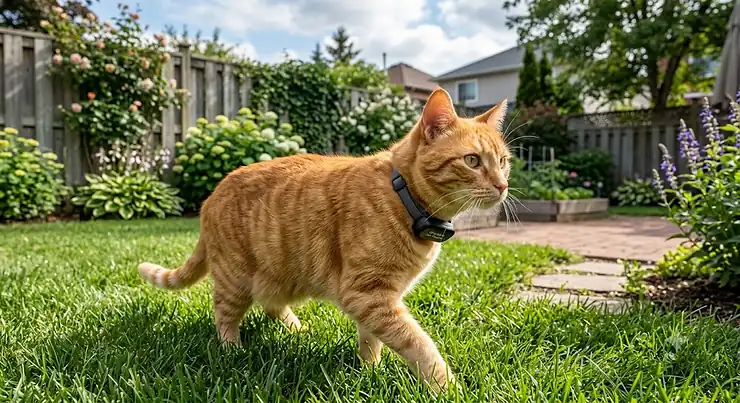
Cats treat “indoors” as more of a suggestion than a rule. One minute yours is curled up on the windowsill, and the next, the door’s cracked open and she’s gone — off to investigate whatever squirrel-related emergency just occurred three yards over. If that scenario makes your stomach drop a little, you’re exactly who this guide is for. A GPS cat collar is a small tracking device, usually clipped to a breakaway collar, that uses satellite or cellular signals to show you your cat’s real-time or near-real-time location on a smartphone app. It’s the difference between frantically walking the block at 11 p.m. and calmly checking your phone to see she’s two houses down, sitting under someone’s porch.

This guide skips the marketing fluff and gets straight to what matters: which GPS cat collar options are actually worth your money in 2026, how they differ from cheaper Bluetooth and radio-frequency alternatives, and how to match a tracker to your specific cat’s size, habits, and your own budget. We researched real products, real specs, and real aggregated review sentiment — no invented five-star testimonials here. According to American Humane, roughly 10 million pets go missing in the United States every year, and a huge share of those are cats who slipped out an open door or window. A good cat tracker collar won’t stop your cat from wandering, but it dramatically shortens the gap between “gone” and “found.” Let’s get into the seven models actually worth considering, plus the buying knowledge that keeps you from wasting money on the wrong one.
Quick Comparison Table
Before the deep dive, here’s the fast version for anyone who just wants the highlights. This table ranks the seven GPS cat collar picks by their standout strength, not by “best overall” — because the right choice really does depend on your cat.
| Product | Tech Type | Weight | Subscription | Best For |
|---|---|---|---|---|
| Tractive GPS Cat Tracker | Cellular GPS + LTE | ~25-30g | Required (annual) | Most cat owners wanting an all-rounder |
| Jiobit Smart Tag | GPS + Cellular + Wi-Fi + Bluetooth | ~18g | Required (monthly/annual) | Tiny cats and multi-pet households |
| Pawfit Lite | 4G LTE GPS | ~17.6g | Required (flexible) | Owners who want the lightest true GPS unit |
| Weenect Cat XS | Cellular GPS (2G/4G/5G) | 27g | Required (from ~$5.56/mo) | Budget-conscious real-time tracking |
| Cube Real-Time GPS Tracker | GPS + Wi-Fi + Cell Triangulation | ~35g | Required (Verizon network) | Owners who also want trip history/speed data |
| Tabcat V2 | Radio Frequency (RF), no GPS | Featherweight tag | None | Cats that hide nearby rather than roam far |
| Apple AirTag + collar holder | Bluetooth (Find My network) | ~11g + holder | None | Mostly-indoor cats on a tight budget |
Looking at the spread above, the clearest split isn’t price — it’s technology. The Tractive GPS Cat Tracker, Jiobit Smart Tag, Pawfit Lite, Weenect Cat XS, and Cube Real-Time GPS Tracker all use true cellular GPS, meaning they can report a location basically anywhere there’s cell signal, but every one of them requires an ongoing subscription. The Tabcat V2 and Apple AirTag skip that recurring cost entirely, at the expense of unlimited range — a trade-off we’ll unpack more in the sections below.
💬 Already leaning toward one? Scroll down for the full breakdown before you commit — the “best” GPS cat collar really does depend on how far your cat roams.
Top 7 GPS Cat Collar Picks: Expert Analysis
We evaluated real products sold on Amazon and directly through manufacturers, weighing tracking technology, weight (a genuinely big deal for a cat that has to wear this thing all day), battery life, subscription cost, and what real owners report after living with each device. Here’s the honest breakdown of all seven.
1. Tractive GPS Cat Tracker — best all-around real-time tracking
The Tractive GPS Cat Tracker (marketed as the CAT Mini) is the most widely reviewed cat-specific GPS collar on the market, and there’s a reason it keeps showing up at the top of comparison lists. It uses LTE cellular connectivity paired with GPS to report your cat’s location, working in over 150 countries on a single SIM baked into the device.
On paper, the specs translate into real convenience: the tracker updates once every 2 to 60 minutes in default mode, and every two to three seconds in LIVE mode, which is the setting you’ll flip on the moment your cat actually goes missing. Battery life is rated at up to a week, though reviewers report closer to a day of runtime if LIVE mode stays on continuously during an active search — worth knowing before you assume a single charge covers a whole weekend of heavy use. Based on the spec comparison with cheaper alternatives, the Tractive GPS Cat Tracker‘s appeal isn’t raw hardware — it’s the maturity of the app and the accuracy of positioning, which testers describe as accurate to within about 10 feet in open areas.
This is the pick for cat owners who want a “set it up once and trust it” experience rather than the cheapest possible hardware. Reviewers consistently note that the app is intuitive, onboarding is simple, and the remote LED-light feature genuinely helps when you’re searching a dark backyard at midnight. On the downside, some Amazon and Trustpilot reviewers have flagged confusion around subscription billing and occasional battery drain faster than advertised, and Tractive now requires a minimum one-year subscription paid upfront rather than offering a simple monthly plan.
Pros:
- ✅ Most cat-specific design with a proven, mature companion app
- ✅ LIVE mode refreshes location every 2-3 seconds when it counts
- ✅ Works in 150+ countries on one bundled SIM
Cons:
- ❌ Annual subscription commitment required, no simple monthly option
- ❌ Battery drains fast in LIVE mode, especially during a real search
Hardware runs in the $50-$65 range at the time of research, with subscription plans starting around $5-$9 a month depending on the term you commit to. For most cat owners weighing reliability against cost, the Tractive GPS Cat Tracker earns its reputation as the safe default choice.
2. Jiobit Smart Tag by Life360 — smallest true GPS tracker available
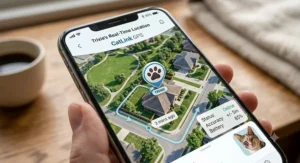
If your cat is the kind who’d notice — and resent — even a slightly bulky collar attachment, the Jiobit Smart Tag deserves a serious look. It weighs only about 0.65 ounces (18 grams), making it one of the smallest devices on this list that still uses actual GPS rather than short-range Bluetooth.
What makes the Jiobit Smart Tag technically interesting is its “progressive beaconing” approach: it blends GPS, cellular, Wi-Fi, and Bluetooth to intelligently choose whichever positioning method uses the least battery for a given situation. In practice, that means the device optimizes power based on context — sipping less battery when your cat’s parked at home, and switching to full GPS the moment she wanders. Manufacturer estimates put battery life at up to 7-30 days depending on usage patterns and how many “trusted places” you’ve set up, though real-world battery during heavy real-time tracking tends to land closer to 2-4 days — a gap worth planning around if you know you’ll lean on live tracking often.
Here’s what most buyers overlook about size-focused trackers like this one: the smaller the device, the smaller the battery, and that’s a real physical trade-off, not a marketing footnote. What most reviewers appreciate is that the tiny form factor makes it genuinely tolerable for cats who fight back against anything heavier. The catch, as with nearly every cellular tracker on this list, is the mandatory data subscription now bundled through Life360’s membership tiers.
Pros:
- ✅ One of the lightest true GPS trackers on the market
- ✅ Smart power-saving blends GPS, cellular, Wi-Fi, and Bluetooth
- ✅ Encrypted data with customizable geofence alerts
Cons:
- ❌ Subscription bundled into Life360 membership, not sold standalone
- ❌ Live tracking drains the small battery noticeably faster
Expect to pay around $120-$140 for the hardware, plus a required membership plan running roughly $8-$15 a month. For cats under 10 pounds who won’t tolerate anything larger, the Jiobit Smart Tag is arguably the most cat-appropriate pick here.
3. Pawfit Lite — lightest dedicated GPS cat collar
The Pawfit Lite was built specifically to solve the biggest complaint about cat GPS trackers: bulk. At just 17.6 grams, it’s lighter than both the Tractive (25g) and the discontinued Jiobit model (18g), making it the lightest dedicated GPS cat tracker currently available. It relies on true 4G LTE positioning rather than Bluetooth crowd-sourcing, which matters if you want a genuine live map rather than a “last seen near this phone” ping.
What the spec sheet won’t tell you outright is how the size trade-off plays out day to day: battery life runs approximately 3-5 days with regular tracking, and switching to activity-only mode (skipping continuous GPS polling) stretches that considerably. The device also folds in activity monitoring — steps, calories, and territory mapping — which is a nice bonus, though it’s clearly secondary to the core tracking function. It ships with a breakaway safety collar and an LED light for spotting your cat in low visibility, both sensible inclusions for a device this size.
Real owner sentiment on Trustpilot skews positive on the weight and setup experience specifically — one reviewer noted choosing it specifically for the weight of the device and how easy the mobile app was to configure for two cats. Some users have flagged charging reliability issues after extended use, which is worth factoring in if you want a tracker that lasts years, not months.
Pros:
- ✅ Lightest dedicated GPS tracker built specifically for cats
- ✅ True 4G LTE positioning, not Bluetooth-only crowd-sourcing
- ✅ Includes breakaway safety collar and low-light LED
Cons:
- ❌ Battery life shorter than heavier competitors (3-5 days)
- ❌ Some owners report charging port reliability problems over time
Pricing sits in the $70-$90 range for the hardware, with flexible subscription tiers. If minimizing collar weight is your single biggest priority, the Pawfit Lite is hard to beat.
4. Weenect Cat XS — smallest housing with no distance limit
The Weenect Cat XS leans hard into its size advantage. At 27 grams and measuring roughly 60.5 x 24.5 x 15 millimeters, the manufacturer markets it as the smallest GPS tracker on the market — a claim that’s at least directionally accurate compared to most cellular competitors, even if the Pawfit Lite and Jiobit both edge it out slightly on weight alone.
Functionally, it reports a new GPS position every second in its “Superlive” mode and works across 2G, 4G, and 5G networks, covering more than 100 countries. What that means practically: you’re not locked into a single carrier’s coverage map, which matters if you live somewhere with spotty service from one network but strong coverage from another. Here’s what’s honest to flag, though — real owner feedback is mixed on accuracy and app reliability, with some reviewers describing difficulty getting payment and subscription activation to go through smoothly, and rural coverage gaps have shown up in owner accounts as a genuine limitation rather than an edge case.
Where the Weenect Cat XS earns its spot on this list is price. It’s one of the more affordable true-GPS options once you factor in the lower subscription floor, which makes it a reasonable entry point for cat owners who want live tracking without committing to a premium ecosystem right away.
Pros:
- ✅ Compact housing among the lightest cellular GPS trackers
- ✅ Multi-network compatibility (2G/4G/5G) across 100+ countries
- ✅ Lower subscription floor than several premium competitors
Cons:
- ❌ Mixed owner reports on accuracy in rural or low-coverage areas
- ❌ Some users report subscription payment and app friction
Hardware runs around $35-$45, with subscriptions starting near $5.56 a month on longer prepaid terms. For budget-focused owners who still want genuine live GPS, the Weenect Cat XS is a sensible middle ground.
5. Cube Real-Time GPS Tracker — Verizon-powered budget cellular pick
The Cube Real-Time GPS Tracker takes a slightly different technical approach than the cat-specific competitors above: it uses GPS, Wi-Fi, cell tower triangulation, and Bluetooth technology together for location reporting, running on Verizon’s network rather than a proprietary global SIM. That layered approach gives it notably precise positioning, and the companion app logs trip history, stops made, and travel speed — details that can tell you whether your cat wandered off on foot or, worse, got picked up and transported somewhere.
What most buyers overlook about the Cube Real-Time GPS Tracker is that it wasn’t originally designed exclusively for cats — it’s a general pet and even personal-item tracker adapted for collar use, which shows up in its slightly larger housing. Reviewers note its size can feel cumbersome for smaller cats, so this is a better fit for larger, more robust felines than for a petite indoor cat. On the plus side, geofencing with customizable alerts for location, speeding, and low battery gives you more granular control than several of the cat-specific competitors offer.
Because it rides on Verizon’s cellular network rather than a bundled international SIM, coverage quality will track closely with how good your Verizon signal already is at home — worth checking before you buy if you’re in a rural pocket with weak service.
Pros:
- ✅ Multi-technology positioning (GPS + Wi-Fi + cell triangulation)
- ✅ Detailed trip history including speed and stop data
- ✅ Customizable alerts for speeding, geofencing, and low battery
Cons:
- ❌ Larger housing, less comfortable for small or petite cats
- ❌ Coverage quality depends heavily on Verizon signal strength
Expect a price range around $40-$55 for the hardware plus an ongoing Verizon-based data plan. It’s a strong pick for owners of larger cats who want more data than just a dot on a map.

6. Tabcat V2 — zero-subscription radio tracking for homebodies
Not every escape-prone cat needs full GPS, and the Tabcat V2 is built on the premise that a lot of “lost” cats haven’t actually gone far — they’re hiding under a neighbor’s deck or wedged behind the shed. Rather than satellites or cell towers — the same Global Positioning System technology that powers every other cellular tracker on this list — it uses radio-frequency technology with a handheld receiver that guides you directly to a featherweight collar tag, with no app, no signal dependency, and zero recurring fees.
The trade-off here is honest and worth stating plainly: range tops out around 400-500 feet, and there’s no live map — just a directional beep-and-flash system that gets more insistent as you close the distance. That makes it fundamentally different from every other product on this list. Based on the spec comparison, this isn’t a tool for tracking a cat that roams the neighborhood or crosses busy streets; it’s a tool for confirming your cat is, in fact, in the bushes three yards over, and walking straight to her.
What reviewers highlight most is the complete absence of ongoing cost and the tag’s tiny weight, which makes it an easy sell for cautious cat owners who mainly want backup reassurance rather than a full tracking system. The lack of any location history or remote app access is the clear limitation — if your cat goes missing while you’re at work, a Tabcat can’t help you until you’re physically close enough to start searching.
Pros:
- ✅ Zero subscription cost, ever — pay once and you’re done
- ✅ Extremely lightweight tag, easy for cats to tolerate
- ✅ Long battery life since there’s no cellular radio draining it
Cons:
- ❌ Limited range of roughly 400-500 feet, no true GPS map
- ❌ No remote app access — you must be physically nearby to search
Pricing sits around $100-$110 for the full kit including two homing tags. For an indoor-outdoor cat that mostly patrols its own yard, the Tabcat V2 is a low-hassle, no-subscription safety net.
7. Apple AirTag + cat collar holder — most affordable no-subscription option
The Apple AirTag wasn’t built for pets, but a cat collar holder accessory turns it into arguably the cheapest location cat collar setup available — provided you understand exactly what it can and can’t do. It uses Bluetooth and Apple’s crowd-sourced Find My network, meaning it shows your cat’s last known location whenever the AirTag passes within Bluetooth range of any iPhone in that network, not a continuous satellite fix.
That distinction matters enormously. As independent comparisons put it, an Apple AirTag shows you where your cat recently was, not a live, continuously updating position — it’s genuinely useful for a mostly-indoor cat that occasionally slips outside and stays within a densely iPhone-populated neighborhood, and far less useful for an outdoor cat that roams into rural or low-traffic areas where fewer iPhones are around to relay a signal. It also requires no subscription at all, which is the entire appeal for cost-conscious owners.
Here’s what most buyers overlook: because the Apple AirTag relies on nearby iPhones rather than a dedicated cellular or GPS radio, its usefulness is directly tied to population density. In a busy suburb, pings can arrive within minutes. In a rural area at night, you might not get an update for hours. It’s also worth noting this only integrates cleanly with Apple’s ecosystem, so Android households will need a different solution entirely.
Pros:
- ✅ Lowest total cost of any option on this list, no subscription ever
- ✅ Tiny and lightweight, barely noticeable on most cats
- ✅ Works well for mostly-indoor cats in populated neighborhoods
Cons:
- ❌ Not true real-time tracking — depends on nearby iPhones
- ❌ Far less reliable in rural areas or for far-roaming cats
Budget around $25-$30 for the AirTag itself plus roughly $10-$20 for a quality collar holder or silicone case. It’s the right call for light peace-of-mind coverage on a tight budget, not a substitute for real GPS if your cat genuinely roams.
Practical Usage Guide: Setting Up Your GPS Cat Collar
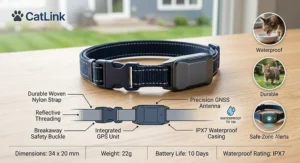
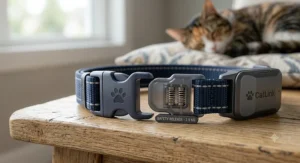
Buying the hardware is the easy part. Getting a cat to actually keep wearing it — and getting the tracker configured so it does its job — takes a little more care. Start with the collar fit itself: you should be able to slide two fingers comfortably between the collar and your cat’s neck, snug enough that it won’t slip over the head, loose enough that it’s not restrictive. Always choose a breakaway buckle design, since a cat that gets a fixed collar snagged on a fence or branch is at real risk of injury.
For the first 30 days, expect an adjustment period. Most cats will paw at a new collar attachment for the first few days; this is normal and usually fades once they get used to the weight. Introduce the tracker gradually — a few hours at a time before leaving it on overnight — rather than immediately expecting all-day tolerance. During setup, configure your safe zone (geofence) generously at first; a boundary that’s too tight will spam you with false “escaped” alerts every time your cat naps on the porch.
Charging schedules matter more than owners expect. Devices with 3-7 day battery ratings should be charged on a fixed weekly schedule rather than waiting for a low-battery alert, since a tracker that dies while your cat is outside is worse than useless — it’s a false sense of security. Common first-month mistakes include forgetting to update the app after a firmware push, leaving LIVE mode running constantly (which tanks battery life fast), and not testing the tracker’s actual range in your specific neighborhood before you need it in an emergency.
Real-World Scenarios: Which Cat Owner Are You?
Different living situations call for genuinely different gear, so here are three common profiles matched to the products above, with the reasoning behind each pairing.
The apartment-dwelling indoor cat owner. Your cat rarely goes outside, but you’re paranoid about an open door during a move or a delivery. Budget is a real constraint, and the cat is unlikely to test a large range. The Apple AirTag with a collar holder covers this scenario well: dense apartment complexes usually mean plenty of nearby iPhones for quick Find My pings, and you’re not paying a monthly fee for capability you’ll rarely need.
The suburban free-roamer. Your cat treats several backyards as personal territory and disappears for hours at a stretch, but rarely leaves a two-block radius. This is squarely Tractive GPS Cat Tracker or Weenect Cat XS territory — you want continuous cellular GPS with a real map, geofence alerts the moment they cross a boundary, and LIVE mode on standby for the (hopefully rare) night they don’t come home on schedule.
The multi-cat household on a budget. You’ve got two or three cats, and outfitting all of them with premium hardware and separate subscriptions adds up fast. The Weenect Cat XS or Cube Real-Time GPS Tracker‘s lower subscription floors make multi-device budgeting more realistic, and both support multiple trackers under one household app.
Problem → Solution Guide: Fixing Common Cat-Tracking Headaches
Problem: your cat keeps removing the collar. Solution: switch to a snugger, cat-specific breakaway design — several of the products above, including the Pawfit Lite and Tractive GPS Cat Tracker, ship with purpose-built cat collars rather than generic pet straps, which reduces slippage significantly.
Problem: the battery dies mid-search. Solution: reserve LIVE mode for actual emergencies, and set a recurring weekly charging reminder rather than relying on low-battery push notifications, which sometimes arrive too late to act on.
Problem: false geofence alerts every few minutes. Solution: widen your safe zone boundary to account for GPS drift, which can be off by 10-30 feet depending on tree cover and building density — a boundary set too tight will constantly cry wolf.
Problem: poor accuracy in a rural area. Solution: prioritize multi-network devices like the Weenect Cat XS or Cube Real-Time GPS Tracker, which can fall back across multiple carriers, rather than single-SIM devices tied to one network’s coverage map.
Problem: recurring subscription costs feel unsustainable. Solution: consider a hybrid approach — a no-subscription option like the Tabcat V2 or Apple AirTag for day-to-day peace of mind, reserving a cellular GPS rental or short-term plan for specific higher-risk periods like moving to a new home.
What Is a GPS Cat Collar?
A GPS cat collar is a small tracking device, typically clipped to or built into a breakaway collar, that uses satellite positioning, cellular networks, or a combination of both to report a cat’s location to a smartphone app. Most models require an ongoing data subscription, weigh between 15 and 35 grams, and offer features like geofencing, location history, and live tracking modes for active searches.
Not every “location cat collar” on the market uses true GPS, though — and that distinction is the single biggest thing to understand before buying.
How to Choose a GPS Cat Collar
Picking the right cat GPS tracker comes down to weighing a handful of factors against your specific cat and lifestyle, not chasing whichever model has the flashiest marketing page. Here’s the expert-reasoned checklist:
- Weigh your cat’s tolerance for wearing gear. A cat under 8 pounds will notice and resist a 35-gram device far more than a 15-pound cat will. Match hardware weight to your cat’s size and personality first.
- Decide how far your cat actually roams. An indoor cat with occasional slip-outs needs far less range than a true outdoor explorer — don’t overpay for global cellular coverage you’ll never use.
- Factor in the real subscription cost, not just hardware price. A $35 tracker with a $13/month plan can cost more over two years than a $90 tracker with a $5/month plan — do the math before comparing sticker prices.
- Check battery life against your realistic use pattern. If you know you’ll lean on LIVE mode during searches, budget for daily charging regardless of the advertised multi-day rating.
- Confirm network coverage in your specific area. Cellular trackers are only as good as the signal where you live — rural areas need multi-network devices more than urban ones do.
- Look for a proper breakaway safety collar. Any tracker without one is a safety liability, full stop, regardless of how good its tracking specs look.
- Read aggregated app reviews, not just hardware reviews. A great sensor paired with a clunky, unreliable app is still a frustrating daily experience.

GPS Cat Collar vs Bluetooth and RF Cat Trackers
The biggest decision point isn’t which brand to buy — it’s which underlying technology fits your situation. True GPS cat collar models, like the Tractive GPS Cat Tracker and Jiobit Smart Tag, use cellular networks to report a continuously updating location almost anywhere with signal, but that capability comes bundled with an ongoing subscription cost that adds up over a cat’s lifetime.
Bluetooth trackers like the Apple AirTag flip that trade-off entirely: no subscription, tiny hardware, but location updates depend entirely on passing by another device on the same network, which makes them unreliable for cats that roam beyond populated areas. Radio-frequency trackers like the Tabcat V2 sidestep both problems by skipping cellular data entirely, offering a direct, no-fee signal — at the cost of a hard range limit of a few hundred feet and zero remote app access.
| Technology | Range | Subscription | Best Scenario |
|---|---|---|---|
| Cellular GPS | Unlimited (with signal) | Required | Cats that roam widely or unpredictably |
| Bluetooth (crowd-sourced) | Depends on nearby devices | None | Mostly-indoor cats in populated areas |
| Radio Frequency | ~400-500 ft | None | Cats that hide nearby rather than travel far |
Reading the comparison above, there’s no universally “best” technology — the Tractive GPS Cat Tracker wins for a genuine outdoor roamer, while the Tabcat V2 or Apple AirTag make more financial sense for a cat that’s realistically never leaving the block. The mistake most first-time buyers make is choosing based on price alone rather than matching the technology to their cat’s actual behavior.
✨ Ready to Stop Guessing Where Your Cat Went?
🔍 Take the stress out of every open door and midnight disappearance. Compare the top GPS cat collar picks above, check current pricing, and pick the one that actually matches how far your cat roams.
Real-Time Tracking: What to Actually Expect
“Real-time tracking” gets thrown around loosely in pet-tech marketing, so let’s be precise about what it actually delivers day to day. Most cellular GPS cat collars operate in two modes: a battery-conserving standard mode that pings every few minutes to an hour, and a LIVE or “Superlive” mode that updates every few seconds but drains the battery noticeably faster. In practice, you’ll leave your tracker in standard mode almost all the time, and flip on live tracking only during an active search — which is exactly how it’s designed to be used.
What the spec sheet won’t tell you is how location accuracy shifts with environment. Open yards and clear sky give the tightest accuracy, often within 10-30 feet. Dense tree cover, multi-story buildings, and being indoors all degrade GPS accuracy — your cat hiding in a crawlspace under the porch might show up as “somewhere near the house” rather than a pinpoint dot. Understanding this upfront prevents the frustration of assuming your tracker is broken when it’s actually just doing its best with a weak signal.
Smart Cat Collar Features for Different Cat Owners
A smart cat collar isn’t a one-size-fits-all product, and the “extra” features beyond raw location tracking matter differently depending on who you are. For owners of senior cats, activity and sleep monitoring (offered by the Tractive GPS Cat Tracker and, to a lesser degree, Pawfit Lite) can flag subtle mobility or behavior changes worth mentioning at the next vet visit — not a diagnostic tool, but a useful early signal. For multi-cat households, look for apps that support multiple devices under one account without forcing separate logins or duplicate subscriptions, which several of the cellular options above handle reasonably well.
For first-time outdoor cat owners easing a previously indoor cat into supervised outdoor time, geofencing with adjustable alert sensitivity is the feature that matters most — it lets you gradually expand the safe zone as your cat (and your nerves) adjust. For owners in rural areas, prioritize multi-network cellular compatibility over flashy extras like activity tracking, since none of the bonus features matter if the core location signal is unreliable where you actually live.
Common Mistakes When Buying a GPS Cat Collar
The most common misstep is buying based purely on price without checking the underlying technology — a cheap Bluetooth tag isn’t a fair substitute for cellular GPS if your cat genuinely roams. A close second is ignoring total cost of ownership: hardware price is a one-time number, but a two- or three-year subscription commitment is where most of the real spend happens, and skipping that math leads to sticker shock later.
Another frequent error is buying a device too heavy for a small or elderly cat, which results in the tracker getting shrugged off within days. Finally, plenty of buyers skip reading real aggregated app reviews and focus purely on hardware specs — a beautifully engineered sensor paired with a buggy, unreliable companion app is still a frustrating daily experience, and app quality varies more between brands than raw GPS accuracy does.
Lost Cat Prevention: Practical Steps Beyond the Collar
A GPS cat collar dramatically improves your odds of a fast recovery, but lost cat prevention works best as a layered strategy, not a single device. the American Humane Association reports microchipped cats are reunited with their owners roughly 38.5% of the time, compared to just 1.8% for cats without a microchip — meaning a permanent ID chip and a GPS collar work together, covering different failure scenarios (a collar can fall off; a microchip can’t). Combine both with a visible ID tag listing a phone number, since not every shelter or neighbor has a chip scanner handy.
Beyond hardware, simple habits reduce risk meaningfully: check window screens for gaps every spring, train family members and guests on the “cat could bolt” door protocol, and photograph your cat regularly so you have a recent, clear image ready if you ever need to post a lost-pet flyer. According to the ASPCA, only about 3.2 million of the roughly 6.5 million animals that enter shelters each year get adopted out again — a sobering reminder that prevention and fast recovery matter far more than hoping a shelter reunion works out.
Long-Term Cost & Location Monitoring: The Subscription Math
The sticker price of a GPS cat collar is rarely the real cost. Location monitoring through a cellular network is what actually powers the live map, and every provider on this list charges for it monthly, annually, or via a discounted multi-year prepay. Run the math over a realistic ownership window before you commit.
| Product | Hardware Price Range | Monthly Subscription | 2-Year Estimated Total |
|---|---|---|---|
| Tractive GPS Cat Tracker | $50-$65 | ~$5-$9/mo | Around $170-$280 |
| Jiobit Smart Tag | $120-$140 | ~$8-$15/mo | Around $310-$500 |
| Weenect Cat XS | $35-$45 | ~$5.56-$13/mo | Around $170-$355 |
| Tabcat V2 | $100-$110 | None | $100-$110 total |
| Apple AirTag + holder | $35-$50 | None | $35-$50 total |
The analysis is straightforward once it’s laid out: the no-subscription options are dramatically cheaper over a two-year span, but only if their limited range actually fits your cat’s habits. If you own an outdoor cat for its whole 15-plus-year lifespan, cellular subscription costs on a device like the Tractive GPS Cat Tracker genuinely add up — worth prepaying multi-year plans where available, since per-month cost typically drops substantially compared to month-to-month billing.
Frequently Asked Questions
❓ Do GPS cat collars actually work for real-time tracking?
❓ How much does a cat GPS tracker cost per month?
❓ Is a GPS cat collar safe for a small cat to wear?
❓ Can I track my cat without a monthly subscription?
❓ What's the difference between a cat tracker collar and a smart cat collar?
Conclusion
There’s no single “best” GPS cat collar — there’s only the best match for your specific cat’s size, roaming habits, and your comfort with an ongoing subscription. If you want the safest, most proven all-around pick, the Tractive GPS Cat Tracker remains the easiest recommendation for most households. If your cat is small and gear-averse, the Jiobit Smart Tag or Pawfit Lite solve the weight problem better than anything else on this list. Budget-focused owners with mostly-indoor cats can get real peace of mind from the Apple AirTag or Tabcat V2 without paying a cent in monthly fees, while owners of large outdoor roamers may prefer the extra data the Cube Real-Time GPS Tracker provides.
Whichever you choose, remember that the collar is one layer of a bigger prevention strategy — pair it with a microchip, a visible ID tag, and a properly fitted breakaway buckle, and you’ve covered the scenarios a single device can’t handle alone. About one in three pets goes missing at some point in their lifetime, and a GPS cat collar is one of the few tools that turns that anxious possibility into something you can actually respond to, calmly, from your phone.
✨ Don’t Miss These Exclusive Deals!
🔍 Ready to stop worrying every time your cat slips outside? Click through to check current pricing and availability on any of the picks above — the right GPS cat collar could save you a very stressful night.
Recommended for You
- 7 Best Harness for Kittens in 2026: Safe, Comfy Picks
- Padded Cat Harness: 7 Comfortable Picks Cats Actually Tolerate (2026)
- Cat vest harness: 7 Comfy Picks That Won’t Turn Walkies Into a Wrestling Match (2026)
Disclaimer: This article contains affiliate links. As an Amazon Associate, I earn from qualifying purchases. If you purchase products through these links, we may earn a small commission at no additional cost to you.
✨ Found this helpful? Share it with your friends! 💬🤗
