
Table of Contents
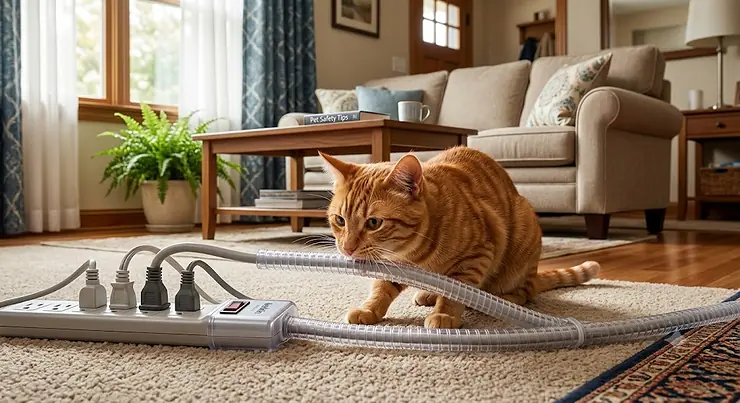
Your cat does not know the difference between a phone charger and a piece of string, and that is exactly the problem. A cord protector for cats is a sleeve, tube, or bitter-coated cover that physically or chemically stops a cat from getting its teeth through a live wire — the electrical version of a helmet for something that never asked to wear one. If you have ever walked into a room to find your charging cable stripped down to bare copper, you already understand why this matters more than most home-safety purchases you will make this year.
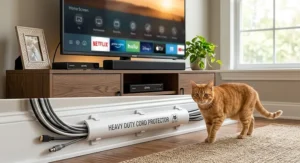
Kittens are the worst offenders, mostly because a dangling cord swings like prey and their teething instincts do the rest, but plenty of adult cats keep the habit going out of boredom, stress, or a texture preference nobody fully understands. Without a safe outlet for that chewing instinct, a cat can turn its attention to electrical cords, and the fallout ranges from burns to full electrocution, plus the added risk of choking on swallowed bits of insulation. That is not a scare tactic — it is the baseline reason this entire product category exists.
The good news: solving it does not require rewiring your house. Below, we researched seven real, currently available cord protector for cats options, from bare-bones budget sleeves to heavy-duty setups built for cats who chew like it is their job. We looked at real specs, aggregated review sentiment where it is verifiable, and — because a cord protector from cats is only as good as its weakest inch — where each one is genuinely worth your money and where it is not. For more on why this behavior happens in the first place, PetMD’s breakdown of why cats chew electrical cords is a solid starting point before you buy anything.
Quick Comparison Table
| Product | Type | Length | Best For |
|---|---|---|---|
| PetCords 10 FT | Split PVC sleeve, unscented | 10 ft | Budget-conscious first-timers |
| PetCords Heavy Duty Extra Strength | Reinforced split sleeve | 10 ft | Aggressive, determined chewers |
| Chewsafe Pet Cord Cover | Bitter apple + citrus infused sleeve | 10 ft | Combining taste deterrent with a physical barrier |
| Alex Tech Wire Loom Tubing | True automotive-grade wire loom | 10 ft | Bundling multiple cables at once |
| PROTECTO Heavy Duty Cord Protector | Clear 2mm PVC tubing | 10 ft | Keeping cords visually discreet |
| Cacovedo Cord Protector | Split PVC tubing | 30 ft | Whole-room or whole-house runs |
| Small Pet Select Heavy Duty Cord Cover | Reinforced white sleeve | 10 ft | Premium daily durability |
Looking at the spread above, the biggest differentiator isn’t price — it’s length and reinforcement. A single PetCords 10 FT sleeve barely covers one desk setup, while Cacovedo‘s 30-foot roll is built for owners protecting an entire home office or media console wall. If your cat is a light, occasional nibbler, most of these will work; if you’ve already replaced a charging cable twice this year, skip straight to the reinforced options like PetCords Heavy Duty Extra Strength or Small Pet Select Heavy Duty Cord Cover.
💬 Found a pick you like already? Jump to the full breakdown below before you check out!
Top 7 Cord Protectors for Cats: Expert Analysis
1. PetCords 10 FT Cord Protector — best budget starter option
Made in the USA and completely unscented, the PetCords 10 FT Cord Protector is the no-frills entry point most people should start with. It’s a split-seam PVC sleeve that you press cords into rather than thread through, which sounds minor until you’re doing this at 11 p.m. after your cat has already had two cords for dinner. Rated to fit cords up to roughly 14-gauge, it acts as what the brand accurately calls a second barrier of defense, not an indestructible shield — a distinction that matters when you’re setting expectations.
Based on the spec comparison, this is the right call for owners dealing with a curious kitten rather than a hardened repeat offender; the sleeve is sturdy enough to discourage casual investigation but isn’t the toughest material on this list. Reviewers consistently note that installation takes under five minutes and that the sleeve holds its shape well around corners and under furniture, which is exactly where cats tend to strike.
Pros:
- ✅ Made in the USA with unscented, pet-safe material
- ✅ Fast, tool-free installation via split seam
- ✅ Fits most standard household power and A/V cords
Cons:
- ❌ 10 ft length runs out quickly on multi-device setups
- ❌ Not reinforced enough for cats that chew aggressively
At around $10-$15 for a single 10 ft length, the value here is straightforward: it’s the cheapest legitimate way to test whether a physical barrier changes your cat’s behavior before you spend more on a heavier-duty version.
2. PetCords Heavy Duty Extra Strength Cord Protector — best for tough chewers
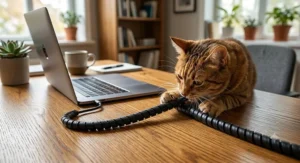
This is the reinforced sibling to the standard PetCords sleeve, built specifically, per the brand, for pets with a documented habit of chewing through the lighter version. What most buyers overlook about this model is that “heavy duty” here refers to wall thickness and tear resistance rather than a wider diameter — it still fits the same cord range, it just takes noticeably more bite pressure to breach.
If your cat has already gone through a standard cord cover, or if you’re dealing with a multi-cat household where one cat’s chewing habit has become a running joke in the group chat, this is the more rational starting point rather than a downgrade path. The added thickness does make it slightly stiffer around tight bends, so plan your cord routing before installing rather than after.
Pros:
- ✅ Noticeably thicker wall than the standard PetCords sleeve
- ✅ Still unscented and odorless for scent-sensitive cats
- ✅ USA-made with consistent quality control
Cons:
- ❌ Stiffer material makes tight corners harder to route
- ❌ Costs more per foot than the standard version
Priced in the $15-$20 range for 10 ft, it’s a fair premium over the base version, and worth paying if you’ve already replaced a cord once.
3. Chewsafe Pet Cord Cover — best dual-deterrent (taste + barrier)
The Chewsafe Pet Cord Cover takes a different approach: instead of relying purely on physical thickness, it’s infused with bitter apple and a citrus scent baked into the material itself, so it doesn’t wash or rub off the way a spray-on deterrent eventually does. On paper this means you’re getting two deterrents stacked on top of each other — a taste your cat hates and a physical layer it still has to get through first.
Reviewers report this combination works particularly well on cats that chew more out of boredom than genuine prey-drive aggression, since the bitter taste interrupts the behavior before real damage happens. One verified customer account describes the product ending a repeated cord-chewing habit in their household after prior physical covers alone hadn’t fully solved it — a useful data point, though as with any single review, it shouldn’t be read as a guarantee for every cat’s preferences.
Pros:
- ✅ Built-in bitter apple and citrus scent, won’t wash off
- ✅ Pre-slit opening for quick, no-tool installation
- ✅ Cuttable to custom lengths for irregular cord runs
Cons:
- ❌ Some cats are simply unbothered by bitter-taste deterrents
- ❌ Citrus scent may be noticeable to sensitive-nosed owners too
Expect to pay in the $12-$18 range for a 10 ft length — reasonable for a two-in-one deterrent, especially if a spray-only approach has already failed you.
4. Alex Tech Wire Loom Tubing — best true wire loom for cable bundling
Unlike the pet-branded sleeves above, the Alex Tech Wire Loom Tubing is genuine automotive- and marine-grade split wire loom, the same category of product used to bundle wiring harnesses in cars, repurposed here specifically as a cord protector from cats. It’s sold in multiple diameters (commonly 1/4 inch and 1/2 inch), which matters because it lets you match the tube tightly to a single charging cable or loosely to a bundle of three or four cords running to a media console.
Here’s what to weigh: wire loom tubing is denser and more rigid than the softer pet-specific sleeves, which is exactly why it holds up better against a cat that treats every cord like a personal chew toy. The trade-off is a slightly more industrial look and a bit more effort threading cords through rather than pressing them into a split seam — though the split-sleeve design still allows side-loading if you buy the split variant rather than closed tubing.
Pros:
- ✅ Genuine automotive-grade material, denser than pet-only sleeves
- ✅ Multiple diameter options for single cords or bundles
- ✅ Doubles as general cable management, not just chew protection
Cons:
- ❌ Slightly more effort to install than press-in pet sleeves
- ❌ Available mostly in black or white — fewer color options
At roughly $8-$14 per 10 ft depending on diameter, it’s one of the more cost-efficient wire loom for cats solutions if you’re bundling multiple cables instead of protecting one at a time.
5. PROTECTO Heavy Duty Cord Protector — best low-profile clear cover
The standout here is right in the name of the finish: PROTECTO Heavy Duty Cord Protector is molded from clear, flexible 2mm-thick PVC, so instead of a visible black tube running along your baseboards, you get something that mostly disappears against most flooring and wall colors. It ships with a bonus utility knife specifically so you can cut it to the exact length you need rather than bunching up excess material where a cat can still get at an exposed edge.
Based on the spec comparison, the thicker 2mm wall is a meaningful upgrade over the thinner, more brittle clear sleeves that tend to crack after a season — a common complaint about lower-end clear protectors this one is explicitly designed to fix. It fits cords up to about 3/8 inch thick via a simple split-seam channel, which covers the vast majority of phone chargers, laptop bricks, and lamp cords in a typical home.
Pros:
- ✅ Clear finish blends into most home decor
- ✅ 2mm PVC thickness resists the cracking cheaper clear covers show
- ✅ Includes a utility knife for custom-length cutting
Cons:
- ❌ Clear material can show scuffs and cloudiness over time
- ❌ Limited to cords under roughly 3/8 inch in diameter
Priced around $13-$19 for 10 ft, it’s a smart pick specifically for anyone who has avoided cord covers so far purely because the black ribbed look clashes with their space.
6. Cacovedo 30 ft Cord Protector — best value for whole-house coverage
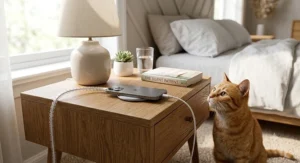
Where most entries on this list ship 10 feet at a time, the Cacovedo 30 ft Cord Protector triples that in a single order, which changes the math entirely if you’re protecting more than one room. It’s a split-seam PVC tube you cut to length and snap cords into, and the extra length means far less seam-matching and patchwork than buying three separate 10 ft rolls from a different brand.
Reviewers consistently mention that the 30 ft length is genuinely usable across an entire home office setup — desk cords, a floor lamp, and a printer cable — with material left over, rather than running short the way a single 10 ft roll often does once you account for corners and slack. The trade-off is that at this length, the tubing is a standard-duty split PVC rather than the reinforced “heavy duty” grade some single chewers may need.
Pros:
- ✅ 30 ft length covers multiple cords or rooms in one purchase
- ✅ Lower effective cost per foot than most 10 ft options
- ✅ Simple cut-to-length, snap-in installation
Cons:
- ❌ Standard-duty thickness, not the toughest option here
- ❌ Longer rolls are bulkier to store leftover material
At around $18-$25 for the full 30 ft, the per-foot value is genuinely the best on this list — worth it the moment you’re covering more than one cord run.
7. Small Pet Select Heavy Duty Cord Cover — best premium daily-durability pick
Rounding out the list, the Small Pet Select Heavy Duty Cord Cover is marketed toward small pets broadly — rabbits, cats, and other persistent chewers — which tells you something about the bite-resistance bar it’s built to clear. The white finish is a deliberate departure from the black-tube default, and reviewers note it holds up well in visible living spaces where a cord cover needs to look intentional rather than like an obvious retrofit.
What most buyers overlook about this model is that “heavy duty” claims vary wildly across this entire product category, and this is one of the few where the reinforced wall thickness is noticeable by feel compared with base-tier competitors. For households with a genuinely persistent chewer where a standard sleeve has already failed once, this is a reasonable next step before considering a full behavioral intervention with your vet.
Pros:
- ✅ Noticeably thicker walls than standard-duty sleeves
- ✅ White finish suits visible, high-traffic living spaces
- ✅ Marketed and tested across multiple small-pet species
Cons:
- ❌ Premium pricing relative to standard 10 ft covers
- ❌ White finish shows dirt faster than black alternatives
Expect to pay in the $16-$22 range for 10 ft — a reasonable premium if aesthetics and proven bite-resistance both matter to you.
✨ Don’t Miss These Exclusive Deals!
🔍 Take your cat-proofing setup to the next level with these carefully selected cord protectors. Click on any highlighted product above to check current pricing and availability. A few dollars now beats a vet bill or a fried charger later.
Wire Loom & Cord Cover Installation: Practical Usage Guide
Buying the right cord protector for cats solves half the problem; installing it properly solves the rest. Start by unplugging everything you’re working on — obvious, but skipped more often than you’d think when you’re in a hurry. Measure the actual cord run rather than eyeballing it, since most sleeves need a few extra inches to account for slack and bends around furniture legs.
For split-seam sleeves like PetCords or PROTECTO, press the cord into the seam starting from one end and work down the length in short sections rather than trying to feed the whole cord in at once — it prevents the seam from twisting and leaving a gap a cat can exploit. If you’re using true Alex Tech Wire Loom Tubing to bundle multiple cables, measure the combined bundle diameter first; a tube that’s too loose defeats the purpose, since cats can still get a tooth into slack material.
Common first-30-day mistakes: leaving an inch of exposed cord at the wall outlet (cats target exactly this spot), cutting the sleeve too short so it bunches instead of laying flat, and forgetting to secure the sleeve’s ends with a cable clip or tape so a cat can’t peel it back from the tip. A quick maintenance check every few weeks — looking for teeth marks on the outside of the sleeve — tells you whether your current level of protection is holding or whether it’s time to size up to a heavier-duty option like Small Pet Select Heavy Duty Cord Cover.
Real Cat Owner Scenarios: Which Cord Protector Fits Your Home
If you’re a first-time kitten owner with one charging cable near the couch and no history of chewing yet, the PetCords 10 FT Cord Protector is genuinely enough — it’s inexpensive, easy to install in one sitting, and gives you a baseline before you know whether your specific cat is a chewer at all.
If you’re working from home with a desk setup — monitor, laptop charger, a desk lamp, maybe a printer — and your cat has already shown interest in cords, the math changes. A single Cacovedo 30 ft Cord Protector roll covers the whole desk run for less per foot than buying three separate short sleeves, and the leftover length is useful for a second location later.
If you’re in a multi-cat household where one specific cat has already destroyed a cord or two, skip the entry-level tier entirely. Reach for PetCords Heavy Duty Extra Strength or the Chewsafe Pet Cord Cover‘s bitter-taste-plus-barrier combination — the goal isn’t just physical resistance at that point, it’s actively making the behavior unpleasant enough that the cat stops testing new cords too.
Chewing Prevention: Problem-Solution Troubleshooting Guide
Problem: My cat chewed through a cover in one sitting. Solution — you likely under-estimated bite strength; move to a reinforced option like Small Pet Select Heavy Duty Cord Cover and pair it with a bitter-apple spray on the exposed ends for added deterrent.
Problem: The cover keeps sliding down and exposing cord ends. Solution — secure both ends with a small piece of cable-friendly tape or a zip tie loosely fastened just past the sleeve opening, not around the cord itself.
Problem: My cat chews furniture and cords equally, so it seems behavioral. Solution — physical covers only address access, not motivation; add interactive play sessions and rotate chew-safe toys, since chewing on cords is often tied to boredom, dental discomfort, or simple exploratory behavior in cats and kittens, and a vet visit can rule out dental causes.
Problem: I have too many cords in one spot and covers keep tangling. Solution — bundle them with genuine Alex Tech Wire Loom Tubing sized to the combined diameter rather than trying to cover each cord individually.
Problem: My cat avoids the cover but attacks any new, uncovered cord immediately. Solution — this is common with new devices; keep a spare length of whichever cover worked best on hand so new cords never sit exposed even for a day.
How to Choose a Cord Protector for Cats
- Match the diameter to your actual cords. Measure before buying — an oversized tube leaves slack a cat can still bite through, while an undersized one won’t close properly.
- Assess your cat’s chew history honestly. A first-time nibbler doesn’t need the same reinforcement as a cat that’s already destroyed two cables.
- Decide if taste deterrent adds value. If your cat is food-motivated and stubborn, a bitter-infused option like Chewsafe Pet Cord Cover adds a second layer physical covers alone don’t provide.
- Consider total length needed, not just one cord. Buying a longer roll like Cacovedo‘s 30 ft option is usually cheaper per foot than multiple short pieces.
- Factor in installation effort. Split-seam press-in designs install faster than true wire loom tubing, which matters if you’re covering many cords at once.
- Check aesthetic fit for visible rooms. Clear or white options like PROTECTO or Small Pet Select blend into living spaces better than standard black tubing.
- Plan for reinforcement, not replacement. If a standard cover fails, size up rather than buying the exact same product twice.
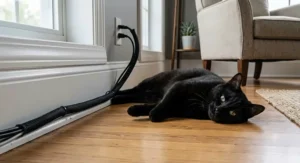
Common Mistakes When Buying a Chew-Proof Cord Cover
The most common mistake is buying based on price alone and assuming any chew-proof cord cover works the same. Reviewers consistently point out that thinner, bargain-bin sleeves crack or split within weeks under a genuinely persistent chewer, while a slightly pricier reinforced option like Small Pet Select Heavy Duty Cord Cover lasts substantially longer — the cheaper option often costs more in replacements over a year.
A second mistake is buying exactly the length of the cord and nothing more, which leaves no slack for the sleeve to bend naturally around furniture without gapping at the seams. A third: assuming a bitter-taste product alone solves a determined physical chewer’s habit — taste deterrents work best as a supplement to a real physical barrier, not a replacement for one. Finally, many owners install a cover once and never check it again; a quick monthly glance for teeth marks tells you whether it’s time to upgrade before a cord actually gets breached.
Cord Protectors vs Bitter Sprays and Deterrent Solutions
| Approach | How It Works | Durability | Best For |
|---|---|---|---|
| Physical cord covers (PetCords, PROTECTO, etc.) | Rigid or semi-rigid barrier around the cord | Long-lasting, doesn’t need reapplication | Cats motivated by texture and prey-drive chewing |
| Bitter spray-on deterrents | Topical taste deterrent applied directly to cords | Wears off, needs reapplication every 1-2 weeks | Mild deterrence on cords you can’t easily cover |
| Infused covers (Chewsafe) | Bitter taste built into the cover material itself | Long-lasting, doesn’t wash off like sprays | Combining both approaches without reapplication hassle |
The written comparison matters more than the table here: a bitter spray is the lowest-effort option, but it needs reapplying constantly and does nothing to protect a cord physically if your cat isn’t taste-sensitive that day. A standard cover like Alex Tech Wire Loom Tubing solves the physical-access problem permanently but does nothing to address a cat that’s simply determined to keep trying. An infused option like Chewsafe Pet Cord Cover essentially combines both, which is why it tends to outperform either approach used alone for genuinely stubborn chewers.
Cable Management for Cat Owners: Features That Actually Matter (And Those That Don’t)
Marketing copy on cord protectors loves to lean on words like “premium” and “ultra-durable” without defining either. What actually matters: wall thickness (measurable, and the real driver of bite resistance), a snug diameter match to your cord (prevents slack a cat can exploit), and secure end-closure (an exposed inch at either end defeats the whole product). What doesn’t matter nearly as much: color, unless you specifically need it to blend into a visible room, and brand name recognition, since several of the products on this list are made by smaller specialty brands rather than household names, with comparable real-world performance.
Genuine cable management is a bonus feature worth weighing too — a product like Alex Tech Wire Loom Tubing doubles as a way to bundle and tidy multiple cords behind a desk or entertainment center, which means you’re solving a cat-safety problem and an aesthetic one in a single purchase rather than buying separate cord organizers later.
Electrical Safety Guide for Cat Households
Cord chewing isn’t just a property-damage risk — it’s a documented cause of serious injury in cats. Electrical energy passing through a chewed cord can trigger tremors, an irregular heartbeat, breathing difficulty, and shock, and fluid can build up in the lungs hours after the initial injury even when a cat initially seems fine. That delayed-symptom pattern is exactly why prevention matters more than reaction here — by the time visible symptoms appear, the injury may already be serious.
Basic electrical safety habits pair well with any cord protector for cats you choose: unplug devices you’re not actively using, especially seasonal ones like space heaters or holiday lighting, and route cords along baseboards rather than across open floor space where they’re more likely to catch a cat’s attention. Cornell University’s veterinary hospital specifically flags cords and lights as an electrocution risk for pets and recommends keeping them out of reach and unplugged whenever possible — advice that applies just as much to a January home office setup as a December tree. If you suspect your cat has already made contact with a live cord, treat it as an emergency regardless of how normal they seem; young cats between roughly 8 weeks and 2 years old are, according to veterinary sources like MSPCA-Angell, the age group most commonly affected, since electrical cords are so often mistaken for chew toys.
Long-Term Cost & Maintenance
A single 10 ft cord cover runs roughly $10-$22 depending on reinforcement level, which sounds trivial until you compare it against the cost of a replaced charging cable, a damaged appliance cord, or — in the worst case — an emergency vet visit for electrical injury, which can run into the hundreds of dollars even for a mild case. Viewed as total cost of ownership, a $20 reinforced cover that lasts two years beats a $10 basic sleeve you replace three times over the same period, both in dollars and in the number of times your cat gets unsupervised access to an exposed cord during a swap.
Maintenance is minimal by design: a monthly visual check for teeth marks or splitting, keeping ends secured, and sizing up if you notice repeated chewing attempts at the same spot. Products like Cacovedo‘s 30 ft roll also age well economically, since leftover material from an initial install becomes free replacement stock for a future cord without another purchase.
FAQ
❓ Does a cord protector for cats actually stop chewing completely?
❓ What's the difference between a cord protector and wire loom for cats?
❓ Can I use a chew-proof cord cover on outdoor extension cords?
❓ How do I know if my cat's cord chewing is a medical issue?
❓ Is a bitter spray enough electrical safety on its own, without a physical cover?
Conclusion
There’s no single best cord protector for cats — there’s only the right match for your specific cat’s chewing history and your specific cord setup. A first-time kitten owner with one visible charger cable is solving a completely different problem than someone whose adult cat has already destroyed two chargers this year, and the seven products above cover that entire range honestly, from the budget-friendly PetCords 10 FT Cord Protector to the reinforced Small Pet Select Heavy Duty Cord Cover.
What matters more than which specific product you pick is that you pick something before an incident happens rather than after. Cord chewing injuries in cats are frequently serious enough to require emergency veterinary care, and the delayed-symptom pattern common to electrical injuries means “my cat seems fine” isn’t the same as “my cat is fine.” Electrical cords consistently rank among the household hazards Texas A&M veterinary researchers flag for pet owners, right alongside toxic plants and unsecured medications, which is a useful reminder that cord-proofing is one piece of a broader pet-safety routine. A $15-$25 cord cover is cheap insurance against a much more expensive and much more frightening outcome — and pairing the right physical cover with basic electrical safety habits at home covers both sides of the problem at once.
Recommended for You
- 7 Best Cat Deterrent Spray Picks 2026: Stop Scratching Fast
- Cat Scratch Tape 2026: 7 Picks That Actually Save Your Sofa
- Cat Scratch Furniture Protector: 7 Best Picks to Save Your Sofa (2026)
Disclaimer: This article contains affiliate links. As an Amazon Associate, I earn from qualifying purchases. If you purchase products through these links, we may earn a small commission at no additional cost to you.
✨ Found this helpful? Share it with your friends! 💬🤗
