
Table of Contents
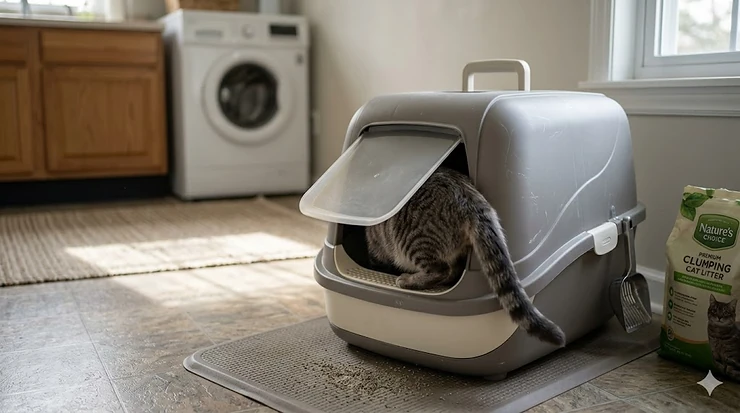
A top entry litter box is an enclosed cat toilet with the opening cut into the lid instead of the front. Your cat climbs in from above, does her business in private, and climbs back out through a textured hatch that scrapes litter off her paws on the way. No side door, no front flap — just a hole in the roof.
Here’s the thing nobody tells you when you’re standing in the pet aisle squinting at boxes: the design sounds almost comically simple, like something a cat would design if cats had opposable thumbs and a grudge against vacuum cleaners. And yet it solves three problems at once — scatter, smell, and the family dog’s unfortunate habit of treating the litter box like a snack bar — better than almost anything else on the market that isn’t wired to an app.
I’ve spent the last several weeks pulling apart listings, customer reviews, and manufacturer specs for every top entry litter box currently selling on Amazon, cross-referencing the marketing claims against what actual buyers report after the honeymoon period wears off. Some of what I found surprised me. A few “premium” features turned out to be more about appearances than function, and a couple of budget boxes punched well above their price tag.
This guide covers seven real, currently available options — from a $20 plastic bin that does exactly one job well, to a $200 robot that scoops itself while you’re at work. We’ll get into specs, but more importantly, we’ll get into what those specs actually mean once the box is sitting in your bathroom and your cat is deciding whether she’s going to dignify it with a visit.
Quick Comparison: 7 Top Entry Litter Boxes at a Glance
| Product | Type | Price Range | Best For |
|---|---|---|---|
| Amazon Basics No-Mess Hooded | Budget | $20–$30 | First litter box, single cat |
| IRIS USA Large Top Entry | Budget | $25–$35 | Dog households, small-medium cats |
| Petmate Top Entry Enclosure | Mid-range | $25–$35 | Eco-conscious, tight budgets |
| Arm & Hammer Premium Top Entry | Mid-range | $30–$40 | Odor-sensitive homes |
| So Phresh Top-Entry | Mid-range | $30–$45 | Bigger cats, multi-cat homes |
| Modkat XL | Premium | $130–$160 | Large/picky cats, side-sprayers |
| PetSafe ScoopFree Ultra Top-Entry | Automatic | $190–$240 | Busy households, health tracking |
Looking at this lineup, there’s a real fork in the road around the $40 mark. Below it, you’re buying a well-made plastic box and doing the scooping yourself; above it, you’re paying for either configurability (Modkat) or for the box to scoop itself (PetSafe). Neither premium option is “better” in some absolute sense — they’re solving different problems, and which one’s worth the jump depends on whether your bottleneck is space, mess, or time.
💬 Just one click — help others make better buying decisions too! 😊
✨ Don’t Miss These Exclusive Deals!
🔍 Take your cat’s bathroom setup to the next level with these carefully selected top entry litter boxes. Click on any highlighted pick below to check current pricing and availability — your floors (and your nose) will thank you. 🐾
The 7 Best Top Entry Litter Boxes: Expert Picks
1. Amazon Basics No-Mess Hooded Cat Litter Box, Top Entry
The Amazon Basics No-Mess Hooded Cat Litter Box is the one to buy if you just want a hole-in-the-roof litter box and nothing else — no configurability, no smart features, no charm, just a 20 x 15 x 15-inch box that does the job.
That size matters more than it sounds: at 15 inches of width, there’s enough floor space for a cat to turn a full circle without flattening herself against a wall, which is exactly the kind of detail cheap boxes usually skip. It ships with a scoop, which keeps your total spend low. What most buyers overlook about budget plastic boxes like this one is that wall thickness, not size, is usually where the cost-cutting happens — and thinner walls mean more flex, more odor absorption into the plastic over time, and a shorter usable life than name-brand competitors.
Reviewers consistently describe it as a solid no-fuss option for a single cat, with the main gripe being that the plastic feels noticeably less rigid than premium alternatives and the finish can pick up odor faster after six-plus months of daily use.
✅ Lowest price point in this whole roundup
✅ Scoop included, so there’s no add-on purchase
✅ Simple grated lid genuinely cuts down on tracked litter
❌ Thinner plastic than branded competitors
❌ Limited color/style options compared to Petmate or So Phresh
Price range: around $20–$30. Verdict: if this is your first top entry litter box and you’re not ready to commit serious money to an experiment your cat might veto, start here.
2. IRIS USA Large Top Entry Cat Litter Box with Lid
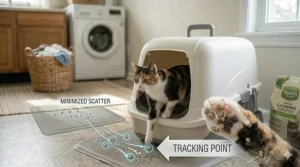
The IRIS USA Large Top Entry Cat Litter Box is one of the most reviewed top entry litter boxes on Amazon, and the reason isn’t mysterious — it nails the basics at a fair price. Outside dimensions run 20.5 x 14.75 x 14.38 inches with a 9.25-inch diameter entry, and the scoop hangs on a molded hook built into the side.
In practice, that hook matters more than it should. Anyone who’s ever lost a scoop in a pile of litter at 6 a.m. will understand why “has a place to put the scoop” is a real selling point and not filler copy. The grooved lid functions as a built-in doormat — litter clinging to paws gets knocked loose and falls back into the pan instead of onto your bathroom tile, which is the entire promise of the top entry design delivered without much fuss.
Customer feedback skews positive, with people specifically calling out the dog-proof design as the reason they switched from an open pan — multiple reviewers mention it stopped a dog from raiding the box entirely. The recurring complaint is the rounded interior corners, which a few owners say make scooping into the corners slightly more awkward than a squared-off bin.
✅ Scoop included with a dedicated storage hook
✅ Strong reputation for stopping dogs from accessing litter
✅ Available in multiple colors to match decor
❌ Rounded corners make corner-scooping a little fiddly
❌ The 9.25″ entry can feel tight for very broad cats
Price range: around $25–$35. Verdict: the best all-around budget pick if a dog-proof litter box is your main motivation.
3. Petmate Top Entry Litter Box Enclosure
The Petmate Top Entry Litter Box Enclosure leans hard into sustainability — it’s made in the USA from 95% post-industrial recycled materials, which is a genuinely unusual flex for a $30 litter pan. Dimensions land around 20.3 x 15.1 x 15.2 inches, with built-in carrying handles and a hinged lid that flips open to one side for cleaning.
That hinge is where the design gets interesting, and not entirely in a good way. Unlike boxes with a lid that tips litter back into the pan in one motion, Petmate’s hinged version opens to a single side, so any loose litter sitting on top when you lift it tends to slide off in that direction rather than falling neatly back inside. It’s a minor design quirk, but if you’re scooping daily, it’s the kind of small friction that adds up over a year of use. The trade-off: the built-in handles make this one of the easier boxes in this lineup to lift and dump for a full litter change, which the lighter, handle-free competitors can’t match.
Owner feedback is largely favorable on durability and the dog-proofing — Petmate’s high walls and top-only access reliably keep curious dogs out — with the lid hinge mechanism being the most common point of friction in long-term reviews.
✅ Made from 95% recycled materials — a real sustainability angle
✅ Built-in handles make full litter changes easier
✅ Reliable dog deterrent thanks to tall, enclosed walls
❌ Hinged lid spills loose litter to one side instead of back in
❌ Scoop isn’t included, so factor that into your total cost
Price range: around $25–$35. Verdict: a strong pick if eco-friendly materials matter to you and you don’t mind buying your own scoop.
4. Arm & Hammer Premium Top Entry Litter Box with Filter
The Arm & Hammer Premium Top Entry Litter Box does something the others don’t: it bakes Microban antimicrobial protection directly into the plastic itself, rather than relying on a separate charcoal filter you have to remember to swap. At roughly 20.3 x 15 x 15 inches, sizing sits right in the middle of this lineup.
Here’s what that actually means day to day — the odor control isn’t a consumable you buy more of, it’s structural, which is genuinely convenient if you’ve ever forgotten to reorder filter cartridges for some other box and paid for it nose-first. The trade-off is built right into the brand’s own guidance: they recommend replacing the entire box every 12 months to keep that protection effective, which quietly turns a one-time purchase into a recurring annual cost most buyers don’t budget for. It accepts essentially any litter type — clumping, crystal, pellet, or pine — which is more flexible than the crystal-only automatic boxes further down this list.
Buyers generally praise the odor control as noticeably better than plain plastic competitors, with the most common downside being that the “replace yearly” guidance feels more like a marketing nudge to repurchase than a hard requirement for most low-traffic, single-cat homes.
✅ Antimicrobial protection is built into the plastic, not a separate filter
✅ Works with virtually any litter type you already have
✅ Trusted, recognizable brand for odor control
❌ Designed as a yearly replacement, adding to long-term cost
❌ No scoop or storage hook included
Price range: around $30–$40. Verdict: the pick for households where smell, not space or mess, is the main battle.
5. So Phresh by Petco Top-Entry Litter Box
The So Phresh by Petco Top-Entry Litter Box is the biggest footprint in this entire roundup — 23.2 x 15.4 x 15 inches — and it’s built from noticeably thicker plastic than most of its same-price competitors, which matters if you’ve got a heavyweight cat who treats digging like a competitive sport.
The tilting lid is a smarter mechanism than a basic hinge: lift it from the correct end and the litter on top tips back into the pan in one motion, rather than scattering. The catch is the “correct end” part — it’s a learning curve for new owners, and the most common complaint in long-term reviews isn’t the tilting mechanism itself but the lid hinges cracking after months of repeated flexing. For a box marketed on increased wall thickness, that’s a notable weak point, though it doesn’t seem to affect every unit.
In practice, the extra length is the real selling point here — it’s the closest thing to a genuinely large top entry litter box in the sub-$50 bracket, which matters enormously for bigger breeds like Maine Coons that feel cramped in standard 20-inch boxes.
✅ Largest interior footprint of any box under $50 here
✅ Thicker walls resist cracking better than thin budget bins
✅ Tilting lid design reduces scattered litter when used correctly
❌ Lid hinges have a reputation for breaking after extended use
❌ Tilting mechanism only works smoothly from one specific side
Price range: around $30–$45. Verdict: the space-efficiency pick for bigger cats who’ve outgrown standard-size boxes.
6. Modkat XL Top or Front-Entry Configurable Litter Box
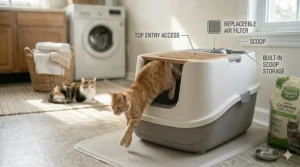
The Modkat XL Litter Box is the most flexible product in this lineup by a wide margin — it converts between top entry and front entry using the same base, just by swapping which liner and cover you install. At 21 x 16.3 x 17 inches with a full-height seamless base, it’s also built for cats who pee at an angle rather than straight down, since there’s no front lip for urine to leak through.
What sets it apart isn’t the size, it’s the lid. Most top entry boxes make you lift off an entire hood to scoop; Modkat’s swivels open with one hand, litter and all, which sounds like a small thing until you’re holding a full scoop and a phone and a cup of coffee at 7 a.m. and suddenly it isn’t. The reusable liner — rated for about three months of use — also means less litter directly contacting (and slowly degrading) the plastic itself, which is part of why this box tends to smell less “plastic-y” over time than cheaper bins.
The honest trade-off, and the one cats.com’s own testing flagged directly, is that despite the spacious outer dimensions, some cats find the enclosed interior tight relative to the box’s footprint — it’s not the friendliest option for an anxious or claustrophobic cat, even though it’s one of the best-designed for tidiness.
✅ Converts between top and front entry as your cat’s needs change
✅ One-handed swivel lid beats removing a full hood every time
✅ Reusable liner cuts down on plastic odor absorption and waste
❌ Premium price tag — multiples of the budget options
❌ Some cats find the enclosed interior tighter than the outer size suggests
Price range: around $130–$160. Verdict: worth the jump if you have a big cat, a side-sprayer, or just want a box that adapts instead of one you’ll replace.
7. PetSafe ScoopFree Ultra Top-Entry Self-Cleaning Litter Box
The PetSafe ScoopFree Ultra Top-Entry Self-Cleaning Litter Box is the only fully automatic option here, and it changes the calculation entirely. Motion sensors detect when your cat leaves the box, a timer counts down five, ten, or twenty minutes, and then a rake sweeps waste into a covered trap — no scooping, no daily maintenance, for roughly two to four weeks at a stretch.
The crystal litter it requires is doing a lot of the heavy lifting here. It’s not compatible with clumping clay, only PetSafe’s silica crystal litter, which absorbs moisture and dehydrates solid waste rather than clumping it — that’s the mechanism behind the genuinely noticeable odor improvement testers report. It’s also why tracking is so low: the crystals are large and don’t stick to paws the way fine clay dust does. The built-in health counter, which logs how many times your cat uses the box, sounds like a gimmick until you remember that a cat’s litter box habits are one of the clearest early indicators that something medical might be wrong — sudden changes in frequency are often the first sign owners get before a vet visit becomes urgent.
The real cost story is in the consumables, not the upfront price. Disposable litter trays run somewhere in the $15–$25 monthly range per cat, and multi-cat households report needing to swap trays more like every nine days than the “weeks” promised in marketing — so the sticker price is genuinely just the entry fee.
✅ Closest thing to zero daily maintenance in this category
✅ Crystal litter delivers a real, noticeable odor improvement
✅ Health counter gives an early warning system for behavior changes
❌ Locked into proprietary crystal litter — no clumping clay allowed
❌ Recurring tray costs add up fast, especially with multiple cats
Price range: around $190–$240, plus ongoing tray costs. Verdict: the right call if your time is worth more than the price difference, or if health tracking genuinely matters for an older or at-risk cat.
Setting Up Your Top Entry Litter Box: A Usage Guide
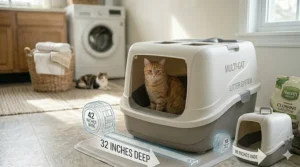
Don’t just swap boxes overnight — cats are creatures of habit, and a sudden change is the single most common reason a brand-new litter box with a top hole ends up ignored in favor of your laundry basket.
Place it next to the old box first. Give your cat at least a week with both available before removing the original. Keep the old box dirty, on purpose. It sounds counterintuitive, but letting the familiar box get a little less appealing while the new one stays fresh nudges the decision in your favor without forcing it. Start with a shallow litter depth — one to two inches is plenty, and a too-deep layer can feel unstable underfoot for a cat learning a new entry point. Watch the climb, not just the use. If your cat is a senior, overweight, or recovering from an injury, that 9-to-10-inch entry height that’s a non-issue for a healthy adult cat can be a genuine deterrent.
If problems do show up — sudden avoidance, accidents nearby but not inside the box — it’s worth ruling out a medical cause before assuming it’s a design complaint. Litter box problems can stem from medical issues, an aversion to the box or litter itself, or a location preference, and the Cornell Feline Health Center has a genuinely useful breakdown of how to tell the difference.
Real-World Scenarios: Matching the Box to Your Household
The apartment-dweller with one indoor cat and zero space to spare: the Amazon Basics or IRIS USA box is the obvious call — both deliver real space efficiency in a tight bathroom footprint without asking you to spend triple digits.
The multi-pet household with a dog who treats the litter box like a buffet: any of these qualify as a genuine dog-proof litter box, but the IRIS USA and So Phresh options have the most reviewer testimony specifically about stopping persistent dogs, thanks to taller walls and a narrower top opening relative to their base.
The owner of a 16-pound Maine Coon who’s outgrown every “large” box they’ve tried: this is Modkat XL or So Phresh territory — both offer genuinely larger interior dimensions, and Modkat’s seamless base is a real advantage if that big cat also happens to spray at an angle.
The household where nobody has time to scoop daily, or where an aging cat’s bathroom habits need monitoring: the PetSafe ScoopFree Ultra earns its premium price here in a way it wouldn’t for a single, healthy young cat in a low-maintenance home.
How to Choose a Top Entry Litter Box: 7 Things That Actually Matter
- Entry height and your cat’s mobility. A 9–10 inch jump is nothing for a healthy adult cat and a real obstacle for a kitten, senior, or arthritic cat — match the box to the cat you actually have, not the cat you wish you had.
- Interior floor space, not box footprint. Two boxes with identical outer dimensions can have very different turn-around room inside depending on wall thickness and shape.
- Lid mechanism. Swivel and tilt-back lids return loose litter to the pan; single-hinge lids that open to one side tend to spill it onto the floor instead.
- Litter compatibility. Standard plastic boxes work with whatever you’re already using; automatic boxes like the ScoopFree line lock you into a specific litter type.
- Multi-cat math. The general guideline from shelters and behaviorists is one box per cat, plus one extra — a top entry box that’s perfect for one cat can become a bottleneck in a three-cat house.
- Scoop and accessories included. A box that’s $5 cheaper but doesn’t include a scoop isn’t actually cheaper once you check out.
- Total cost over a year, not just the sticker price. Annual-replacement boxes and crystal-litter systems both carry real recurring costs that the listing price doesn’t show you.
Common Mistakes People Make Buying a Top Entry Litter Box
Buying based on outer dimensions alone. A box that looks huge in the product photo can have a surprisingly cramped interior once you account for wall thickness and a sloped or stepped base.
Ignoring their cat’s age and weight before checking the entry height. This is the single most common reason a perfectly good top entry litter box gets rejected — not a design flaw, just a mismatch between the product and the cat using it.
Assuming “dog-proof” means “leak-proof” or “smell-proof.” A top entry design genuinely deters dogs and reduces tracking, but it isn’t a substitute for regular scooping — an unmaintained top entry box can actually trap odor more than an open pan would.
Switching cold, with no transition period. Cats that have used an open pan their whole lives don’t automatically understand a hole in the ceiling is the new bathroom — see the usage guide above before you give up on a box too early.
Top Entry vs. Hooded vs. Open Litter Boxes
| Box Type | Litter Tracking | Odor Containment | Dog-Proofing | Cat Acceptance |
|---|---|---|---|---|
| Open pan | High | Low | None | Highest |
| Hooded (front entry) | Moderate | Moderate–High | Partial | High |
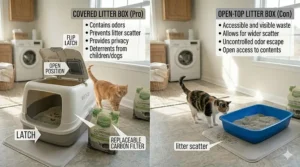
| Top entry | Low | High | Strong | Moderate, learning curve |
| Automatic top entry | Lowest | Highest | Strong | Moderate |
The pattern here is pretty consistent: every step up in mess-and-odor control costs you a little in initial cat acceptance. Open pans win on day-one usability precisely because there’s nothing new to learn, while top entry and automatic designs ask for a short adjustment period in exchange for a long-term payoff in cleaner floors. If you’ve got a notoriously stubborn or anxious cat, that trade-off is worth weighing honestly before you buy — and the American Society for the Prevention of Cruelty to Animals has long noted that litter box format preference varies enormously from cat to cat, which is really just a polite way of saying there’s no universally “best” design, only a best design for your specific cat.
Features That Actually Matter (And Ones That Don’t)
Actually matters: wall thickness and rigidity (thin plastic flexes, cracks, and absorbs odor faster), a lid mechanism that returns litter to the pan instead of the floor, and an entry height appropriate to your specific cat.
Doesn’t matter much: color options (your cat does not care, and neither does anyone visiting your bathroom), “bonus” branded toys packed in for marketing flair, and claims about lid material being “antibacterial” unless that protection is structural (like Arm & Hammer’s embedded Microban) rather than a thin surface coating that wears off in months.
Matters more than it sounds: a built-in hook or slot for the scoop. It’s a one-dollar manufacturing detail that solves a daily annoyance, and its absence on otherwise-good boxes like the Petmate model is a real, if minor, ding.
Top Entry Litter Boxes for Seniors, Kittens, and Multi-Cat Homes
Senior cats generally do better with the lowest available entry height in this category, or skip top entry entirely in favor of a low-sided open pan if arthritis is already diagnosed — no top entry litter box, however well-designed, beats a box your cat physically can’t comfortably climb into.
Kittens can usually manage a top entry box once they’re a few months old and reasonably mobile, but a kitten too small to clear the entry height will simply avoid the box, which can look like a behavior problem when it’s really just a sizing issue. Modkat’s convertible front-entry mode is specifically useful here, letting you start low and switch to top entry as the kitten grows.
Multi-cat homes need to think in terms of total boxes, not total cats — the one-per-cat-plus-one rule applies regardless of box style, and a single excellent top entry box won’t resolve territorial litter box disputes between cats who don’t get along.
Long-Term Cost and Maintenance: What You’re Really Paying
| Box Category | Upfront Price | Recurring Cost | Box Lifespan |
|---|---|---|---|
| Budget plastic (Amazon Basics, IRIS, Petmate) | $20–$35 | Litter only | 1–2 years |
| Arm & Hammer Premium | $30–$40 | Litter + annual box replacement | 12 months by design |
| So Phresh / Modkat XL | $30–$160 | Litter (+ liners every ~3 months for Modkat) | Several years |
| PetSafe ScoopFree Ultra | $190–$240 | $15–$25/month/cat in disposable trays | Years (tray, not box, is consumable) |
Run the math past a year and the picture shifts noticeably: the ScoopFree’s intimidating sticker price gets diluted by time saved, but its tray costs mean it’s rarely the cheapest option even at the two-year mark for a multi-cat home. Meanwhile, the Arm & Hammer box’s “replace yearly” design quietly turns a $35 purchase into a recurring $35-a-year line item, which budget boxes built to last several years simply don’t carry. If raw lifetime cost is your priority, the Petmate or So Phresh boxes — bought once, used for years, with no proprietary consumables — usually win.
It’s also worth a quick mention of basic hygiene here: regardless of which box you choose, the CDC recommends that pregnant individuals avoid handling litter directly, since cat feces can carry the parasite that causes toxoplasmosis — a good reminder that “dog-proof” boxes aren’t a substitute for basic litter-handling hygiene for the humans in the house either.
Frequently Asked Questions
❓ Are top entry litter boxes good for cats?
❓ Why won't my cat use a top entry litter box?
❓ Do top entry litter boxes really stop dogs from eating litter?
❓ What size cat is too big for a top entry litter box?
❓ How often should I clean a top entry litter box?
Conclusion
There’s no single best top entry litter box — there’s a best one for your cat, your budget, and how much daily maintenance you’re willing to sign up for. If you want the simplest possible entry point, the Amazon Basics or IRIS USA boxes get the job done without asking much of your wallet. If odor control or eco-friendly materials matter more, Arm & Hammer and Petmate are worth the small step up. Big cats and side-sprayers do better with the extra room in the So Phresh or Modkat XL. And if your real bottleneck is time, not money, the PetSafe ScoopFree Ultra is the only option here that actually removes scooping from your to-do list entirely.
Whichever you choose, give your cat a real transition period before judging the box a failure — and watch for sudden changes in litter box habits, since those are often the first sign something else needs attention, top entry box or not.
✨ Don’t Miss These Exclusive Deals!
🔍 Take your cat’s bathroom setup to the next level with these carefully selected top entry litter boxes. Click on any highlighted pick above to check current pricing and availability. Your cat — and your floors — deserve the upgrade! 😊
Recommended for You
- Covered Litter Box: 7 Best Picks for 2026, Tested & Reviewed
- Self-Cleaning Litter Box for Multiple Cats: 7 Top Picks (2026)
- Best Automatic Litter Box Under $300: 7 Smart Picks for 2026
Disclaimer: This article contains affiliate links. As an Amazon Associate, I earn from qualifying purchases. If you purchase products through these links, we may earn a small commission at no additional cost to you.
✨ Found this helpful? Share it with your friends! 💬🤗
