
Table of Contents
Somewhere between the third knocked-over pothos and the fourth trip to vacuum potting soil off the rug, most cat owners reach the same conclusion: the plants and the cat cannot simply “work it out.” A plant protector for cats is any tool — physical, scent-based, or motion-triggered — that keeps a curious paw or set of teeth away from your greenery without hurting the animal or ruining the plant. Some are cages. Some are sprays. A few are just clever placement disguised as furniture. None of them are magic, and that’s actually good news, because it means the right pick depends on your specific cat, your specific plant, and how much patience you have for reapplying things.
This guide skips the vague “cats hate citrus” folklore you’ve probably already tried and failed with. Instead, it walks through seven real, currently sold products — physical cages, taste and scent deterrents, a motion-activated sprayer, and a couple of clever placement tools — with honest notes on what each one actually does well, where it falls short, and who should skip it entirely. Because not every toxic-looking leaf is actually dangerous and not every “cat-proof” label holds up to a determined kitten, we’ll also touch on the safety side: which plants matter more than any protector you buy, based on the ASPCA’s toxic and non-toxic plant database. If you’ve been Googling “cat proof planters” at 11 p.m. with a chewed monstera leaf in hand, you’re in the right place.
Quick Comparison Table
| Protection Type | Best For | Setup Effort | Reapplication Needed |
|---|---|---|---|
| Mesh Plant Cage | New or seedling plants, multi-cat homes | Low | None |
| Granular/Spray Deterrent | Digging in soil, litter-box substitution | Low | Every 1–3 weeks |
| Motion-Activated Spray | Persistent jumpers and counter-surfers | Medium | Occasional refill |
| Elevated/Hanging Planter | Chewers, batting, out-of-reach placement | Medium | None |
| Taste Deterrent Spray | Leaf-nibbling, chewing specific plants | Low | Every few days |
| Scat/Spike Mat | Digging and scratching around pot base | Low | None |
Physical barriers like the mesh cage and elevated planter win on convenience because once they’re installed, you’re done — no calendar reminders, no reapplying anything. Deterrent sprays and granules ask for more ongoing effort, but they’re the only options that let your plant sit at floor level in an open room, which matters if you actually want to enjoy your monstera instead of hiding it. If your cat is a digger rather than a nibbler, the scat mat or granular deterrent will outperform anything scent-based on a leaf, since the problem is happening in the soil, not on the foliage.
💬 Just one click — help others make better buying decisions too!😊
Top 7 Plant Protectors for Cats: Expert Analysis
1. Nature’s Mace Cat Repellent Granules — anti-dig barrier for soil and pots
The standout here is simple: it’s built specifically to stop digging, not just chewing, which is the behavior most likely to send potting mix flying across your floor. Nature’s Mace relies on plant-based ingredients that create a scent barrier, gradually training cats to avoid treated soil, patios, and flowerpots without resorting to harsh chemicals. In practice, that means sprinkling a light layer around the base and surface of the soil, which is far less fussy than most people expect from a “repellent” product.
Based on the application guidance, results build over roughly a week of consistent use rather than working instantly, and the maker recommends reapplying every two to three weeks for ongoing effectiveness, since results vary depending on how ingrained the cat’s habit already is. That’s an honest caveat worth taking seriously — if your cat has already claimed a pot as a litter box substitute, the soil itself may need replacing first. Aggregated reviewer sentiment on the brand’s granular line skews positive for training out digging behavior over a few weeks, though a handful of reviewers on the concentrate/spray version noted mixed results depending on how motivated their particular cat was.
Pros:
- ✅ No hardware or assembly — just sprinkle and go
- ✅ Plant-based formula, safe for indoor use around pets
- ✅ Doubles as protection against digging and light chewing
Cons:
- ❌ Needs reapplication every 2–3 weeks for lasting results
- ❌ Less effective once a cat has already claimed a pot as a bathroom
Prices tend to run in the $15–$20 range for the 2.5 lb bag at the time of research — check current pricing before buying, since it fluctuates. For anyone whose main problem is digging rather than nibbling, this is a genuinely low-effort first move.
2. PetSafe SSSCAT Automatic Spray Pet Deterrent — hands-off correction for repeat offenders
The PetSafe SSSCAT stands out because it removes you from the equation entirely — no more sprinting across the room to shoo a cat off the plant shelf. It’s a motion sensor and spray canister combo that senses a pet’s motion from up to three feet away and emits a quick, odorless spray as a reminder to stay away from off-limits areas, and it’s explicitly marketed for protecting plants, countertops, and furniture alike.
What most buyers overlook about this device is that consistency matters more than intensity: reviewers describing success tend to run it continuously for a few weeks rather than intermittently, using it as a training tool rather than a permanent fixture. Aggregated feedback is genuinely mixed — several reviewers reported strong results, including one describing it as a safe and effective way to keep cats from jumping onto a plant table, while others reported the sensor becoming unreliable after a few months or missing fast-moving cats entirely. That split is worth weighing honestly rather than glossing over.
Pros:
- ✅ Fully automatic — no supervision required
- ✅ Odorless spray won’t stain furniture or floors
- ✅ Works on counters, shelves, and floor-level plants alike
Cons:
- ❌ Sensor reliability reported as inconsistent by some users over time
- ❌ Replacement canisters add an ongoing cost
Expect to pay somewhere in the $30–$40 range for the starter unit, with refill cans priced separately — again, confirm current pricing since these shift. If you’ve got a specific problem shelf or windowsill a cat keeps returning to, this earns its price tag faster than almost anything else on this list.
3. Grannick’s Bitter Apple Spray — the classic taste deterrent, now aimed at leaves
Grannick’s Bitter Apple built its reputation on furniture and cords, but it’s just as often used directly on foliage, and that dual purpose is its standout feature. The formula works by leaving an unpleasant taste on contact — reviewers note it’s safe to use on plants specifically to discourage pets from eating them, without harming the animal if ingested.
Here’s what the label won’t tell you outright: several long-time users report the deterrent effect fades once the spray fully dries, meaning a light, glossy leaf may need more frequent reapplication than a porous surface like fabric. One reviewer with a large houseplant collection specifically noted spraying plants that a cat kept trying to eat, with chewing stopping and the plant surviving the treatment — a useful data point since some owners worry taste deterrents will damage delicate foliage. Reviewers also consistently note the initial alcohol-like scent as the more immediate deterrent, with the bitter taste as backup once a cat actually makes contact.
Pros:
- ✅ Verified safe for direct application to leaves and stems
- ✅ Doesn’t harm the plant when used as directed
- ✅ Compact bottle works for spot-treating a few problem plants
Cons:
- ❌ Effectiveness reported as fading once the spray dries
- ❌ Requires reapplication every few days on frequently-targeted plants
Typically priced in the $8–$12 range for an 8 oz bottle, this is one of the cheapest entries here, and a reasonable low-commitment first try before investing in hardware.
4. Homarden Cat Repellent Spike Mat — physical digging stopper for pot bases
The Homarden Spike Mat takes an entirely different approach: instead of scent or taste, it’s a textured mat with soft, blunt spikes designed to sit around or under a pot so digging simply feels unpleasant underfoot. That tactile discomfort — never sharp enough to injure, just annoying enough to discourage — is the standout feature that separates it from every scent-based option on this list.
Based on the design, this solves a problem sprays can’t: cats who dig specifically around the rim of a pot rather than touching the foliage at all. It’s aimed at both indoor potted plants and outdoor garden beds, and its flat profile means it tucks under a pot’s edge without looking like an obvious deterrent device. Aggregated buyer sentiment for spike-style scat mats in this category generally reports moderate-to-strong results for digging specifically, with more limited effect on cats who are motivated by chewing leaves rather than pawing at soil — worth noting if digging isn’t actually your main issue.
Pros:
- ✅ Zero scent or chemical residue near the plant
- ✅ Reusable across multiple pots as your collection grows
- ✅ Doubles as a furniture and garden-bed deterrent
Cons:
- ❌ Does nothing to stop leaf-chewing above the soil line
- ❌ Cut-to-fit installation takes a few extra minutes per pot
Priced generally under $20 for a roll that covers multiple pots, this is a smart pairing with a taste deterrent spray if your cat is both a digger and a nibbler.
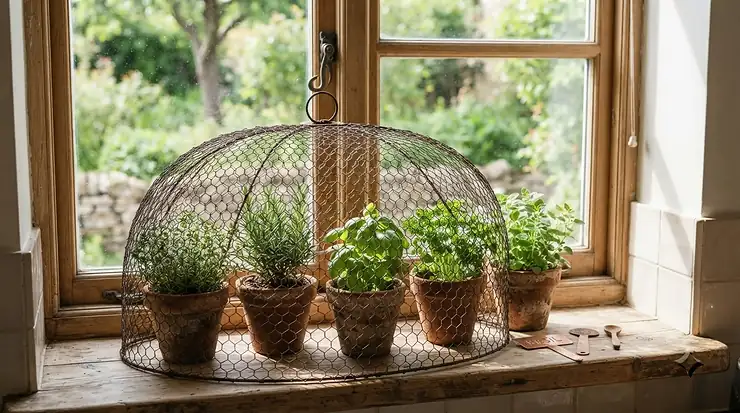
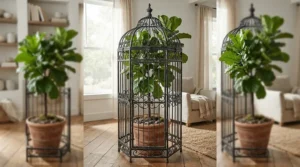
5. DECOHS Pop-Up Mesh Plant Cover Cage — the physical barrier that ends the guessing game
If you want to stop guessing whether a deterrent is “working,” the DECOHS Pop-Up Mesh Plant Cage removes the question entirely by putting a breathable mesh dome between your cat and the plant. Its standout feature is the collapsible, pop-up design — it folds flat for storage and springs into a full enclosure in seconds, no tent poles or assembly required.
Key specs matter here in a practical way: the mesh is fine enough to block a cat’s paw and teeth while still letting light and water through, so the plant inside keeps growing normally rather than suffering in a sealed environment. This is arguably the single most foolproof option on this list for a simple reason — a physical barrier doesn’t rely on a cat disliking a smell or taste it might eventually get used to. It’s especially suited to newly propagated cuttings, seedlings, or a plant you know is toxic but haven’t relocated yet, since it removes access rather than merely discouraging it.
Pros:
- ✅ Guarantees zero contact regardless of cat persistence
- ✅ No reapplication, refills, or batteries ever needed
- ✅ Mesh still allows light and airflow for healthy growth
Cons:
- ❌ Visibly changes the room’s aesthetic while in use
- ❌ Not practical for large floor plants or trees
Expect a price in the $15–$25 range depending on size, and know that this is the option most likely to satisfy an “I need this solved today” level of frustration.

6. Mkono Macrame Plant Hanger — elevation as a deterrent strategy
The Mkono Macrame Hanger doesn’t fight your cat’s behavior at all — it just moves the plant somewhere the behavior can’t reach, which is arguably the most honest form of “cat-proofing” available. Its standout feature is the handwoven cotton cord design that suspends a pot well above jumping height from most furniture, provided it’s hung with real thought toward what your cat can leap onto nearby.
One notable honest limitation from real-world reviewers: this only works if the surrounding furniture doesn’t create a launchpad. A-Z Animals’ review coverage specifically highlights that this hanger keeps plants completely out of reach for owners whose cats previously made trouble with floor-level plants, once hung correctly — but the same source also flagged that buyers unaware the pot isn’t included were caught off guard, so budget separately for a planter. For cats that primarily bat at or chew leaves rather than climb aggressively, elevation alone often solves the entire problem without any spray or barrier at all.
Pros:
- ✅ Zero ongoing cost or maintenance once installed
- ✅ Doubles as attractive, boho-style home décor
- ✅ Works for any pot up to roughly 9 inches in diameter
Cons:
- ❌ Ineffective if hung near climbable furniture or shelves
- ❌ Pot and plant are sold separately
Generally priced under $15, this is one of the most budget-friendly picks here — provided your ceiling height and furniture layout actually support it.
7. Nature’s Mace Cat Repellent Spray (40 oz) — the liquid backup for stubborn zones
Rounding out the list is the spray counterpart to the granular formula above, aimed at situations where granules aren’t practical — hanging foliage, vertical surfaces, or spots you need to treat fast without waiting for a barrier to dry into the soil. The standout feature is its dual indoor/outdoor labeling, meaning the same bottle handles a windowsill herb garden and a porch full of potted flowers.
The maker’s own training schedule is refreshingly specific rather than vague marketing fluff: apply daily for the first 7–10 “training days,” then every other day the following week, tapering to once weekly for maintenance. That’s useful because it sets realistic expectations — this isn’t a one-and-done spray, it’s a short behavioral retraining program. Aggregated customer sentiment splits along a predictable line: owners who followed the tapering schedule closely reported meaningfully reduced cat activity in treated zones, while those expecting instant results after a single application were more likely to report disappointment.
Pros:
- ✅ Works on both indoor pots and outdoor garden beds
- ✅ Clear, structured application schedule from the manufacturer
- ✅ Plant-based formula avoids harsh synthetic chemicals
Cons:
- ❌ Requires daily application during the initial training period
- ❌ Results depend heavily on following the schedule consistently
Typically priced in the $20–$30 range for the 40 oz bottle, this is best treated as a commitment rather than a quick fix — but for plants that can’t be caged or elevated, it may be the only realistic option.
✨ Don’t Miss These Exclusive Deals!
🔍 Take your indoor plant collection to the next level with these carefully selected products.Click on any highlighted item to check current pricing and availability. These tools will help you create a genuinely cat-safe home your whole household — feline included — will love!
Top 7 Products at a Glance
| Product | Type | Price Range | Best For |
|---|---|---|---|
| Nature’s Mace Granules | Digging deterrent | $15–$20 | Soil-diggers, litter-box substitution |
| PetSafe SSSCAT | Motion-activated spray | $30–$40 | Repeat jumpers and counter-surfers |
| Grannick’s Bitter Apple | Taste deterrent | $8–$12 | Leaf and stem chewing |
| Homarden Spike Mat | Physical digging barrier | Under $20 | Pot-base digging and scratching |
| DECOHS Mesh Cage | Physical enclosure | $15–$25 | Seedlings, toxic or high-value plants |
| Mkono Macrame Hanger | Elevated placement | Under $15 | Batting, low-effort chewers |
| Nature’s Mace Spray | Digging & chewing deterrent | $20–$30 | Vertical surfaces, mixed indoor/outdoor use |
Looking at the comparison above, the DECOHS Mesh Cage delivers the most reliable protection for anyone tired of guessing whether a deterrent is working, since it removes access entirely rather than relying on scent aversion. Budget-conscious buyers should note that the Mkono Macrame Hanger and Grannick’s Bitter Apple solve very different problems for under $15 each, so pairing the two often costs less than a single motion-activated device. If digging is your specific pain point rather than chewing or batting, the Homarden Spike Mat paired with Nature’s Mace Granules covers that ground more thoroughly than anything scent-based on a leaf.

Practical Usage Guide: Setting Up Your Cat-Proof Plant Station
Whatever combination you land on, the first 30 days matter more than any single product spec. Start by treating one “problem plant” at a time rather than overhauling your entire collection overnight — cats notice sudden, sweeping changes and sometimes respond with more curiosity, not less. If you’re using a spray or granular deterrent, apply it in the evening or early morning when your cat is less likely to be nearby watching (and possibly associating the smell with you rather than the plant).
A common early mistake is under-committing to the schedule. Reapplying a taste deterrent once and giving up after a week is the single biggest reason these products get poor reviews online — the training window genuinely needs the full stretch the manufacturer recommends. For physical barriers like the mesh cage, check the enclosure daily for the first week; cats often test a new barrier repeatedly before deciding it’s not worth the effort, and a torn seam on day three undoes the whole point. If you’re elevating a plant with a hanger, do a “furniture audit” first — walk the room and identify every surface within jumping distance, because a cat that can’t reach the pot directly may still reach it via a bookshelf two feet away.
Maintenance going forward is refreshingly light for physical barriers (essentially none) and more involved for scent-based products, which typically need refreshing every one to three weeks depending on humidity, cleaning habits, and how motivated your particular cat remains.
Real-World Scenarios: Matching the Protector to Your Household
Consider a college student in a studio apartment with one indoor cat and a small collection of pothos and snake plants on a single shelf. Space is tight, budget is tighter, and the cat has full run of the apartment at all hours. Here, the Mkono Macrame Hanger paired with Grannick’s Bitter Apple on any plant that can’t be hung solves both the reach problem and the chew problem for under $30 combined — no batteries, no ongoing subscription of refill cans.
Now picture a multi-cat household — say three cats, a mix of ages, in a house with a dedicated plant room full of higher-value or seasonal plants. Here, a single deterrent rarely covers three different personalities. The PetSafe SSSCAT handles the boldest jumper who ignores scent-based warnings entirely, while Nature’s Mace Granules manage the soil-digging habits of the shyer cats who never get close enough to trigger a motion sensor. Layering tools by behavior type, rather than buying one thing and hoping it covers everyone, tends to produce far better results in multi-cat homes.
Finally, think about a new plant parent who just brought home a handful of seedlings or cuttings that are especially fragile and can’t tolerate any contact at all — even a curious sniff could snap a stem. The DECOHS Mesh Cage is the obvious answer here: it isn’t about training the cat’s behavior at all, it’s about removing the opportunity for damage while the plant establishes itself, with the option to remove the cage entirely once the plant is sturdy enough to survive casual contact.
Problem → Solution: Fixing the 5 Most Common Cat-and-Plant Conflicts
Problem 1 — Digging in the soil. This is almost always about texture and territory, not hunger. Solution: pair the Homarden Spike Mat with a light layer of Nature’s Mace Granules, since the mat handles the physical discomfort and the granules handle the scent-based avoidance.
Problem 2 — Chewing on leaf tips. Often driven by curiosity or the texture of new growth. Solution: Grannick’s Bitter Apple applied to leaf undersides, reapplied every few days until the behavior fades.
Problem 3 — Batting pots off shelves. This is play behavior, not malice, and usually happens on unstable or overly accessible surfaces. Solution: relocate to the Mkono Macrame Hanger in a spot with no adjacent furniture launchpad.
Problem 4 — A specific “off-limits” shelf the cat keeps returning to. Solution: the PetSafe SSSCAT, since it targets a fixed location rather than a specific plant, making it ideal for repeat-offense zones.
Problem 5 — Newly propagated cuttings getting knocked over or nibbled before they root. Solution: the DECOHS Mesh Cage, removed only once the cutting has established a stable root system.
How to Choose the Right Plant Protector for Cats
- Identify the actual behavior first. Digging, chewing, batting, and climbing each call for a different tool — a scent deterrent won’t stop a cat that’s simply knocking pots off a shelf for fun.
- Match the tool to the plant’s fragility. Seedlings and cuttings tolerate zero contact and need a physical cage; established, sturdy plants can often get by with a spray or elevation alone.
- Consider your own maintenance tolerance. If you know you won’t remember to reapply a spray every few days, invest in a physical barrier or elevated hanger instead.
- Check for multi-cat compatibility. A motion sensor calibrated for one cat may under- or over-trigger with three cats of different sizes moving through the same space.
- Factor in aesthetics if the plant lives in a shared room. A mesh cage is highly effective but visually obvious; a hanger or spike mat blends in more naturally with home décor.
- Verify the plant isn’t actually toxic in the first place. No deterrent is a substitute for knowing whether a plant belongs in a cat home at all — cross-reference against the ASPCA’s toxic and non-toxic plant list before deciding it’s worth protecting.
- Budget for the full solution, not just the product. Refill cans, replacement mesh, and reapplication supplies add real cost over a year — factor that in before comparing sticker prices.
Common Mistakes When Buying a Cat-Proof Planter
The most frequent mistake is buying a single product and expecting it to solve every behavior at once — a spray won’t stop a determined jumper, and a cage won’t help a cat digging in an entirely different pot across the room. A close second is giving up too early on scent-based deterrents; most manufacturers explicitly build in a multi-week training period, and stopping after day three all but guarantees a “this doesn’t work” review.
Another overlooked issue is choosing decorative cat-proof planters based on looks rather than actual barrier height or mesh density — a stylish elevated stand that’s still within a determined cat’s jumping range offers no real protection at all. Finally, many buyers skip verifying plant toxicity entirely, assuming that if the cat can’t reach the plant, the plant’s chemical makeup doesn’t matter. It still does, especially if trimmings or fallen leaves end up on the floor where a cat can find them without needing to reach the pot at all.
Plant Cage vs Deterrent Spray: Which Actually Works Better
A physical plant cage for cats and a scent-based deterrent spray solve the same problem through entirely different mechanisms, and neither is universally “better” — they’re suited to different situations. A cage offers guaranteed protection regardless of how motivated or food-driven a cat is, because there’s no behavior to train at all; the barrier simply exists. That makes it the stronger choice for toxic plants, fragile seedlings, or households where consistency in applying a spray realistically won’t happen.
A deterrent spray, on the other hand, wins on flexibility. It works on plants too large or oddly shaped to cage, doesn’t visually clutter a room, and can be applied to multiple plants scattered across a house without buying a separate barrier for each one. The tradeoff is ongoing commitment — a spray that’s forgotten for two weeks quietly stops working, while a cage keeps doing its job with zero attention. If your priority is “solve this once and stop thinking about it,” lean toward a cage; if your priority is “keep my plants looking normal in an open room,” lean toward a spray and accept the maintenance that comes with it.
Houseplant Safety: What Every Cat Owner Should Actually Know
Houseplant safety starts well before any protector product enters the picture. Some common houseplants — lilies, sago palm, and several popular philodendron varieties among them — carry real toxicity risk for cats, and no deterrent spray or cage substitutes for simply not bringing a genuinely dangerous plant into a home with a cat that has any interest in chewing. The ASPCA maintains a searchable database of toxic and non-toxic plants specifically for cats, and it’s worth checking any new plant against that list before it’s even unpacked from its nursery pot, not after a chewed leaf shows up.
It also helps to understand why cats are drawn to plants in the first place, since that context shapes which protector actually makes sense. Researchers presenting at the International Society for Applied Ethology found that plant-eating in cats appears to be an instinctual behavior inherited from wild ancestors, likely tied to expelling intestinal parasites, rather than a sign of illness or dietary deficiency. That reframes the whole situation: your cat probably isn’t “misbehaving” so much as following an old evolutionary script, which is exactly why redirecting the behavior — toward a safe alternative like cat grass — often works better long-term than pure deterrence alone. Offering an approved, non-toxic outlet alongside whichever protector you choose tends to reduce overall interest in the “forbidden” plants faster than deterrents used in isolation.
If a cat does ingest something and you’re unsure of the plant’s toxicity, don’t wait for symptoms to confirm your suspicion — treat it as urgent and contact your veterinarian or the ASPCA Animal Poison Control Center promptly for guidance specific to the plant involved.
🚨 Worried About a Specific Plant? Check It Before It’s a Problem
Cross-reference every new houseplant against a verified toxicity list before it enters a room your cat has access to — a five-minute check now beats an emergency vet visit later.
What to Expect: Real-World Performance in Digging Prevention
Digging behavior responds differently to intervention than chewing or batting does, mostly because it’s tied to territorial and litter-box-adjacent instincts rather than pure curiosity. In practice, expect granular and spike-mat solutions to show noticeable improvement within the first one to two weeks of consistent use, provided the soil hasn’t already been repeatedly used as a bathroom substitute — if it has, replacing the top layer of soil alongside the deterrent produces meaningfully faster results than the deterrent alone.
Don’t expect zero digging on day one. Most cats test a newly treated pot at least once or twice before the deterrent fully registers, and a single dig session in week one isn’t a sign the product has failed — it’s closer to the norm. What genuinely signals failure is no improvement at all after the manufacturer’s full recommended training window has passed, at which point switching to a physical barrier like a spike mat or cage, rather than a different scent formula, tends to produce better outcomes than repeatedly trying variations on the same scent-based approach.
Long-Term Cost & Maintenance: What Plant Preservation Really Costs
Plant preservation isn’t a one-time purchase so much as an ongoing relationship with whichever method you choose, and the true cost only becomes clear over a full year of use. A physical cage or elevated hanger has the lowest lifetime cost by far — one purchase, effectively zero recurring spend, and the only real “maintenance” is occasionally checking mesh integrity or hanger stability. Scent-based deterrents look cheaper upfront but add up: reapplying a granular product every two to three weeks, or a spray on a stricter daily-then-weekly schedule, means the $15–$20 bag or bottle you bought in January is realistically a recurring line item across an entire year.
Motion-activated devices sit in the middle — a moderate upfront cost for the unit itself, plus periodic refill canisters that add a smaller but real recurring expense. It’s also worth folding in a small ongoing investment in approved enrichment alternatives that redirect a cat’s attention away from houseplants entirely, since cats given a legitimate outlet for chewing and exploring tend to need less ongoing deterrent maintenance overall. When you tally total cost of ownership across twelve months, a $15 mesh cage that’s still doing its job in December often ends up cheaper than a $10 spray bottle repurchased six times over the same period. That doesn’t mean sprays are a bad investment — for plants too large to cage, they’re often the only realistic option — but it’s worth going in with accurate expectations about the real annual spend rather than comparing single-purchase price tags side by side.
Benefits vs Traditional Alternatives
| Approach | Reliability | Cost Over Time | Effort Required |
|---|---|---|---|
| Purpose-built protector products | High | Moderate | Low to moderate |
| DIY foil/tape on soil | Low | Low | High (frequent reapplication) |
| Aluminum pot wrapping | Moderate | Low | Moderate |
| Relocating plants entirely | High | None | High (loses display options) |
| Ignoring the problem | None | High (replacing plants) | None upfront, high long-term |
Purpose-built products consistently outperform DIY tricks like foil or tape specifically because they’re engineered around actual feline behavior rather than internet folklore, and the table above reflects that gap in reliability. Relocating plants entirely is genuinely effective but comes at the cost of losing your preferred home layout, which is exactly the tradeoff purpose-built protectors are designed to avoid. Ignoring the problem is, unsurprisingly, the most expensive path long-term once you factor in repeatedly replacing damaged or destroyed plants.
FAQ
❓ What is the best plant protector for cats that chew leaves?
❓ Do cat-proof planters actually work?
❓ Are plant deterrent sprays safe for cats?
❓ How long does it take a plant deterrent to stop a cat from digging?
❓ What's the fastest way to prevent digging prevention issues in a new plant?
Conclusion
There’s no single plant protector for cats that fits every household, and that’s honestly the most useful thing to take away from all seven of these options. A determined jumper needs something entirely different from a soil-digger, and a fragile seedling needs protection a sturdy, established plant simply doesn’t. What matters is matching the tool to the actual behavior you’re seeing — digging calls for granules or a spike mat, chewing calls for a taste deterrent, and anything you truly can’t risk losing belongs under a physical cage until it’s sturdy enough to handle casual contact.
Start with one plant, one product, and the full recommended training window before judging whether it worked. Layer tools as needed in multi-cat households, budget honestly for ongoing maintenance rather than just the sticker price, and always double-check a plant’s toxicity before deciding it’s worth protecting at all. Get that sequence right, and the running battle between your cat and your houseplants stops being a daily frustration and becomes something closer to a settled truce — plants intact, cat unharmed, and a lot less potting soil on your floor.
Recommended for You
- Cat-Proof Cabinet Locks: 7 Genius Picks to Stop Raids (2026)
- 7 Best Pet-Proof Screen Door Picks for 2026
- 7 Best Cat Window Screen Picks for Safe Fresh Air in 2026
Disclaimer: This article contains affiliate links. As an Amazon Associate, I earn from qualifying purchases. If you purchase products through these links, we may earn a small commission at no additional cost to you.
✨ Found this helpful? Share it with your friends! 💬🤗
