
Table of Contents
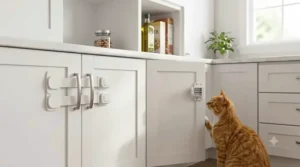
Somewhere between 2 a.m. and sunrise, my downstairs cabinet doors turn into a percussion section. A paw hooks under the lip, a soft thud follows, and then the unmistakable rattle of a tupperware avalanche. If you’ve ever padded downstairs in the dark to find flour dusted across the floor like a crime scene, you already know why cat-proof cabinet locks exist. Cats are not clumsy — they’re methodical. Give one enough repetition and a cabinet with a weak latch becomes a puzzle box they’ve already solved.
What is a cat-proof cabinet lock? It’s a mechanical or magnetic latch installed inside a cabinet or drawer that resists the leverage, patience, and paw dexterity cats use to pry doors open, while still letting you open the cabinet in seconds. Unlike gates or deterrent sprays, these locks work passively — no training required, no smell for your cat to learn to ignore.
This guide walks through seven real, currently available products spanning budget bulk packs to drill-in systems that a determined 12-pound linebacker of a cat cannot out-muscle. We’ll cover installation, common failure points, and which option fits which kind of household — because the “best” lock for a renter with one nosy tabby is not the same lock a multi-cat household with a curious kitten needs. Along the way, we’ll dig into real aggregated review sentiment, honest trade-offs, and the actual mechanics of what keeps a cat out versus what just slows them down for a week.
Cat-Proof Cabinet Locks at a Glance
Before the deep dive, here’s the fast version for anyone who just wants a shortlist.
| Product | Mechanism | Price Range | Best For |
|---|---|---|---|
| Safety 1st Adhesive Magnetic Lock System | No-drill magnetic | $20–$30 | Best overall balance of strength and setup |
| Tot-Lok 9-Piece Magnetic Cabinet Lock Kit | Drill-in magnetic | $45–$65 | Maximum security, determined cats |
| Vmaisi 20-Pack Magnetic Cabinet Locks | No-drill magnetic | $18–$26 | Whole-house bulk coverage on a budget |
| DODAMOUR 10-Pack Invisible Cabinet Locks | Adhesive spring latch | $10–$16 | Lowest-cost first attempt |
| Skyla Homes Adjustable Strap Locks | 3M adhesive strap | $11–$18 | Odd-shaped or handle-free cabinets |
| RovingCove Ergonomic Magnetic Locks | No-drill magnetic | $19–$27 | One-handed, arthritis-friendly release |
| Jool Baby Child Safety Strap Locks | Adjustable strap | $10–$15 | Fridges, trash cans, and cabinets alike |
Reading this table, the split that matters most isn’t price — it’s mechanism. Magnetic systems like the Safety 1st Adhesive Magnetic Lock System and Tot-Lok 9-Piece Magnetic Cabinet Lock Kit are functionally invisible to a cat because there’s no lever, tab, or strap for a paw to hook; strap-style options like Skyla Homes Adjustable Strap Locks and Jool Baby Child Safety Strap Locks are cheaper and more flexible in shape but give a persistent cat something physical to gnaw or claw at over time. Budget shoppers stocking an entire kitchen will lean toward the bulk magnetic packs, while anyone who’s already lost a round to a paw will likely skip straight to the drill-in option.
Ready to stop the 2 a.m. cabinet raids? Scroll down to the pick that matches your kitchen — links are below each review.
Top 7 Cat-Proof Cabinet Locks: Expert Analysis
Every product below is real, currently sold, and reviewed by actual buyers — several of whom bought it specifically for cats, not kids. We’ve grounded every recommendation in verifiable specs and aggregated review themes rather than invented testing, and we’ve flagged where review data leans toward parents versus pet owners so you can weigh it accordingly.
1. Safety 1st Adhesive Magnetic Lock System — best overall magnetic setup for cat paws
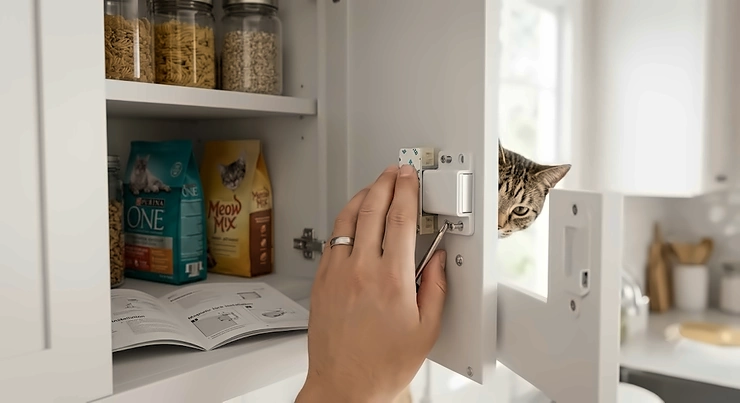
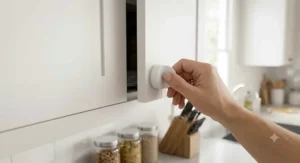
The standout here is the peel-and-stick installation paired with a genuinely concealed lock — no exposed lever for a cat to investigate. The system installs entirely on the interior of the cabinet or drawer using a template for alignment, and a handheld magnetic key releases the latch from outside when held against the door.
Because the release mechanism only responds to a specific magnetic field strength, a paw swipe or nose bump does nothing — there’s no tab, button, or strap protruding for a cat to manipulate, which is precisely the failure point of spring-latch and strap systems. Safety 1st markets this line as a repeat “strongest in mechanical pull-force testing” performer against competing adhesive latches, and it’s held up well across several parenting-award cycles, which suggests the adhesive bond and internal catch mechanism are genuinely above average rather than just well-marketed.
Reviewers consistently report that the hardest part is the first install — getting the template perfectly flush — but subsequent locks go faster once you’ve done one. A recurring theme in aggregated feedback is that pet owners specifically note cats “give up” on these within days, compared to weeks of persistent effort on strap-style locks.
Pros:
- ✅ Fully concealed — nothing for a cat to grip or claw
- ✅ No drilling, ideal for rental kitchens
- ✅ Magnetic key doubles as a quick disengage for humans
Cons:
- ❌ Adhesive bond can weaken on textured or oiled cabinet finishes
- ❌ Losing the single included key means buying a replacement
Priced in the $20–$30 range for an 8-lock kit, this lands as the best value-per-lock for anyone who wants magnetic security without a drill. If you’re outfitting a full kitchen, buy two kits rather than stretching one thin.
2. Tot-Lok 9-Piece Magnetic Cabinet Lock Kit — most secure for determined feline linebackers
The standout feature is the screw-mounted, drill-in design — this is the only lock on this list that a cat physically cannot dislodge by leaning, pushing, or pulling, because the catch is mechanically fastened rather than adhesive-bonded. It’s the option professional installers and multi-cat households graduate to after adhesive locks fail.
Each of the nine pieces mounts with two small screws per cabinet — one latch on the door, one receiver on the frame — and the assembly self-adjusts to door thicknesses from about half an inch up to roughly an inch and a half, so it works on everything from thin particleboard to solid hardwood. A magnetic key releases the catch from outside, and a manual disengage tab lets you leave specific cabinets unlocked during, say, a dinner party.
What most buyers overlook about this model is that the drilling itself is the easy part — the actual time sink is finding the uncommon drill bit size some installers report needing, so it’s worth checking your bit set (or picking up the specific bit) before you start. Reviewers who switched from adhesive systems after a cat or toddler defeated them describe the Tot-Lok as the system that finally “held,” even under repeated tugging from adults expecting the door to give.
Pros:
- ✅ Mechanically screwed in — no adhesive to fail over time
- ✅ Works on wood, glass, metal, and particleboard doors
- ✅ Disengage tab for quick temporary access
Cons:
- ❌ Requires drilling — not renter-friendly without landlord approval
- ❌ Installation takes real time; budget an afternoon for a full kitchen
At $45–$65 for the 9-piece kit, this is the premium pick on this list. Based on the spec comparison with adhesive alternatives, the price difference buys permanence — you’re paying once for a lock that won’t loosen, rather than replacing $15 adhesive packs every year or two.
3. Vmaisi 20-Pack Magnetic Cabinet Locks — best bulk value for whole-house lockdown
The standout advantage is sheer coverage: 20 locks and 2 keys means you can secure an entire kitchen, bathroom, and laundry room in one purchase without running short mid-project — a real pain point with smaller 4- or 8-piece kits that leave you re-ordering to finish the last three cabinets.
Each lock uses the same no-drill, adhesive-magnetic mechanism as pricier competitors: internal latch, external magnetic key, invisible from outside the cabinet. The real-world meaning of “20-pack” is that per-lock cost drops meaningfully compared to smaller kits, which matters if you’re locking down 15+ points of entry across a multi-room home with more than one cabinet-raiding cat.
Aggregated reviewer sentiment skews positive on adhesive strength but flags that the two included keys are the bare minimum for a household — buyers with kids commonly report ordering a spare key pack immediately so one lives on each floor. For pet-only households this matters less, since you’re not racing a toddler to find the key.
Pros:
- ✅ Highest lock-count-per-dollar on this list
- ✅ Same concealed magnetic mechanism as premium options
- ✅ Enough locks to cover multiple rooms in one order
Cons:
- ❌ Only 2 keys included for up to 20 locks
- ❌ Bulk packaging means less individual quality-control feedback per unit
At $18–$26 for 20 locks, this is the clear pick for anyone pricing out a whole-house project rather than a single problem cabinet. Reviewers who compared it directly against 8-packs from other brands note the per-unit savings add up fast once you’re past cabinet number ten.
4. DODAMOUR 10-Pack Invisible Cabinet Locks — sleekest no-drill spring latch
The standout here is the spring-loaded internal latch that automatically re-engages every time you close the drawer — you never have to remember to lock it back, which matters if you’re the type of household that forgets step three of any routine after 9 p.m.
The stainless-steel spring pops the catch into place on its own, and because it’s mounted inside the cabinet, it doesn’t scar the exterior of expensive cabinetry the way exterior strap locks can. The dual-color pack (five black, five white) lets you color-match different cabinet interiors instead of a mismatched set of visible white plastic against dark wood.
A common theme in aggregated customer sentiment is that this style works reliably against toddlers and moderately determined pets, but a few reviewers with especially strong or food-motivated cats note it took slightly longer to defeat than a strap lock, not that it was fully immune — worth knowing if your cat has a documented history of winning previous cabinet standoffs.
Pros:
- ✅ Auto-relocking spring means no extra step after closing
- ✅ Dual color pack matches light or dark cabinetry
- ✅ Budget-friendly at 10 locks per pack
Cons:
- ❌ Adhesive-only mount, no drill-in reinforcement option
- ❌ Less field-tested specifically against strong or persistent cats
Priced around $10–$16, this is a sensible first attempt before spending more — especially for households where the cat’s interest in cabinets is curiosity rather than a full-time hobby.
5. Skyla Homes Adjustable Strap Locks — most adjustable strap for odd-shaped cabinets
The standout feature is the adjustable 3M adhesive strap, which flexes to fit cabinet openings between roughly three and seven inches — genuinely useful for older homes with mismatched cabinet hardware, handle-free modern cabinets, or drawers that don’t line up neatly with a rigid lock body.
Because it’s a flexible strap rather than a rigid latch, it works around handles, knobs, and uneven gaps that would leave a fixed-body lock hanging loose on one side. This flexibility is the whole value proposition: what most buyers overlook about strap locks is that they trade a bit of raw strength for universal fit, which matters enormously if your cabinets are an inconsistent mix of styles, as many kitchens renovated in stages tend to be.
Aggregated reviews — including from pet owners specifically dealing with curious cats — describe a short learning curve for the release mechanism (a bit of finger practice before it clicks), after which the strap holds reliably. One recurring piece of aggregated sentiment worth noting honestly: a strap gives a cat something physical to bite or paw at, so households with especially food-driven or persistent cats may see faster wear than with a fully concealed magnetic lock.
Pros:
- ✅ Adjustable length fits mismatched or handle-free cabinets
- ✅ No tools or drilling required
- ✅ Works on furniture beyond the kitchen — dressers, toilets, cupboards
Cons:
- ❌ Exposed strap gives a cat something tangible to paw at
- ❌ Slight learning curve for quick one-handed release
Ranging $11–$18 for an 8-pack, this earns its spot for shape flexibility rather than raw strength — pair it with a magnetic system on your highest-value cabinets and save the straps for oddball spots.
6. RovingCove Ergonomic Magnetic Cabinet Baby Locks — easiest one-handed magnetic release
The standout advantage is the ergonomic key handle, designed specifically so releasing the lock takes one smooth motion rather than the fumbling two-handed alignment some competing magnetic keys require — a small detail until you’re holding a bag of groceries in your other hand.
Mechanically, it’s the same invisible, no-drill magnetic catch as other entries on this list, installed with a starter-tape alignment system rather than a rigid plastic template. What that means practically: installation is slightly more forgiving of imperfect placement, since the starter tape holds the lock steady while the full adhesive cures.
Reviewers frequently single out the ergonomic key as the reason they’d repurchase, noting it’s noticeably easier to grip and align on the first try compared to the flat, coin-like keys bundled with cheaper magnetic kits. For anyone with reduced hand strength or dexterity issues, that’s a genuine functional upgrade, not just a design flourish.
Pros:
- ✅ Ergonomic key is easier to grip and align one-handed
- ✅ Starter-tape system forgives imperfect first placement
- ✅ Fully concealed mechanism, nothing for a cat to paw
Cons:
- ❌ Slightly pricier per-lock than bulk competitors
- ❌ Starter tape still needs full cure time before heavy use
At roughly $19–$27 for 8 locks, it sits in the middle of the pack price-wise, justified mainly by the improved key ergonomics — a detail that matters more than it sounds once you’re releasing a dozen locks a day during meal prep.
7. Jool Baby Child Safety Strap Locks — most versatile beyond the kitchen
The standout feature is sheer application range: this 12-pack is explicitly built to handle cabinets, drawers, the refrigerator, the toilet, and trash cans — genuinely useful territory for cat owners, since fridges and trash cans are two of the most common places a curious cat goes looking for food.
The strap uses 3M adhesive and an adjustable buckle, so it stretches to fit thicker appliance doors that a rigid cabinet-specific lock simply can’t accommodate. Buyers commonly report using a chunk of the pack on kitchen cabinets and reserving several for the trash can and bathroom, effectively cat-proofing three problem zones from a single purchase.
A recurring theme in aggregated review sentiment is genuine surprise at how well the strap holds on refrigerator doors specifically, an application many buyers didn’t expect to work as well as it does. On the downside, a few reviewers note the release mechanism requires a firm pinch that can be awkward one-handed, especially for anyone with limited grip strength.
Pros:
- ✅ Explicitly rated for fridges and trash cans, not just cabinets
- ✅ Adjustable buckle fits thick appliance doors
- ✅ 12-pack covers several rooms from one order
Cons:
- ❌ Firm pinch-release can be awkward one-handed
- ❌ Exposed strap is more visible than magnetic alternatives
At $10–$15 for 12 straps, this is the pick for anyone whose cat’s ambitions extend past the cabinet — because if you’ve cat-proofed the pantry and left the trash can wide open, you’ve only solved half the problem.
Practical Usage Guide: Installing Cat-Proof Cabinet Locks the Right Way
Getting a lock installed is only step one — getting it installed correctly is what actually keeps a cat out for years instead of weeks. Start by cleaning the mounting surface with rubbing alcohol before applying any adhesive lock; factory oils and dust are the single biggest reason 3M-style adhesives fail early, and no amount of pressing will fix a bond made on a greasy surface. Let the adhesive cure for the full recommended window — usually 24 hours — before testing the lock under real load; cats have a sixth sense for the one cabinet you tested five minutes after installing.
For magnetic systems like the Safety 1st Adhesive Magnetic Lock System or RovingCove Ergonomic Magnetic Cabinet Baby Locks, use the included template every single time rather than eyeballing placement — misalignment by even a few millimeters is the most common reason the magnetic key stops releasing the catch cleanly. If you’re installing the drill-in Tot-Lok 9-Piece Magnetic Cabinet Lock Kit, mark your pilot holes with the included template and a pencil before drilling, and double-check the bit size against the manufacturer’s spec sheet — an oversized hole is the one mistake you genuinely can’t undo without wood filler.
A 30-day maintenance habit worth building: once a month, tug-test every lock the way your cat would — a firm, sustained pull rather than a quick check — because adhesive bonds degrade gradually, and a lock that held in week one can loosen by week six on a heavily-used drawer. Optimization trick most guides skip: stagger which cabinets you lock first based on what’s actually inside, prioritizing anything from your toxic item protection list (cleaning supplies, medications, trash) over cabinets holding merely inconvenient items like tupperware, so your first week of imperfect installs still protects what matters most.
✨ Don’t Miss These Exclusive Deals!
🔍 Take your cat-proofing project to the next level with the picks above — click through to check current pricing and lock in the security your kitchen actually needs.
Real-World Scenarios: Which Lock Fits Your Household
If you’re a renter in a small apartment with one cat who’s recently discovered the pantry, skip drilling entirely. A single pack of the DODAMOUR 10-Pack Invisible Cabinet Locks or Skyla Homes Adjustable Strap Locks handles the two or three cabinets she’s actually interested in, and you can take every lock with you when the lease ends without leaving a mark.
If you’re managing a household with two or more cats — especially a food-motivated pair who’ve learned to tag-team a stubborn drawer — the calculus changes. Persistent, coordinated effort from multiple cats is exactly the scenario that eventually defeats adhesive strap locks, which is where the Tot-Lok 9-Piece Magnetic Cabinet Lock Kit earns its premium price: nothing short of unscrewing the hardware will get that cabinet open, and two cats working together can’t out-patience a screw.
If you’re juggling both a toddler and a cat in the same kitchen, buy in bulk and standardize on one magnetic system rather than mixing mechanisms room to room — the Vmaisi 20-Pack Magnetic Cabinet Locks gives you enough units to cover every cabinet a small human or a determined cat might target, and using one key style everywhere means you’re not hunting for the right key at 6 p.m. with dinner burning on the stove.
Problem → Solution: Fixing the Most Common Cat-Proofing Fails
Problem: The adhesive lock popped off within a week. This is almost always a surface-prep issue rather than a product defect — re-clean the cabinet with rubbing alcohol, let it dry completely, and reapply, giving the full 24-hour cure window before any real-world testing.
Problem: My cat figured out the strap-style lock. Strap locks give a cat a physical target to paw and chew, and a sufficiently motivated cat can eventually work one loose. Switch that specific cabinet to a magnetic system like the Safety 1st Adhesive Magnetic Lock System, which removes the external grip point entirely.
Problem: The magnetic key won’t release the lock. Nine times out of ten this is a placement issue — the key needs to sit directly over the internal latch, not just anywhere on the door. Re-check the mounting template and confirm the key is making contact at the exact marked spot.
Problem: One lock is holding but a nearby unlocked drawer became the new target. Cats redirect curiosity rather than abandoning it. Treat cabinet-proofing as a whole-kitchen project from day one rather than reacting cabinet by cabinet — this is precisely why bulk packs like the 20-count Vmaisi 20-Pack Magnetic Cabinet Locks outperform buying a 4-pack and hoping.
Problem: I need something that works on the fridge or trash can too, not just cabinets. Standard cabinet-specific locks often won’t stretch around thicker appliance doors. Reach for a strap system explicitly rated for multiple surfaces, like the Jool Baby Child Safety Strap Locks, rather than forcing a cabinet lock onto a job it wasn’t built for.
How to Choose Cat-Proof Cabinet Locks
Choosing the right childproof locks for cats comes down to matching the mechanism to your specific cat’s persistence level and your cabinet’s construction. Here’s the decision process, step by step:
- Assess your cat’s track record. A cat who’s opened one drawer once is a different problem than one who’s defeated three lock types already — match lock strength to demonstrated determination, not hypothetical worst-case behavior.
- Check your lease or ownership status. Renters should default to adhesive or strap systems; owners planning to stay long-term can justify the drill-in Tot-Lok 9-Piece Magnetic Cabinet Lock Kit for permanent problem cabinets.
- Inventory what’s actually inside each cabinet. Cabinets holding cleaning chemicals or medications deserve your strongest lock first — this is where toxic item protection should drive the decision, not convenience.
- Measure your cabinet and drawer thickness. Magnetic systems generally list a supported thickness range; strap systems flex more but have their own length limits — confirm fit before buying in bulk.
- Decide between adhesive and drill-in based on surface material. Textured, oiled, or painted cabinet fronts hold adhesive less reliably than smooth laminate, which nudges the decision toward drill-in options on problem surfaces.
- Buy slightly more than you think you need. Running short mid-project on a Saturday afternoon is how half-finished cat-proofing projects happen — bulk packs solve this cheaply upfront.
- Plan your key storage before you finish installing. A magnetic key living in a junk drawer defeats the entire purpose within a week — designate one spot, ideally on a high shelf your cat can’t access.
Common Mistakes When Buying Cabinet Safety Locks
The single most common mistake in shopping for cabinet safety locks is buying based on price-per-unit alone without accounting for mechanism type — a rock-bottom strap 4-pack that a cat defeats in a month costs more over a year than a slightly pricier magnetic system that lasts indefinitely. A close second is under-buying: households routinely purchase an 8-pack for a kitchen that actually has 14 cabinets and drawers, then either leave several unlocked or scramble to reorder mid-project.
Another frequent misstep is ignoring cabinet material entirely. What most buyers overlook is that adhesive bond strength varies significantly between smooth laminate, textured wood veneer, and painted surfaces — a lock rated highly on laminate reviews may underperform on a textured farmhouse-style cabinet front. Reading reviews without checking whether the reviewer’s cabinet material matches your own is a quiet but common cause of disappointment.
Finally, many buyers skip the manufacturer’s cure-time instructions and test the lock under real pressure within the hour, which can peel a bond that would have held perfectly after the full recommended wait. Patience during installation is, frankly, the cheapest upgrade available to any lock on this list.
Cat-Proof Cabinet Locks vs Traditional Childproof Latches
Traditional childproof latches — the plastic U-shaped clips that hook over two cabinet handles — were designed with a specific defeat scenario in mind: small human fingers lacking the strength or coordination to squeeze a spring-loaded release. That design assumption breaks down against cats for one simple reason: cat paws apply concentrated, repeated leverage in a way toddler hands rarely do, and a determined cat can spend hours a day on a single latch with zero frustration threshold.
This is where purpose-built drawer locks for cats — the magnetic and strap systems covered throughout this guide — diverge meaningfully from traditional U-clip designs. Magnetic systems remove the external grip point entirely, so there’s nothing for a paw to hook regardless of how many hours a cat invests. Strap-style locks split the difference: still more resistant than a basic U-clip because the release mechanism requires a specific pinch-and-pull motion cats can’t replicate, but not as bulletproof as a fully concealed magnetic catch.
Cats are also famously dexterous with their forepaws — research on feline behavior notes that cats can manipulate objects with a level of precision that lets some individuals learn to work door handles and latches through repeated trial and error, which is exactly the skill set a basic U-clip latch was never tested against. If your household already tried a $5 pack of standard childproof latches and watched a cat defeat them within days, that’s not a fluke — it’s a mismatch between the threat model the product was designed for and the one it actually faced.
Curiosity Control: What to Expect from Real-World Performance
On paper, every lock on this list “keeps cabinets closed.” In practice, curiosity control looks different day to day depending on your cat’s personality and how bored she is that particular week. Expect an adjustment period in the first 48–72 hours: most cats will investigate a newly locked cabinet more intensely than usual, precisely because something changed. This is normal and not a sign the lock is failing — it’s a sign your cat noticed.
What the spec sheet won’t tell you, but reviewers note repeatedly, is that cats generalize quickly once a few cabinets prove unbeatable. Households that locked their most-targeted cabinets first — rather than randomly — report a broader drop in overall cabinet-related mischief within one to two weeks, even in cabinets left unlocked. The working theory among long-term users is that a cat’s ongoing “success rate” across the whole kitchen drops enough that the behavior loses its reward value.
Realistically, expect occasional relapses. A cat who ignores a locked pantry for months may suddenly test it again after a schedule change, a new food smell, or simple boredom on a rainy day. Locks don’t eliminate curiosity — they make acting on it consistently unproductive, which is the actual mechanism behind long-term behavior change.
Toxic Item Protection: Safety, Regulations & Compliance Guide
Toxic item protection is arguably the single most important reason to prioritize cabinet locks over convenience-only concerns like mess. The ASPCA Animal Poison Control Center maintains detailed guidance on which cleaning products, medications, and cosmetic items pose real poisoning risk to cats — items that are frequently stored in exactly the low kitchen and bathroom cabinets cats are most drawn to investigate. Over-the-counter medications and supplements consistently rank among the top categories of pet poisoning calls each year, which makes any cabinet storing pill bottles, vitamins, or supplements a priority lock target rather than an afterthought.
On the regulatory side, cabinet and drawer child safety locks sold in the U.S. are increasingly measured against ASTM F3492, a Consumer Product Safety Commission-referenced voluntary standard covering safety requirements and test methods for cabinet and drawer locks and latches. While this standard was written with child safety in mind rather than pets specifically, the pull-force and durability testing it requires is directly relevant to cat-proofing, since the mechanical forces a determined cat applies aren’t wildly different from an older child’s.
Practically, this means prioritizing any cabinet storing cleaning chemicals, medications, or small ingestible items — twist ties, rubber bands, plastic wrap — well ahead of cabinets holding merely inconvenient items. If your cat has ever nosed open a cabinet under the sink, treat that as the first lock you install, not the fifth.
Secure Storage for Multi-Pet Households and Beyond
Secure storage gets meaningfully harder to maintain once you’re managing multiple cats, or cats alongside dogs and small children, because the number of “attempts per day” on any given cabinet scales with every curious creature in the house. A single cat testing a cabinet occasionally is a different maintenance load than three cats rotating through the same weak point throughout the day — what holds up against one nose and one set of paws may wear down faster under a multi-pet rotation.
For multi-cat homes specifically, standardizing on one lock mechanism across the entire kitchen — rather than mixing strap and magnetic types room to room — simplifies both installation and your own muscle memory for release. It also means buying in genuine bulk makes more financial sense; the per-lock savings on something like the Vmaisi 20-Pack Magnetic Cabinet Locks compound quickly once you’re securing 15-plus points across a larger footprint.
Multi-species households add another wrinkle: a lock rated well against cats may need to hold up against a dog’s stronger jaw and paw strength too, which is where drill-in options like the Tot-Lok 9-Piece Magnetic Cabinet Lock Kit earn their premium price for anyone managing both a cat and a larger dog with overlapping cabinet interests. Secure storage, in other words, isn’t a one-time purchase decision — it’s an ongoing calibration against exactly how many curious animals are testing your kitchen on any given day.
Price Range & Value Analysis: What You’re Really Paying For
| Product | Price Range | Cost Per Lock (approx.) | Longevity Signal |
|---|---|---|---|
| DODAMOUR 10-Pack Invisible Cabinet Locks | $10–$16 | ~$1.00–$1.60 | Moderate — adhesive only |
| Jool Baby Child Safety Strap Locks | $10–$15 | ~$0.83–$1.25 | Moderate — exposed strap wears |
| Skyla Homes Adjustable Strap Locks | $11–$18 | ~$1.40–$2.25 | Moderate — flexible but exposed |
| Vmaisi 20-Pack Magnetic Cabinet Locks | $18–$26 | ~$0.90–$1.30 | High — concealed mechanism |
| RovingCove Ergonomic Magnetic Locks | $19–$27 | ~$2.40–$3.40 | High — concealed mechanism |
| Safety 1st Adhesive Magnetic Lock System | $20–$30 | ~$2.50–$3.75 | High — concealed mechanism |
| Tot-Lok 9-Piece Magnetic Cabinet Lock Kit | $45–$65 | ~$5.00–$7.20 | Highest — mechanically fastened |
Looking at the table, the real story isn’t the sticker price — it’s cost per year of actual security. The Tot-Lok 9-Piece Magnetic Cabinet Lock Kit costs three to five times more per lock than the budget strap options, but if it never needs replacing, the total cost of ownership over five years likely undercuts buying and re-buying strap packs every 12–18 months. For a household with a mild, non-persistent cat, that math tips the other way — the cheaper strap and adhesive options may genuinely never need replacing, making them the better long-term value.
💬 Just one click — help others make better buying decisions too! 😊
Frequently Asked Questions
❓ Do cat-proof cabinet locks work on drawers as well as doors?
❓ Will a magnetic cabinet lock work through granite or thick cabinet doors?
❓ Can I remove adhesive cat-proof locks without damaging cabinets?
❓ How many cabinet locks does an average kitchen need?
❓ Are magnetic cabinet locks safer than strap locks for curious cats?
Conclusion
Cat-proof cabinet locks aren’t glamorous, but they solve a genuinely stressful problem: the gap between how curious your cat is and how safe your cabinets actually are. Budget shoppers outfitting a whole kitchen should start with the Vmaisi 20-Pack Magnetic Cabinet Locks for bulk concealed coverage, renters wanting a no-commitment first attempt can lean on the DODAMOUR 10-Pack Invisible Cabinet Locks or Skyla Homes Adjustable Strap Locks, and anyone who’s already lost a round to a determined cat should skip straight to the Tot-Lok 9-Piece Magnetic Cabinet Lock Kit for a permanent fix.
The honest takeaway from digging through real specs and real review sentiment: mechanism matters more than brand name. A concealed magnetic catch beats an exposed strap against a truly persistent cat every time, and no amount of marketing changes that basic mechanical fact. Match the lock to your cat’s actual track record, prioritize cabinets holding anything on the toxic item protection list, and give adhesive systems their full cure time — do those three things and most households never think about their cabinets again.
Recommended for You
- 7 Best Pet-Proof Screen Door Picks for 2026
- 7 Best Cat Window Screen Picks for Safe Fresh Air in 2026
- 7 Best cord protector for cats Picks That Actually Stop Chewing (2026)
Disclaimer: This article contains affiliate links. As an Amazon Associate, I earn from qualifying purchases. If you purchase products through these links, we may earn a small commission at no additional cost to you.
✨ Found this helpful? Share it with your friends! 💬🤗
