
Table of Contents
You’re staring at your 600-square-foot apartment, wondering how on earth you’ll fit a cat tree without turning your living room into an obstacle course. I get it. Between the couch, coffee table, and that bike you swear you’ll use someday, floor space is precious real estate.
Here’s the thing though: your cat doesn’t care about your minimalist aesthetic. They’re hardwired to climb, scratch, and survey their domain from elevated perches. Research from the National Institutes of Health confirms that cats need vertical territory to maintain both physical and psychological health—especially in confined indoor environments.
The good news? A small cat tree doesn’t mean sacrificing your cat’s happiness or your sanity. Today’s compact cat tree designs pack multiple levels, scratching posts, and cozy hideaways into footprints smaller than most end tables. I’ve tested dozens of space-saving cat trees, measured countless dimensions, and yes, assembled way too many flat-pack furniture pieces at 2 AM.
This guide cuts through the marketing fluff to show you exactly which mini cat tree models deliver real value in apartment cat tree scenarios. Whether you’re working with a studio apartment or just prefer furniture that doesn’t dominate the room, you’ll find options that actually fit both your space and your budget.
Quick Comparison Table
| Product | Height | Base Size | Key Features | Price Range | Best For |
|---|---|---|---|---|---|
| PETEPELA Cactus Cat Tree | 32″ | Compact footprint | 4-in-1 design, sisal ramp, hammock | $60-$80 | Style-conscious buyers |
| Feandrea Small Cat Tree UPCT010GD02S | 18.3″ | 20.1″ x 15.4″ | Ultra-compact, scratching ramp | $50-$70 | Tiny apartments |
| Amazon Basics Multi-Platform | 22″ | 18″ x 14″ | Budget-friendly, stable base | $40-$55 | First-time buyers |
| SYANDLVY Small Cat Tree | 18″ | 16.14″ x 12.2″ | Minimalist design, plush covering | $45-$65 | Kittens & small cats |
| Woochpet Small Cat Tree | 43.35″ | Moderate footprint | Green leaf design, 2-door condo | $70-$90 | Nature-themed decor |
| Feandrea Cat Tower UPCT141G01 | 45.3″ | Medium base | Ramp access, spacious cave | $75-$95 | Senior cats |
| Amazon Basics Cat Condo Tower | 19.7″ | 15.8″ x 15.8″ | Hammock bed, dual posts | $35-$50 | Tight budgets |
💬 Just one click – help others make better buying decisions too! 😊
Top 7 Small Cat Tree Products: Expert Analysis
1. PETEPELA Cactus Cat Tree – The Instagram-Worthy Option
If you’ve scrolled through pet Instagram lately, you’ve probably seen this quirky cactus-shaped tower. But beyond the aesthetic appeal, this compact cat tree packs serious functionality into its 32-inch frame.
Key Specifications:
- Height: 31.5 inches
- 4-in-1 design: condo, hammock, scratching ramp, top perch
- Natural sisal covering
- Weight capacity: Up to 15 lbs
The PETEPELA Cactus Cat Tree distinguishes itself with a sisal scratching ramp that doubles as a stability feature. The hammock sits at a comfortable mid-height, perfect for cats who like options. Customer feedback consistently praises the removable top perch cushion—finally, something you can actually wash.
✅ Pros:
- Unique design blends with modern decor
- Sisal ramp adds structural stability
- Removable, washable cushions
❌ Cons:
- Not suitable for cats over 15 lbs
- Assembly requires patience
Price Range: $60-$80 Customer Satisfaction: Users report their cats claimed this tree within hours of assembly, with the condo becoming the preferred napping spot.
2. Feandrea Small Cat Tree UPCT010GD02S – The Space Maximizer
When every square inch counts, Feandrea Small Cat Tree delivers maximum features in minimum space. At just 20.1″ x 15.4″ x 18.3″, this is genuinely apartment-sized furniture.
Key Specifications:
- Dimensions: 20.1″L x 15.4″W x 18.3″H
- Scratching ramp/ladder combo
- Plush fabric covering
- Anti-tip kit included
The scratching ramp serves double duty as an easy-access ladder for kittens and senior cats. One reviewer noted her 12-year-old cat with arthritis navigated this tree effortlessly, unlike taller models with bigger jumps between levels.
✅ Pros:
- Fits balcony corners perfectly
- Senior-cat friendly design
- Fully wrapped in soft plush
❌ Cons:
- Limited vertical climbing
- Top perch cushion not removable
Price Range: $50-$70 Best For: Studio apartments, elderly cats, or balcony installations
3. Amazon Basics Multi-Platform Cat Tree – The Budget Champion
Don’t let the budget price fool you—Amazon Basics delivers surprising quality at the $40-$55 price point. With over 6,400 reviews averaging 4.6 stars, this is the small cat tree equivalent of a reliable sedan.
Key Specifications:
- Height: 22 inches
- Base: 18″ x 14″
- Natural jute rope posts
- Sturdy chipboard construction
- Weight limit: Up to 25 lbs
The square base provides excellent stability, and the jute-wrapped posts withstand serious scratching sessions. Assembly takes about 15 minutes with included tools—no Allen wrench hunt required.
✅ Pros:
- Exceptional value for money
- Quick, straightforward assembly
- Compact footprint
❌ Cons:
- Basic aesthetics
- Limited height for active climbers
Price Range: $40-$55 Real User Feedback: “Perfect for my one-bedroom. Fits in the corner, cats love it, doesn’t wobble.” — Verified Amazon Buyer
4. SYANDLVY Small Cat Tree – The Minimalist Choice
For those who prefer clean lines and understated design, SYANDLVY Small Cat Tree checks all the boxes without screaming “cat furniture.”
Key Specifications:
- Compact dimensions: 16.14″ x 12.2″ x 18″
- Skin-friendly plush covering
- Reinforced sisal post and board
- P2-grade particle wood construction
This mini cat tree proves that small doesn’t mean flimsy. The reinforced base plate and quality materials create a stable structure that doesn’t shake when cats jump on and off.
✅ Pros:
- Modern, neutral aesthetic
- Rock-solid stability
- Skin-friendly materials
❌ Cons:
- Best for cats under 12 lbs
- Limited perching variety
Price Range: $45-$65 Ideal Placement: Small offices, bedroom corners, or apartments where furniture needs to blend seamlessly
5. Woochpet Small Cat Tree – The Nature Lover’s Pick
Standing at 43.35 inches, Woochpet Small Cat Tree brings a touch of outdoors inside with its lifelike green leaves and natural aesthetic.
Key Specifications:
- Height: 43.35 inches
- Dimensions: 43.35″ x 22.5″ x 15.4″
- 2-door condo design
- Ball track toy included
- Weight: 9.94 lbs
The 2-door condo gives cats flexibility—they can enter from either side, reducing the “trapped” feeling some cats experience in single-entry condos. The integrated ball track keeps solo cats entertained while you’re at work.
✅ Pros:
- Unique botanical design
- Dual-entry condo reduces anxiety
- Interactive ball track toy
❌ Cons:
- Taller than most “small” trees
- Leaves may not suit all decor styles
Price Range: $70-$90 Customer Insight: Multiple reviews mention cats specifically gravitating toward the leaf decorations, batting at them like they’re real plants.
6. Feandrea Cat Tower UPCT141G01 – The Senior Cat Specialist
When your cat’s glory days of leaping five feet straight up are behind them, Feandrea Cat Tower offers dignified access via its thoughtful ramp design.
Key Specifications:
- Height: 45.3 inches
- Includes access ramp
- Spacious cave: ideal for larger cats
- Scratching post and perch combination
The gradual ramp makes this perfect for cats with mobility issues, obesity concerns, or just plain laziness. The spacious cave accommodates cats up to 16 lbs comfortably.
✅ Pros:
- Ramp access for all ages
- Large cave for bigger cats
- Neutral color options
❌ Cons:
- Perch cushions not removable
- Medium footprint
Price Range: $75-$95 Veterinary Insight: Cat behaviorists often recommend ramped access for cats over 10 years old to protect aging joints.
7. Amazon Basics Cat Condo Tower – The Hammock Haven
At under $50, Amazon Basics Cat Condo Tower delivers the luxury of a plush hammock without the luxury price tag.
Key Specifications:
- Dimensions: 15.8″ x 15.8″ x 19.7″
- Plush hammock bed
- Dual sisal scratching posts
- Interactive hanging ball
The hammock is the star feature here—reviewers note even chunky cats curl up comfortably. The dual posts provide scratching surfaces on both sides, and the hanging ball keeps kittens occupied.
✅ Pros:
- Hammock is surprisingly spacious
- Ultra-compact base
- Great starter tree
❌ Cons:
- May wobble with very active cats
- Limited climbing height
Price Range: $35-$50 Best For: Budget-conscious buyers, kittens, or as a secondary tree in multi-room setups
What Makes a Small Cat Tree Worth Buying?
Not all compact furniture is created equal. After testing models ranging from $30 to $150, here’s what actually matters:
Stability Over Size
The biggest mistake? Assuming smaller automatically means sturdier. Wrong. A wobbly 18-inch tree is worse than no tree at all. Look for:
- Heavy base plates (P2-grade particle board minimum)
- Anti-tip kits (essential for tall, narrow designs)
- Low center of gravity (wider base relative to height)
Scratching Surfaces That Actually Work
Your cat’s front claws need 12-18 inches of vertical scratching space to get a full-body stretch. Natural sisal rope consistently outperforms carpeted posts—it’s more durable and more satisfying for cats. According to veterinary research on environmental enrichment, cats prefer prominent vertical scratching surfaces in areas they frequent.
Smart Vertical Design
In limited space solutions, think vertical, not horizontal. A 40-inch tall tree with a 15-inch base occupies less floor space than a sprawling 20-inch model. The trick? Multi-level platforms that create a climbing circuit without a massive footprint.
Material Quality Indicators
Red flags:
- Excessive chemical smell upon opening
- Visible glue residue
- Thin, easily-snagged fabric
- Posts that feel hollow
Green flags:
- Minimal packaging odor
- Clean construction
- Tightly-wound sisal (no gaps)
- Removable, washable cushions
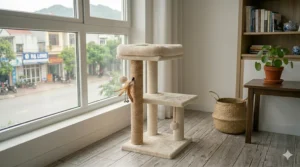
Understanding Cat Tree Dimensions for Apartment Living
Here’s what those measurements actually mean for your space:
Ceiling Height Considerations
Standard apartments have 8-foot ceilings. A 45-inch cat tree leaves 51 inches of clearance—plenty for most situations. Floor-to-ceiling models (adjustable 95-108 inches) maximize vertical space in studio apartments where floor real estate is at a premium.
Traffic Flow
Measure your walking paths. You need at least 24-30 inches of clearance for comfortable navigation. A 15-inch base tree in a corner leaves your walkway untouched.
Window Access
Cats love window views, but placing a tree directly in front blocks natural light. Position it adjacent to windows—your cat still gets the view, you keep your sunshine.
Small Cat Tree vs. Traditional Cat Trees: Real Comparisons
| Feature | Small Cat Tree | Traditional Cat Tree | Winner for Small Spaces |
|---|---|---|---|
| Floor Space | 12-20″ base typical | 24-36″ base typical | Small ✅ |
| Assembly Time | 10-20 minutes | 30-60 minutes | Small ✅ |
| Price Range | $35-$95 | $80-$300+ | Small ✅ |
| Multi-Cat Capacity | 1-2 cats usually | 2-4+ cats | Traditional ✅ |
| Scratching Surface | Limited (1-2 posts) | Extensive (3-6 posts) | Traditional ✅ |
| Mobility | Easy to move | Often stays put | Small ✅ |
How to Choose the Right Small Cat Tree for Your Apartment
Stop buying based on cuteness alone. Here’s the actual decision framework:
Step 1: Measure Your Space
Grab a tape measure. Identify potential locations and measure length, width, and height clearances. Write these down. Yes, actually write them down—you’ll thank me when you’re comparing products.
Step 2: Assess Your Cat’s Personality
Active climbers need multiple levels and height. Anxious cats prefer enclosed condos. Senior cats benefit from ramps or low platforms. Scratchers require substantial sisal coverage.
Step 3: Calculate Your Budget Reality
Quality small cat trees range $40-$95. Budget an extra $10-20 for potential replacement parts or accessories. A $50 tree that lasts three years beats a $30 tree replaced annually.
Step 4: Check Weight Limits
Manufacturers often lowball these. If your cat weighs 12 lbs and the limit is 15 lbs, you’re already in questionable territory. Add a 25-30% buffer for safety.
Step 5: Read Assembly Reviews
Search “[product name] assembly” in reviews. If multiple people mention missing parts, unclear instructions, or stripped screws, keep shopping.
Step 6: Verify Return Policies
Even perfect specs don’t guarantee your cat will actually use it. Ensure you can return it within 30 days if Mittens gives it a hard pass.
Space-Saving Design Strategies Beyond Cat Trees
Maximize vertical territory without cluttering floors:
Wall-Mounted Shelves: Install floating shelves at varying heights to create a “cat highway.” This uses zero floor space while providing climbing opportunities.
Window Perches: Suction-cup or bracket-mounted perches turn windows into prime real estate. Most support 20+ lbs and install in minutes.
Dual-Purpose Furniture: Cat condos that double as end tables or storage units blend function with feline-friendliness. You’ll find these marketed as “modern cat furniture.”
Corner Utilization: Corners are dead space for humans but perfect for compact cat trees. A 15-inch triangular base fits most corners without interfering with doors.
Common Small Cat Tree Mistakes to Avoid
Mistake #1: Ignoring Your Cat’s Age
Kittens can scale anything. Senior cats need gentle slopes. Don’t buy a kitten tree for a 10-year-old cat.
Mistake #2: Prioritizing Aesthetics Over Function
That minimalist ladder-style tree looks amazing on Instagram. Your cat wants platforms to actually lie on, not tiny shelves to balance on.
Mistake #3: Skipping the Anti-Tip Kit
“It looks stable” is not a safety strategy. Use the wall anchors. Period.
Mistake #4: Placing It in Low-Traffic Areas
Cats are social. They want to be where you are. A tree in a spare bedroom collects dust. A tree near your couch gets used daily.
Mistake #5: Not Testing Stability Before Your Cat Does
After assembly, push it. Hard. If it wobbles with your hand pressure, it’ll wobble with a jumping cat.
Maintenance and Longevity Tips
Extend your investment with these practices:
Weekly: Vacuum loose fur from platforms. Use a lint roller on fabric surfaces.
Monthly: Inspect sisal posts for fraying. Tighten any loose bolts or connections. Check for worn spots where your cat frequently scratches.
Quarterly: Deep clean removable cushions according to manufacturer instructions. Replace hanging toys if damaged.
Annually: Consider replacing heavily-worn sisal posts. Many manufacturers sell replacement parts—you don’t need an entirely new tree.
Pro Tip: Sprinkle fresh catnip on the tree quarterly to renew your cat’s interest. It’s like giving them a reason to rediscover old furniture.
✨ Don’t Miss These Exclusive Deals!
🔍 Take your cat’s comfort to the next level with these carefully selected products. Click on any highlighted item to check current pricing and availability. These compact solutions will help you create an enriched environment your feline friend will love!
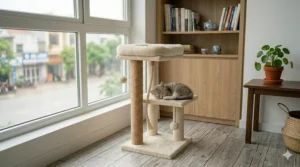
The Science Behind Vertical Space for Cats
Why does your cat insist on sitting on top of the refrigerator? It’s not personal—it’s biology.
Domestic cats descended from wild ancestors who climbed to escape predators and scout for prey. Even though your tabby faces no threats beyond the vacuum cleaner, those instincts remain hardwired. Height provides:
Security: Elevated positions offer 360-degree views and escape routes. Anxious cats often retreat to high spaces during stressful situations.
Territory: In the wild, the highest perch belongs to the dominant cat. Even in single-cat homes, claiming vertical space satisfies territorial instincts.
Exercise: Climbing strengthens core muscles and maintains flexibility. Indoor cats especially benefit from this built-in workout.
Mental Stimulation: Different vantage points provide novel perspectives on familiar environments. This combats boredom—a leading cause of destructive behavior.
Research published in the Journal of Feline Medicine and Surgery found that providing vertical structures significantly reduces stress indicators in confined cats. The study specifically noted that vertical resting spaces and hiding boxes were among the most effective environmental enrichments.
Multi-Cat Households: Sizing Up or Staying Small?
Three cats, 500 square feet. Can a small cat tree work? Sometimes yes, often no.
The Math: Each cat needs roughly 18 square feet of territory. Vertical space effectively multiplies your square footage—a four-level cat tree creates four separate territories within one footprint.
The Reality: Territorial disputes happen when cats can’t maintain social distance. According to NIH research on environmental enrichment, cats need the ability to keep 1-3 meters apart horizontally and vertically when sharing spaces.
Small Space Solutions for Multiple Cats:
Option 1: Two smaller trees in different rooms beats one medium tree. Cats can separate when tension arises.
Option 2: Combine a small floor tree with wall-mounted shelves. This creates multiple pathways and perching options without consuming floor space.
Option 3: Consider one taller (40-45 inch) narrow tree with multiple levels. Cats naturally separate by height—dominant cats claim higher perches.
Warning Signs Your Setup Isn’t Working:
- Cats avoiding the tree entirely
- Aggressive encounters near the tree
- One cat monopolizing all levels
- Elimination issues (stress-related)
If you see these, you need more territory, not bigger furniture.
Budget-Friendly vs. Premium: What You’re Actually Paying For
The price gap between a $40 Amazon Basics model and a $200 designer tree seems huge. What’s the real difference?
Budget Models ($35-$70)
Materials: Particle board, polyester fabric, basic sisal
Durability: 1-3 years with average use
Assembly: Basic instructions, standard hardware
Design: Functional but generic
Best For: First-time cat owners, kittens (who outgrow preferences), temporary housing situations
Mid-Range ($70-$120)
Materials: Higher-grade particle board, better fabric quality, natural sisal
Durability: 3-5 years
Assembly: Clear instructions, quality hardware
Design: More aesthetic options
Best For: Long-term cat owners, specific decor needs, cats with strong preferences
Premium ($120+)
Materials: Solid wood, eco-friendly finishes, premium fabrics
Durability: 5+ years
Assembly: Professional-grade construction
Design: Furniture-quality aesthetics
Best For: Design-conscious buyers, heavy/multiple cats, permanent installations
Real Talk: A well-maintained mid-range tree often outlasts a neglected premium model. Focus on materials and construction quality, not just price tags.
Small Cat Tree Materials Decoded
Let’s talk about what your cat tree is actually made from:
Base Construction
P2-Grade Particle Board: The industry standard. Compressed wood particles bonded with resin. Decent strength-to-weight ratio. Gets the job done.
MDF (Medium-Density Fiberboard): Denser than particle board, smoother surface. Slightly heavier but more stable. Common in mid-range models.
Solid Wood: Premium option. Heavier, more expensive, but significantly more durable. Look for pine or birch in high-end models.
Covering Materials
Faux Fur/Plush: Soft, comfortable, but shows wear quickly. Becomes matted over time. Harder to clean than other options.
Short-Pile Carpet: More durable than plush. Easier to vacuum. Less luxurious feel.
Sherpa/Fleece: Good middle ground. Soft enough for comfort, durable enough to withstand regular use.
Scratching Surfaces
Natural Sisal Rope: The gold standard. Durable, satisfying texture, long-lasting. Unwind it and you’ll see why—those fibers can take serious abuse.
Jute Rope: Slightly softer than sisal. Still good but wears faster.
Carpet: Acceptable for occasional scratching but not ideal for dedicated scratchers. Loops can catch claws.
Seagrass: Eco-friendly option gaining popularity. Similar durability to sisal with a different texture some cats prefer.
Seasonal Considerations for Cat Tree Placement
Where you position your compact cat tree changes with the seasons—if you want maximum usage.
Summer Strategy
- Move away from direct sunlight to prevent overheating
- Position near fans or AC vents for comfortable lounging
- Consider window placement for bird watching during active dawn hours
Winter Warmth
- Near radiators (but not too close—maintain 3 feet minimum for safety)
- Sunny spots become premium real estate
- Away from drafty windows to keep cozy perches comfortable
Year-Round Optimization
Your cat’s preferred spots change with temperature. Notice where they nap during different seasons and adjust tree placement accordingly. A mobile small cat tree makes this easy—most models weigh 10-25 lbs and relocate with minimal effort.
FAQ: Your Small Cat Tree Questions Answered
❓ Can a small cat tree work for large cats?
❓ How do I stop my small cat tree from wobbling?
❓ What's the minimum height for a cat tree to be effective?
❓ Do cats actually use small cat trees or prefer furniture?
❓ How often should I replace a small cat tree?
Conclusion: Small Spaces, Big Impact
Your apartment doesn’t need a jungle gym to keep your cat happy. What it needs is smart, intentional design that respects both your space constraints and your cat’s biological needs.
The small cat tree models highlighted here prove that compact doesn’t mean compromised. Whether you’re drawn to the quirky aesthetics of the PETEPELA Cactus Cat Tree, the budget-friendly reliability of Amazon Basics, or the senior-friendly design of Feandrea’s ramped models, there’s a space-saving solution that fits.
Remember: the best small cat tree is the one your cat actually uses. Factor in their age, weight, personality, and your available space. Measure twice, order once. And when that box arrives, assemble it promptly—your cat’s been eyeing that spot by the window long enough.
Give your feline friend the vertical territory they crave without sacrificing the livable apartment you need. It’s not just possible—it’s the entire point of thoughtful, compact cat furniture design.
Your 600-square-foot apartment just got a whole lot bigger. At least from your cat’s perspective.
Recommended for You
- 7 Best Tall Cat Trees 2026
- 7 Best Cat Tree for Large Cats 2026 – Heavy Duty Reviews
- 7 Best Cat Tree Options Your Cat Will Love in 2026
Disclaimer: This article contains affiliate links. If you purchase products through these links, we may earn a small commission at no additional cost to you.
✨ Found this helpful? Share it with your friends! 💬🤗
