
Table of Contents
Somewhere around the third time you play doorman for a cat who just wants to sit on the porch for eleven minutes, you start Googling. That’s usually how people land on a window cat door — not because they read about it in a design magazine, but because their cat has trained them, Pavlov-style, to drop whatever they’re holding and open a door. A window cat door solves that by turning an existing window into a pet-sized exit, without a contractor, a permit, or a hole cut into your siding. It slides into the track your window already uses, seals the gap, and gives your cat a lockable portal in and out on their own schedule — which, let’s be honest, was always going to happen eventually anyway.

This guide walks through seven real, currently-sold window cat door options spanning budget aluminum inserts to sealed, four-way-locking premium builds, plus the sizing math, installation quirks, and safety context that most product listings skip entirely. If you rent, if your windows are an odd sash style, or if you just don’t want to explain to your landlord why there’s suddenly a hole in the door — a window insert is usually the fix. Before jumping into the lineup, it helps to understand exactly what one of these devices is, and what it isn’t. A well-chosen window cat door can also double as the entry point for a catio, giving cats a safe, enclosed way to experience the outdoors without the risks of free roaming.
What Is a Window Cat Door?
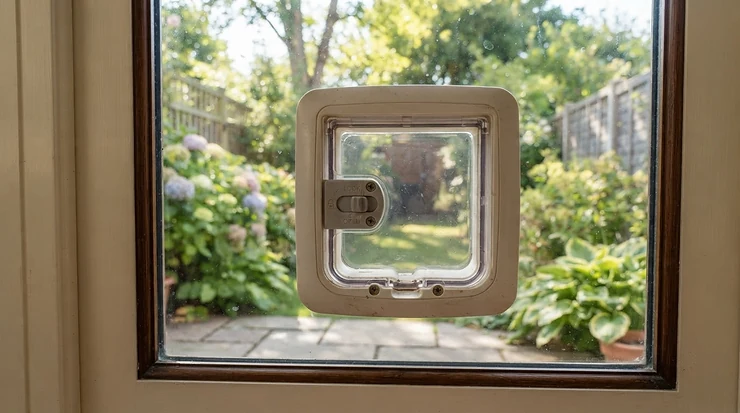
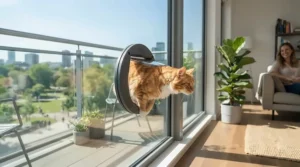
A window cat door is a framed insert — usually aluminum or PVC — that replaces a section of your window screen or glass pane. It sits inside the existing window track, includes a small flap or panel sized for a cat, and typically offers a locking mechanism so you can control in/out access. No cutting, no drilling into structural material, and in most cases, no landlord drama.
Quick Comparison: Window Cat Door Options at a Glance
| Product | Type | Best For | Price Range |
|---|---|---|---|
| Ideal Pet Products Aluminum Sash Window Pet Door | Sash insert | Classic double-hung windows | $50-$90 |
| VEVOR Cat Door for Window | Sliding insert | Budget-conscious multi-cat homes | $60-$90 |
| HOMEPEDIA Full-Size Window Cat Door | Sliding insert | Renters wanting a clean look | $70-$100 |
| SAKSUN Cat Door for Window | Sliding insert | Tight apartment windows | $50-$80 |
| Petoasis Cat Door for Window & Small Dog | Sliding insert | Small dogs and larger cats | $60-$90 |
| Security Boss Standard Pet Door Insert | Custom sliding insert | Odd or oversized window widths | $90-$150 |
| PetSafe Extreme Weather Energy Efficient Pet Door | Flap for DIY catio panel | Insulated catio access | $100-$180 |
Look at that table long enough and a pattern emerges: price climbs almost in lockstep with weatherproofing and lock complexity, not with raw size. The Ideal Pet Products Aluminum Sash Window Pet Door and SAKSUN Cat Door for Window sit at the accessible end because they trade some insulation and lock granularity for a simpler build, while the Security Boss Standard Pet Door Insert and PetSafe Extreme Weather Energy Efficient Pet Door justify their premium with tighter seals and configurability. If your climate swings hard between seasons, that difference in sealing quality is where your money actually goes.
Found a favorite already? Bookmark this page — you’ll want the sizing section before you check out.
Top 7 Window Cat Doors: Expert Analysis
1. Ideal Pet Products Aluminum Sash Window Pet Door — best for classic double-hung windows
If your home still has old-school sash windows — the kind that slide up and down rather than side to side — this is the insert built specifically for that mechanism. The aluminum frame telescopes to fit widths from roughly 23 to 38 inches depending on the size you order, so it locks into the existing window channel the same way your screen once did.
The flap size options run from a compact “Chubby Kat” cutout up to larger dog-friendly openings, and the frame itself is powder-coated aluminum rather than plastic, which matters more than it sounds — plastic frames can warp under direct summer sun sitting behind glass. Based on the spec comparison across sash-specific inserts, this one wins mainly on simplicity: there’s no adjustable width dial to fuss with, just a telescoping fit that locks with a thumbscrew.
Reviewers consistently note that installation takes under 20 minutes with no tools beyond a tape measure, though a recurring theme in aggregated feedback is that the vinyl flap can stiffen in cold weather, making it less flexible for smaller kittens to push through. This is a known limitation of unheated vinyl flaps generally, not a defect specific to this unit.
Pros:
- ✅ Purpose-built for double-hung sash window tracks
- ✅ Durable aluminum frame resists warping in sun
- ✅ Fast, tool-free telescoping installation
Cons:
- ❌ Vinyl flap stiffens noticeably in cold climates
- ❌ Limited to sash-style windows, not sliding ones
At around $50 to $90 depending on size, the Ideal Pet Products Aluminum Sash Window Pet Door is a strong value pick if your window style matches — check current pricing before buying, since size options shift the cost meaningfully.
2. VEVOR Cat Door for Window — best all-around lock control on a budget
The VEVOR Cat Door for Window is the insert most people stumble onto first, mostly because it shows up early in search results and delivers a surprising amount of function for the price. It’s built for horizontal sliding windows, with an aluminum frame and a high-transparency acrylic panel surrounding the flap.
What sets it apart on paper is the four-way lock: in-only, out-only, both, or fully locked. That’s genuinely useful if you’re managing a multi-cat household where one cat needs supervised access and another doesn’t. The magnetic closure on the flap also cuts down on the draft you’d otherwise feel standing near the window in winter.
A common complaint in user reviews is that the width-adjustment mechanism can feel loose after repeated seasonal removal and reinstallation — something worth reinforcing with weatherstripping tape if you plan to swap it out for screens every summer. Reviewers do consistently praise the clarity of the included instructions, which is not something you can say for every budget import.
Pros:
- ✅ Four-way lock modes for multi-cat households
- ✅ Magnetic closure reduces drafts
- ✅ Clear instructions and easy self-installation
Cons:
- ❌ Adjustment track can loosen with repeated use
- ❌ Frame is aluminum but panel is acrylic, not glass
In the $60 to $90 range at the time of research, the VEVOR Cat Door for Window delivers premium-feeling lock control without the premium price tag.
3. HOMEPEDIA Full-Size Window Cat Door — best for a clean, low-profile look
Renters tend to gravitate toward the HOMEPEDIA Full-Size Window Cat Door because it reads less like “pet equipment” and more like a normal window panel once installed. The HD glass-look panel and white aluminum trim blend into most window aesthetics, and the sizing accommodates a fairly wide range — typically 24 to 28 inches — with quick-fit clips instead of screws.
Here’s what most buyers overlook about this model: it’s rated for cats and small dogs, but the flap opening itself is on the smaller side of that range, so if you’re outfitting a larger cat, measure the shoulder width carefully before ordering. On paper this means it’s a great fit for average domestic shorthairs and mixed breeds, less ideal for Maine Coons or similarly large-framed cats.
Aggregated review sentiment points to strong satisfaction with the visual fit and a one-minute install process, though a handful of buyers mention the magnetic seal is on the lighter side, meaning determined cats can nose it open even when it’s meant to stay shut in “locked” mode.
Pros:
- ✅ Blends visually with existing window glass
- ✅ Quick-fit clip installation, no screws needed
- ✅ Wide adjustable width range for sliding windows
Cons:
- ❌ Flap opening runs small for large-breed cats
- ❌ Magnetic lock can be nudged open by persistent pets
Priced roughly $70 to $100, the HOMEPEDIA Full-Size Window Cat Door earns its spot for anyone prioritizing aesthetics over heavy-duty security.
4. SAKSUN Cat Door for Window — best for tight apartment window openings
Apartment dwellers with narrow sliding windows often run into a frustrating problem: most inserts assume a window wider than what they’ve actually got. The SAKSUN Cat Door for Window addresses that by adjusting comfortably down to a 27-inch width, making it one of the more compact-window-friendly options on this list.
The aluminum frame and weatherproof gasket combination hold up reasonably well against rain intrusion, based on the spec sheet’s IP-style sealing claims, and the four lock settings mirror what you’d find on pricier competitors. What most buyers overlook here is that “weatherproof” on a window insert generally means resistant to wind-driven rain, not submersion — so don’t expect it to perform like an exterior-grade wall-mounted door in a driving storm.
Reviewers consistently report satisfaction with the fit in narrow window frames specifically, which lines up with its market positioning, though a recurring theme is that the plastic latch clips feel less substantial than the metal components elsewhere on the unit.
Pros:
- ✅ Fits narrower window widths than most competitors
- ✅ Four lock modes match pricier alternatives
- ✅ Weatherproof gasket handles wind-driven rain
Cons:
- ❌ Plastic latch clips feel less durable than frame
- ❌ Smaller cat flap opening than full-size models
Expect to pay in the $50 to $80 range, making the SAKSUN Cat Door for Window a sensible pick when your window itself is the limiting factor.
5. Petoasis Cat Door for Window & Small Dog — best for larger cats and small dog crossover
If your household includes a chunky cat or a small dog alongside your feline, the Petoasis Cat Door for Window & Small Dog is built with that crossover use case in mind. The flap opening runs larger than most cat-specific inserts, and the kit includes extra sealing strips and a supplemental window lock — a small but genuinely thoughtful inclusion that other brands charge extra for.
Based on the spec comparison, the all-aluminum frame construction outperforms the mixed aluminum-and-ABS builds seen on some competitors in terms of long-term rigidity, especially in windows exposed to direct sun. What the spec sheet won’t tell you, but reviewers note, is that the wider flap opening makes it noticeably easier for cold air to sneak through around the edges in winter unless the supplemental sealing strips are applied carefully during install.
Aggregated feedback trends positive around durability and sizing flexibility, with a repeated theme that the four-way lock mechanism feels notably sturdier than entry-level competitors — a detail that matters if you’re locking pets in or out daily rather than occasionally.
Pros:
- ✅ Larger flap opening fits bigger cats and small dogs
- ✅ Includes bonus window lock and sealing strips
- ✅ Sturdier four-way lock than entry-level rivals
Cons:
- ❌ Wider flap can let in more draft if unsealed
- ❌ Bulkier profile than compact cat-only models
At around $60 to $90, the Petoasis Cat Door for Window & Small Dog is a smart pick for mixed-pet or larger-cat households.
6. Security Boss Standard Pet Door Insert for Window — best for odd or oversized window widths
Most window inserts top out around 38 inches of adjustability. The Security Boss Standard Pet Door Insert for Window is built for the households that fall outside that range, offering multiple customizable width configurations rather than a single fixed telescoping span. That flexibility comes from a tension-mounted aluminum frame designed to be measured and matched to your specific window, rather than a one-size-fits-most approach.
Here’s what most buyers overlook about this model: because it’s built to spec rather than off a fixed catalog size, ordering requires more careful upfront measuring than the plug-and-play competitors on this list — but the payoff is a noticeably tighter fit with fewer drafts once installed. On paper, that translates into better energy performance over a full winter, which matters if the window in question is one you use daily.
Reviewers consistently point to the tension-mount system as easier to remove seasonally than screw-in alternatives, useful if you want to swap back to a regular screen for part of the year. A common complaint, however, is that the ordering process itself takes longer since you’re selecting from more configuration options rather than a single dropdown.
Pros:
- ✅ Customizable widths fit oversized or odd windows
- ✅ Tension-mount design is easy to remove seasonally
- ✅ Tighter seal reduces drafts versus fixed inserts
Cons:
- ❌ Ordering requires careful pre-measurement
- ❌ Higher price than fixed-size competitors
Priced around $90 to $150, the Security Boss Standard Pet Door Insert for Window earns its premium tag through genuine fit precision.
7. PetSafe Extreme Weather Energy Efficient Pet Door — best insulated flap for a DIY catio panel
This one works a little differently than the others on this list. Rather than being sold as a complete window-track insert, the PetSafe Extreme Weather Energy Efficient Pet Door is a standalone insulated flap unit that pet owners commonly mount into a custom plexiglass panel cut to fit a window opening — a popular approach among catio builders who want a more insulated entry point than a stock aluminum-and-vinyl kit provides.
The telescoping, triple-flap design is what earns it the “energy efficient” branding: three overlapping vinyl flaps trap more air than a standard single-flap door, which matters if the opening leads to an unheated outdoor catio enclosure rather than directly into conditioned living space. Based on the spec comparison against single-flap inserts, the difference in draft resistance is significant enough to notice standing near the opening on a cold day.
What the spec sheet won’t tell you, but reviewers note, is that the DIY plexiglass-panel approach requires more handyman comfort than the plug-and-fit inserts elsewhere on this list — you’re cutting a hole in a purchased panel and mounting the flap frame yourself. For catio-focused households willing to do that extra step, the payoff is a warmer, more secure link between house and enclosure.
Pros:
- ✅ Triple-flap design meaningfully cuts drafts
- ✅ Popular, proven choice for DIY catio access panels
- ✅ Durable frame built for frequent daily use
Cons:
- ❌ Requires DIY plexiglass panel work, not plug-in
- ❌ Higher price than standard window inserts
At roughly $100 to $180, the PetSafe Extreme Weather Energy Efficient Pet Door is the pick for anyone building a proper catio rather than a simple window pass-through.
Practical Window Installation Guide: Getting the Fit Right the First Time
Most window installation headaches with these inserts come down to skipping the measuring step, so start there. Measure your window’s total width at the exact point the insert will sit — sashes taper slightly at the top on older homes, so measure at both top and bottom of the intended spot and use the smaller number. Then measure your cat: shoulder width and chest-to-back height, not just “how big he looks.” A flap opening should exceed both measurements by roughly 10 percent for comfortable passage without squeezing.
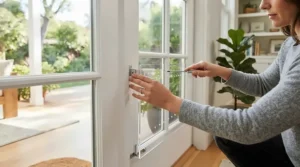
Before installing, clean the window track thoroughly — accumulated dirt and old weatherstripping residue is the number one reason inserts sit crooked and let in drafts. Most kits telescope or clip into place without tools, but running a thin bead of clear silicone along the top seam adds meaningful weatherproofing that most instructions don’t emphasize. If you’re working with an older aluminum sash window, following the sizing methodology laid out by manufacturers like Ideal Pet Products, which recommends measuring the widest point of your cat’s shoulder and the distance from the top of the back to the bottom of the chest, will save you a return shipment.
A common first-30-days mistake is locking the insert before the cat has learned to use it, which teaches them the window is now off-limits rather than an exit. Prop the flap open with tape for the first several days, let the cat walk through freely, then gradually let the flap fall on its own.
Real-World Scenarios: Which Window Cat Door Fits Your Situation
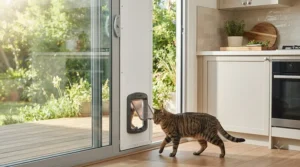
The apartment renter with a sliding window. If your lease forbids permanent modifications, a plug-in insert like the SAKSUN Cat Door for Window or HOMEPEDIA Full-Size Window Cat Door solves the problem without touching drywall or the window frame itself, and both remove cleanly at move-out.
The multi-cat household with mixed access needs. When one cat should have outdoor access and another shouldn’t, a four-way lock model like the VEVOR Cat Door for Window or Petoasis Cat Door for Window & Small Dog lets you flip between in-only, out-only, and fully locked without swapping hardware.
The catio owner building a real enclosure. If the end goal is a proper outdoor catio rather than an open-ended yard exit, the PetSafe Extreme Weather Energy Efficient Pet Door paired with a custom plexiglass panel gives a more insulated, secure transition point than a stock window insert alone.
Problem → Solution: Fixing Common Window Cat Door Headaches
Drafts around the frame usually trace back to a gap between the insert and the original window track — press weatherstripping foam into the seam rather than relying on the kit’s stock gasket alone. A flap that won’t stay latched shut typically means the magnetic strips have shifted out of alignment during shipping; realigning them by hand fixes most cases without a warranty claim. Cats refusing to use the new opening almost always comes down to unfamiliarity rather than a design flaw — propping the flap open during a training period resolves the majority of hesitancy within a week. If squirrels or raccoons are pushing through an unlocked flap at night, switching to “in-only” lock mode overnight closes that gap immediately. And if the insert feels loose in the track after a season of use, a strip of adhesive-backed foam tape along the contact edges tightens the fit without replacing the whole unit.
How to Choose a Window Cat Door
- Measure your window opening at its narrowest point — inserts telescope within a range, and buying outside that range means returns.
- Measure your cat, not your assumptions — shoulder width and chest height determine the minimum flap size, and guessing leads to a door that’s technically installed but functionally useless.
- Match the window type — sash (up-down) windows need sash-specific inserts; sliding (side-to-side) windows need a different frame profile entirely.
- Prioritize lock modes if you have multiple pets — a simple flap works for one cat with full outdoor freedom, but four-way locks matter fast in multi-pet homes.
- Weigh climate against seal quality — colder regions benefit from triple-flap or heavily gasketed designs over basic single-flap inserts.
- Check the frame material — aluminum resists warping better than all-plastic frames sitting in direct sunlight for years.
- Confirm it’s removable if you rent — plug-in and tension-mount designs come out cleanly; ones requiring drilled screws don’t.
Cat Window Insert vs Sash Window Cat Door vs Wall-Mounted Cat Flap
These three terms get used almost interchangeably online, but they solve different problems. A general cat window insert typically refers to any pane-replacement unit designed for sliding windows — it clips or telescopes into the horizontal track and works best on apartment-style windows that slide left-right. A sash window cat door is purpose-built for the vertical up-down mechanism found in older or traditional homes, with a frame shaped to nest into that specific channel rather than a horizontal slider’s track. A wall-mounted cat flap, by contrast, isn’t a window product at all — it’s cut directly into an exterior door or wall, which usually means permanent modification, often professional installation, and in most rental situations, a conversation with your landlord you’d rather avoid.
The practical takeaway: if you already have a window that opens the direction you need, an insert avoids construction entirely. If you don’t have a suitable window, or you want a permanent, integrated look, a wall-mounted flap becomes the better long-term investment despite the higher upfront cost and installation complexity.
Common Mistakes When Buying a Window-Mounted Cat Door
The single most common mistake is ordering based on window type alone without checking the width-adjustment range — a sash insert rated for 27 to 32 inches simply won’t telescope down to fit a 24-inch window, no matter how much force is applied. A close second is underestimating cat size; a “Chubby Kat” flap sized for an average domestic shorthair may be genuinely too small for a Maine Coon or Ragdoll, leading to reluctant or refused use. Buyers also frequently skip checking lock-mode count, then discover mid-ownership that a simple flap-only design offers no way to keep a cat in during vet visits or bad weather. Finally, some buyers assume “weatherproof” means suitable for any climate extreme, when in practice most inserts are rated for moderate wind and rain resistance, not sustained sub-freezing exposure without supplemental insulation — something worth weighing seriously if outdoor access matters even in winter, and something to discuss with resources like humane welfare organizations before assuming unsupervised access is automatically the safer option for a formerly declawed or otherwise vulnerable cat, a concern groups like the Humane Society of the United States and the ASPCA have specifically raised in the context of declawed cats losing a key defense mechanism.
What to Expect: Real-World Performance
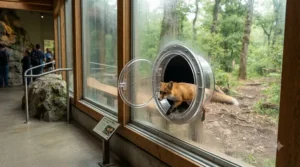
On paper, a window cat door sounds like it should function identically to a human door, just smaller. In practice, expect a short adjustment period — most cats take three to ten days to fully trust a new flap, particularly if they’ve never used one before. Expect some seasonal maintenance too: flaps stiffen in cold weather, gaskets compress over a year or two, and locks occasionally need realigning after repeated use. What you shouldn’t expect is silence — even magnetic-closure flaps make an audible clack with each pass, which some cats initially find startling and most eventually ignore entirely. Weatherproofing performs roughly as advertised for wind-driven rain and moderate temperature swings, but don’t expect a $70 insert to match the insulation value of the wall it’s replacing a section of window with.
Catio Access & Alternative Entry Points Beyond a Basic Window Door
A window cat door doesn’t have to lead straight outside to open ground. Increasingly, owners use these inserts as the connective tissue between an indoor room and an enclosed catio — a screened outdoor structure that gives cats sun, air, and stimulation without the risks of true free roaming. When building this kind of alternative entry setup, the insert becomes less about “letting the cat out” and more about creating a secure transition point between two contained spaces. That distinction matters for lock selection: a catio-connected door benefits more from insulation and daily-use durability than from complex multi-mode locking, since the cat generally isn’t leaving the property either way.
For households without room for a full catio, some owners repurpose a second-floor or side window as an alternative entry solely for supervised access — paired with a harness-and-leash routine or a fully enclosed window box rather than open access to the ground. Whichever direction you go, the guiding principle from welfare organizations remains consistent: contained, supervised outdoor time delivers most of the enrichment benefit with a fraction of the risk of unrestricted roaming.
Long-Term Cost & Maintenance
A $60 window insert isn’t a one-time cost if you factor in realistic upkeep. Budget for annual weatherstripping replacement (a few dollars in foam tape), occasional flap replacement after two to four years of daily use depending on climate exposure, and possibly a magnet or latch realignment kit if the closure weakens over time. Compared to a professionally installed wall-mounted cat flap — which can run several hundred dollars installed — a window insert’s total cost of ownership over five years still comes out meaningfully lower, even accounting for a mid-life replacement. The math shifts if you move frequently, since a window insert travels with you far more easily than a permanently cut wall flap ever could.
Safety, Regulations & Compliance Guide
Before installing any window-based pet access point, it’s worth pairing pet safety with general window safety. The U.S. Consumer Product Safety Commission has documented an estimated 5,600 children aged 12 and under treated in emergency departments in 2024 after falling from windows, and its guidance is explicit that screens alone were never designed to prevent falls — a relevant point if a window cat door is installed in a room children also use, since a pet insert modifies the same opening a child could push against. If the window in question is in a child-accessible room, pairing the pet door installation with a compliant window guard or stop is a reasonable extra step, not an overreaction.
On the pet side, most window cat door manufacturers rate flap openings by weight and shoulder width rather than breed, so there’s no formal regulatory body governing sizing the way there is for, say, crib slats. Use manufacturer sizing charts as a floor, not a ceiling — when in doubt, size up rather than down.
Frequently Asked Questions
❓ Can a window cat door be installed without tools?
❓ How do I measure my cat for the right flap size?
❓ Will a window cat door let cold air into my house?
❓ Can I lock my cat out at night with these doors?
❓ Do window cat doors work on sliding windows and sash windows equally well?
Conclusion
A window cat door isn’t a glamorous purchase, but it solves a genuinely annoying daily problem with minimal disruption to your home. Whether you land on the budget-friendly SAKSUN Cat Door for Window, the lock-heavy VEVOR Cat Door for Window, or the built-for-catios PetSafe Extreme Weather Energy Efficient Pet Door, the right choice comes down to your window type, your cat’s size, and how much control over access you actually need day to day. Measure twice, check the lock modes you’ll realistically use, and pair the installation with sensible window safety if kids share the space. Get those three things right, and you’ve traded a lifetime of door-opening duty for a five-minute install.
Recommended for You
- Sliding Glass Cat Door: 7 Genius Picks for 2026 (Ranked)
- Microchip Cat Door 2026: 7 Best Picks to Stop Sneaky Strays
- Best Cat Door 2026: 7 Picks That Actually Work
Disclaimer: This article contains affiliate links. As an Amazon Associate, I earn from qualifying purchases. If you purchase products through these links, we may earn a small commission at no additional cost to you.
✨ Found this helpful? Share it with your friends! 💬🤗
