
Table of Contents
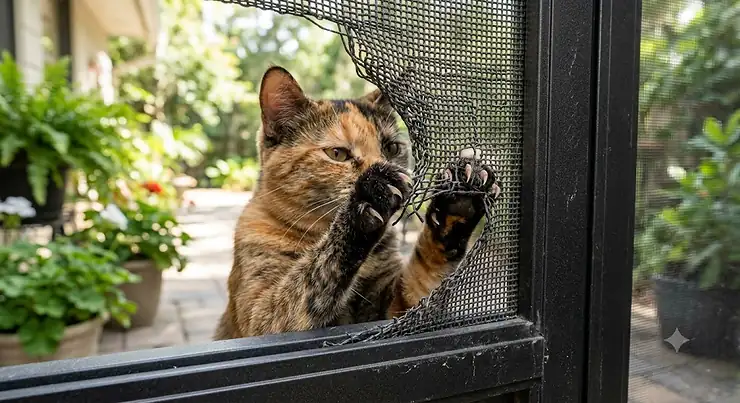
If you own a dog that treats your screen door like a personal trampoline, or a cat who views mesh as a scratching post with a view, you already know why a pet-proof screen door isn’t a luxury — it’s damage control. A pet-proof screen door is a reinforced door screen, typically made from PVC-coated polyester or heavy-gauge mesh, engineered to resist punctures and tears from claws, paws, and persistent pushing, unlike standard fiberglass screening that shreds within weeks. I’ve spent years around dogs who consider “closed door” a suggestion rather than a rule, and the difference between a flimsy builder-grade screen and a genuine pet-proof screen door isn’t subtle — it’s the difference between replacing your screen every spring and forgetting it exists.
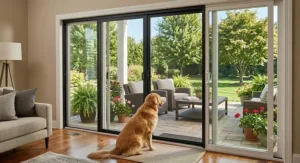
This guide breaks down seven real, currently available products spanning replacement mesh rolls, steel grilles, magnetic curtains, and full door kits. You’ll get honest analysis pulled from manufacturer specs and aggregated customer feedback, not recycled marketing copy. According to the ASPCA’s overview of destructive scratching, cats scratch during play, while stretching, to mark territory, and to shed the worn outer layer of their claws — which explains why no screen is entirely “scratch-proof,” only more resistant to the behavior your pet isn’t going to stop anytime soon. We’ll cover what actually holds up, what doesn’t, and how to match a solution to your specific animal, door type, and budget.
Quick Comparison Table
Before diving into the full breakdown, here’s a fast snapshot of how the seven products stack up on durability tier, format, and who they suit best.
| Product | Format | Durability Tier | Best For |
|---|---|---|---|
| Phifer PetScreen | Replacement mesh roll | Heavy-duty | DIY re-screening on a budget |
| Saint-Gobain ADFORS Pet Resistant Screen | Replacement mesh roll | Heavy-duty + fire-rated | Safety-conscious households |
| Guardian Steel Pet Grille | Overlay grille | Ultra heavy-duty | Determined dogs, no screen removal |
| PROTECTO Heavy Duty Door Protector | Clear shield panel | Moderate | Cats scratching near the base |
| MAGZO Heavy Duty Magnetic Screen Door | Full magnetic curtain | Heavy-duty | Renters, hands-free entry |
| RiteScreen KD Mfit Sliding Screen Door | Complete door kit | Heavy-duty | Full sliding door replacement |
| Prime-Line Sliding Patio Door Grill | Overlay grille | Moderate | Budget-conscious grille shoppers |
Looking at the spread, the pattern is clear: replacement mesh (like Phifer PetScreen and Saint-Gobain ADFORS Pet Resistant Screen) suits anyone keeping their existing frame, while overlay grilles such as the Guardian Steel Pet Grille add a second line of defense without touching the screen at all. If your dog is a repeat offender who’s already destroyed two screens, the grille route or the full RiteScreen KD Mfit Sliding Screen Door replacement will outlast anything mesh-only.
💬 Already know which type fits your home? Jump straight to the product that matches — or keep scrolling for the full breakdown.
Top 7 Pet-Proof Screen Door Options: Expert Analysis
We researched real Amazon and manufacturer listings to find seven genuinely different approaches to the same problem: keeping claws from winning. Each one below includes honest analysis of specs, aggregated review sentiment, and who it actually fits — not just a features list.
1. Phifer PetScreen — 7x stronger than standard fiberglass mesh
The headline claim here isn’t marketing fluff — it’s backed by real numbers. Phifer’s PetScreen is woven from vinyl-coated polyester yarn with a .025″ diameter and a Mullen bursting strength of 538 psi, compared to the roughly 55-70 psi you’d see from standard fiberglass insect screen. In practice, that translates to a screen that can absorb a cat’s full-body lean or a dog’s nose-push without stretching out of shape. The 36% openness rating keeps airflow close to what you’d get from a regular screen, so you’re not sacrificing much ventilation for the durability upgrade.
This is the pick for homeowners comfortable doing their own re-screening who want proven, industry-standard material rather than a no-name import. Reviewers consistently report that the thickness makes it slightly trickier to fit into narrow factory spline grooves — you may need a slightly larger spline size to seat it properly, something the product listing itself flags. Aggregated feedback across major retailers also notes that the black and grey color options hold up visually over multiple seasons without the yellowing some cheaper meshes develop.
Pros:
- ✅ Nearly 10x the burst strength of standard fiberglass screen
- ✅ Available in five width options up to 96 inches
- ✅ Widely stocked, so replacement rolls are easy to source
Cons:
- ❌ Thicker yarn can require a larger spline for a clean fit
- ❌ Charcoal/black only in wider roll sizes
At around $40-70 for a standard door-sized roll, and up toward $90 for the widest options, Phifer PetScreen sits squarely in the mid-range — a smart value pick if you’re comfortable with a weekend DIY re-screening project.
2. Saint-Gobain ADFORS Pet Resistant Screen — the only flame-resistant pet screen on the market
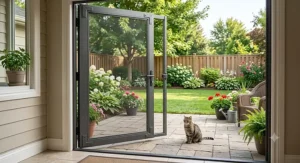
What most buyers overlook about this one is the safety angle. Saint-Gobain markets this as the only pet-resistant screen that also carries flame-resistance certification, having passed the ASTM D3656 insect screening specification, which governs appearance, mesh, mass per unit area, flame resistance, bursting strength, and color stability for vinyl-coated yarn screening — along with ASTM D6413 and ISO 11925-2 vertical burn tests. For households with older aluminum-frame patio doors near a grill, fire pit, or kitchen exit, that’s a meaningfully different risk profile than a standard pet screen.
Beyond the fire rating, the polyester yarn construction performs similarly to other heavy-duty pet screens in day-to-day claw resistance, and it’s sold in a charcoal finish that stays easy to see through from both sides. Based on the spec comparison with Phifer’s offering, the two products are close competitors on raw durability; ADFORS pulls ahead specifically on the fire-safety credential, which is a differentiator worth paying attention to if it applies to your situation.
Pros:
- ✅ Only pet screen with verified flame-resistant certification
- ✅ Charcoal finish maintains good two-way visibility
- ✅ Polyester construction resists claw punctures well
Cons:
- ❌ Premium positioning pushes price slightly above standard PetScreen
- ❌ Fewer width options than some competitors
Expect to pay in the $45-75 range for a typical roll, landing this one in the mid-range tier — reasonable for the added fire-safety margin.
3. Guardian Steel Pet Grille — adds a steel barrier without replacing your screen
Here’s what the spec sheet won’t tell you outright: a grille solves a completely different problem than replacement mesh. Instead of upgrading the screen material itself, the Guardian Steel Pet Grille mounts an expanded steel mesh panel directly over your existing screen door, physically blocking claws and noses from ever reaching the fabric. It’s constructed from steel with a powder-coat finish, ships in white, black, bronze, and grey, and comes in 30″, 36″, and 48″ widths with mounting hardware included.
This is the pick for anyone whose dog has already destroyed a screen (or two) and who doesn’t want to gamble on mesh alone holding up. Aggregated buyer feedback describes the grille as heavy-duty and well-finished, with several reviewers specifically noting it worked for both dogs and small children pushing on the door — though a few mention that non-standard door widths require careful measuring before ordering, since the grille won’t compress or stretch to fit.
Pros:
- ✅ Physical steel barrier stops claws before they reach the screen
- ✅ Four finish options to match existing door hardware
- ✅ Mounting hardware included for straightforward installation
Cons:
- ❌ Doesn’t fit non-standard door widths without modification
- ❌ Adds a visible grid pattern that some find less sleek
Price typically runs $60-100 depending on size and finish, positioning the Guardian Steel Pet Grille as a mid-to-premium option — but for a repeat-offender dog, it’s often cheaper than replacing mesh every season.
4. PROTECTO Heavy Duty Door Protector — a clear shield built for cat-height scratching
Cats rarely attack a screen the way dogs do — they tend to scratch low, near the bottom third of the door, in short repeated bursts. The PROTECTO Heavy Duty Door Protector is designed around exactly that pattern: a clear 35″ x 24″ panel that mounts over the lower section of a screen, window, or sliding door without blocking the view or the light. Because it’s transparent, it’s the least visually intrusive option on this list.
Reviewers consistently report that installation takes just a few minutes with basic adhesive or screws, and that the clear panel genuinely disappears once mounted — a common theme in feedback for cat-specific door protection products. What most buyers overlook is that this product protects a zone, not the entire screen; it won’t stop a large dog leaning its full weight against the top half of the door. Based on the spec comparison, this is a targeted fix rather than a whole-door solution, and it’s honestly marketed that way.
Pros:
- ✅ Nearly invisible once installed, unlike grilles or mesh overlays
- ✅ Works on screens, windows, and sliding glass doors alike
- ✅ Fast, tool-light installation process
Cons:
- ❌ Covers only the lower section, not the full door
- ❌ Less effective against large dogs than full-panel solutions
At roughly $20-40, this is the most budget-friendly entry here — a smart, low-commitment pick if your cat screen door protector needs are limited to one stubborn scratching zone.
5. MAGZO Heavy Duty Magnetic Screen Door — hands-free entry with reinforced mesh
The MAGZO Heavy Duty Magnetic Screen Door takes a different approach entirely: instead of reinforcing a fixed screen, it replaces the whole opening with a magnetic curtain made from thickened polyester mesh rated at roughly 250 grams per square meter — more than double the density of the roughly 120 g/m² mesh used in standard magnetic screens. The 14×11 weave count adds tensile strength specifically aimed at resisting scratches and tears, and the seams use upgraded high-strength thread rather than standard stitching.
What stands out here is the magnet configuration: alternating strong and short magnet segments run the full length of the curtain, letting it snap shut automatically after a pet or person walks through — genuinely useful for households where propping a screen door open isn’t an option. Aggregated review sentiment points to this being a strong fit for cats and small-to-medium dogs, though independent comparisons note that a determined large dog can still push through any magnetic seam by design, since that’s what lets the curtain open in the first place. The real test is whether it re-seals cleanly afterward, and the denser mesh and stronger magnets here perform noticeably better on that front than entry-level competitors.
Pros:
- ✅ Hands-free magnetic closure ideal for pets moving in and out
- ✅ Reinforced 250g/m² mesh roughly doubles standard screen density
- ✅ No permanent modification, making it renter-friendly
Cons:
- ❌ Large or aggressive dogs may eventually wear down the seam edges
- ❌ Not a substitute for a hard screen if you have multiple large dogs
Priced around $25-40 depending on size, the MAGZO Heavy Duty Magnetic Screen Door is an excellent value pick for anyone who wants heavy-duty pet screen performance without permanently altering their door frame.
6. RiteScreen KD Mfit Sliding Screen Door — a full replacement kit with PetScreen mesh built in
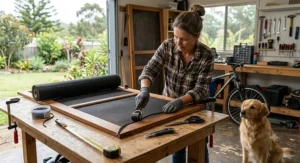
When the existing door frame itself is damaged — bent tracks, warped aluminum, a hinge that won’t hold anymore — patching the screen won’t fix the underlying problem. The RiteScreen KD Mfit Sliding Screen Door is a ready-to-assemble aluminum-frame kit with an adjustable fit spanning 78″ to 81″ openings, which the manufacturer states covers roughly 95% of sliding door frames in the U.S. It’s available with the same PetScreen mesh used in Phifer’s standalone rolls, meaning you get the 7x-stronger material built directly into a brand-new frame rather than retrofitted into an old one.
This is the pick for households doing a genuine door replacement rather than a screen repair — new construction, a remodel, or a frame that’s simply beyond saving. Based on the spec comparison, the adjustable-height design is the standout feature: rather than needing an exact custom measurement, it flexes across a three-inch range, which meaningfully reduces the return-and-reorder headache common with rigid screen door kits. The tradeoff is assembly time and a locking handle mechanism that a few buyers describe as needing careful alignment during setup.
Pros:
- ✅ Adjustable height fits roughly 95% of U.S. sliding door frames
- ✅ Includes heavy-duty PetScreen mesh option built into the frame
- ✅ Locking handle adds a security layer standard screens lack
Cons:
- ❌ Requires more assembly time than a simple mesh swap
- ❌ Higher upfront cost than repair-only options
Expect a price range of roughly $130-200 for the complete kit — a premium investment, but one that solves frame problems mesh alone never will.
7. Prime-Line Sliding Patio Door Grill — the budget-friendly grille alternative
Not every household needs the full steel treatment of the Guardian grille. The Prime-Line Sliding Patio Door Grill offers a lighter-weight overlay option in a 48″ width with a bronze finish, sold as a single-pack unit designed to mount over an existing sliding screen door. It functions on the same principle as heavier steel grilles — creating a barrier between pets and the mesh — just with less material and, correspondingly, less resistance to sustained force.
Here’s what the spec sheet won’t tell you: lighter grilles like this one are better suited to cats and smaller dogs than to large, high-energy breeds that lean or jump against doors. Aggregated buyer feedback for this style of grille tends to highlight ease of installation and color-matching with existing bronze or brass door hardware as the main draws, while noting that thinner grille wire can bend under sustained pressure from a large dog. If your primary concern is a cat pushing at the screen rather than a 70-pound dog throwing its shoulder into it, this is a perfectly adequate, budget-conscious layer of door protection.
Pros:
- ✅ Lightweight design is easy to install solo
- ✅ Bronze finish matches common patio door hardware
- ✅ Meaningfully lower price than steel grille alternatives
Cons:
- ❌ Thinner wire bends under sustained pressure from large dogs
- ❌ Single-pack sizing limits fit flexibility
Priced around $25-45, the Prime-Line Sliding Patio Door Grill is the value pick among grille-style options, particularly for cat households or smaller breeds.
Practical Usage Guide: Installing and Maintaining Your Pet-Proof Screen Door
Getting the durability benefits of any pet-proof screen door depends heavily on correct installation — a heavy-duty mesh installed with the wrong spline size will pop out just as easily as cheap screening. Start by measuring your existing frame’s groove width before ordering spline; thicker pet-resistant mesh, like Phifer PetScreen or Saint-Gobain ADFORS Pet Resistant Screen, often needs a slightly larger spline (around .125″) than what shipped with your original screen, or the material won’t seat tightly enough to resist pushing.
During the first 30 days, resist the urge to pull the mesh drum-tight during installation — pet-resistant screen has less stretch than standard fiberglass, and over-tensioning can stress the corners where most tears actually start. Once installed, a quick monthly check of the spline groove and corner seams catches loosening before it becomes a full gap. For grille-style products like the Guardian Steel Pet Grille, re-torque the mounting screws after the first few weeks, since expanded metal settles slightly into its frame under repeated pressure. Wipe mesh down seasonally with a soft brush and mild soap — avoid pressure washing, which can distort the weave pattern on vinyl-coated products.
Real-World Scenarios: Which Pet-Proof Screen Door Fits Your Household
Picture three different households, each with a different claw problem. First, a young couple renting a two-bedroom apartment with one indoor cat who scratches at the patio door every morning wanting to watch birds. For them, the PROTECTO Heavy Duty Door Protector or the MAGZO Heavy Duty Magnetic Screen Door makes the most sense — no permanent modification, renter-friendly, and sized appropriately for a single cat’s scratching pattern rather than a full-force dog impact.
Second, consider a family with two mid-sized dogs and a backyard they access dozens of times a day. Here, standard mesh alone won’t survive the volume of use, no matter how heavy-duty; the combination of Phifer PetScreen as the base material plus a Guardian Steel Pet Grille overlay gives two layers of resistance, which matters when the door sees fifty-plus openings daily. Third, picture a homeowner mid-renovation whose sliding door frame itself is bent from age and prior dog damage. No screen upgrade fixes a warped frame — that’s exactly the scenario the RiteScreen KD Mfit Sliding Screen Door kit was built for, since it replaces the frame and the mesh together in one adjustable unit.
Problem → Solution: Fixing Common Pet-Proof Screen Door Headaches
Problem: Claws punch through within weeks. Standard fiberglass screen simply isn’t rated for repeated point pressure. Solution: swap to a vinyl-coated polyester mesh like Phifer PetScreen, which tests at roughly 538 psi bursting strength versus standard screen’s fraction of that number.
Problem: The dog pushes the whole screen out of its frame. This usually means the spline, not the mesh, has failed. Solution: re-spline with a slightly larger diameter cord, or add a Guardian Steel Pet Grille so force is absorbed by steel rather than the screen’s edge.
Problem: The cat scratches one specific low corner obsessively. A full mesh replacement is overkill for a localized habit. Solution: a targeted panel like the PROTECTO Heavy Duty Door Protector solves it without touching the rest of the door.
Problem: You rent and can’t modify the frame. Solution: the MAGZO Heavy Duty Magnetic Screen Door requires no drilling or permanent fasteners and can be removed at move-out without a trace.
Problem: The whole frame is warped from years of pet damage. No mesh product fixes structural warping. Solution: a full kit like the RiteScreen KD Mfit Sliding Screen Door replaces the frame and screen together.
Buyer’s Decision Framework
If your primary concern is a single cat scratching at one spot, choose a targeted clear panel because it’s the least invasive, lowest-cost fix for a localized habit. If you have one or two dogs under 40 pounds with moderate energy, choose a heavy-duty replacement mesh because it balances airflow, visibility, and durability without extra hardware. If you have a large or multiple dogs that have already destroyed a screen once, choose a steel grille overlay because it adds a physical barrier that doesn’t rely on mesh tensile strength alone. If your door frame itself is damaged or you’re renovating, choose a full replacement kit because patch solutions can’t fix structural problems. And if you rent or need a removable option, choose a magnetic reinforced curtain because it requires no permanent modification to the frame.
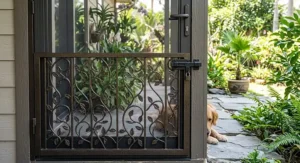
How to Choose a Pet-Proof Screen Door
Choosing the right pet-proof screen door comes down to matching material and format to your specific pet’s behavior, not just picking the highest-rated listing. Here’s the process that actually works:
- Identify the damage pattern first. Cats scratch low and repeatedly in one spot; dogs tend to push, jump, or nose the entire panel. Your damage pattern determines whether you need a full mesh swap or a targeted panel.
- Check your frame’s condition. If the track, hinges, or aluminum frame are bent or warped, no screen upgrade will fix that — you need a full kit.
- Match mesh density to pet size. Small cats are well-served by standard pet-resistant mesh; larger or multiple dogs benefit from adding a steel grille layer.
- Consider your lease or ownership status. Renters should lean toward removable, non-permanent options like magnetic curtains.
- Factor in climate and safety needs. If your screen is near a grill, fire pit, or kitchen exit, a flame-resistant option adds a genuine safety margin.
- Set a realistic budget tier. Clear panels and grilles run cheaper; full door kits cost more but solve structural issues mesh can’t touch.
- Plan for installation skill level. DIY mesh replacement requires basic tools and patience; grilles and magnetic curtains install faster with less skill required.
🔍 Ready to Stop Replacing Your Screen Every Season?
Compare current pricing and availability on the picks above — a heavier mesh or a grille layer often pays for itself the first time it saves you a full re-screening job.
Common Mistakes When Buying a Pet-Proof Screen Door
The most common mistake is buying based on the word “pet-proof” alone without checking the actual mesh weight or bursting strength — marketing language varies wildly between brands, while real specs like grams per square meter or Mullen bursting strength tell you the actual story. A second frequent error is ignoring spline size; pairing heavy-duty mesh with the original, thinner spline leaves the material loose enough to pop out under the first hard push. Buyers also commonly underestimate their pet’s actual behavior, buying a lightweight grille for a 60-pound dog that needed steel, or a full expensive kit when a $30 magnetic curtain would have solved a one-cat scratching habit just as well.
Another mistake worth flagging: assuming all pet screens fit all frame types. Sliding patio doors, hinged screen doors, and window screens each have different groove depths and frame profiles, and a roll of mesh rated for one doesn’t automatically fit another without adjustment. Finally, many buyers skip measuring twice before ordering rigid grilles — unlike flexible mesh, a steel grille that’s a half-inch off simply won’t mount.
Pet-Proof Screen Door vs Traditional Screen Door
The core difference between a pet-proof screen door and a traditional one comes down to material engineering, not appearance — they look nearly identical hanging in a frame. Traditional fiberglass screen prioritizes low cost and light weight, which is exactly why it fails so quickly against claws: the woven fiberglass strands have minimal tensile strength and no coating to resist puncture. Pet-resistant versions use PVC- or vinyl-coated polyester or steel-reinforced construction specifically to resist that point pressure.
| Factor | Traditional Screen | Pet-Proof Screen Door |
|---|---|---|
| Typical bursting strength | ~55-70 psi | 300-540+ psi |
| Material | Fiberglass yarn | Vinyl-coated polyester or steel |
| Lifespan with pets | Weeks to months | Multiple years |
| Airflow/visibility | Slightly better | Comparable, minor reduction |
| Best For | Homes without pets | Homes with cats or dogs |
Interpreting the numbers above, the strength gap explains almost everything about why pet owners eventually switch: a screen rated at 500+ psi simply absorbs the same claw pressure that shreds standard fiberglass in a single season. The minor tradeoff in airflow and visibility is negligible in day-to-day use, and for households with dogs or cats, that tradeoff is clearly worth the multi-year lifespan extension.
💬 Skip the trial-and-error — the picks above already passed the durability test.
Screen Durability and Claw Resistance: What Actually Matters
Not every “durability” claim on a product listing translates into real-world claw resistance, so it helps to know which specs actually matter. Bursting strength (measured in psi via the Mullen test) is the single best predictor of how a screen handles a cat’s full-body lean or a dog’s nose push — higher numbers mean more force absorbed before the weave gives way. Yarn diameter and weave density (like the 14×11 count on reinforced magnetic screens) matter almost as much, since a tighter, thicker weave resists puncture even before the bursting threshold is reached.
What matters comparatively less, despite heavy marketing emphasis, is color — charcoal, black, and grey all perform identically in terms of screen durability; the color choice is purely about visibility preference. Similarly, “fine mesh count” marketed for insect control doesn’t correlate with claw resistance at all; a screen can keep out gnats and still tear instantly under a cat’s claws if it lacks reinforced yarn. If you’re prioritizing claw resistance specifically, look past the color options and insect-mesh-count marketing and go straight to the bursting strength and yarn coating specs.
Cat Screen Door Protector: What Cat Owners Need to Know
Cats present a genuinely different challenge than dogs when it comes to screen damage. Rather than the broad-force pushing that dogs apply, cats tend to focus repeated, concentrated scratching on one low section of a door — a pattern Cornell’s Feline Health Center describes as normal investigative and play behavior rather than destructive intent, noting that scratching largely serves as scent-marking and claw maintenance. That behavioral distinction matters practically: a cat screen door protector doesn’t necessarily need to cover the full door the way a dog-focused solution does.
For most cat households, a targeted lower-panel solution like the PROTECTO Heavy Duty Door Protector solves the problem more efficiently and affordably than a full mesh replacement, since it addresses exactly where the scratching happens. Multi-cat homes, or households where cats also jump at the screen chasing birds or bugs, benefit more from a full heavy-duty mesh swap using Saint-Gobain ADFORS Pet Resistant Screen or Phifer PetScreen, since repeated jumping applies force across a wider area than a single scratching cat. Either way, redirecting the behavior with an appropriate scratching post nearby, alongside the physical door upgrade, tends to reduce the frequency of door-focused scratching over time.
Long-Term Cost & Maintenance
Thinking in terms of total cost of ownership changes which product looks like the better deal. A standard fiberglass screen replaced every few months due to pet damage can easily cost more over two years than a single heavy-duty pet screen installed once and left alone — the math favors upfront investment in genuine door protection rather than repeated patch jobs. A heavy-duty pet screen roll priced in the $40-75 range that lasts three-plus years works out to roughly a dollar or two per month, compared to standard screen that might need replacing two or three times in that same span.
Grilles and full door kits front-load the cost but essentially eliminate ongoing mesh replacement entirely, since the steel or aluminum components don’t degrade the way woven mesh does under claw pressure. Maintenance costs stay low across all these options — occasional spline tightening, seasonal cleaning, and the rare hardware re-torque — but the products with reinforced construction consistently need that maintenance far less often than standard screening, which is really the entire value proposition of paying more upfront.

Frequently Asked Questions
❓ Do pet-proof screen doors actually stop scratching completely?
❓ Can I install pet-resistant mesh in my existing screen door frame?
❓ Is a steel pet grille better than replacement mesh?
❓ How long does heavy-duty pet screen actually last?
❓ What's the difference between scratch-resistant screen and regular pet screen?
Conclusion
Choosing the right pet-proof screen door isn’t about finding one universally “best” product — it’s about matching material and format to your specific pet’s behavior, your door type, and your budget. A single cat with a scratching habit needs something entirely different than a household with two large, door-charging dogs, and the seven options covered here span that full range honestly, from a $20 clear panel to a $200 full door kit. What matters most is looking past marketing language toward real bursting-strength numbers and aggregated review patterns, since those tell you far more than a product name ever will.
Whatever combination fits your household, remember that screen durability and claw resistance work best paired with basic behavioral redirection — a scratching post, consistent training, or simply managing high-traffic hours — rather than relying on hardware alone. Reference sources like the ASPCA’s guidance on redirecting scratching toward appropriate surfaces alongside a properly rated screen, and you’ll spend far less time and money fighting the same battle every season.
✨ Found Your Match Among These 7 Picks?
Check current pricing on the option that fits your household best — the right upgrade now saves a full re-screening job later.
Recommended for You
- 7 Best Cat Window Screen Picks for Safe Fresh Air in 2026
- 7 Best cord protector for cats Picks That Actually Stop Chewing (2026)
- 7 Best Cat Deterrent Spray Picks 2026: Stop Scratching Fast
Disclaimer: This article contains affiliate links. As an Amazon Associate, I earn from qualifying purchases. If you purchase products through these links, we may earn a small commission at no additional cost to you.
✨ Found this helpful? Share it with your friends! 💬🤗
