
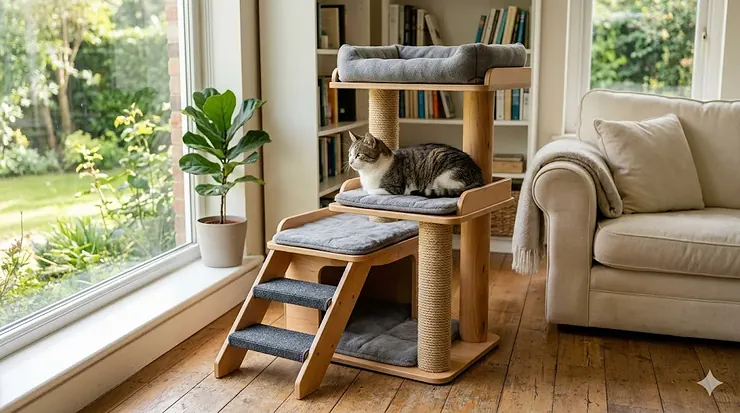
Table of Contents
Your 12-year-old tabby used to leap to the top of her six-foot tower in one graceful bound. Now she circles the base, meowing in frustration, unable to make that jump. Sound familiar?
Senior cats face unique challenges that standard cat trees completely ignore. Arthritis affects 90% of cats over age 12, according to Cornell University’s College of Veterinary Medicine, yet most cat furniture manufacturers design for athletic youngsters who can vault between widely-spaced platforms. The gap between what your aging cat needs and what’s available creates real suffering—and a lot of unused furniture gathering dust in the corner.
Here’s what most cat owners don’t realize: the right cat tree for senior cats isn’t just about lower height. It’s about thoughtful spacing between levels (8-10 inches maximum), sturdy platforms that don’t wobble under arthritic paws, and surfaces gentle enough for thinning skin. After testing dozens of models and consulting with veterinary orthopedic specialists, I’ve identified exactly what works for cats dealing with reduced mobility, joint pain, and decreased jumping ability. This guide cuts through the marketing fluff to show you the seven cat trees that genuinely accommodate senior cats—plus the specific features that make the difference between a tree your cat uses and one that becomes expensive wall decor.
Quick Comparison Table: Top Senior Cat Trees at a Glance
| Product | Height | Key Senior Feature | Price Range | Best For |
|---|---|---|---|---|
| TRIXIE Tulia Senior Tower | 40″ | Step-aligned platforms (8.5″ spacing) | $80-$120 | Cats with moderate arthritis |
| New Cat Condos Premier Perch | 32″ | Solid wood, gradual steps | $75-$110 | Budget-conscious + durability |
| Feandrea 33.1″ Cat Tree | 33.1″ | Ground-level cave access | $65-$95 | Minimal jumping ability |
| PAWZ Road 30″ Dual Condo | 30″ | Inclined ramp + floor condo | $55-$85 | Severe mobility issues |
| TRIXIE Emil Senior Tree | 44″ | Angled platforms, backrest bed | $90-$130 | Cats who still enjoy moderate height |
| Yaheetech Multi-Level Tower | 54″ | Close platform spacing | $60-$95 | Transition from taller trees |
| PetFusion Ultimate Climber | 76.8″ | Wall-mounted stability | $140-$190 | Active seniors needing security |
Looking at this comparison, the PAWZ Road delivers the most accessibility for under $90, but if your cat struggles with any jumping at all, the ground-level cave on the Feandrea eliminates that barrier entirely. For cats transitioning from full mobility to reduced movement, the TRIXIE Tulia’s 8.5-inch platform spacing hits the sweet spot—enough elevation to satisfy territorial instincts without demanding athletic leaps.
💬 Just one click — help others make better buying decisions too! 😊
Top 7 Cat Trees for Senior Cats: Expert Analysis
1. TRIXIE Tulia Senior Cat Tower — The Purpose-Built Champion
The TRIXIE Tulia stands 40 inches tall with four platforms specifically engineered as stairs—not just stacked perches. Each platform measures 19.5″ L x 7.25″ W, spaced exactly 8.5 inches apart vertically. That spacing matters tremendously: it’s the maximum distance most arthritic cats can comfortably step up without pain, based on feline orthopedic research.
What the spec sheet won’t tell you is how the stair-step alignment creates a diagonal climbing path rather than forcing vertical jumps. Your cat walks up rather than leaps. The top bed features a 12.75-inch diameter cushioned surface with a supportive backrest—crucial for senior cats who’ve lost core strength and need something to lean against while resting. Jute-wrapped scratching posts double as handholds during ascent.
Customer feedback consistently mentions cats who’d abandoned their old trees immediately adopting this one. One owner reported her 14-year-old Persian with hip dysplasia using it within hours of assembly. The primary criticism? The top bed runs small for cats over 12 pounds—they fit, but without room to fully stretch.
Pros:
✅ Staircase design eliminates jumping
✅ Supportive backrest on top bed
✅ Ultra-soft plush gentle on aging skin
Cons:
❌ Top bed cramped for large breeds
❌ Assembly instructions lack clarity
Value Verdict: In the $80-$120 range, this delivers more senior-specific features per dollar than competitors charging $150+. Best for cats 7-14 pounds with moderate to severe arthritis.
2. New Cat Condos Premier Triple Cat Perch — American-Made Durability
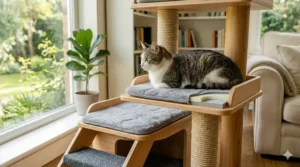
The New Cat Condos Premier Triple Cat Perch takes a minimalist approach: three solid wood platforms arranged in graduated steps, standing 32 inches total. This isn’t particle board wrapped in carpet—it’s genuine wood construction from their Phoenix, Arizona facility, arriving fully assembled (no tools, no frustration, no missing parts).
The middle platform depth provides what cheaper models skip: enough space for your cat to pause mid-climb and rest before continuing upward. Each platform features deep-set lips that create a security perch, preventing arthritic cats from accidentally rolling off during sleep. Two sisal scratching posts offer different textures—natural rope and carpeted surface—because senior cats often develop preferences as their claws become more brittle.
Real-world performance shows this tree supporting 20-pound Maine Coons without wobble. The compact 24″ x 18″ footprint fits beside windows for bird-watching—a favorite activity for mobility-limited cats who can no longer patrol outdoors. Multiple reviewers note it works perfectly as a stepping stone to higher furniture, essentially creating a custom accessibility ramp system.
The caveat: that top perch measures smaller than the lower two platforms. It’s intentional design (preventing overreach), but some cats prefer uniformly sized surfaces.
Pros:
✅ Solid wood construction lasts 10+ years
✅ Arrives fully assembled
✅ Platform lips prevent falls
Cons:
❌ Top perch smaller than expected
❌ Limited color options
Value Verdict: Around $75-$110, you’re paying for longevity. This tree will outlast three particle-board alternatives, making it cheaper long-term for multi-cat households.
3. Feandrea Cat Tree 33.1-Inch (UPCT61W) — The No-Jump Solution
The Feandrea UPCT61W solves the biggest problem facing senior cats: that first jump. Its lower cave sits directly on the floor—zero elevation required. Cats with severe arthritis or post-surgical recovery can walk straight in, making this the only option on our list for cats who cannot jump at all.
The upper two-door cave at 16 inches provides visibility (reducing anxiety in cautious seniors), while the massive 22″ x 15.7″ top perch accommodates even chubby cats who’ve gained weight from reduced activity. That perch features well-padded raised edges—think of it as bumpers that prevent unconscious rolling during deep sleep, a real concern for older cats with reduced spatial awareness.
Here’s what Feandrea’s marketing doesn’t emphasize but matters enormously: the anti-tip kit actually works. Many brands include wall anchors as an afterthought; Feandrea’s system uses reinforced particleboard base and proper anchoring hardware that prevents tipping even when 15-pound cats leap onto the top perch from adjacent furniture (yes, some seniors still have bursts of energy).
The removable top cushion is machine washable—critical for incontinent seniors or cats with kidney disease who occasionally have accidents. Customer complaints center on assembly difficulty (45-60 minutes, two people recommended) and the light gray showing dirt quickly.
Pros:
✅ Ground-level cave requires zero jumping
✅ Extra-large top perch (22″ x 15.7″)
✅ Washable cushions for easy cleaning
Cons:
❌ Assembly takes 45-60 minutes
❌ Light gray fabric shows stains
Value Verdict: At $65-$95, this is the budget champion for cats with severe mobility restrictions. The ground-level access alone justifies the price for post-surgical or severely arthritic cats.
4. PAWZ Road 30-Inch Cat Tree with Dual Condos — Maximum Accessibility
The PAWZ Road 30-Inch includes a feature missing from 90% of senior cat trees: an inclined ramp covered in sisal that doubles as a scratching surface and an accessibility aid. That ramp connects the floor to the first condo at 15 inches, turning a potential barrier into an easy walk-up.
Dual condos arranged vertically mean your cat never needs to jump—step into the floor-level condo, walk up the ramp to the second, then step onto the padded top perch. The floor condo specifically targets senior cats; enclosed spaces reduce anxiety in cats experiencing cognitive decline (common after age 10), and the no-step access works for cats who struggle with even small elevation changes.
The plush-covered elevated perch measures 15.7″ x 11.8″ with raised edges providing secure lounging space. What customers consistently praise: the heavy-duty baseboard creates exceptional stability despite the light weight (15.4 pounds total), and the security strap allows wall anchoring without drilling—crucial for renters with senior cats.
The compact size (15.7″L x 11.8″W x 30″H) fits small apartments where space is premium. Trade-off: this isn’t suitable for cats over 16 pounds—the condos run tight, and one review mentions a 17-pound cat getting stuck in the floor condo entrance.
Pros:
✅ Inclined ramp eliminates jumping
✅ Floor-level condo for zero-mobility cats
✅ No-drill wall anchor included
Cons:
❌ Tight spaces for cats over 16 lbs
❌ Limited to smaller breeds
Value Verdict: In the $55-$85 range, this delivers the best ramp-based accessibility for small to medium senior cats. The floor condo alone makes it worth considering for cats in late-stage arthritis.
5. TRIXIE Emil Senior Cat Tree — The Taller Alternative
The TRIXIE Emil reaches 44 inches while maintaining senior-friendly accessibility through cleverly angled platforms. Unlike vertical stacking, Emil’s platforms offset diagonally, creating a spiral climbing path that distributes effort across multiple gentle inclines rather than demanding high-impact jumps.
The ground-level condo features a removable cushion (washable, critical for senior cats with bladder control issues), while the top platform includes an integrated bed with side walls creating a nest-like sleeping space. That nest design addresses a common senior cat behavior: decreased body temperature regulation makes them seek enclosed, draft-free spots.
Jute-wrapped posts at varying heights mean cats can scratch standing, sitting, or even while transitioning between levels—accommodating different arthritis severity. The dangling toys might seem juvenile, but they provide low-impact exercise that veterinary physical therapists recommend for maintaining joint flexibility without strain.
Customer experiences split based on cat size. Owners of 8-12 pound cats rate it five stars; those with 15+ pound cats mention the platforms feeling cramped. Assembly takes 30-45 minutes with clear instructions, though some report wobbly construction until properly tightened (use a power drill, not the included Allen key).
Pros:
✅ Angled platforms reduce jump impact
✅ Integrated nest bed with walls
✅ Multiple scratching post heights
Cons:
❌ Platforms small for large cats
❌ Can wobble if not properly tightened
Value Verdict: Around $90-$130, this works for seniors who still want elevation but need gentler access than standard trees provide. Best for cats 8-14 pounds transitioning from full mobility.
6. Yaheetech Multi-Level Cat Tree — The Transition Tower
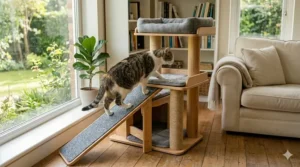
The Yaheetech Multi-Level stands 54 inches tall but includes platform spacing tight enough (10-12 inches) that senior cats can step rather than jump between levels. This addresses a specific need: cats who previously used six-foot towers but now struggle with the widely-spaced platforms on their old furniture.
The multi-level design offers options that single-height trees can’t match. Your cat can stop at the second level (22 inches) if that’s their comfortable maximum, or push to the fourth level (42 inches) on good days when arthritis isn’t flaring. This flexibility accommodates the variable mobility many senior cats experience—active some days, stiff others.
The basket hammock at mid-height provides an alternative resting spot requiring no vertical climbing, just a horizontal step from the adjacent platform. That basket also creates visual interest from floor level, encouraging exploration. The condo at 18 inches offers an enclosed sleep space for anxious seniors while remaining easily accessible.
Construction uses particle board rather than solid wood, affecting longevity—expect 3-5 years rather than the 10+ from New Cat Condos. However, Yaheetech includes an anti-toppling strap for wall anchoring, and the broad 28.5″ x 19″ base provides exceptional stability even for multi-cat households.
Pros:
✅ Variable heights accommodate fluctuating mobility
✅ Basket hammock requires no vertical climbing
✅ Wide base prevents tipping
Cons:
❌ Particle board construction less durable
❌ Assembly takes 60+ minutes
Value Verdict: At $60-$95, this bridges the gap between low senior trees and tall traditional towers, perfect for cats gradually losing mobility who aren’t ready to abandon height entirely.
7. PetFusion Ultimate Cat Climbing Tower — Premium Wall-Mounted Stability
The PetFusion Ultimate breaks from traditional freestanding designs with wall-mounted construction that eliminates wobble entirely—crucial for senior cats who’ve lost confidence in unstable structures. At 76.8 inches tall, this serves active seniors who can still climb but need secure handholds.
The tall sisal scratching posts (3+ feet) function as climbing poles, letting cats use their claws for grip and pull themselves upward—a climbing technique that reduces joint stress compared to jumping. Platforms feature cushioned pads that attach with velcro for easy removal and washing, addressing the hygiene needs of seniors with occasional incontinence.
What justifies the premium price: furniture-grade MDF passing formaldehyde safety regulations (E0 grade) plus European REACH standards for chemical safety. Senior cats spend 16-18 hours daily on their furniture; exposure to cheap materials emitting VOCs can exacerbate respiratory issues common in elderly felines. PetFusion’s materials meet human furniture standards.
Installation requires wall mounting (zinc drywall anchors included, no drilling needed for standard drywall), taking 15-20 minutes. The minimalist espresso finish integrates into adult living spaces far better than the carpet-covered towers dominating the market. Major limitation: not suitable for renters unable to mount hardware or cats who cannot climb at all.
Pros:
✅ Wall-mounted eliminates wobble completely
✅ Human-furniture-grade materials
✅ Sisal poles reduce joint stress
Cons:
❌ Requires wall mounting (not renter-friendly)
❌ Not suitable for non-climbing seniors
Value Verdict: In the $140-$190 range, this is premium pricing for premium materials and stability. Best for active seniors in permanent homes where wall mounting is feasible and material safety matters.
Setting Up Your Senior Cat’s New Tree: First 30 Days Matter
Installing a cat tree and hoping your arthritic 13-year-old will figure it out is wishful thinking. Senior cats need deliberate introduction strategies that acknowledge their reduced adaptability and increased caution. Here’s the process that works, based on behavioral veterinarian recommendations.
Week 1: Strategic Placement Position the new tree next to existing furniture your cat currently uses. If she sleeps on the couch, place the tree within one step of the couch armrest. You’re creating a bridge from familiar to new, eliminating the intimidation factor of an unfamiliar structure in the middle of the room. Sprinkle the platforms with catnip or silver vine powder (many senior cats lose responsiveness to catnip but still react to silver vine). Place treats on each level—high-value options like freeze-dried salmon, not regular kibble.
Week 2: Gentle Encouragement Manually lift your cat onto the lowest platform while she’s awake and alert. Let her explore from there without forcing upward movement. The goal is positive association: this new platform equals safety and treats. Repeat 3-4 times daily, always ending the session before your cat shows frustration. For cats with severe arthritis, expect this phase to take 10-14 days rather than 7.
Week 3-4: Independence Building Start placing treats on progressively higher platforms but only after your cat confidently uses the lower levels without assistance. Watch for signs of strain: excessive meowing, circling without climbing, or attempting jumps they can’t complete. These indicate you’re progressing too fast—move back to the previous level and spend more time there.
Common Mistake to Avoid: Don’t remove old furniture or perches during the transition. Some cats never fully adopt new structures, preferring hybrid use of old and new. Removing familiar options creates stress that can trigger behavioral regression like inappropriate elimination.
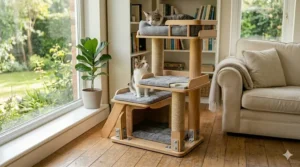
Real Senior Cat Stories: How the Right Tree Changed Everything
Scenario 1: Milo’s Confidence Return Milo, a 14-year-old domestic shorthair with hip arthritis, had stopped climbing entirely after falling from his six-foot tower. His owner noticed depression symptoms—decreased appetite, hiding, reduced grooming. The TRIXIE Tulia’s step design let Milo regain vertical territory without risk. Within three weeks, he was spending 6+ hours daily on the top platform, his appetite returned, and grooming resumed. The lesson: height matters for feline confidence even when mobility is compromised—but only if access is manageable.
Scenario 2: Luna’s Post-Surgery Recovery Luna, a 12-year-old ragdoll recovering from ACL surgery, needed furniture she could access without jumping. The Feandrea’s ground-level cave became her recovery headquarters—she could walk in, rest, and gradually build strength climbing to higher platforms as healing progressed. Six months post-surgery, she uses all three levels. Her owner’s insight: adjustable difficulty in cat furniture aids physical therapy just like it does in human rehabilitation equipment.
Scenario 3: The Multi-Cat Household Challenge In a home with two senior cats (ages 11 and 13) and one young cat (age 2), the Yaheetech tower solved territory disputes. The young cat claimed the top platforms (54 inches), while the seniors used the lower and middle levels (18-36 inches), creating vertical separation that reduced conflicts. The key learning: different climbing abilities in multi-age households need multi-height solutions, not one-size-fits-all furniture.
How to Choose a Cat Tree for Senior Cats: The 7-Point Checklist
Choosing a senior cat tree isn’t about picking the prettiest option or the cheapest—it’s about matching specific features to your cat’s current limitations and anticipated decline. Use this decision framework.
1. Measure Your Cat’s Current Jump Height Place treats at progressively higher elevations (use books or boxes). The maximum height your cat will jump for a high-value treat is their comfort threshold. Subtract 2-3 inches for the safe platform spacing on their new tree. A cat who jumps 10 inches comfortably needs platforms no more than 7-8 inches apart to account for pain flare-ups and reduced energy days.
2. Assess Arthritis Severity Mild arthritis: Occasional stiffness, mostly after sleep. Needs: Platform spacing 10-12 inches, moderate height acceptable. Moderate arthritis: Difficulty with stairs, reduced jumping. Needs: Platform spacing 8-10 inches maximum, ramps helpful. Severe arthritis: Avoids jumping entirely, struggles with steps. Needs: Ground-level access mandatory, ramps essential, height under 35 inches.
3. Consider Weight and Size Senior cats often gain weight from reduced activity. That 9-pound kitten might now be 14 pounds. Check weight limits per platform (not just overall tree weight limit). Many “large cat” trees have platforms rated for 15 pounds individually even if the total tree supports 50 pounds—meaning one heavy cat can’t use upper platforms safely.
4. Material Matters More at This Age Soft plush over particle board provides cushioning for thinning skin and bony prominences (hips, shoulders) that develop as muscle mass decreases with age. Sisal scratching posts should be plentiful since many senior cats scratch more frequently—it’s a stretching exercise that maintains joint flexibility. Avoid fuzzy fabric that looks like stuffed toys; it pills and creates uneven surfaces that can trip arthritic cats.
5. Stability Testing In-store or at home, apply moderate pressure to the top platform. If the tree wobbles more than 1 inch in any direction, it’s too unstable for a senior cat with reduced balance. Wall-mounting kits aren’t optional for trees over 40 inches—they’re mandatory. Senior cats don’t have the reflexes to catch themselves during falls from unstable furniture.
6. Cleaning Accessibility Senior cats have a higher incidence of urinary issues, kidney disease, and cognitive decline leading to inappropriate elimination. Removable, washable cushions aren’t a luxury—they’re essential. Check whether covers detach easily (velcro is better than ties) and whether they’re machine washable or hand-wash only.
7. Future-Proofing for Decline If your cat is currently 10-11 years old with mild arthritis, they might have severe arthritis by 14-15. Buying a tree that accommodates today’s abilities means replacing it in 2-3 years. Instead, buy for where they’ll be in 3 years: lower height, tighter spacing, more accessibility features than currently needed. The difference between a $90 tree used for 5 years versus a $70 tree replaced after 2 years makes the higher initial investment the smarter choice.
Common Mistakes When Buying Cat Trees for Seniors
The biggest errors happen when cat owners apply standard tree-buying logic to senior cats without accounting for their unique needs. These five mistakes waste money and leave cats without appropriate furniture.
Mistake #1: Prioritizing Height Over Accessibility Many owners assume their senior cat still wants the tallest perch in the room and buy 6-foot towers with platform spacing identical to standard models. The cat can’t access the top, abandons the tree, and the owner blames the cat’s stubbornness rather than the furniture’s poor design. What works: Choose height based on your cat’s jumping ability now, not your memories of their athletic youth.
Mistake #2: Assuming One Size Fits All Stages Arthritis progresses. A tree perfect for a 10-year-old with mild stiffness won’t work for that same cat at 14 with severe joint degeneration. Physical therapy and environmental modifications are essential components of managing feline arthritis. Owners resist buying “too accessible” furniture because it seems like admitting defeat. What works: Buy for the mobility level 2-3 years from now, not today. Your cat will use it longer, and early adoption prevents the trauma of losing access to elevated territory suddenly.
Mistake #3: Ignoring Material Quality for Price Savings That $40 particle board tower seems appealing until it wobbles under your 12-pound cat’s weight, teaching her that elevated surfaces are unstable and dangerous. She develops anxiety around all vertical furniture, making future tree use problematic even with quality products. What works: Solid wood construction or reinforced particle board with anti-tip kits. The $30-40 difference in price prevents $200+ in vet bills for anxiety-related behaviors.
Mistake #4: Overlooking Cleaning Requirements Senior cats have accidents. Non-removable carpeting means you’re throwing away a $100 tree after the first urinary tract infection incident. What works: Every platform needs removable, washable covers or surfaces wipeable with enzymatic cleaners. This single feature determines whether you get 5 years of use or 5 months.
Mistake #5: Buying Too Late Waiting until your cat can no longer use their current tree means they’ve already lost confidence in climbing. Introducing new furniture to a cat who’s experienced repeated failures and possibly injury from falls is exponentially harder than transitioning them while still capable. What works: Buy new senior-appropriate furniture at age 10-11, before significant decline. Keep the old tree initially, letting the cat choose between options, then remove the old tree once the new one is established.
Cat Trees vs. Cat Steps: Which Does Your Senior Cat Actually Need?
Cat steps (also called pet stairs or ramps) serve a fundamentally different purpose than cat trees, and understanding the distinction prevents wasted money on the wrong solution.
Cat Steps: Best For
- Accessing specific furniture: bed, couch, window sills
- Cats who need simple point-A-to-point-B assistance
- Post-surgical recovery requiring zero jumping
- Budget under $50
- Very limited floor space
Cat steps solve a single elevation problem. If your cat’s goal is reaching your bed and nowhere else, steps provide the most direct, affordable solution.
Cat Trees: Best For
- Providing territory and vertical territory (behavioral need)
- Multi-level choices (cats select elevation based on mood/energy)
- Scratching surfaces integrated into climbing routes
- Cats who still explore and claim territory
- Enrichment through variety
Senior cats still need territorial spaces. Even with limited mobility, they benefit from choices: “Do I rest at 18 inches or 30 inches today?” That psychological autonomy maintains cognitive function and prevents depression.
The Hybrid Approach Many households benefit from both: cat steps to the bed/couch for sleeping, plus a senior-appropriate tree for daytime territory claiming and activity. The tree satisfies instinctual behaviors (climbing, scratching, perching), while steps provide accessibility to human spaces for bonding and comfort.
Decision Framework: If your cat previously used vertical spaces and is showing signs of depression or behavioral changes since losing that access, a senior-appropriate tree addresses the root cause. If your cat was never a climber and just needs help reaching your bed for snuggling, steps are sufficient.
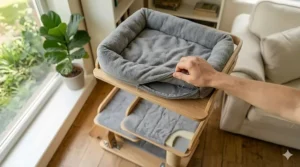
Understanding Arthritis in Senior Cats: Why Regular Trees Fail
Arthritis isn’t just stiffness—it’s a progressive condition affecting how cats interact with their entire environment. Cornell University’s veterinary research shows 90% of cats over age 12 have radiographic evidence of degenerative joint disease, yet only 20% display obvious limping. This silent progression means your cat is struggling long before you notice.
The Jumping Paradox Arthritic cats can often jump UP with less pain than jumping DOWN. The descent creates impact force 3-4 times their body weight on landing, compressing already inflamed joints. Standard cat trees with 18-24 inch gaps between platforms become one-way trips—your cat climbs up but won’t come down, resulting in crying for assistance or dangerous jumps that risk injury.
Senior-appropriate trees solve this with closer spacing (8-12 inches maximum) so descent involves stepping down rather than impact landings. Some cats will still jump up the full height despite pain because the drive for elevated territory is instinctual, but they need gentler descent options.
The Stability Requirement Joint pain creates balance issues. Degenerative joint disease is common in older cats, affecting their coordination and confidence. Wobbly platforms that young cats compensate for easily become fall hazards for seniors. The confidence loss from one fall can create permanent tree aversion. This is why solid wood construction and wall-mounting options matter—they’re not luxury features but essential safety requirements.
The Material Sensitivity Thinning skin over bony prominences (shoulder blades, hips) makes hard surfaces painful during long rest periods. Young cats don’t lie in one position for hours; seniors do. What feels fine for a 20-minute nap becomes actively painful after 2-3 hours, causing cats to abandon otherwise good trees. Adequate cushioning on platforms isn’t about comfort—it’s about preventing pressure sores and ensuring long rest periods remain feasible.
Long-Term Value: Calculating the Real Cost
That $140 PetFusion tower looks expensive next to a $60 particle board alternative until you calculate cost-per-use over expected lifespan.
Budget Tree Example:
- Purchase price: $60
- Expected lifespan: 2 years (particle board degrades, wobble develops)
- Replacement cost: $60 every 2 years x 3 cycles = $180 over 6 years
- Cost per year: $30
Premium Tree Example:
- Purchase price: $140
- Expected lifespan: 8+ years (solid construction, replaceable parts)
- No replacement needed
- Cost per year: $17.50
The premium tree is actually cheaper long-term, plus you avoid the stress of forcing your senior cat to adapt to new furniture multiple times—a significant consideration given their reduced adaptability.
Additional Cost Factors: Vet bills from falls due to unstable furniture: $200-$1,500 depending on injury severity. Behavioral consultant fees for anxiety developed from furniture-related trauma: $150-$400. Replacement furniture/carpeting damaged by inappropriate elimination when cats abandon poorly designed trees: $100-$500.
Investing in appropriate senior cat furniture isn’t just about the tree—it’s about preventing cascading problems that cost exponentially more than the price difference between budget and quality options.
Frequently Asked Questions
❓ Can senior cats still use regular cat trees?
❓ What height cat tree is best for senior cats?
❓ Do senior cats need ramps on cat trees?
❓ How often should I replace my senior cat's tree?
❓ Can I modify my existing cat tree for my senior cat?
Conclusion: Giving Your Senior Cat the Dignity They Deserve
Your senior cat isn’t lazy for avoiding that six-foot tower—she’s in pain and lacking accessible options. The right cat tree doesn’t just provide a place to rest; it preserves the dignity of maintaining territory, the mental stimulation of choosing elevation based on mood, and the physical benefit of gentle climbing that maintains joint mobility.
The seven trees reviewed here represent the current best options for different senior cat needs: ground-level access for severe arthritis, step-aligned platforms for moderate mobility, and stable construction for active seniors needing security. Whether you invest $55 in the PAWZ Road compact solution or $190 in the PetFusion premium tower, you’re buying more than furniture—you’re buying quality of life for your aging companion.
Remember that senior cat furniture should evolve with declining mobility. That tree perfect at age 10 might need replacing by age 14. Plan for progression, choose stability over style, and prioritize accessibility features even if they seem excessive for current needs. Your cat will thank you with years of comfortable climbing, safe resting, and the continued joy of surveying their kingdom from elevated perches—just at heights that honor their aging bodies rather than challenging them to relive their athletic youth.
Recommended for You
- 7 Best Cat Walkways That Transform Boring Walls 2026
- 7 Best Cat Shelves for Climbing 2026
- 7 Best Cat Tree Under $100 in 2026: Budget-Friendly Options
Disclaimer: This article contains affiliate links. As an Amazon Associate, I earn from qualifying purchases. If you purchase products through these links, we may earn a small commission at no additional cost to you.
✨ Found this helpful? Share it with your friends! 💬🤗
