Table of Contents
Dry shampoo powder for greasy cat fur is a no-water grooming product, usually starch- or clay-based, that soaks up surface oil and loose debris from a dry coat so you can brush it out. It’s a between-baths touch-up, not a medical treatment. It also comes with caveats worth knowing before you shake anything near a cat.
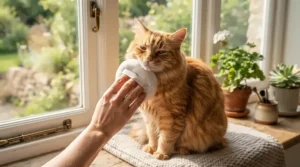
Here’s the situation most owners find themselves in. You pet your cat and your hand comes away feeling like it lost a fight with a bag of potato chips. The oil comes from sebaceous glands, and when they overproduce, the result is sebum buildup that mats fur, yellows light coats and starts to smell. A greasy patch at the base of the tail often points to tail gland hyperplasia, better known as stud tail, which is an oil-gland problem rather than a grooming failure.
A word about how this guide was built. I haven’t tested these products on a cat, and I won’t pretend otherwise. Everything below comes from ingredient lists, manufacturer specs, veterinary resources and aggregated retailer and editorial review sentiment. Where reviews were thin or unverifiable, I say so.
Cat-specific powder options are limited, and the veterinary world is cautious about powders near cats. So this lineup has three true powders and four powder-free alternatives, for the cats and situations where powder is the wrong tool. Along the way you’ll get a clear look at powder inhalation safety, a sensible response to stud tail, and a way to pick the right product for your cat’s coat and temperament.
Quick Comparison: Dry Shampoo Powder for Greasy Cat Fur at a Glance
| Product | Format | Best For | Approx. Price Range* | Standout |
|---|---|---|---|---|
| Jatisse Cat Dry Shampoo Powder | Powder | Budget grease and odor control | Budget tier, under roughly $20 | Labeled talc-free |
| Bio-Groom Pro-White Grooming Powder | Powder | Soiled, light-colored coats | Roughly $12–$25 | Very fine, bright powder |
| Dr Zoo Talc Free Dry Shampoo | Powder | Cats that tolerate a gentle starch-and-clay blend | Mid-teens to low $20s (imports) | Multi-absorbent formula |
| Douxo S3 SEB Mousse | Leave-on mousse | Seborrhea-type oily skin, stud tail support | Roughly mid-$20s | Developed with veterinary dermatologists |
| Hepper Waterless No Rinse Pet Shampoo | Foam | Mild oiliness, sensitive owners | Roughly $10–$18 | Four-ingredient formula |
| Vet’s Best Waterless Cat Bath | Foam | Everyday freshening, senior cats | Roughly $8–$15 | Aloe and oatmeal blend |
| Burt’s Bees Waterless Shampoo for Cats | Spray | Budget dander and dry-skin touch-ups | Roughly $8–$15 | Gentle natural-leaning formula |
*Ranges are approximate at the time of research (October 2026). Prices vary by seller and size, so check the current price on the listing.
Looking at the table, the three powders are the strongest on raw oil absorption, but they’re also the ones that demand the most careful application. Douxo S3 SEB Mousse costs the most per ounce, yet it’s the only product here built around the underlying oily-skin problem rather than just the symptom. If you only want an affordable between-baths freshener, Vet’s Best Waterless Cat Bath and Burt’s Bees Waterless Shampoo for Cats keep the price low and the dust cloud at zero.
💬 Just one click — help others make better buying decisions too!😊
Top 7 Picks for Dry Shampoo Powder for Greasy Cat Fur: Expert Analysis
1. Jatisse Cat Dry Shampoo Powder — budget powder aimed squarely at grease
The pitch here is simple: absorb oil, kill odor, keep the price friendly. Jatisse comes in a container of roughly 5.3 ounces, according to one editorial roundup, and the label advertises talc-free and paraben-free. That matters because talc is the ingredient vets most want kept away from cats.
In practice, a powder like this works by giving surface oil something to cling to. The oil-laden particles then come out with a brush. That roundup describes it as better at heavy grease and odor than foams, but warns that you must brush thoroughly or a white residue lingers on dark coats. Picture a black cat wearing a dusting of flour. Not a good look.
Who is it for? A short-haired cat with moderately greasy fur, a calm temperament and no history of breathing trouble. On review sentiment, I couldn’t verify a deep pool of independent buyer feedback, so treat it as promising but not proven. Check the ingredient list on the current listing before buying.
Pros:
- ✅ Label advertises talc-free and paraben-free
- ✅ Targets grease and odor directly
- ✅ Budget-tier entry point for powder
Cons:
- ❌ White residue shows on dark coats
- ❌ Thin independent review trail
Price range: budget tier, under roughly $20. Verdict: a cost-effective test run if you’ve already cleared powder with your vet.
2. Bio-Groom Pro-White Smooth Grooming Powder for Cats — fine, bright powder for soiled coats
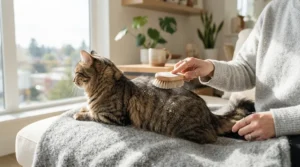
This one comes from the grooming-supply world rather than the pet-boutique aisle. The 6-ounce (170 g) powder is marketed as extra fine, extra soft, bright and highly absorbent. It’s pitched at cleaning, deodorizing and soaking up moisture and oil, and especially at urine-soiled coats. The maker also says it has no abrasives or harmful additives, which is a manufacturer claim rather than something I could independently verify.
Here’s the double-edged part. Fineness helps a powder spread and absorb, but fine particles also hang in the air longer. That’s the whole reason powder inhalation safety deserves its own section later. A single retailer review I found called it “too dusty.” One review is hardly a verdict, but it matches what physics would predict.
Based on the spec sheet, it suits light-coated cats with messy hindquarters or a visibly oily rump, applied outdoors or in a well-ventilated room. Dark coats will need extra brushing.
Pros:
- ✅ Designed for oily and soiled coats
- ✅ Brushes out easily, per the maker
- ✅ Widely stocked in grooming supply channels
Cons:
- ❌ Fine particles raise the dust factor
- ❌ Bright white pigment shows on dark fur
Price range: roughly $12–$25, depending on seller. Verdict: good value if you handle it with care, and not my first choice for a nervous or asthmatic cat.
3. Dr Zoo Talc Free Dry Shampoo — starch-and-clay blend with skin-barrier extras
Dr Zoo, an Australian brand, lists its formula openly: tapioca starch, sodium bicarbonate, corn starch, bentonite clay, rice bran powder, panthenol, piroctone olamine, allantoin and a phthalate-free fragrance. Translated from label-speak, you get three starches to soak up oil, clay to bind grime, baking soda for odor, and a few conditioning and anti-flake ingredients.
The maker suggests leaving the powder on for 5 to 10 minutes and then brushing it out, which is a sensible window. For a cat, skip the blow-dry the dog-oriented directions mention and brush instead. The brand also says the powder can clump in heat and humidity, which is refreshingly honest. Baking soda and fragrance are one more thing a licking cat might swallow, so thorough brushing matters.
Availability for US shoppers can depend on import sellers, so confirm the listing before you commit. I couldn’t verify an aggregated buyer-review base for the US market.
Pros:
- ✅ Talc-free, with a transparent ingredient list
- ✅ Multiple absorbents for oily coats
- ✅ Allantoin and panthenol support skin comfort
Cons:
- ❌ Can clump in humid conditions
- ❌ US availability may depend on importers
Price range: mid-teens to low $20s with import costs. Verdict: the most thoughtfully formulated powder of the three, provided you can find it stocked.
4. Douxo S3 SEB Mousse — the vet-channel option for truly oily skin
If the cause of the grease is seborrhea rather than a one-off mess, this is the odd one out in the best way. The 5.1 fluid ounce mousse is made for oily, flaky skin in dogs and cats. It uses a pair of skin-regulating ingredients, Ophytrium and Seboliance, and the maker says it was developed with veterinary dermatologists. The brand also says its shampoo-and-mousse protocol reduced seborrhea symptoms by 91%, though the trials it cites were largely in dogs, so I’d hold that number loosely for cats.
Practically, it’s a leave-on foam applied to a dry, brushed coat. One retailer’s usage notes suggest 1–2 pumps massaged in, avoiding eyes and mouth, typically a few times a week as directed by your vet. No powder cloud means nothing airborne to inhale. Retailer Q&A says it’s fine for cats with mild dander, and one buyer mentioned their cats bolted after sniffing it, so scent tolerance varies.
Pros:
- ✅ Built around oily-skin management
- ✅ No airborne powder to inhale
- ✅ Leave-on formula, no rinsing required
Cons:
- ❌ Highest cost per ounce in this lineup
- ❌ Some cats dislike the foam or scent
Price range: roughly mid-$20s. Verdict: worth the premium for chronic greasiness or suspected stud tail, ideally after a vet check.
5. Hepper Waterless No Rinse Pet Shampoo — four ingredients, zero drama
The ingredient list is almost comically short: water, polysorbate 20, glycerin and fragrance. The maker says it is pH balanced and free of soap, sulfates, dyes, phthalates, DEA and gluten, and it’s described as US-made. You massage the foam into the coat, or onto your hands first, and brush it through.
What the spec sheet won’t tell you: a minimalist formula usually means fewer irritation triggers, but also lighter degreasing. This is a freshening product, not a sebum-control product. It’s a good fit for mild oiliness and for cats with sensitive skin. A cat with a thick greasy stripe along the spine will likely want something stronger.
Several roundups rank it best overall, but one of them was published on the brand’s own blog, which deserves a grain of salt. I couldn’t verify an aggregated review count, so I won’t quote one.
Pros:
- ✅ Extremely short, simple ingredient list
- ✅ No powder dust to inhale
- ✅ pH balanced, soap- and sulfate-free
Cons:
- ❌ Gentle formula, limited heavy-grease power
- ❌ Contains added fragrance
Price range: roughly $10–$18. Verdict: the safe, easy default for mild oil and sensitive households.
6. Vet’s Best Waterless Cat Bath — aloe-and-oatmeal foam for everyday freshening
This 4-ounce foam combines aloe vera, neem oil, vitamin E and oatmeal. The maker says it’s formulated by veterinarians, safe for cats 12 weeks and older and compatible with flea treatments.
Reviewer themes are consistent. Buyers often mention a pleasant scent, a softer and visibly less greasy coat, and ease of use. One reviewer whose cat adores coconut oil says they use it specifically to cut excess oil. Common complaints include cats trying to lick it off after application, a pump that stopped working for one buyer, and a mixed reaction to the smell.
Because the label lists neem oil and cats lick residue, a quick check with your vet makes sense for heavy lickers. Overall this is a friendly option for seniors who can’t reach their own backs anymore.
Pros:
- ✅ Soothing aloe, vitamin E and oatmeal blend
- ✅ Reviewers report a less greasy, softer coat
- ✅ Maker says flea-treatment compatible
Cons:
- ❌ Cats may lick it off while it dries
- ❌ Pump reliability complaints appear in reviews
Price range: roughly $8–$15. Verdict: an easy, affordable foam for light touch-ups between baths.
7. Burt’s Bees Waterless Shampoo for Cats — gentle budget spray for dry-skin and dander days
A spray that pairs honey, apple extract and citric acid, with the maker claiming a 99.8% natural formula free of sulfates and artificial colorants. It carries a calming fragrance aimed at cats and tells you to avoid the eyes.
Editorial roundups name it the best budget waterless cat shampoo, and some owners praise it for easing dander and dry skin. Here’s the honest read: that profile suggests it leans toward dry-skin support rather than hardcore grease-busting. For an oily coat, it’s a light-duty tool.
Sprays can startle cats, since some dislike the hiss and mist, so introduce it gradually and keep it away from the face. The ingredients are gentle, but gentle isn’t the same as strong enough for a stubborn greasy patch.
Pros:
- ✅ Short, natural-leaning ingredient story
- ✅ Budget-friendly for routine upkeep
- ✅ No powder dust involved
Cons:
- ❌ Not specifically a grease-control formula
- ❌ Spray format may startle sensitive cats
Price range: roughly $8–$15. Verdict: a thrifty maintenance pick, and not the heavy hitter for oily fur.
How to Apply Dry Shampoo Powder for Greasy Cat Fur Safely
Technique matters more than brand here, and a few small habits cut most of the risk.
- Choose the room. A bathroom with the fan on or a well-ventilated space works. Skip rooms with the AC blasting the dust around.
- Start dry. The fur must be completely dry. A damp coat clumps the powder into paste.
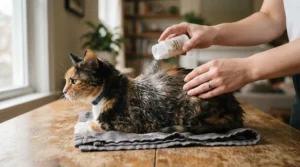
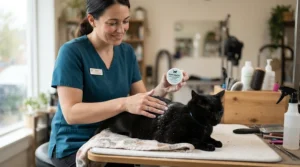
- Powder your hands, not the cat. Sprinkle a small amount into your palm, then rub it into the coat close to the skin. Never puff or shake it overhead.
- Work with the grain, then against it. Massage gently from the greasy zone outward. Keep it away from the face, nose, eyes, ears and mouth.
- Wait briefly. Follow the label, usually 5–10 minutes. Don’t leave it on overnight, because your cat will groom it into their stomach.
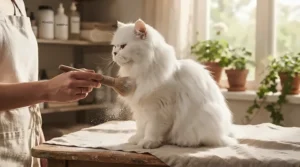
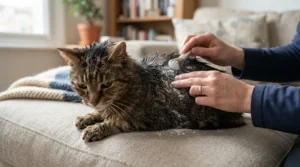
- Brush thoroughly. Use a fine comb or brush until no visible powder remains, then wipe with a barely damp cloth.
- Reward and observe. Offer a treat, and watch breathing and skin afterwards.
On frequency, start with one session and see how the skin responds. If you need powder every few days just to keep the coat presentable, the greasiness is a symptom worth asking your vet about, not something to keep dusting over.
Real-World Scenarios: Matching Cat Dry Shampoo Powder to Your Cat
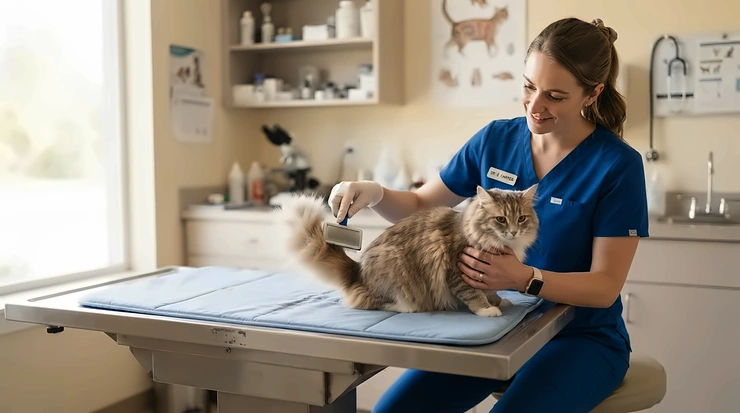
Scenario 1: The senior tuxedo with a greasy lower back. Say a 14-year-old cat can’t twist around to groom, lives in a small apartment and has no known breathing issues. A starch-based option like Dr Zoo Talc Free Dry Shampoo can work if applied in a ventilated bathroom with thorough brushing, but the visible residue on black fur is a real drawback. Vet’s Best Waterless Cat Bath avoids the residue problem entirely and makes more sense on a dark coat.
Scenario 2: The intact or neutered male with a greasy tail base. Picture a cat with a shiny, waxy patch above the tail and a few blackheads. This looks like classic stud tail territory, so the first call is to the vet. For ongoing management, Douxo S3 SEB Mousse fits the oily-skin profile, while powder is only a stopgap for the rest of the coat.
Scenario 3: The anxious cat with a wheeze history. For a cat that has coughed or wheezed before, I’d skip all three powders. Hepper Waterless No Rinse Pet Shampoo or Burt’s Bees Waterless Shampoo for Cats keep the air clear, and budget stays low at roughly $10–$18 each.
Problem → Solution Guide: Fixing Common Dry Shampoo Powder Headaches
Problem: white residue won’t disappear on a dark coat. Brush longer with a fine comb, then wipe with a barely damp cloth. If it keeps happening, switch to foam like Vet’s Best Waterless Cat Bath.
Problem: your cat licks it off. Apply sparingly, brush it out fully and distract with a treat until the coat is clean. For heavy lickers, powder may simply be the wrong format.
Problem: the powder clumps. Humidity is the usual culprit, and Dr Zoo Talc Free Dry Shampoo‘s maker openly warns about it. Store it sealed, use a dry room and don’t apply to a damp coat.
Problem: the coat is greasy again in two days. That points to an underlying cause such as stud tail, seborrhea or a diet or health issue. Douxo S3 SEB Mousse manages symptoms, and your vet can find the cause.
✨ Don’t Miss These Carefully Selected Options!
🔍 Take your cat’s coat care to the next level with products matched to real needs. Click any highlighted item to check current pricing and availability. A cleaner, softer, less greasy coat is closer than you think! 🐾
How to Choose Dry Shampoo Powder for Greasy Cat Fur: 7 Steps
- Rule out a medical cause first. Persistent grease with hair loss, blackheads or odor deserves a vet visit before a powder.
- Match format to temperament. Anxious or wheezy cats usually do better with foam or mousse than powder.
- Read the ingredient list. Avoid talc, and prefer clear starch- or clay-based formulas.
- Consider particle fineness. Ultra-fine powder spreads well but floats longer in the air.
- Confirm it’s labeled for cats. Check age limits, since some products specify 12 weeks and older.
- Mind the fragrance. Strong scents can bother cats and sensitive owners.
- Plan the brush-out. Any powder is only as safe as your ability to remove it afterward.
Powder Inhalation Safety: What Every Cat Owner Needs to Know
This is the part most product pages skip. Cats groom constantly, so anything on the fur ends up in the mouth, and a cloud of fine powder is easy to breathe in. Vet-reviewed resources are consistent on this. Catster’s veterinary guide on baby powder says cornstarch-based powders are safer than talc but still not recommended for cats, partly because of grooming and ingestion.
Then there’s airway sensitivity. The Merck Veterinary Manual’s feline asthma entry lists dust, perfumes and similar airborne irritants among the triggers to avoid for asthmatic cats. A powder product combines dust and often fragrance.
What does that mean in practice? If your cat has ever coughed, wheezed or been diagnosed with asthma, powders are the wrong tool. For healthy cats, the risk is lower but real, and it’s manageable. Apply by hand rather than shaking, work in a ventilated room, keep the face off limits, brush out thoroughly and never leave powder on overnight. Also skip human dry shampoo, which often carries propellants and fragrance, and homemade starch dustings.
When in doubt, a foam or mousse removes the inhalation question entirely, and that’s exactly why four of the seven picks above aren’t powders.
Cat Dry Shampoo Powder vs. Foam, Mousse and Spray
| Format | How It Works | Inhalation Exposure | Mess Level | Best For |
|---|---|---|---|---|
| Powder | Absorbs surface oil, brushed out | Highest | Medium to high | Jatisse, Dr Zoo, Bio-Groom Pro-White on healthy, calm cats |
| Foam | Lifts oil and dirt, massaged in | Low | Low | Hepper, Vet’s Best for mild oiliness |
| Mousse (medicated type) | Regulates sebum, leave-on | Low | Low | Douxo S3 SEB Mousse for chronic seborrhea-type grease |
| Spray | Mist applied, brushed through | Low to medium | Low to medium | Burt’s Bees for dry-skin and dander days |
Powder wins on pure grease absorption but loses on safety margin. Foam and mousse trade a little absorbing power for a much cleaner air profile, which matters more in a home with small airways. For most households, I’d treat powder as the specialist tool rather than the default.
Features That Actually Matter for a Dry Shampoo for Oily Cat Coat (And Those That Don’t)
What matters:
- Absorbent type. Starches, clay and rice bran are the working ingredients of any grease-absorbing powder for cat fur.
- Talc-free labeling. A hard filter.
- Particle size. Fine powder floats more, so choose with your cat’s airway in mind.
- Brushability. A formula that combs out cleanly beats one that clings.
What matters less:
- “Natural” branding. It’s marketing shorthand with no fixed meaning.
- Heavy fragrance. It adds nothing for the cat and can bother airways.
- Extra vitamins. Panthenol and similar additives are nice, but a rinse-free product barely contacts skin long enough to matter.
The sneaky one is the dispenser. A shaker top invites overhead puffing, while a tub you scoop from encourages hand application. That small design choice quietly changes your exposure.
Sebum Buildup and Stud Tail: When Powder Isn’t Enough
Stud tail is an overactive oil-gland issue near the base of the tail, and it can affect neutered and female cats too. Signs include a greasy spot, yellowing of pale fur, scaly skin and blackheads, and hair loss. Because it can progress to infection, it isn’t something to bury under powder.
According to Vetstreet’s veterinary Q&A on oily tails, vets typically recommend frequent washing of the area with medicated shampoo, sometimes clipping the hair, and antibiotics if infection is present. Neutering helps in many male cases, though it doesn’t cure every cat.
Where does a product from this list fit? Mild, uninfected sebum buildup may respond to a gentle freshener like Hepper Waterless No Rinse Pet Shampoo between vet-directed care. A sebum-focused option like Douxo S3 SEB Mousse is closer to what vets reach for with oily skin, though you should confirm it fits your cat’s diagnosis. Powder around an inflamed or infected tail base is likely to irritate rather than help.
Long-Term Cost and Maintenance: What Dry Shampoo Really Costs
| Product | Format | Approx. Price Range | Value Verdict |
|---|---|---|---|
| Jatisse Cat Dry Shampoo Powder | Powder | Under roughly $20 | Low cost per session, if powder suits your cat |
| Bio-Groom Pro-White Grooming Powder | Powder | Roughly $12–$25 | Large 6 oz container stretches far |
| Dr Zoo Talc Free Dry Shampoo | Powder | Mid-teens to low $20s | Good formula, import costs add up |
| Douxo S3 SEB Mousse | Mousse | Roughly mid-$20s | Higher upfront, targets the cause |
| Hepper Waterless No Rinse Pet Shampoo | Foam | Roughly $10–$18 | Solid everyday value |
| Vet’s Best Waterless Cat Bath | Foam | Roughly $8–$15 | Strong budget foam |
| Burt’s Bees Waterless Shampoo for Cats | Spray | Roughly $8–$15 | Lowest-risk maintenance pick |
Price per bottle isn’t the whole story, because a cheap product you need every few days costs more than a pricier one that fixes the problem. Douxo S3 SEB Mousse looks expensive until you factor in that it aims at the underlying oiliness. The budget foams and spray keep upkeep cheap, while the powders are cost-effective only if your cat tolerates them without fuss.
Maintenance is simple. Store powders sealed and dry, replace pumps that clog and keep a dedicated fine brush for brush-outs. Prices vary and may change, so check the current price before you decide.
Common Mistakes When Buying Dry Shampoo Powder for Greasy Cat Fur
- Reaching for baby powder or cornstarch. Vet-reviewed sources advise against both for cats.
- Ignoring the cat’s health history. Any cough or wheeze should move powder off the list.
- Skipping the brush-out. Leftover powder gets swallowed.
- Shaking powder over the cat. It creates exactly the cloud you want to avoid.
- Treating chronic grease as a grooming problem. Persistent oiliness is often a skin or hormonal signal.
- Overusing it. Frequent dusting can dry the skin and hides the real issue.
- Trusting “natural” labels. Check the actual ingredients, scent included.
The most expensive mistake isn’t any of these in isolation. It’s picking a product by marketing copy instead of matching it to your cat’s coat color, temperament and airway.
Frequently Asked Questions
❓ Is cat dry shampoo powder safe to use?
❓ How often can I use dry shampoo for an oily cat coat?
❓ Can dry shampoo powder help with stud tail?
❓ Can I use baby powder or cornstarch on a greasy cat?
❓ Foam or powder: which is better for sebum buildup?
Conclusion
Greasy fur is annoying, but it’s also information. A one-off oily patch after a lazy week is a grooming problem. A coat that’s greasy again within days, especially around the tail base, is a skin question that powder can’t answer.
If powder fits your cat, start with a talc-free option such as Jatisse Cat Dry Shampoo Powder or Dr Zoo Talc Free Dry Shampoo, apply it by hand and brush it out thoroughly. Bio-Groom Pro-White Grooming Powder suits light coats with soiled areas but demands extra care because of its fineness. If you’d rather keep the air clear, Hepper Waterless No Rinse Pet Shampoo, Vet’s Best Waterless Cat Bath and Burt’s Bees Waterless Shampoo for Cats are gentler, cheaper routes. For stubborn oiliness or suspected stud tail, Douxo S3 SEB Mousse is the most targeted choice, and a vet visit comes first.
The smartest takeaway from all the research is this: match the format to your cat, not the other way around. Prices and availability change, so check current listings before you buy.
✨ Ready to give your cat a cleaner, softer coat?
🐱 Click any highlighted product above to check current pricing and availability, and pick the format that suits your cat’s coat, temperament and breathing. Your furniture, and your hands, will thank you!
Recommended for You
- Deodorizing Cat Shampoo For Smelly Cats: 7 Best Picks In 2026
- No-Rinse Foam Shampoo For Senior Cats: 7 Best Gentle Picks 2026
- Cat Conditioner For Long-Haired Cats Prone To Matting: 7 Best (2026)
Disclaimer: This article contains affiliate links. As an Amazon Associate, I earn from qualifying purchases. If you purchase products through these links, we may earn a small commission at no additional cost to you.
✨ Found this helpful? Share it with your friends! 💬🤗
