
Table of Contents
Somewhere between “my cat hates the car” and “I really want to take her camping,” there’s a piece of gear that quietly changes everything: the cat backpack carrier. It’s not a gimmick. A well-built cat backpack carrier turns a stressful, white-knuckle trip to the vet into something closer to a stroll, and it turns “I wish my cat could come on this hike” into “grab the leash, she’s already at the door.”

So what is a cat backpack carrier, exactly? It’s a wearable, structured pet enclosure — usually with mesh panels, a bubble or window viewport, and padded straps — that lets you transport your cat on your back instead of in your arms or dangling from a soft-sided bag. Some fold flat for storage. Others expand mid-trip so your cat can stretch out during a break.
I’ve spent the last few weeks digging through spec sheets, aggregated owner feedback, and side-by-side comparisons of the models currently earning the most attention from cat parents in 2026. A few things became obvious fast: ventilation quality varies wildly between “advertised” and “actual,” weight capacity numbers are often optimistic, and the difference between a carrier that gets used every week and one that gets shoved in a closet usually comes down to three or four details nobody puts on the box. That’s what this guide digs into.
Before you buy anything, it’s worth knowing that veterinary guidance on safely transporting pets treats a secured, well-ventilated enclosure as the baseline — a standard every product on this list needs to clear, bubble window or not. We’ll flag where each one meets that bar and where it falls short.
Quick Comparison Table
| Product | Weight Capacity | Bubble Window | Expandable | Best For |
|---|---|---|---|---|
| Sherpa Airline Approved Bubble Backpack | Up to 20 lbs | Yes (swappable) | No | Air travel & vet visits |
| Travel Cat Navigator | Up to 25 lbs | No (mesh windows) | No | Feature-heavy daily use |
| LOLLIMEOW Large Pet Carrier Backpack | Up to 26 lbs | Yes (removable) | No | Budget-conscious owners with bigger cats |
| Texsens Pet Backpack Carrier | Up to 15-18 lbs | Yes | No | Small cats & short outings |
| Pecute Expandable Cat Backpack Carrier | Up to 24 lbs | No (mesh) | Yes | Cats who need room to move |
| Petkit Cat Backpack Carrier | Up to 15 lbs | Yes (hard shell) | No | Owners who want structure & durability |
| Fat Cat Backpack Carrier | Up to 15 lbs | No (mesh top) | No | Everyday walks & casual outings |
A quick scan tells you most of what you need before diving into the details: bubble-window models tend to trade a little breathing room for visibility and structure, while expandable and mesh-forward designs lean into airflow and flexibility. If your cat is a bigger, more laid-back type, the higher-capacity options like the LOLLIMEOW Large Pet Carrier Backpack or the Travel Cat Navigator deserve a closer look before anything with a hard bubble shell.
💬 Just one click — help others make better buying decisions too!😊
Top 7 Cat Backpack Carriers: Expert Analysis
1. Sherpa Airline Approved Bubble Backpack — best for flights and vet trips
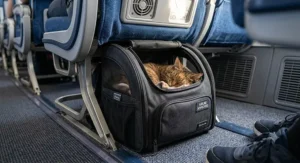
The Sherpa Airline Approved Bubble Backpack built its reputation on being genuinely airline-compliant, not just “airline-style.” That distinction matters more than most product pages let on.
Its plexiglass bubble expands the usable interior noticeably, and the nine air holes plus faux-leather shell keep the whole thing sturdy enough to hold its shape when set down at a gate or exam room. Reviewers note the shoulder straps stay comfortable even loaded near the 20-pound ceiling, though the bubble does show scuff marks over time and needs a damp-cloth wipe to stay clear. Based on the spec comparison, this is the pick for owners whose priority is documentation-friendly, in-cabin travel rather than rugged outdoor use — the faux-leather build isn’t meant for mud and branches.
Aggregated review sentiment consistently praises the swappable bubble-to-mesh option, letting nervous cats hide from stimulation while calmer cats enjoy the view. Reported gripes center on the price relative to competitors and a “new bag” smell that fades within a week or two.
Pros:
- ✅ Genuinely airline-compliant dimensions and structure
- ✅ Swappable bubble or mesh panel for different cat temperaments
- ✅ Machine-washable faux-leather material
Cons:
- ❌ Premium price compared to similar-capacity models
- ❌ Not built for rough outdoor terrain
Expect to pay in the mid-$100s to upper-$100s range depending on the retailer and color; given the airline compliance and build quality, it’s a fair trade for anyone flying regularly with their cat.
2. Travel Cat Navigator — most feature-rich for daily carrying
If you’ve ever dug through a diaper bag looking for wipes while also trying to keep a cat calm, the Travel Cat Navigator was clearly designed with that exact chaos in mind.
At a 25-pound capacity, it’s rated for larger cats than most bubble-style competitors, and the two mesh water bottle pockets plus a large internal pocket mean you’re not sacrificing storage for pet space. Two zippered mesh side windows and a top panel let your cat pop their head out for fresh air on breaks — something the sealed-bubble designs can’t offer as easily. What most buyers overlook here is the buckle system on the zipper pulls, which locks the zippers together so a cat can’t learn to work them open from the inside; that’s a real problem some owners report with simpler zip-only designs.
Reviewers who tested this model against several competitors describe it as one of the most thoughtfully engineered options for cats that dislike being fully enclosed, though several mention it runs bulkier and tighter in the main compartment than its 25-pound rating suggests. Cats that prefer a snug, den-like space may love it; cats that like to stretch out may not.
Pros:
- ✅ Highest weight capacity among daily-use models on this list
- ✅ Anti-escape buckled zipper pulls for determined cats
- ✅ Multiple storage pockets for essentials
Cons:
- ❌ Main compartment feels tight relative to its rated capacity
- ❌ Bulkier profile than sleeker bubble-style carriers
Priced in the $150-$200 range, it’s positioned as a premium daily-carry option rather than an occasional-trip bag — the price makes more sense if you’re using it weekly.
3. LOLLIMEOW Large Pet Carrier Backpack — best value for bigger cats
Budget-friendly and generously sized, the LOLLIMEOW Large Pet Carrier Backpack is the rare carrier that doesn’t punish you for owning a chunkier cat.
Rated for cats up to 26 pounds despite weighing only about 3 pounds itself, the build prioritizes interior space over bells and whistles. A zippered mesh top lets your cat’s head poke out, the bubble window is fully removable if your cat prefers it gone entirely, and side mesh windows add cross-ventilation. Here’s what to weigh: the trade-off for that generous capacity and low price is a bubble window that reviewers say scratches more easily than pricier acrylic alternatives, so it’s better suited to owners who don’t mind a little wear showing.
Aggregated review sentiment is largely positive on comfort and space, with the built-in leash tether frequently singled out as a nice safety touch that not every competitor includes standard. The main recurring complaint is the scratch-prone bubble surface after repeated use.
Pros:
- ✅ Highest weight capacity for the price point
- ✅ Removable bubble for cats who prefer it gone
- ✅ Built-in leash tether included standard
Cons:
- ❌ Bubble window scratches more easily than premium acrylic models
- ❌ Fewer organizational pockets than feature-heavy competitors
At roughly $40-$60, it’s one of the most accessible entry points into this category without giving up real capacity.
4. Texsens Pet Backpack Carrier — best compact option for small cats
The Texsens Pet Backpack Carrier is built around a simple idea: small cats don’t need a big bag, they need a well-ventilated, secure one.
Measuring roughly 12.6 x 11.4 x 16.5 inches, it’s sized for cats up to about 15-18 pounds, with three PVC mesh side panels that prioritize airflow and visibility over the enclosed feel of a bubble. Chest buckles and secure straps keep the pack stable on your back rather than swinging with each step — something owners of smaller, more anxious cats consistently flag as important. On paper this means the Texsens trades some structural rigidity for weight savings and packability; it’s collapsible, which matters if you’re storing it between trips or packing it in a suitcase.
Reviewers describe it as a reliable, no-fuss option for short outings and vet visits rather than long treks, with the removable, washable mat earning consistent praise for easy cleanup after accidents.
Pros:
- ✅ Excellent airflow from three-sided mesh construction
- ✅ Collapsible design for easy storage or packing
- ✅ Removable, machine-washable interior mat
Cons:
- ❌ Lower weight capacity than most others on this list
- ❌ Less structural rigidity than hard-shell bubble designs
Typically priced under $50, it’s a smart pick if your cat is on the smaller end and your trips are short and frequent rather than long and rugged.
5. Pecute Expandable Cat Backpack Carrier — best expandable design
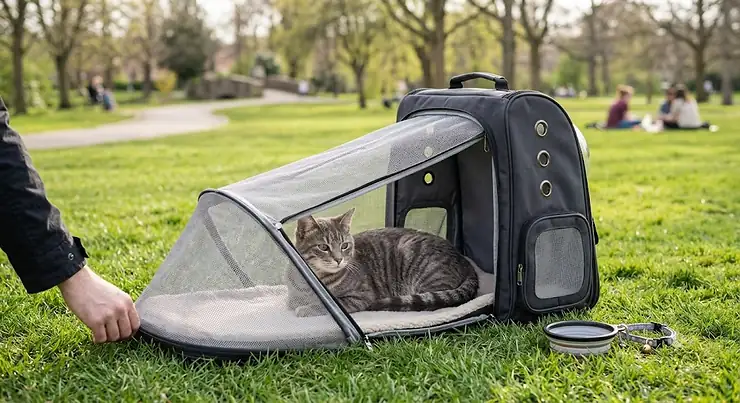
For cat parents who want the option of extra room without committing to a permanently bulky bag, the Pecute Expandable Cat Backpack Carrier is the standout expandable cat backpack in this lineup.
Available in Large and Extra Large sizes, it holds cats up to 24 pounds, and the expandable back panel unzips to add meaningful extra floor space during rest stops — a feature that matters a lot on longer outings where your cat needs to stretch, shift position, or just not feel cramped after an hour. Four mesh windows provide strong airflow from multiple angles, which reviewers note keeps the interior noticeably cooler than sealed-bubble alternatives on warm days. What the spec sheet won’t tell you, but reviewers note, is that the expansion zipper is sturdy enough to survive repeated daily use without the seam stress you’d expect from a budget expandable design.
Aggregated feedback highlights the washable cushion and stability buckles as genuinely useful extras, with the durable Oxford cloth construction holding up well against scratches and everyday wear.
Pros:
- ✅ Expandable back panel adds real usable space on demand
- ✅ Four mesh windows for superior airflow
- ✅ Available in two size options for different cats
Cons:
- ❌ No bubble window for cats who enjoy a panoramic view
- ❌ Expanded shape can feel less compact for tight spaces
Priced in the $50-$80 range, it delivers strong value for anyone prioritizing flexibility over the bubble-window aesthetic.
6. Petkit Cat Backpack Carrier — most structured hard-shell bubble
The Petkit Cat Backpack Carrier leans hard into the hard-shell bubble aesthetic, and for cats up to about 15 pounds, that structure brings real benefits — plus a few complications worth knowing before you buy.
The rigid shell holds its shape whether it’s full, empty, set on the ground, or slung over one shoulder, which softer bubble designs can’t always claim. Reviewers who’ve compared it directly against sealed-bubble competitors describe the added protection and stability as genuinely useful for cats that dislike a wobbly, shifting enclosure. Here’s what to weigh, though: that same rigidity means less give for cats who like to press against the sides or reposition themselves, and the fixed shape doesn’t compress for storage the way a soft-sided bag would.
Based on the spec comparison, this is best suited to owners who prioritize a stable, protective structure over packability or a squeeze-friendly interior — think shorter trips and calmer cats rather than all-day hiking companions.
Pros:
- ✅ Rigid hard-shell structure holds its shape reliably
- ✅ Feels more protective for nervous or wiggly cats
- ✅ Distinctive bubble design with strong visibility
Cons:
- ❌ Doesn’t compress or fold flat for storage
- ❌ Less give for cats who like to reposition inside
Expect a price point in the $70-$110 range depending on color and retailer, positioning it as a mid-tier structured option.
7. Fat Cat Backpack Carrier — best everyday walking companion
Consistently described as the most charming design in the category, the Fat Cat Backpack Carrier backs up its looks with genuinely practical features for casual, everyday use.
It’s spacious for its 15-pound rating, with two decently sized mesh side pockets, a rollable top panel for extra ventilation control, and a leash clip that adds a layer of security during walks. What most buyers overlook about this model is how well the rollable top functions as a customizable airflow dial — roll it down fully for warm days, or leave it mostly closed for a cooler, calmer environment for a nervous cat. Reviewers who tested it against feature-heavier competitors note that its bottom edge can sit awkwardly against the hip depending on your torso length and how much weight is inside, which is worth checking before committing to long walks.
Aggregated sentiment consistently calls it the most visually appealing option tested, with owners appreciating the blend of a soft-sided bag’s comfort and a structured carrier’s stability.
Pros:
- ✅ Rollable top panel for adjustable ventilation
- ✅ Attractive, approachable design for everyday walking transport
- ✅ Leash clip adds an extra layer of security
Cons:
- ❌ Bottom edge may dig into the hip on longer walks
- ❌ Smaller weight capacity limits it to smaller cats
Priced around $60-$90, it’s a strong pick for owners whose main use case is neighborhood walks rather than backcountry hikes.
Practical Usage Guide: Getting Your Cat Comfortable
Buying the right cat backpack carrier is only half the job — the other half is getting your cat to actually tolerate riding in it. Start weeks before your first real outing, not the morning of. Leave the bag open and accessible in a room your cat already likes, and drop treats or a favorite toy inside so it becomes a place with good associations rather than a signal that something unpleasant is about to happen.
Once your cat wanders in and out on their own, start closing the top for short stretches — thirty seconds, then a minute, gradually extending. Add a familiar blanket or an unwashed shirt with your scent to keep the interior smelling like home rather than like new fabric. When you’re ready to move, carry the bag around the house before ever stepping outside; a cat that’s never felt the bag’s motion indoors is far more likely to panic the first time it happens on a sidewalk.
A quick maintenance habit worth building in: wipe down the bubble or mesh panels after every outdoor trip, check the zippers and buckles for wear monthly, and let the interior mat air out between uses to avoid trapped odor. Common first-month mistakes include skipping the acclimation period entirely, overloading the pack beyond its rated capacity “just this once,” and assuming a carrier that worked for a calm cat will automatically work for an anxious one without any adjustment period.
Real-World Scenarios: Which Cat Backpack Carrier Fits Your Life
Picture three different cat owners, because the “best” cat backpack carrier genuinely depends on who’s wearing it and who’s riding in it.
The first is a college student in a small apartment with a mellow, food-motivated cat and frequent short trips to a nearby park. For that situation, a lighter, budget-friendly option like the LOLLIMEOW Large Pet Carrier Backpack makes sense — low cost, generous capacity, easy storage in a dorm-sized closet.
The second is a frequent flyer who takes their cat cross-country several times a year and needs documentation-ready, in-cabin compliance every time. The Sherpa Airline Approved Bubble Backpack is the obvious fit here; its airline compliance isn’t a marketing claim, it’s the entire reason to buy it.
The third is a weekend hiker with a bigger, more adventurous cat who genuinely enjoys the outdoors and needs room to reposition during a two-hour trail walk. That’s where the Pecute Expandable Cat Backpack Carrier earns its keep — the expandable panel and four-way mesh ventilation solve a problem the other two scenarios don’t even have.
How to Choose a Cat Backpack Carrier
What is a cat backpack carrier? It’s a structured, wearable pet enclosure with ventilation panels or a bubble window that lets you transport a cat hands-free on your back, rather than carrying it by hand or over one shoulder in a soft-sided bag.
Choosing the right one comes down to a short list of criteria, each with real consequences if you skip it:
- Weight and size fit — measure your cat’s actual weight and length, not a guess, and choose a carrier rated comfortably above that number.
- Ventilation style — bubble windows offer visibility and structure; mesh-forward designs offer superior airflow, which matters more in warmer climates.
- Expandability — if your cat needs to reposition or stretch during longer outings, an expandable cat backpack solves a comfort problem a fixed-size bag can’t.
- Security features — look for anti-escape zipper buckles, an internal safety tether, and sturdy stitching around stress points.
- Strap comfort — padded, adjustable straps matter more than they seem to on paper, especially once you’re carrying a loaded 15-25 pound pack for an hour.
- Ease of cleaning — a removable, washable mat saves real hassle after an anxious cat has an accident mid-trip.
- Intended use case — a carrier optimized for air travel isn’t the same as one optimized for hiking, and buying for the wrong use case is the single most common mistake.
It’s also worth remembering that a clinical pilot study on feline travel anxiety cites owner surveys finding travel- or carrier-related anxiety as the most commonly reported behavior problem, affecting roughly two-thirds of cat owners — which is exactly why the acclimation process above matters as much as the product spec sheet.
Bubble Cat Backpack vs Traditional Cat Carrier
A bubble cat backpack and a traditional soft-sided carrier solve overlapping but genuinely different problems, and picking between them isn’t just an aesthetic choice.
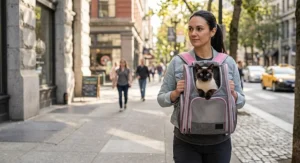
Traditional carriers — the kind with a simple zip-top or front door and no rigid viewing panel — tend to be lighter, cheaper, and easier to collapse for storage. They’re also generally more forgiving for cats that get overstimulated by visual input, since the enclosed fabric sides block outside stimuli almost entirely. A bubble cat backpack, by contrast, gives your cat a wide field of view and gives you the ability to check on them at a glance without unzipping anything — genuinely useful during a long walk or a crowded terminal.
The trade-off is durability versus flexibility. Bubble panels, whether acrylic or plexiglass, can scratch or cloud over time and don’t compress the way soft fabric does. Veterinary guidance on car travel with cats emphasizes keeping the carrier itself a stable, secure space regardless of style, so the “right” choice really comes down to your specific cat’s temperament — a curious cat generally does better with a bubble; an easily overwhelmed cat often prefers the calmer, more enclosed feel of a traditional design.
Cat Carrier Backpack for Hiking: What Actually Matters Outdoors
Not every cat backpack carrier on the market is genuinely built for outdoor adventures, and the difference shows up fast once you’re twenty minutes into a trail.
A cat carrier backpack for hiking needs three things a casual walking-around-the-block carrier doesn’t strictly require: durable, water-resistant fabric that shrugs off dew and light rain; multi-directional mesh ventilation that keeps the interior from overheating during sustained physical exertion on your part (which raises your own body heat and, indirectly, the pack’s interior temperature); and a stable, low-shift harness system so the pack doesn’t bounce awkwardly over uneven terrain. Models like the Pecute Expandable Cat Backpack Carrier and the Travel Cat Navigator were built with exactly this kind of use in mind, thanks to their reinforced construction and multiple ventilation points.
Hydration matters more outdoors than in daily errands, too — bring water for your cat, not just yourself, and plan rest stops every 30-45 minutes where the cat can be let out (on a harness, never free) to stretch. Trail conditions also mean checking the carrier’s zippers and seams for wear more frequently than you would with a carrier that mostly rides in a car.
Expandable Cat Backpack Carriers: When More Room Wins
An expandable cat backpack earns its premium the moment a trip runs longer than about 45 minutes. Cats, like people, get uncomfortable holding one position too long, and a fixed-size enclosure gives them nowhere to go.
The mechanism is usually a zippered back or side panel that opens up additional floor space — sometimes several extra inches in each direction — turning a snug carrier into a genuine mini-lounging area during breaks. This matters most for bigger cats, senior cats with joint stiffness, or any cat prone to restlessness. The Pecute Expandable Cat Backpack Carrier demonstrates this well, with a back panel that unzips to noticeably more usable space without compromising the pack’s structural stability once it’s collapsed back down for the return trip.
The trade-off is a slightly bulkier profile when expanded and, in some budget models, weaker stitching around the expansion seam — which is exactly the kind of detail aggregated reviews are useful for catching before you buy.
Hands-Free Carrying: Why It Changes the Whole Experience
The single biggest functional upgrade a cat backpack carrier offers over a traditional shoulder bag is hands-free carrying — and it’s easy to underrate until you’ve actually tried it.
With both hands free, you can manage a leash, hold a trekking pole, take photos, open doors, or simply keep your balance on uneven ground — all things that become genuinely awkward with a bag dangling from one arm. It also distributes weight across both shoulders and your back rather than one side, which matters a lot once you’re carrying a cat in the 15-25 pound range for more than a few minutes. Reviewers across multiple models consistently cite this as the reason they switched from a traditional carrier in the first place, describing long airport walks or multi-mile trail sections that would have been miserable one-handed.
The practical upshot: if your trips involve any walking distance at all — through a terminal, along a trail, across a parking lot — hands-free carrying isn’t a nice-to-have, it’s the entire point of choosing a backpack-style carrier over anything else.
Common Mistakes When Buying a Cat Backpack Carrier
The most common mistake is sizing up “just in case” — buying a carrier rated well above your cat’s actual weight, assuming bigger is always safer. In practice, an oversized carrier gives your cat room to shift around unpredictably, which can be more destabilizing than a snugly fitted one. The second common mistake is skipping the acclimation period described earlier and expecting a cat to tolerate a brand-new enclosure on day one of a big trip. The third is prioritizing looks — a cute bubble design — over ventilation needs specific to your climate; a bubble-heavy design in a hot, humid region without enough mesh can genuinely overheat a cat faster than owners expect. Finally, many buyers skip checking strap padding and adjustability, only to discover on a long walk that a bag with unpadded straps digs in painfully within twenty minutes.
Safety and Airline Regulations Guide
Whether you’re heading to the airport or just around the neighborhood, a few safety fundamentals apply to every cat backpack carrier. Cats should be confined to a carrier during travel to help them feel secure, prevent them from crawling under your feet, and prevent escape — the same logic that applies in a car applies just as much on foot or in transit.
If you’re flying, confirm your specific airline’s carrier dimension requirements before you buy, since “airline approved” branding on a product page doesn’t always match every carrier’s current policy. According to FDA guidance on traveling with pets, it’s worth acclimating your cat to the carrier well before your trip so there’s less anxiety and resistance when it’s actually time to travel, and you should always keep your cat secured inside the carrier — never let them out for “one more pet” right before boarding or transit, since that’s a common escape risk. For outdoor walking transport, always use a secondary safety tether or harness clip inside the pack in case a zipper fails, and never leave a loaded carrier unattended in direct sun or a parked vehicle.
Long-Term Cost & Maintenance
A cat backpack carrier is a multi-year purchase if you buy the right one, so it’s worth thinking in terms of total cost of ownership rather than sticker price alone. A $40 budget model that needs replacing every year because the bubble window scratches through or the zippers fail isn’t actually cheaper than a $120 model that lasts five years of regular use.
Maintenance costs are modest but real: replacement interior mats run a few dollars each, and most bubble panels can be cleaned with a simple damp cloth rather than specialized products. The biggest long-term cost driver is usage frequency — a carrier used weekly for hikes and errands will show wear far faster than one used a few times a year for vet visits, so match your budget tier to how often you’ll actually use it rather than buying the cheapest option and hoping it holds up.
Features That Actually Matter (And Those That Don’t)
Cutting through the marketing noise: multi-directional ventilation, a genuinely padded and adjustable strap system, reinforced zipper pulls, and a removable washable mat are the features that consistently show up in positive long-term reviews. What matters far less than the marketing suggests: exact color options, “designer” branding, and cosmetic bubble tinting, none of which affect your cat’s actual comfort or safety. If a listing spends more copy on aesthetic details than on ventilation and capacity specs, that’s usually a signal to keep reading the fine print before buying.
Frequently Asked Questions
❓ Are cat backpack carriers safe for cats?
❓ How much weight can a cat backpack carrier hold?
❓ Can I take my cat backpack carrier on a plane?
❓ Is a bubble cat backpack better than a mesh carrier?
❓ How do I get my cat used to a backpack carrier?
Conclusion
A good cat backpack carrier does something deceptively simple: it lets you bring your cat along without turning the trip into a wrestling match or a one-armed juggling act. Whether you’re chasing airline compliance with the Sherpa Airline Approved Bubble Backpack, hunting for value with the LOLLIMEOW Large Pet Carrier Backpack, or gearing up for real trail miles with the Pecute Expandable Cat Backpack Carrier, the right pick comes down to matching the carrier’s design to your cat’s temperament and your actual use case — not just the cutest bubble window on the shelf.
Take the acclimation process seriously, check weight and ventilation specs against your cat’s real measurements, and treat this as a multi-year purchase rather than an impulse buy. Do that, and a cat backpack carrier stops being a novelty item and starts being genuinely useful gear you reach for constantly.
✨ Don’t Miss These Exclusive Deals!
🔍 Take your outdoor adventures to the next level with these carefully selected cat backpack carriers. Click on any highlighted item to check current pricing and availability. These picks will help you create comfortable, hands-free walking transport your cat will actually enjoy!
Recommended for You
- 7 Best Airline Approved Cat Carrier Picks for Flying in 2026
- Best Cat Carrier Guide 2026: 7 Safe & Comfy Picks Reviewed
- 7 Best Cat Litter Scoop Picks for 2026: Ultimate Buying Guide
Disclaimer: This article contains affiliate links. As an Amazon Associate, I earn from qualifying purchases. If you purchase products through these links, we may earn a small commission at no additional cost to you.
✨ Found this helpful? Share it with your friends! 💬🤗
