
Table of Contents
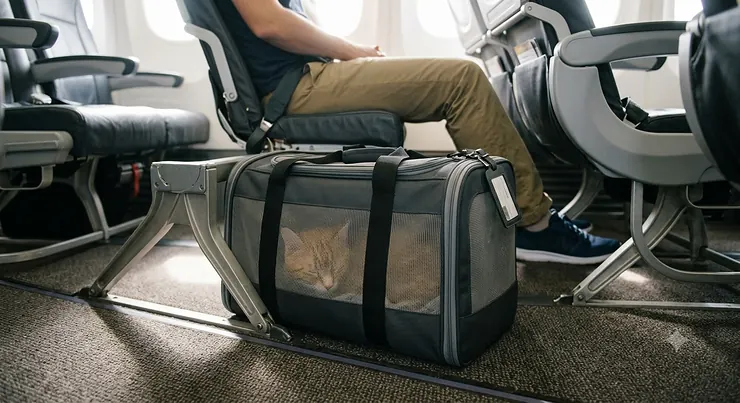
The first time you try to wedge a carrier under an airplane seat with a Delta gate agent tapping their foot behind you, you understand exactly why the phrase airline approved cat carrier gets typed into Google at 2 a.m. the night before a flight. It sounds like a simple checkbox: buy the bag, zip in the cat, board the plane. In practice, it’s part engineering problem, part psychology experiment, because you’re trying to satisfy two very different customers at once — a gate agent measuring your bag against a metal sizer, and a cat who did not consent to any of this.
Here’s the honest starting point: an airline approved cat carrier is a soft- or semi-structured bag built to slide under the seat in front of you, ventilate well enough for a multi-hour flight, and contain any accidents with a waterproof base. It is not a single certified standard — it’s a design category that manufacturers build toward, and it’s on you to double-check it against your specific airline’s posted dimensions. That distinction matters more than almost anything else in this guide, and we’ll come back to it.
We spent time cross-referencing manufacturer specs, aggregated buyer feedback from Chewy, Amazon, and Petco, and guidance from veterinary and federal sources to build a shortlist of seven real carriers spanning budget, mid-range, and premium territory. None of these are invented — you can search every model by name. What follows is a breakdown of what each one actually does well, where it falls short, and how to think about sizing, TSA screening, and cabin comfort so your cat’s first flight isn’t also its worst day.
Quick Comparison: Airline Approved Cat Carrier Picks at a Glance
| Carrier | Best For | Approx. Price | Weight Capacity |
|---|---|---|---|
| Sherpa Original Deluxe | Overall reliability | $45–$65 range | Up to 22 lbs (large) |
| Frisco Basic | Tightest budget | $25–$35 range | Up to 18 lbs |
| Sleepypod Air | Crash-tested premium travel | $190–$220 range | Up to 18 lbs |
| PetAmi Premium | Value with extras included | $40–$55 range | Up to 18 lbs |
| SturdiBag Pro 3.0 | Unpredictable seat dimensions | $140–$160 range | Up to 25–30 lbs (structurally) |
| Pet Gear I-GO2 Sport | Long terminal walks | $60–$85 range | Up to 15 lbs |
| EliteField Soft-Sided | Lightweight budget alternative | $30–$45 range | Up to 15–18 lbs |
Looking at the spread above, the pattern is pretty clear: price tracks with engineering complexity, not luxury branding. The Sleepypod Air and SturdiBag Pro 3.0 cost more because they’re solving a genuinely hard problem — fitting variable, unpredictable under-seat spaces — while the Frisco Basic and EliteField Soft-Sided keep costs down by using a simpler, single-size soft bag that works fine as long as your cat and your airline’s seat both cooperate. If you fly the same one or two airlines repeatedly, a budget pick that matches those specific dimensions can outperform a “universal” premium carrier that’s overbuilt for your needs.
💬 Already have a favorite pick in mind? Scroll down to see exactly how it stacks up against the competition.
💬 Just one click — help others make better buying decisions too!😊
Top 7 Airline Approved Cat Carriers: Expert Analysis
1. Sherpa Original Deluxe — the industry’s most recognized “guaranteed on board” name
The standout feature here is Sherpa’s Guaranteed On Board program: if the small or medium size gets rejected at the gate, the company reimburses your flight and pet fee. That’s a meaningful risk-reducer for a first-time flyer who’s never tested their exact airline’s under-seat clearance. The carrier comes in three sizes — small (15″ x 10″ x 8.5″, up to 8 lbs), medium (17″ x 11″ x 10.5″, up to 16 lbs), and large (19″ x 11.75″ x 11.5″, up to 22 lbs) — and uses a patented spring-wire frame that lets you push down the rear end several inches to clear tighter seat gaps without restricting your cat’s head space.
What most buyers overlook about this model is that the Guaranteed On Board reimbursement only applies to the small and medium sizes; the large size carries restrictions on certain airlines due to its dimensions, so a big cat pushing the upper weight limit is exactly the buyer who benefits least from the safety net. Based on the spec comparison, this carrier is best suited to cats under roughly 16 pounds who need one bag that also works for car rides and vet visits, not just flights.
Aggregated customer sentiment on Petco’s listing frequently mentions that the carrier fits securely under airline seats and stands up well on rolling luggage, and buyers highlight the sturdy construction and washable liner. A recurring theme in the same reviews is that a genuinely large cat — one reviewer described a 20-pound cat that was both too tall and too long — simply won’t fit even in the large size, so measure your cat lying down before you buy up a size on faith.
Pros:
- ✅ Guaranteed On Board refund program on small/medium sizes
- ✅ Spring-wire frame compresses several inches for tight cabins
- ✅ Removable, machine-washable faux lambskin liner
Cons:
- ❌ Large size excluded from some airlines’ under-seat approval
- ❌ Genuinely oversized cats may not fit even in the large
At around $45 to $65 depending on size and color, the Sherpa Original Deluxe sits comfortably in the mid-range and earns its price through the reimbursement program alone — that’s a rare feature in this category and a real hedge against a wasted trip to the airport.
2. Frisco Basic — best budget pick for the occasional flyer
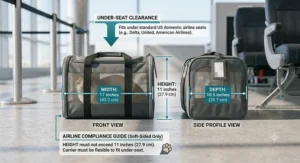
The standout here is price: this is the most affordable carrier on this list that’s still purpose-built for air travel, not just repurposed from a general-use pet bag. The small/medium size measures 17 x 8 x 11.5 inches, while the medium/large measures 19 x 10 x 13 inches, and both are designed to slightly collapse to comply with under-seat compartment requirements on most airlines.
In practice, that “slight collapse” is doing real work — the sides are soft enough to squeeze but the interior floor is sherpa-lined and machine washable, so you’re not sacrificing comfort just to hit a price point. Security comes from auto-locking zippers that can only be unzipped from the outside, which matters more than it sounds like for a cat that’s motivated to escape at exactly the wrong moment, like on the jet bridge. Reviewers on Chewy note the carrier comfortably held a 14-pound Maine Coon sitting upright, though the company itself flags that the carrier is designed for pets lying down and your cat may not be able to fully stand — a fair trade-off at this price, but worth knowing before you buy.
This is the carrier to choose if you fly once or twice a year and don’t want to spend more on a carrier than you did on the checked bag. It’s not the carrier for a cat with anxiety who claws at zippers or an owner who needs the reassurance of a manufacturer refund program.
Pros:
- ✅ Lowest price point in this entire roundup
- ✅ Auto-locking zippers only release from the outside
- ✅ Machine-washable sherpa floor liner included
Cons:
- ❌ No interior tether for extra escape security
- ❌ Cat may not have full standing room inside
Priced under $35 in most colorways, the Frisco Basic proves that “budget” and “unsafe” aren’t synonyms — it just asks you to have realistic expectations about interior roominess.
3. Sleepypod Air — the only crash-tested carrier engineered specifically for planes
The Sleepypod Air’s standout feature is that it’s the only in-cabin carrier independently crash-tested by the Center for Pet Safety, a nonprofit that runs pet restraint systems through the same dynamic testing protocol used for child safety seats. Its compressible design shrinks from 22 inches down to 16 inches long while keeping the same 10.5-inch width and height, which means it’s built to physically deform around whatever the aircraft seat frame demands rather than hoping it’s already the right size.
Here’s what the spec sheet won’t spell out clearly: that flexibility comes from a fabric-and-frame system rather than mesh-heavy ventilation, and reviewers on Chewy have pointed out it offers less airflow than competing carriers and can be harder to see the animal inside because of the darker mesh. On the flip side, one reviewer flying internationally described using it successfully on a six-hour flight with a 12-pound cat, calling the zippers strong enough to hold up to accidental knocks during boarding. Buyers also consistently mention the price as the sticking point relative to its competitors — at around $199.99, reviewers question whether the cost is justified against cheaper alternatives, particularly since a cat close to the 18-pound limit may struggle to turn around inside, according to at least one detailed customer account.
Who should care about this one: owners who also plan to use the same carrier as a car safety seat, and anyone who wants independently verified crash protection as part of the calculus, not just an airline compliance label. If your travel is strictly cabin-to-cabin with no car component, you’re paying for a safety feature you may never test.
Pros:
- ✅ Only carrier independently crash-tested by Center for Pet Safety
- ✅ Compresses in length to adapt to varying seat clearances
- ✅ Doubles as a car safety seat and standalone pet bed
Cons:
- ❌ Noticeably less ventilation than mesh-forward competitors
- ❌ Cats near the 18-pound limit report a snug turning radius
At roughly $190 to $220, this is the premium anchor of the lineup — not because it’s flashier, but because it’s solving a safety problem competitors haven’t attempted at all.
4. PetAmi Premium — best value soft-sided carrier under $60
PetAmi’s standout advantage is what’s included at this price: a collapsible travel bowl ships with every carrier, alongside a sherpa-lined interior bed and a safety buckle strap. The small size measures approximately 17 x 10.2 x 11.2 inches, which lines up closely with several major airlines’ minimum under-seat clearances, making it a reasonable default pick if you haven’t settled on a specific carrier route yet.
Reviewers consistently note the value proposition here, but the honest read on aggregated feedback is mixed on durability. Several buyers on Chewy reported the bag doesn’t hold its shape well and needs the walls stood back up repeatedly, and there’s no top-entry option — both zippers open from the ends only, which can complicate loading a cat that plants its paws against the opening. What most buyers overlook is that the “premium” naming refers to the feature set relative to price, not to build materials rivaling the SturdiBag or Sleepypod Air.
This carrier earns its spot for cost-conscious flyers who want more than the bare-minimum Frisco Basic without jumping to three-figure pricing. It’s a reasonable pick for a calm, cooperative cat; it’s a frustrating one for a cat that resists being loaded through a side opening.
Pros:
- ✅ Collapsible travel bowl included at no extra cost
- ✅ Dimensions align closely with common airline minimums
- ✅ Adjustable shoulder strap and seatbelt-compatible buckle
Cons:
- ❌ Side walls can collapse inward without reinforcement
- ❌ No top-entry option for reluctant or anxious cats
Typically priced in the $40 to $55 range, the PetAmi Premium sits at the sweet spot between disposable and durable — good enough for regular use, not built for years of hard travel.
5. SturdiBag Pro 3.0 — the smartest fit when seat dimensions are unpredictable
The SturdiBag Pro 3.0’s defining feature is its patented flex-height rod system, which lets the entire top of the carrier compress downward like an accordion when it meets the underside of an airline seat, then spring back once the obstruction clears. Rather than relying on soft sides that simply squish under pressure, this is a structural response to the fact that under-seat spacing and configurations vary between regional, national, and international routes as different aircraft bodies are used.
Based on the spec comparison, this design advantage explains why the carrier has been a fixture in the show-cat circuit since 1993 and earned a Wirecutter recommendation as a top travel pick for small cats and dogs. The tradeoff is price — the Pro 3.0 retails around $148 — and a narrower color and style range than mainstream mass-market brands. It also includes a genuinely useful detail competitors skip: a privacy flap that lets you control stimulation for an anxious cat without sacrificing airflow when you want it open.
This is the pick for frequent flyers, cats with real anxiety who benefit from the privacy flap, or anyone who’s already been turned away at a gate once and doesn’t want a repeat. It’s overkill for someone flying a single well-known route on a wide-body aircraft where clearance was never really in question.
Pros:
- ✅ Flex-height rods genuinely adapt mid-flight to seat clearance
- ✅ Privacy flap lets you control visual stimulation for anxious cats
- ✅ Four-point straps plus security clips on every zipper
Cons:
- ❌ Highest recurring price point outside the Sleepypod Air
- ❌ Fewer color and pattern choices than mass-market competitors
In the $140 to $160 range, the SturdiBag Pro 3.0 is priced like specialty travel gear because that’s precisely what it is — most buyers won’t need it, but frequent flyers with unpredictable routes will feel the difference immediately.
6. Pet Gear I-GO2 Sport — best for navigating a crowded terminal
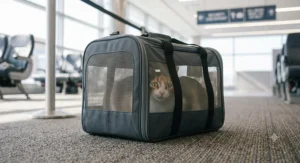
The I-GO2 Sport’s standout trick is versatility: it converts between backpack, tote, rolling case, and car seat without extra attachments, using a telescoping handle and wheel base built into the bag itself. At 12 x 8 x 17.5 inches and roughly 3 pounds, it’s compact enough to sling over a shoulder through security, then extend the handle and roll it once you clear the checkpoint and your arms need a break.
Here’s what the marketing copy doesn’t emphasize: Chewy’s own product page notes that this carrier is approved by certain airlines and recommends double-checking your specific airline’s guidelines rather than claiming blanket approval, which is more honest framing than most competitors offer, but it also means you can’t assume compliance without homework. Buyer feedback is candid about the fit — one reviewer mentioned their 6-pound cat barely fit, suggesting the interior dimensions run tighter than the exterior measurements imply. The rolling function draws consistent praise, especially from travelers managing mobility limitations who specifically described the wheels as a genuine relief compared to carrying a carrier by hand through a long terminal.
Choose this one if your itinerary involves long connections or you simply dislike carrying weight through an airport. Skip it if your cat is already close to the 15-pound ceiling, since real-world interior space runs snug.
Pros:
- ✅ Converts between backpack, tote, and rolling case instantly
- ✅ Telescoping handle removes hand-carry strain on long walks
- ✅ Interior tether attaches directly to a harness for security
Cons:
- ❌ Only two wheels, less stable than four-wheel alternatives
- ❌ Interior space runs tight near the 15-pound weight limit
Running $60 to $85 depending on retailer, the Pet Gear I-GO2 Sport charges a fair premium for genuine airport-logistics convenience, not just cosmetic extras.
7. EliteField Soft-Sided — lightest carrier for compact, cost-conscious travel
The EliteField’s headline advantage is its 3-year warranty, which is unusually long for a carrier in its price bracket and signals the manufacturer’s confidence in the stitching and zipper hardware holding up over repeated trips. It’s available in a 17-inch and 19-inch size, the latter measuring 19 x 10 x 13 inches, with color options including black, charcoal gray, pink, purple, sky blue, and sapphire blue.
What most buyers overlook is that the seatbelt loop doing double-duty for both car rides and luggage-strap attachment is a small but genuinely useful detail that saves you from buying a separate car restraint for local trips. The honest downside, echoed across multiple review sources, is structural: this carrier only has a front entrance rather than a top-loading option, and the lightweight material tends to collapse in on itself when carried without a firm interior support. Reviewers also generally recommend sizing up to the 19-inch version even for smaller cats, since the compact size runs noticeably tight.
This carrier makes sense for a light, occasional-use bag — someone who needs a functional carrier for one trip a year and doesn’t want to invest heavily, but still wants the peace of mind of a multi-year warranty if a zipper fails early.
Pros:
- ✅ Three-year manufacturer warranty, longer than most budget rivals
- ✅ Waterproof base with a removable, washable plush bed
- ✅ Seatbelt loop doubles for car travel and luggage attachment
Cons:
- ❌ Front-only entry makes loading a resistant cat harder
- ❌ Lightweight walls collapse without a firm interior liner
Priced around $30 to $45, the EliteField trades some structural rigidity for a genuinely long warranty — a fair swap if you’re not flying with a particularly wriggly cat.
Practical Usage Guide: Preparing Your Cat and Carrier Before the Flight
Buying the right bag is only half the job. The other half happens in the weeks before departure, and it’s the part Amazon listings never cover.
Start carrier training at least three to four weeks out. Leave the carrier open in a room your cat already spends time in, drop treats or a familiar blanket inside, and let curiosity do the work — placing a familiar toy or blanket in the carrier can help your cat feel more comfortable long before travel day arrives. Feeding your cat near or inside the carrier reinforces a positive association instead of the “this bag means the vet” reflex most cats already have.
On the maintenance side, wash the removable liner after every trip, not just when it looks dirty — cats pick up on residual scent from prior trips (or prior animals, if the carrier is secondhand), and a neutral-smelling interior reduces one layer of stress. Check zippers and seams for wear before every flight; a failed zipper mid-security-line is a genuinely bad afternoon.
The most common first-30-days mistake isn’t about the carrier at all — it’s skipping the health certificate timeline. A Certificate of Veterinary Inspection is generally required within 10 days before air travel, so schedule that vet visit deliberately rather than as an afterthought the week of your flight. The American Veterinary Medical Association’s guidance is worth reading in full if this is your first time flying with a cat — see their pet travel resource for a complete checklist before departure.
✨ Ready to start carrier training today? A few minutes each evening this week beats a stressful scramble the night before your flight.
Real-World Scenarios: Matching the Right Carrier to Your Trip
The first-time flyer with a nervous cat. Say you’re relocating a rescue cat across the country for the first time, and she’s never been further than the vet’s office. The SturdiBag Pro 3.0‘s privacy flap and flex-height design reduce two variables at once — visual overstimulation and the gate-side sizing gamble — which matters more than saving money when the stakes are a stressed animal on a five-hour flight.
The frequent business traveler with a calm senior cat. If you fly the same regional route monthly and your cat has already proven she tolerates travel well, the Sherpa Original Deluxe medium size offers the reimbursement safety net without paying for features you won’t use, like crash-test certification for a trip that never involves a car seat.
The budget-conscious college student moving home for holidays. A once- or twice-a-year flyer with a cooperative, mid-sized cat doesn’t need premium engineering. The Frisco Basic or EliteField Soft-Sided covers the essentials — under-seat compliance, a washable liner, secure zippers — without the cost of a carrier that will spend eleven months in a closet.
Each of these profiles shares one constraint worth repeating: airline pet reservations are limited per flight, so book your pet’s spot as early as you book your own seat, regardless of which carrier you choose.
Problem to Solution: Fixing the Most Common In-Flight Carrier Headaches
Cat won’t stop meowing before boarding. Reduce novel stimulation rather than adding more — a covered privacy panel (built into the SturdiBag Pro 3.0 and available as an add-on for others) often calms a cat faster than trying to soothe them verbally in a loud terminal.
Carrier gets flagged as oversized at the gate. This is exactly why the Sherpa Original Deluxe‘s Guaranteed On Board program exists — but if you’re using a different carrier, measure it against your airline’s exact posted under-seat dimensions before departure, not the general “most airlines” language printed on the packaging.
Cat refuses to enter the carrier at security. Practice runs matter here more than any product feature. If you’re using a front-entry-only design like the EliteField Soft-Sided, consider a top-loading model instead if your cat resists being pushed through a narrow opening under stress.
Carrier zipper fails mid-trip. Inspect zippers before every flight, not just the first one. A three-year warranty, like the one included with the EliteField Soft-Sided, at least covers manufacturing defects if a zipper track fails prematurely.
Cat has an accident during the flight. Line the interior with an absorbent pad regardless of which carrier you buy — lining the carrier with an absorbent puppy potty pad in case your cat needs to relieve itself during travel is standard veterinary advice, and every carrier on this list has a waterproof base designed to contain exactly this scenario.
What Is an Airline Approved Cat Carrier?
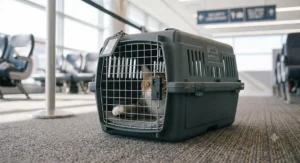
An airline approved cat carrier is a soft- or semi-rigid bag designed to fit beneath the seat in front of you, with mesh ventilation, a waterproof base, and enough flexibility to compress into varying under-seat spaces across different aircraft. It is a design category, not a government certification — always verify dimensions against your specific airline before flying.
That last sentence deserves emphasis because it trips up more first-time flyers than any sizing chart. The term “airline approved” usually just means the carrier can contain moisture, not that it’s guaranteed to fit on any specific flight. There’s no single regulatory body stamping these bags with universal approval; each airline sets its own under-seat dimensions, and those numbers can even vary by aircraft model within the same airline’s fleet.
How to Choose an Airline Approved Cat Carrier
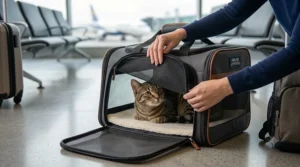
- Measure your cat lying down, not just standing. Interior length needs to accommodate a resting position, since most soft-sided carriers aren’t tall enough for a cat to fully stand upright once compressed under a seat.
- Check your specific airline’s under-seat dimensions before buying. Generic “airline approved” marketing language is a starting point, not a guarantee — cross-reference the exact numbers posted on your carrier’s website.
- Decide whether flex-height matters for your route. If you’re flying multiple airlines or regional jets with narrow cabins, a compressible design like the SturdiBag Pro 3.0 or Sleepypod Air reduces gate-side risk.
- Weigh ventilation against structure. Heavily mesh-paneled bags ventilate best but may sag; frame-supported bags hold shape but can run warmer — match this to your cat’s temperament and your climate.
- Factor in the reimbursement or warranty terms. A program like Sherpa’s Guaranteed On Board, or EliteField’s three-year warranty, shifts some financial risk back to the manufacturer.
- Test-load your cat at home before the trip. A dry run reveals whether your cat resists a front-entry-only design weeks before it becomes a security-line problem.
- Budget for the whole trip, not just the carrier. Pet fees, potential health certificates, and time for carrier acclimation all factor into whether a $40 or $200 carrier actually makes financial sense for your travel frequency.
Under Seat Cat Carrier: Getting the Dimensions Right
The phrase under seat cat carrier gets used almost interchangeably with “airline approved,” but the practical difference is dimensional, not conceptual. Airlines publish maximum under-seat carrier dimensions on their websites — typically somewhere in the range of 17 to 19 inches long, 10 to 12 inches wide, and 8 to 11 inches tall — but those numbers shift depending on the aircraft type assigned to your specific flight, not just the airline brand.
This is precisely the gap that flex-height and compressible designs are built to close. As one manufacturer bluntly put it, under-seat spacing and configurations vary between regional, national, and international routes because different aircraft bodies are used, meaning the same airline can have meaningfully different clearance on a regional jet versus a wide-body international flight. If your itinerary involves a connection on a smaller aircraft, size your carrier to the tightest leg of the trip, not the roomiest one.
TSA Approved Cat Carrier: What “TSA Approved” Actually Means
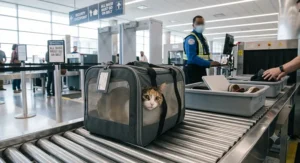
There’s no such product category as a “TSA approved cat carrier” in the way people search for it — TSA doesn’t certify carrier brands or models. What TSA does regulate is the screening process itself: small pets are allowed through the checkpoint, and you’ll need to remove your pet from the carrying case and place the empty case through the X-ray machine.
That single instruction — never send the cat through the X-ray, only the empty carrier — is worth memorizing before you ever reach the checkpoint. You should maintain control of your pet with a leash and remove the leash when carrying your pet through the metal detector, since animal carriers will undergo a visual and/or physical inspection. Practically, that means a harness (not just a collar) is worth having on hand even for a strictly in-cabin flight, purely for the security screening moment. For the complete, current procedure, TSA’s own guidance is available directly on their pet screening page.
If your cat tends to bolt when startled, request a private screening room in advance — travelers with pets that may struggle or attempt to jump away can request a TSA officer screen the pet in a private room rather than in the open checkpoint area.
Cat Carrier for Flying: Cabin Travel Versus Cargo
Nearly every carrier discussed in this guide is designed for cabin travel — meaning your cat rides with you, under the seat, for the entire flight. That’s a deliberate distinction worth making explicit, because cargo-hold pet travel is a fundamentally different logistics and welfare question, and none of the picks above are intended for it.
Cabin travel keeps your cat within reach the entire flight, which matters for temperature regulation, stress monitoring, and simply being able to react if something goes wrong. Veterinary guidance consistently favors cabin travel when it’s an option: most cats travel well in the cabin without needing medication, and you should try to keep the carrier on your lap or the seat beside you rather than the floor, away from noisy areas or other animals when possible.
Weight limits are the deciding factor in whether cabin travel is even available to you. Most airlines cap the combined weight of cat-plus-carrier somewhere around 20 pounds for cabin eligibility, which is exactly why every carrier on this list targets 15- to 22-pound capacities — anything heavier typically pushes a cat into cargo territory, a very different set of considerations entirely and one this guide isn’t attempting to cover.
Flight Requirements and Airline Regulations: What to Confirm Before You Book
Airline regulations around pet travel are not standardized federally in the way TSA security screening is — each airline sets its own flight requirements, and those requirements can include the number of pets allowed per cabin, breed restrictions, and documentation deadlines. Some airlines set minimum age requirements, such as not permitting kittens under 16 weeks old on international routes, so confirm age eligibility alongside carrier dimensions.
Federally, the baseline welfare framework comes from the Animal Welfare Act, enforced by USDA/APHIS, which establishes certain requirements for transporting animals by plane that airlines must follow. That’s a floor, not a ceiling — individual airlines layer their own pet policies, fees, and reservation limits on top of it, and those details change often enough that checking the current version on your airline’s website before every trip is worth the ten minutes it takes. The FDA’s consumer-facing pet travel guidance is a solid starting point if you want the full regulatory picture in plain language before you start comparing airline-specific pages.
One flight requirement that trips up first-time flyers more than any carrier spec: most airlines require pet reservations to be made directly with an agent, not through standard online booking, and cabin pet slots are capped per flight. Book that reservation the same day you book your own ticket.
Common Mistakes When Buying an Airline Approved Cat Carrier
The single most expensive mistake is buying based on your cat’s breed reputation rather than actual measurements — a “small” cat breed can still be long-bodied enough to need a size up, and a carrier that looks generously sized in photos can run tight in person. Measure nose-to-base-of-tail length and standing height, then compare against interior (not exterior) carrier dimensions, since manufacturers often advertise the larger exterior number.
A second common error is assuming “airline approved” branding removes the need to check your specific airline’s page. As established earlier, the marketing term mainly signals moisture containment, not a guaranteed fit on your route, so skipping that verification step is the most preventable reason travelers get turned away at the gate.
A third mistake worth flagging: buying a carrier the week of the flight and skipping acclimation entirely. A cat encountering an unfamiliar bag for the first time in a chaotic airport is far more likely to panic, scratch at zippers, or resist loading — all problems a few weeks of at-home exposure would have solved for free.
Long-Term Cost and Maintenance: What You’re Really Paying For
Sticker price tells an incomplete story here. A $30 budget carrier that needs replacing every one or two trips because the zippers or side panels wear out isn’t actually cheaper than a $150 carrier that lasts a decade of regular flying — the real comparison is cost-per-trip, not cost-per-purchase.
Run the simple math: if you fly with your cat twice a year, a $45 Sherpa Original Deluxe that lasts five years works out to roughly $4.50 per trip, assuming no replacement liners or repairs. A $148 SturdiBag Pro 3.0 used at the same frequency for a decade comes out to about $7.40 per trip — more expensive per use, but arguably justified if the flex-height design meaningfully reduces the risk of a rejected boarding, which carries its own real cost in rebooking fees and stress. The math shifts further in the premium carrier’s favor for anyone flying six or more times a year, where the durability gap compounds faster.
Maintenance costs are modest across the board — replacement liners run $15 to $25 for most brands — but factor in that soft-sided carriers with mesh panels generally show wear (small tears, pilling) faster than frame-supported designs, simply because mesh is the weakest structural point on any bag in this category.
Buyer’s Decision Framework: A Quick Priority Checklist
If your cat is under 12 pounds and you fly rarely, choose a budget soft-sided carrier because the lighter use case doesn’t justify premium engineering.
If your cat has documented travel anxiety, choose a carrier with a privacy panel because reducing visual stimulation addresses the root behavioral issue rather than just containing the symptoms.
If you fly six or more times per year, choose a durable, higher-warranty option because the cost-per-trip math favors upfront investment over repeated budget replacements.
If your route includes a regional-jet connection, choose a flex-height design because fixed-size carriers carry the highest rejection risk on smaller aircraft.
If mobility or long connections are a factor, choose a rolling or backpack hybrid because carrying weight by hand across a large terminal adds unnecessary physical strain.
🔍 Still torn between two options? Re-read the scenario that matches your trip above — the right pick usually becomes obvious once you match it to your actual travel pattern instead of the general reviews.
Frequently Asked Questions
❓ Do airlines really require a 'TSA approved' cat carrier?
❓ What size cat carrier fits under an airplane seat?
❓ Can my cat sit up and turn around in an airline approved cat carrier?
❓ Do I need a health certificate to fly with my cat in the cabin?
❓ What happens if my cat carrier doesn't fit under the seat at the gate?
Conclusion
Flying with a cat rewards preparation over impulse-buying. The carrier you choose matters, but it’s one piece of a larger system that includes carrier acclimation weeks in advance, a health certificate scheduled with intention rather than panic, and a clear-eyed understanding that “airline approved” is a helpful signal, not a guarantee against your specific flight’s under-seat dimensions.
Of the seven carriers covered here, there’s no single universal winner — the Sherpa Original Deluxe earns its reputation through a genuine reimbursement safety net, the Sleepypod Air stands alone on independently verified crash safety, and the Frisco Basic proves a tight budget doesn’t have to mean an unsafe or uncomfortable trip. The right choice depends on how often you fly, how anxious your particular cat gets, and whether your itinerary includes the kind of regional-jet connections that make flex-height designs worth their higher price tag.
Whichever carrier you land on, the fundamentals stay the same: measure your cat honestly, verify dimensions against your actual airline before you fly, and give your cat real time to get comfortable with the bag before travel day arrives. That preparation does more for a smooth flight than any single feature on any single carrier.
✨ Don’t Miss These Exclusive Deals!
🔍 Take your cat’s next flight to the next level with carriers built for real cabin travel. Click on any highlighted pick above to check current pricing and availability before your trip. The right carrier turns a stressful travel day into a genuinely smooth one for both of you!
Recommended for You
- Best Cat Carrier Guide 2026: 7 Safe & Comfy Picks Reviewed
- 7 Best Cat Litter Scoop Picks for 2026: Ultimate Buying Guide
- 7 Best Cat Litter Deodorizer Picks That Actually Work in 2026
Disclaimer: This article contains affiliate links. As an Amazon Associate, I earn from qualifying purchases. If you purchase products through these links, we may earn a small commission at no additional cost to you.
✨ Found this helpful? Share it with your friends! 💬🤗
