Table of Contents
Here’s an uncomfortable truth nobody puts on the bag: a litter box doesn’t smell bad because your cat is dirty. It smells bad because urea is turning into ammonia gas about four feet from where you eat breakfast. A cat litter deodorizer is a powder, crystal, spray, or additive you sprinkle or spray into the box to neutralize that smell chemically, rather than just perfuming it. Some do this by binding odor molecules (activated carbon, zeolite), some by reacting with acidic compounds (baking soda), and a rare few by biologically breaking down waste (enzymes). Not all of them do what the label implies, and after digging through spec sheets, ingredient lists, and mountains of aggregated review data, the differences between “masking” and “eliminating” turned out to matter a lot more than fragrance strength ever did.
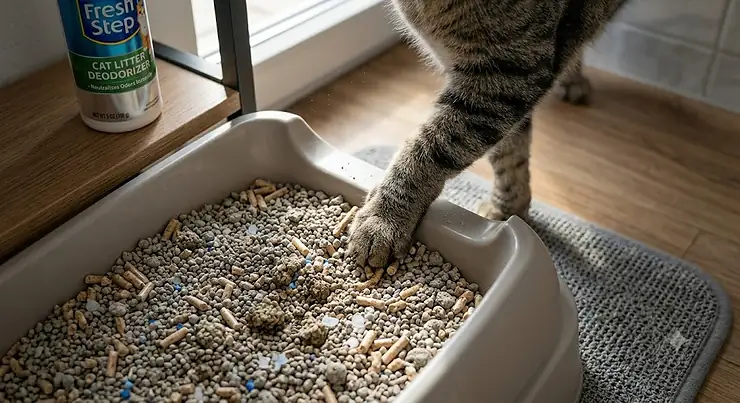
This guide breaks down seven real, currently available products spanning budget shakers to lab-grade carbon additives, explains the chemistry in plain English, and tells you honestly which type fits your actual household — one cat versus four, apartment versus house, sensitive-nosed human versus sensitive-nosed cat. According to the Cornell Feline Health Center, litter box aversion is one of the most common behavior complaints vets hear about, and a heavily fragranced deodorizer can quietly be the culprit rather than the cure. So before you dump another scoop of something floral into the box, let’s talk about what’s actually happening at the molecular level — and which product handles it best for your specific situation.
Quick Comparison: Top Litter Box Odor Eliminator Picks
If you’re in a hurry, here’s the condensed version. This table ranks the seven picks by mechanism, format, and who they suit best, so you can jump straight to a section below.
| Product | Mechanism | Format | Best For |
|---|---|---|---|
| Arm & Hammer Cat Litter Deodorizer Powder | Baking soda | Shaker powder | Budget, single-cat homes |
| Fresh Step Deodorizing Crystals | Baking soda + silica | Dissolving crystals | Easy cleanup, moderate budgets |
| NonScents Cat Litter Deodorizer | Zeolite mineral | Granules | Fragrance-sensitive cats |
| Rocco & Roxie Cat Litter Deodorizer | Corncob + essential oils | Granules | Strong-odor, multi-pet homes |
| Purrify Activated Carbon Additive | Activated carbon | Fine granules | Serious ammonia control |
| Hepper Litter Additive | Bio-enzymes | Powder | Eco-conscious, all-litter compatibility |
| Nature’s Miracle Odor Destroyer Spray | Enzymes | Spray | Spot-treatment, quick refresh |
A pattern emerges fast here: the products relying on baking soda (Arm & Hammer, Fresh Step) are the cheapest and most familiar, but they lean on a chemical reaction that’s genuinely limited against ammonia gas specifically. The mineral- and carbon-based options (NonScents, Purrify) cost more per container but tend to outlast the powders because they’re trapping molecules rather than reacting them away. Enzyme products (Hepper, Nature’s Miracle) sit in a different lane entirely — they’re better suited to breaking down organic residue than to ongoing, day-after-day gas control inside a busy box.
💬 Found a match already? Scroll to that product’s full breakdown below — or keep reading for the science that explains why it wins.
💬 Just one click — help others make better buying decisions too!😊
Top 7 Cat Litter Deodorizers: Expert Analysis
Before the individual breakdowns, here’s the specs-and-price snapshot for all seven, side by side.
| Product | Active Ingredient | Container Size | Price Range | Best Use Case |
|---|---|---|---|---|
| Arm & Hammer Powder | Baking soda | ~30 oz shaker | Under $10 | Daily sprinkle, single cat |
| Fresh Step Crystals | Baking soda + silica gel | ~24 oz shaker | $8–$12 | Fast-dissolving, low mess |
| NonScents | Zeolite | 12–15 oz bag | $12–$18 | Unscented multi-cat use |
| Rocco & Roxie | Corncob + essential oils | ~25 oz jar | $10–$16 | Strong, persistent odor |
| Purrify Activated Carbon | Coconut-based activated carbon | Small concentrated pouch | $15–$25 | Ammonia-heavy, serious odor |
| Hepper Litter Additive | Bio-enzymes | ~8 oz jar | $15–$20 | Natural, biodegradable homes |
| Nature’s Miracle Spray | Enzymatic solution | ~24 oz spray bottle | $8–$12 | Spot treatment, box refresh |
Reading this table sideways instead of down tells its own story: price roughly tracks with how targeted the chemistry is, not with how big the container is. A budget shaker with a giant scoop hole still loses to a small pouch of activated carbon when it comes to actual ammonia adsorption, because volume isn’t the variable that matters — surface area and binding capacity are. Keep that in mind as you read the individual verdicts, because “biggest bag for the buck” and “best value” are not the same question here.
✨ Ready to stop guessing and start fixing the smell? Keep scrolling — the full rundown starts right below.
1. Arm & Hammer Cat Litter Deodorizer Powder — instant, moisture-activated baking soda sprinkle
The standout here is timing: this powder doesn’t wait around, it activates the moment your cat’s litter box gets wet, sending baking soda into action almost instantly rather than sitting inert until you remember to top it up. The formula is engineered to prevent clumping at the bottom of the box, which sounds minor until you’ve scraped a baked-on baking-soda crust off a plastic pan at 11 p.m. Reviewers frequently point out that a light dusting goes a long way, though heavier households tend to reapply every couple of days rather than weekly. Based on the ingredient profile, this is best understood as a reactive deodorizer — baking soda neutralizes some acidic odor compounds through a genuine chemical reaction, but ammonia gas (which is basic, not acidic) is only partially addressed, which is why the effect fades faster in multi-cat boxes. Aggregated customer sentiment across major retail sites consistently describes it as reliable for single-cat households but “needing backup” once a second or third cat joins the box. It’s an honest, no-frills product that does exactly what baking soda has always done — just packaged for convenience.
Pros:
- ✅ Reacts immediately on contact with moisture
- ✅ Prevents hard clumping at the box bottom
- ✅ Extremely affordable per ounce
Cons:
- ❌ Limited effect against ammonia specifically
- ❌ Needs frequent reapplication in busy boxes
Priced under $10 for a shaker that lasts several weeks in a single-cat home, this is the deodorizer to buy if your only complaint is “it’s a little stinky sometimes” rather than “I can smell this from the hallway.”
2. Fresh Step Cat Litter Deodorizing Crystals — dissolves clean, no powdery residue
What stands out immediately is the cleanup factor: unlike granular competitors, these crystals dissolve after your cat uses the box, meaning there’s no gritty residue building up at the bottom over time. The blend combines baking soda with silica-based moisture absorption, and it’s designed to activate only when triggered by waste — so you’re not smelling a chemical burst every time you walk past an untouched box. Here’s what most buyers overlook: because the crystals only activate on contact, a lightly used box in a low-traffic room might not get enough activation to stay ahead of odor between cleanings, which is why this performs best on a strict daily-scoop schedule rather than as a substitute for one. Reviewers repeatedly mention it as easy on sensitive noses (both human and feline) and note that multi-cat households sometimes find the odor control window shorter than advertised. Honestly, for people who hate scrubbing dried powder residue off plastic, the dissolving format alone can be worth the switch.
Pros:
- ✅ Dissolves for genuinely easier cleanup
- ✅ Activates only on actual contact, not constantly
- ✅ Mild, non-overpowering baseline scent
Cons:
- ❌ Shorter effective window in multi-cat boxes
- ❌ Still relies on baking soda’s limited ammonia reach
At $8–$12 per container, it slots in just above Arm & Hammer for buyers who specifically want to stop dealing with dried powder crust.
3. NonScents Cat Litter Deodorizer — zeolite mineral technology with zero added fragrance
The standout feature is right in the name: there’s no fragrance at all, which matters enormously for cats with sensitive noses, since a cat’s estimated 200 million scent receptors make heavy perfumes borderline hostile rather than “fresh.” The active ingredient is natural zeolite, a porous volcanic mineral that works through molecular adsorption rather than masking — meaning odor compounds get physically trapped in the mineral’s structure instead of simply covered up. Reviewers repeatedly describe it as the pick that finally worked for cats who previously refused a scented litter box altogether, and multiple aggregated reviews mention it extending litter life meaningfully, which lowers the frequency of full litter changes. What most buyers overlook about zeolite specifically is that its adsorption capacity, while real, is lower per gram than activated carbon’s — so in genuinely heavy-odor multi-cat setups, it performs well but not at the absolute top tier for raw ammonia-trapping power. Still, for anyone whose priority is “no scent, no irritation, just less stink,” this is hard to beat.
Pros:
- ✅ Completely fragrance-free formula
- ✅ Traps odor molecularly rather than masking
- ✅ Extends time between full litter changes
Cons:
- ❌ Lower per-gram adsorption than activated carbon
- ❌ Premium price relative to baking soda options
In the $12–$18 range, it’s a smart mid-tier pick specifically for households prioritizing a cat’s comfort over raw odor-killing horsepower.
4. Rocco & Roxie Cat Litter Deodorizer — corncob base built for genuinely strong odors
This one leads with brute-force freshness: a corncob granule base infused with a proprietary essential oil blend designed specifically to tackle the toughest litter box smells rather than gently freshen a mild one. The corncob granules are naturally absorbent and low-dust, which matters if anyone in the household has respiratory sensitivity, and the essential oil blend is noticeably stronger than most competitors on this list — a deliberate choice for households where a light dusting of baking soda simply isn’t cutting it anymore. Based on aggregated review sentiment, cat owners with three or more cats sharing boxes consistently rate this among the strongest performers for actual odor suppression, though a subset of reviewers with fragrance-sensitive cats report their cats initially avoiding a freshly treated box. Here’s the honest trade-off: the same essential oil intensity that wins over multi-cat households is precisely what can backfire with a scent-averse cat, so this is a “know your cat” purchase rather than a universal recommendation.
Pros:
- ✅ Strong performance against tough, layered odors
- ✅ Low-dust corncob base is respiratory-friendly
- ✅ Well-reviewed specifically for multi-cat homes
Cons:
- ❌ Essential oil scent can prompt box avoidance in sensitive cats
- ❌ Not fragrance-free, ruling it out for scent-averse households
Priced roughly $10–$16, it earns its spot as the strong-odor specialist on this list — just introduce it gradually if your cat has ever turned up their nose at a scented litter before.
5. Purrify Activated Carbon Cat Litter Additive — coconut-based activated carbon for serious ammonia control
The standout here is pure surface area: high-quality activated carbon can exceed 3,000 square meters of adsorptive surface per gram — roughly a football field’s worth of microscopic pore structure packed into a spoonful of granules — which is why a small amount dramatically outperforms cups of baking soda against ammonia specifically. This isn’t marketing spin; the same activated carbon adsorption technology is recognized by the EPA as a leading method for removing organic compounds and odor-causing molecules from municipal drinking water, and the underlying chemistry translates directly to a litter box environment. Based on the spec comparison against the mineral and baking-soda options above, activated carbon binds gas molecules on contact rather than reacting with only a subset of them, which explains why it holds up longer between top-ups in ammonia-heavy, multi-cat boxes. Reviewers consistently describe a noticeable difference specifically in the sharp, eye-watering ammonia smell rather than the general “litter box” scent, which tracks with what the chemistry predicts. The trade-off is cost — concentrated carbon products run higher per ounce than powder alternatives, though because so little is needed per application, the effective cost-per-use narrows considerably.
Pros:
- ✅ Highest per-gram odor-adsorption capacity on this list
- ✅ Specifically effective against sharp ammonia odor
- ✅ Small amount needed per application
Cons:
- ❌ Higher sticker price than powder competitors
- ❌ Less widely available in big-box retail stores
At $15–$25 for a concentrated pouch, this is the pick for anyone who’s tried baking soda and essential oils and is still getting hit in the face at the doorway — activated carbon is the technology built for exactly that problem.
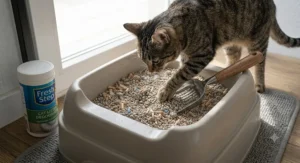
6. Hepper Litter Additive — bio-enzyme formula that skips fragrance and synthetic chemicals entirely
What stands out immediately is the ingredient philosophy: bio-enzymes instead of minerals, fragrance, or baking soda, positioned as a biodegradable, earth-friendly alternative that’s compatible with literally any litter type — clay, crystal, pellet, or natural. The enzymes work by breaking down the organic compounds in waste at a biological level rather than adsorbing or reacting with the resulting gas, which is a meaningfully different mechanism than everything else on this list. Reviewers highlight its versatility beyond the litter box itself — the same additive works in trash cans, animal carriers, and kennels, which extends its practical value well past a single use case. What most buyers overlook about enzyme-based products generally is that they shine brightest against organic residue and buildup over time, making this a better long-game additive for litter longevity than an instant, sharp-odor-killing solution the moment a cat uses the box. It’s fragrance-free and safe for kittens, which matters if odor control shouldn’t come at the cost of respiratory or behavioral sensitivity.
Pros:
- ✅ Fully biodegradable, fragrance-free formula
- ✅ Works across every litter type and several non-litter uses
- ✅ Safe profile for kittens and sensitive cats
Cons:
- ❌ Slower-acting than instant-adsorption formulas
- ❌ Premium price for a relatively small jar
Running $15–$20, this is the values-driven premium pick — buy it if sustainability and gentle ingredients matter as much to you as the smell itself.
7. Nature’s Miracle Just for Cats Odor Destroyer Spray — enzymatic spot-treatment for fast, targeted refresh
The standout feature is efficiency: you genuinely need very little product per application, and a single spray session can keep a treated spot fresh for roughly a week, which is unusual for a liquid format. As an enzymatic spray rather than a granular additive, it’s built for a different job entirely — treating specific problem areas (box edges, the surrounding floor, a lingering smell after a deep clean) rather than living inside the litter itself day to day. Based on the format alone, this is best used as a barrier-method pretreatment on a clean, dry box before adding fresh litter, since that prevents odor molecules from bonding to the plastic surface in the first place rather than trying to chase the smell after it’s already set in. Aggregated reviews consistently praise it for handling stubborn residual odor after a full litter change, with the common caveat that it’s a maintenance tool, not a magic fix for a box that’s rarely scooped — spraying a neglected box once and expecting lasting results is, per multiple reviewers’ own admission, “backwards” thinking.
Pros:
- ✅ Small amount covers surprisingly large problem areas
- ✅ Excellent for post-cleaning residual odor
- ✅ Versatile beyond just the litter box itself
Cons:
- ❌ Not a substitute for consistent scooping
- ❌ Shorter-lasting than granular in-litter additives
At $8–$12 per bottle, it’s the cheapest way to plug a specific gap — keep one under the sink for the day after a deep clean, or for guests-are-coming emergencies.
Cat Litter Freshener vs Cat Litter Deodorizer: What’s the Difference
People use these terms interchangeably, but there’s a real distinction worth knowing before you buy either one. A cat litter freshener is typically a lighter-duty product — often just a scent additive or a spray meant to make the room smell nicer, without necessarily doing much chemical work against the underlying odor molecules. A cat litter deodorizer, by contrast, is formulated specifically to neutralize or trap odor at a molecular level, whether through baking soda’s acid-neutralizing reaction, zeolite or activated carbon’s physical adsorption, or enzymatic breakdown of waste itself. In practice, a lot of products marketed as “freshener” lean almost entirely on fragrance, while products marketed as “deodorizer” at least attempt some form of active odor-molecule intervention — though as the breakdown above shows, not all deodorizer mechanisms are created equal either.
| Approach | How It Works | Odor Removed? | Typical Duration |
|---|---|---|---|
| Fragrance-only freshener | Adds a competing scent | No — odor remains, just masked | Hours |
| Baking soda deodorizer | Chemical acid-base reaction | Partial | 1–3 days |
| Mineral/carbon deodorizer | Physical molecular adsorption | Substantial | 3–7+ days |
| Enzymatic spray/additive | Biological breakdown of waste | Gradual, cumulative | Ongoing with use |
The table makes the hierarchy pretty clear: pure fresheners lose their effect the fastest because they’re not addressing the actual source molecule, while adsorption-based deodorizers hold their ground the longest because the odor compound has physically nowhere left to go once it’s trapped in the porous structure. If a product you’ve been using “stops working” within an hour of application, there’s a good chance it’s a freshener wearing a deodorizer’s marketing.
💬 Not sure which category your current product falls into? Check the ingredient list — if fragrance or perfume is listed first, you’re using a freshener.
Activated Charcoal Litter Filter Technology Explained
Of every ingredient covered in this guide, activated charcoal (also called activated carbon) is the one worth understanding at a slightly deeper level, because the science behind it is genuinely impressive and explains why it consistently outperforms lighter-duty options. Activated carbon is created by processing carbon-rich material — often coconut shells — under controlled heat to generate an enormous internal network of microscopic pores. That structure is what gives it such staggering surface area per gram, and it’s the same underlying property that makes it useful for far more than litter boxes. It’s the standard technology municipalities lean on when filtering organic compounds and odor-causing molecules out of drinking water, a use case the EPA has documented extensively in its water treatment guidance.
In a litter box specifically, this translates to physically trapping ammonia and sulfur-compound gas molecules on contact rather than reacting with only a portion of them the way baking soda does. That’s why activated charcoal litter additives can outperform a much larger volume of baking soda — it isn’t about how much product you use, it’s about how much internal surface area that product actually offers the air passing through it. The catch, and it’s an important one: activated carbon has a finite binding capacity. Once its pore structure is saturated with trapped molecules, it stops working, which is why “sprinkle it once and forget it forever” isn’t realistic — regular reapplication on the schedule the manufacturer recommends is what keeps the science working in your favor.
✨ Want odor control backed by the same principle used to purify drinking water? The activated carbon pick above (#5) is built exactly on this mechanism.
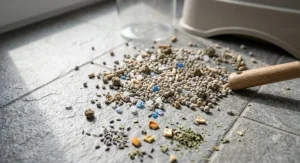
Odor Neutralizer vs Odor Masker: The Chemistry Behind Smell Control
This is the single most useful distinction in the entire deodorizer category, and it’s worth internalizing before your next purchase. An odor masker adds a second, stronger scent on top of an existing smell — your nose is now processing two competing signals, and it perceives the stronger one as “winning,” even though the original odor molecules are still floating in the air completely unchanged. An odor neutralizer, by contrast, actually alters or captures the offending molecule itself, whether by chemical reaction (baking soda meeting an acidic compound), physical adsorption (carbon or zeolite trapping a gas molecule in a pore), or enzymatic digestion (bacteria-produced enzymes breaking down organic waste into non-odorous byproducts).
Here’s what most buyers overlook: heavily fragranced litter and deodorizer products are almost always maskers rather than neutralizers, and because cats’ sense of smell is dramatically more sensitive than a human’s, a product that smells “clean” to you can smell overwhelming to your cat — a documented factor in litter box avoidance according to feline behaviorists. Genuine smell control, in other words, isn’t about finding the strongest-smelling product on the shelf; it’s about finding the one engineered to reduce the number of odor molecules reaching your nose (and your cat’s) in the first place. When comparing labels, look for language like “neutralizes,” “adsorbs,” or “breaks down” rather than “covers” or “masks” — it’s a small wording difference that reflects a genuinely different mechanism underneath.
Air Purification and Ventilation: Do You Need Both?
A deodorizer treats the litter itself, but odor molecules that have already become airborne are a separate problem — which is where air purification enters the picture. If your litter box lives in a small, enclosed bathroom or closet with minimal airflow, even the best-performing additive on this list is fighting an uphill battle against a room with nowhere for treated air to circulate. A standalone air purifier with an activated carbon filter stage tackles the airborne half of the equation using the same adsorption principle discussed above, just applied to ambient air instead of the litter substrate directly.
Realistically, most single-cat households in a reasonably ventilated space don’t need both — a solid deodorizer plus a daily scoop handles it. But multi-cat homes, enclosed litter box furniture, or rooms with genuinely poor airflow tend to see a real, noticeable improvement when a carbon-filtered air purifier runs nearby, because it’s catching the fraction of odor that escaped the litter treatment before it ever reached your nose. Think of the deodorizer as defense at the source and an air purifier as a second line of defense for whatever slips past — the two aren’t redundant, they’re handling different stages of the same problem.
✨ Don’t Miss These Exclusive Deals!
🔍 Take your litter box freshness to the next level with these carefully selected picks. Click through to check current pricing and availability, and give your home the clean, neutral air it deserves!
Practical Usage Guide: Getting the Most From Your Deodorizer
Buying the right product only gets you halfway there — application technique makes a measurable difference in how well any of these seven perform. Start with a clean box: adding deodorizer to litter that’s already saturated with old waste is like spraying air freshener over a full trash can, since the additive has to compete with odor that’s already deeply set in. Scoop first, then apply.
For powders and granules, a thin, even layer worked into the top inch of fresh litter tends to outperform a thick pile dumped in one spot, since surface contact with waste is what triggers the chemical or adsorptive process. For sprays like the enzymatic pick above, apply to a dry, empty box before adding litter for the strongest barrier effect, rather than spraying directly onto already-used litter.
A simple 30-day rhythm that works well in practice: scoop at least once daily, top up the deodorizer every time you add fresh litter, and do a full litter and box wash weekly (Cornell’s behavioral guidance recommends this cadence specifically to prevent aversion-triggering residual odor). The most common first-month mistake is over-applying a strongly scented product hoping “more is better” — with essential-oil or fragrance-based options, this is far more likely to make a cat avoid the box than to genuinely reduce odor.
Real-World Scenarios: Matching a Deodorizer to Your Household
The apartment-dwelling single-cat owner: Limited square footage means odor has nowhere to dissipate, but a single cat also means moderate waste volume. NonScents or Fresh Step Crystals hit a sensible middle ground here — fragrance-light or fragrance-free, moderate cost, and sufficient for one cat’s output without overkill.
The multi-cat household with three or more cats sharing boxes: Waste volume climbs fast, and baking-soda-only products simply run out of capacity too quickly. Rocco & Roxie’s stronger corncob-and-oil formula or Purrify’s activated carbon are better matched to this volume — the trade-off is testing your cats’ tolerance for the stronger scent (Rocco & Roxie) versus the higher unit cost (Purrify).
The budget-conscious, sensitive-cat owner: If a cat has already shown box avoidance with scented products, Hepper’s fragrance-free bio-enzyme additive or plain Arm & Hammer powder are the safer starting points — both skip added fragrance entirely, letting you isolate whether scent sensitivity was actually the underlying issue.
Problem → Solution: Fixing the Top Litter Box Odor Complaints
Problem: Ammonia smell hits you before you even enter the room. This is a strong signal you’re dealing with a masking product rather than a neutralizing one. Switch to activated carbon (Purrify) or zeolite (NonScents), both of which target ammonia specifically through adsorption rather than competing fragrance.
Problem: My cat suddenly avoids the litter box after I added a new deodorizer. Scent intensity is the most likely culprit. Remove the current product, return to a fragrance-free option like Hepper or plain Arm & Hammer for a week, and reintroduce anything scented gradually and sparingly if at all.
Problem: The smell comes back within hours of scooping. This usually points to a masking-only product or simply not enough surface contact between the deodorizer and the waste. Try a thinner, more even application, or step up to a stronger adsorption mechanism like activated carbon.
Problem: Litter box odor lingers in the room even between cat visits. This is the airborne half of the problem discussed above — pair your current deodorizer with a carbon-filtered air purifier or improve ventilation in the room itself.
Problem: I’m going through deodorizer too fast and it’s getting expensive. Concentrated, high-adsorption products like activated carbon actually cost less per use despite a higher sticker price, since so little is needed per application — the Long-Term Cost section below breaks this down further.
How to Choose a Cat Litter Deodorizer
Cutting through the marketing, here’s the actual decision process, in order:
- Identify your real problem first. Sharp ammonia smell, general staleness, and lingering room odor are three different problems with three different best-fit solutions — don’t buy based on packaging before diagnosing which one you actually have.
- Check your cat’s scent tolerance. If your cat has ever hesitated at a scented litter before, start fragrance-free (zeolite, activated carbon, or enzyme-based) rather than risking box avoidance.
- Match the mechanism to your household size. Single cats do fine with baking soda; two or more cats generally need adsorption-based (mineral or carbon) products to keep pace with waste volume.
- Weigh cost-per-use, not shelf price. A concentrated carbon product priced higher upfront can still be cheaper per application than a bulky powder you’re refilling weekly.
- Consider your litter type’s compatibility. Some additives are formulated for clumping clay specifically; enzyme-based options like Hepper tend to be the most universally compatible across litter types.
- Factor in application format. Powders and granules suit daily maintenance; sprays suit spot-treatment and post-cleaning refresh — many households genuinely benefit from having both on hand.
- Confirm current availability and price range before buying, since formulations, package sizes, and pricing shift over time — always check current price and reviews at the time of purchase.
Common Mistakes When Buying a Cat Litter Deodorizer
The single most common mistake is chasing scent strength as a proxy for effectiveness — a heavily perfumed product feels like it’s “working harder” to a human nose, while doing nothing extra against the actual odor molecules and potentially discouraging a cat from using the box at all. A close second is buying based on container size alone, assuming a bigger bag automatically means better value, when a small pouch of concentrated activated carbon can outlast several refills of a diluted powder. Buyers also frequently skip checking litter-type compatibility, adding a clay-formulated additive to crystal or natural litter where it doesn’t bind or activate the same way. Finally, a subtle but real mistake: expecting any deodorizer to compensate for infrequent scooping. Every product on this list, including the strongest activated carbon pick, has a finite capacity — none of them are a substitute for a regular cleaning schedule.
Features That Actually Matter (And Those That Don’t)
Matters: the underlying mechanism (adsorption beats reaction beats masking for sustained control), fragrance-free formulation for sensitive cats, litter-type compatibility, and genuine cost-per-use rather than sticker price. Doesn’t matter nearly as much as marketing suggests: scent intensity, colorful packaging claims like “instant,” and container size in isolation from concentration. A frequently overhyped feature is “natural” labeling on its own — corncob, zeolite, and activated carbon are all naturally derived, yet perform very differently from one another, so “natural” tells you almost nothing about actual effectiveness without also knowing the mechanism behind it.
Long-Term Cost & Maintenance
| Product | Approx. Applications Per Container | Effective Cost-Per-Use |
|---|---|---|
| Arm & Hammer Powder | ~15–20 | Low |
| Fresh Step Crystals | ~12–15 | Low |
| NonScents | ~15–20 (extends litter life) | Low–Moderate |
| Rocco & Roxie | ~10–15 | Moderate |
| Purrify Activated Carbon | ~20–25 (small doses go far) | Moderate, lower per-use than sticker suggests |
| Hepper Litter Additive | ~15–20 | Moderate |
| Nature’s Miracle Spray | ~20+ (spot use) | Low |
The takeaway here mirrors what showed up earlier in the guide: sticker price and true long-term cost frequently diverge. Purrify’s activated carbon carries the highest upfront price on this list, yet because such a small amount is needed per application, its effective cost-per-use lands closer to the mid-tier products than its shelf price suggests — and it also extends the usable life of the underlying litter itself by keeping ammonia from breaking it down chemically over time, which is a maintenance saving that rarely gets mentioned on the packaging.
💬 Crunched the numbers and found your pick? One tap helps other cat owners make a smarter call too!
Safety, Regulations & Compliance Guide
Litter box hygiene isn’t purely a smell issue — there’s a genuine health dimension worth understanding, particularly for pregnant individuals and anyone immunocompromised. Cat feces can carry the parasite Toxoplasma gondii, and per CDC guidance for cat owners, the parasite doesn’t become infectious until roughly one to five days after being shed, which is precisely why daily scooping is recommended regardless of which deodorizer you use — it’s a genuine safety measure, not just an odor one. Pregnant individuals are generally advised to delegate litter box duty when possible, or to wear disposable gloves and wash hands thoroughly afterward if no one else is available.
On the product side, none of the deodorizers covered here are regulated as drugs or pesticides, but ingredient transparency still varies. Fragrance-free, mineral- or enzyme-based formulas (NonScents, Hepper) tend to carry the fewest potential irritants for households with asthma or fragrance sensitivities. If a cat shows any signs of respiratory irritation, sneezing, or box avoidance after a new product is introduced, discontinuing use and consulting a veterinarian is the responsible next step — a deodorizer should never come at the cost of a cat’s comfort or a household’s genuine health precautions around waste handling.
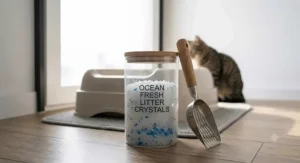
Cat Litter Deodorizer for Multi-Cat Households and Sensitive Cats
Multi-cat households face a compounding problem: waste volume scales with cat count, but litter box count and cleaning frequency often don’t scale to match, which is exactly the scenario where a weaker deodorizer gets overwhelmed fastest. For these homes, adsorption-strength products — activated carbon or, for tolerant cats, the stronger corncob-and-oil blend — tend to outperform baking-soda options that simply don’t have the capacity for the added load. The old “one litter box per cat, plus one extra” rule matters here too, since spreading waste across more boxes reduces the concentration any single deodorizer application has to fight.
Sensitive cats — kittens, seniors, or any cat with a documented history of box avoidance — do best starting with the gentlest, most fragrance-free options on this list (Hepper, NonScents, plain Arm & Hammer) before ever introducing anything with added essential oils. Given how dramatically more sensitive a cat’s nose is than a human’s, what reads as “barely scented” to you can be genuinely off-putting to them, so the safest strategy with any new sensitive cat is always to introduce a small amount, observe box usage for a few days, and only scale up once you’re confident it isn’t triggering avoidance.
Frequently Asked Questions
❓ Does cat litter deodorizer actually work, or does it just mask smell?
❓ How often should I add cat litter deodorizer?
❓ Is activated charcoal litter deodorizer safe for cats?
❓ Can I use cat litter deodorizer with clumping litter?
❓ Why does my cat avoid the box after I add a new deodorizer?
Conclusion
If there’s one idea worth carrying away from all seven of these products, it’s this: the smell isn’t the enemy, the gas molecule is — and the best deodorizer for your home is whichever one actually deals with that molecule rather than just outshouting it. Budget baking-soda options like Arm & Hammer and Fresh Step earn their place for light, single-cat duty. NonScents and Hepper cover the fragrance-sensitive lane admirably. Rocco & Roxie brings genuine firepower for multi-cat odor at the cost of scent intensity, and Purrify’s activated carbon sits at the top of the list for anyone who’s tried everything else and is still getting hit with ammonia at the door. None of these are magic — every one of them still needs a scooped, reasonably maintained box underneath to do its job. But matched correctly to your household size, your cat’s sensitivity, and the actual odor problem you’re facing, the right pick from this list should make walking past that box a genuinely non-event again.
✨ Ready to Finally Fix That Litter Box Smell?
🔍 Check current pricing and availability on any of the seven picks above, and pick the mechanism — not just the scent — that actually matches your household’s needs.
Recommended for You
- Cat Litter Mat: 7 Best Picks to Stop Litter Tracking in 2026
- Corner Litter Box: 7 Best Space-Saving Picks for 2026
- 7 Best Hidden Litter Box Furniture Picks for a Fresh Home (2026)
Disclaimer: This article contains affiliate links. As an Amazon Associate, I earn from qualifying purchases. If you purchase products through these links, we may earn a small commission at no additional cost to you.
✨ Found this helpful? Share it with your friends! 💬🤗
