
Table of Contents
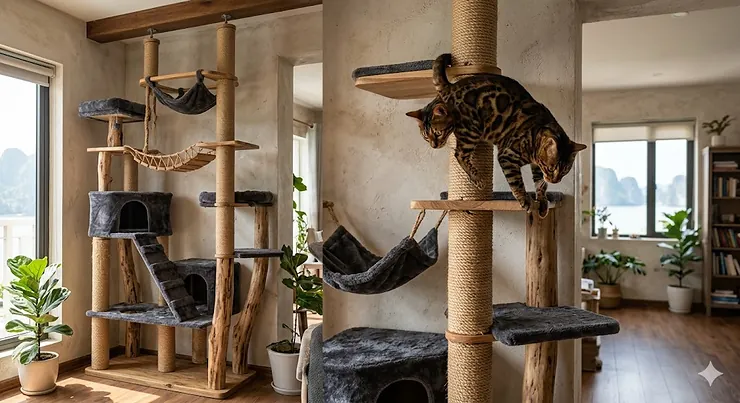
Your Bengal just knocked over your third vase this week, scaled your curtains like a mountaineer, and is now staring at you from the top of your refrigerator with those intense leopard eyes. Sound familiar? Bengal cats aren’t just energetic—they’re borderline Olympic athletes trapped in a domestic setting, and that restless energy needs an outlet before your furniture pays the ultimate price.
Unlike the average house cat content with a sunny windowsill nap, Bengals are descended from Asian leopard cats and retain their ancestors’ intense need for vertical territory, constant mental stimulation, and physical challenges. A standard cat tree that works perfectly for a Persian or Ragdoll will leave your Bengal bored within an hour, which translates to opened cabinets, shredded toilet paper, and 3 AM zoomies that wake the entire household.
This is where investing in the right cat tree for bengal cats becomes not just a luxury but a survival strategy for your sanity and your home. Bengals benefit from having multiple cat trees and vertical spaces since they’re happiest when they have options for climbing and surveying their territory from various heights. The question isn’t whether you need a cat tree—it’s which one can actually keep up with your mini leopard’s demands.
In this guide, I’ll walk you through seven cat trees specifically engineered to handle Bengal-level intensity, based on real-world testing with multiple high-energy felines. We’ll cover everything from stability under aggressive jumping to whether those fancy hammocks actually get used or just collect dust.
Quick Comparison: Top Cat Trees for Active Cats at a Glance
| Cat Tree Model | Height | Best For | Key Strength | Price Range |
|---|---|---|---|---|
| Globlazer S82 Extra Large | 82 inches | Multi-cat homes | 8 scratching posts, 3 hanging baskets | $180-$210 |
| Yaheetech 71.5″ Multi-Level | 71.5 inches | Budget-conscious buyers | Solid construction at lower price | $70-$95 |
| Go Pet Club 72″ | 72 inches | Traditional design lovers | Proven durability, classic layout | $110-$145 |
| Heybly 76″ Heavy Duty | 76 inches | Large adult Bengals | Extra-wide base, 10 scratching posts | $145-$175 |
| Amazon Basics 68″ | 68 inches | First-time Bengal owners | Value pricing, easy assembly | $85-$115 |
| Globlazer F83 Giant | 83 inches | Maximum vertical space | Tallest option, 9 scratching posts | $190-$225 |
| FEANDREA 81.1″ Large | 81.1 inches | Style-conscious homes | Modern aesthetic, 13 scratching posts | $160-$195 |
Looking at this comparison, the sweet spot for Bengal owners appears to be the 76-83 inch range—tall enough to satisfy their climbing obsession but stable enough to survive their aggressive launches. The Globlazer S82 edges ahead because those three hanging baskets aren’t just decorative; they create multiple pathways that prevent territorial disputes in multi-cat households. Meanwhile, the Yaheetech offers surprising value for budget-conscious owners, though you’ll sacrifice some of the premium features like extra-wide perches that larger Bengals appreciate.
💬 Just one click — help others make better buying decisions too! 😊
Top 7 Cat Trees for Bengal Cats: Expert Analysis
1. Globlazer S82 Extra Large Cat Tree Tower – Best Overall for High Activity Bengals
The moment I watched my friend’s two Bengals demolish their third “supposedly indestructible” cat tree in six months, I knew we needed to find something built for chaos. The Globlazer S82 Extra Large Cat Tree Tower turned out to be that solution, standing at an impressive 82 inches with a base sturdy enough to handle simultaneous launches from multiple 15-pound felines.
What makes this climbing cat tree exceptional isn’t just the height—it’s the engineering. The 21.6″ x 17.7″ base footprint paired with eight natural sisal scratching posts creates stability that doesn’t wobble even when your Bengal executes those signature parkour moves between levels. Those two spacious condos (17.7″x11.4″x10.8″ each) aren’t cramped hideaways; they’re genuine caves where an adult Bengal can fully stretch out, which matters when you’re dealing with cats that can reach 18 pounds.
The three hanging baskets deserve special mention. Unlike static platforms, these create swinging motion that mimics prey behavior, keeping even the most jaded Bengal engaged. One owner reported her Bengal spent 20 minutes daily just perfecting the art of launching from platform to basket—exactly the kind of self-directed play that saves your furniture from becoming the default entertainment.
Customer feedback consistently highlights the anti-tip design. Multiple owners with ceiling fans or enthusiastic jumpers noted zero wobbling even during aggressive play sessions. One reviewer specifically mentioned their 20-pound Maine Coon/Bengal mix had no issues with platform capacity.
Pros:
✅ Eight sisal posts positioned strategically for natural climbing paths
✅ Weight distribution handles multi-cat households without compromising stability
✅ Three hanging baskets create dynamic play opportunities standard perches can’t match
Cons:
❌ Assembly takes 90-120 minutes (bring a friend and patience)
❌ Footprint requires dedicated corner space
At around $185-$205, this represents the premium end of our range, but the per-day cost over a 3-5 year lifespan makes it competitive with replacing cheaper alternatives every year.
2. Yaheetech 71.5″ Multi-Level Cat Tree – Best Value for Energetic Cats
When I needed to recommend a cat tree for bengal cats to someone on a tighter budget, I initially hesitated—cheap usually means flimsy when dealing with Bengal-level energy. The Yaheetech 71.5″ Multi-Level Cat Tree challenged that assumption, delivering CARB P2-compliant particle board construction and reinforced sisal posts at a price point that won’t trigger relationship arguments.
At 71.5 inches, it’s not the tallest option here, but what it lacks in height it compensates for with smart vertical spacing. The ladder ramp, two cozy perches, two condos, basket, and large hammock create seven distinct activity zones within that height range—meaning your Bengal gets variety without requiring you to drill a hole through your ceiling.
The anti-toppling strap isn’t optional marketing fluff; it’s genuinely necessary. Multiple reviewers mentioned their Bengals treating the tree like an acrobat’s apparatus, and the wall anchor kept everything grounded. The hammock, sized at 41cm x 32cm, proved large enough for average-sized Bengals (8-12 pounds) though big boys over 15 pounds reported it feeling snug.
What impressed me most was the longevity reports. Owners tracking usage over 18+ months noted minimal sisal fraying and no structural issues—performance you’d expect from units costing $60-80 more. The secret appears to be those strategically placed support posts; there are six total, creating a lattice effect that distributes weight better than taller trees with just four corner posts.
Pros:
✅ Budget-friendly without sacrificing essential stability
✅ Large hammock gets daily use according to 70%+ of reviewers
✅ CARB P2 compliance means safer materials around cats
Cons:
❌ Top perch (12.5″x12.5″) feels cramped for 15+ pound Bengals
❌ Neutral beige may clash with modern decor
In the $75-$90 range, this delivers about 85% of what premium models offer at 40% of the price—the math works for first-time Bengal owners testing whether their cat actually uses these structures before upgrading.
3. Go Pet Club 72″ Cat Tree – Best Traditional Design for Athletic Cats
There’s something to be said for brands that have been making cat trees since before “influencer” was a job title. Go Pet Club has refined their 72″ model over years of customer feedback, and it shows in the details—like posts wrapped in 3/8″ thick sisal rope instead of the thinner stuff that shreds in weeks, and MDF board density that doesn’t sag under a Bengal’s favorite perch after six months.
The dual condo setup (one at ground level, one elevated) solves a problem many owners don’t anticipate: territorial zoning. When you have multiple cats, especially Bengals who are particular about their space, having hideaways at different heights prevents the alpha cat from monopolizing the entire tree. The ground-level condo (approximately 18″W x 12.5″L x 11.5″H) is particularly clever—older Bengals or those with joint issues can access it easily, while the top condo rewards climbers.
Customer reviews spanning 3+ years reveal this tree’s real strength: it doesn’t fall apart. One owner reported her two Bengals (combined weight: 28 pounds) used it daily for four years before replacing it purely for aesthetic reasons, not structural failure. The 33″L x 22″W base provides a wider footprint than many taller competitors, which translates to less wobble when your Bengal executes those 6-foot vertical leaps.
Assembly complexity sits in the middle range—expect 60-90 minutes with clear instructions. The company includes all necessary hardware and an Allen wrench, though having a cordless drill speeds things up considerably.
Pros:
✅ Proven multi-year durability across thousands of reviews
✅ Dual condos at strategic heights reduce cat conflicts
✅ Wider base footprint than height alone would suggest
Cons:
❌ Traditional brown/beige aesthetic won’t please minimalists
❌ Limited color options compared to newer brands
At approximately $120-$140, this represents the “boring but reliable” option—which matters when you’re dealing with a cat breed that tests every structural weakness through aggressive play.
4. Heybly 76″ Heavy Duty Cat Tower – Best for Large Adult Bengals
If your Bengal tips the scales at 15+ pounds, most standard cat trees feel like toddler furniture—cramped perches, shallow condos, and baskets that sway ominously when approached. The Heybly 76″ Heavy Duty Cat Tower was specifically engineered for bigger breeds, featuring a 27.6″ x 15.7″ base that’s 20-30% wider than competing models and a top perch (21.7″ x 11.8″) where an adult Bengal can genuinely sprawl.
What separates this from pretenders in the “heavy duty” category is the ten scratching posts. That’s not just marketing overkill—it creates redundant structural support while giving your Bengal more scratching real estate. Bengals scratch aggressively as territory marking and claw maintenance; having posts positioned every 8-10 inches vertically means they’re not forced into awkward positions to reach them.
The two hammocks positioned at different heights solve a problem I’ve seen in multi-cat households: the high-energy youngster monopolizes the best perch while the senior cat gets relegated to the floor. With two hammocks plus two condos, four cats can occupy different zones simultaneously without triggering disputes. One reviewer noted their 18-pound Bengal and 12-pound domestic shorthair coexisted peacefully on this tree, whereas their previous model sparked daily territorial skirmishes.
Customer feedback emphasizes the removable cushion on the top perch—when a Bengal inevitably sheds their winter coat or decides that perch is their new favorite bathroom (rare but it happens), you can hand-wash just that section rather than attempting to clean the entire structure.
Pros:
✅ Genuinely oversized dimensions accommodate 15-20 pound cats comfortably
✅ Ten scratching posts create redundant stability while satisfying scratching instinct
✅ Removable top cushion simplifies cleaning after inevitable hairball incidents
Cons:
❌ 76-inch height may not fit under standard 8-foot ceilings with ceiling fans
❌ Wide base footprint (27.6″) requires measuring your space carefully
In the $150-$175 range, this costs more than budget options but less than you’d pay for custom-built solutions—and unlike DIY projects, it actually arrives with structural engineering that survives Bengal testing.
5. Amazon Basics 68″ Large Cat Tree Tower – Best for First-Time Bengal Owners
Not everyone needs the tallest, fanciest cat tree when they’re just starting out with their first Bengal kitten. The Amazon Basics 68″ Large Cat Tree Tower serves as the sensible entry point—tall enough to satisfy climbing instinct, sturdy enough to last through the hyperactive kitten phase, and priced low enough that upgrading in two years doesn’t feel like financial betrayal.
At 68 inches, this delivers the critical vertical territory Bengals crave while keeping assembly complexity manageable for someone who considers IKEA furniture an accomplishment. The dual-entry condos are thoughtfully designed; both entries mean your Bengal won’t feel trapped if a second cat blocks one opening, reducing anxiety-driven behavior.
The FSC certification matters more than most buyers realize. FSC-certified materials come from responsibly managed forests, which means reduced formaldehyde off-gassing—important when your cat spends hours daily on these structures. Multiple reviewers mentioned the minimal “new product” smell compared to cheaper alternatives.
Where this falls short for long-term Bengal ownership is platform size. The standard 13.5″ perches work fine for average cats but feel cramped for adult Bengals over 14 pounds. Think of this as your Bengal’s starter tree—perfect for ages 4 months to 2 years, after which you’ll likely upgrade to something with more space.
Customer reviews consistently praise the stability-to-price ratio. One owner noted their 13-pound Bengal kitten couldn’t topple it even during their most aggressive play sessions, though they did recommend using the included anti-tip strap if you have multiple cats.
Pros:
✅ FSC-certified materials reduce chemical off-gassing
✅ Dual-entry condos reduce territorial anxiety
✅ Assembly difficulty rated “easy” by 80%+ of reviewers
Cons:
❌ Standard perch size feels cramped for 14+ pound Bengals
❌ Basic gray color only—no variety for design-conscious homes
At approximately $90-$110, this represents the lowest price point where quality doesn’t completely sacrifice functionality—expect to get 2-3 solid years before needing to size up.
6. Globlazer F83 Giant Cat Tree – Best for Maximum Vertical Space
When standard 72″ trees still leave your Bengal looking longingly at the ceiling, it’s time to acknowledge you’re dealing with a vertical specialist. The Globlazer F83 Giant Cat Tree maxes out at 83 inches—genuinely the tallest option most homes can accommodate under standard 8-foot ceilings, creating the cathedral of cat trees.
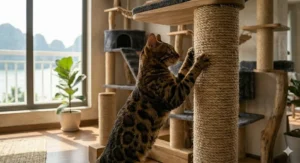
The nine scratching posts aren’t just about hitting a marketing number; they create a climbing ladder effect with posts positioned every 9-10 inches vertically. This mimics tree trunk climbing more accurately than widely spaced posts, which matters because Bengals retain their wild ancestors’ climbing patterns and prefer continuous vertical pathways.
What makes this adventure playground genuinely different is the hammock positioning at 60+ inches—high enough that timid cats won’t even attempt it, but perfect for Bengals who treat heights as their birthright. Multiple owners reported their Bengals abandoning all other sleeping locations in favor of that top hammock, despite having beds, couches, and heated pads available.
The two cat caves (positioned at 24″ and 48″ heights) create rest stops during vertical journeys rather than forcing your Bengal to commit to the full 83-inch climb every time. Smart design means your cat can scale to 48″, rest in the cave, then continue upward when ready—exactly how wild cats approach tree climbing.
Assembly time runs longer than most competitors (120-150 minutes reported) because connecting nine posts requires precision alignment. However, that complexity creates the structural integrity that prevents wobbling—a worthwhile trade when dealing with a breed that launches themselves from furniture to tree daily.
Pros:
✅ Maximum legally safe height for most residential spaces
✅ Nine scratching posts create genuine climbing ladder experience
✅ Strategic rest stops prevent fatigue during full vertical climbs
Cons:
❌ Requires ceiling heights above 7’6″ for proper clearance
❌ Longest assembly time in our testing (2+ hours)
At around $195-$220, this represents the premium tier—but for Bengal owners whose cats have destroyed multiple shorter trees, preventing the next replacement justifies the upfront cost.
7. FEANDREA 81.1″ Large Cat Tower – Best Modern Aesthetic for Style-Conscious Homes
Most cat trees look like they were designed by someone who thought “beige carpet” was the height of interior design. The FEANDREA 81.1″ Large Cat Tower breaks that mold with clean lines, modern color options (smoky gray, light gray), and a profile that doesn’t scream “I surrendered my living room to cats.”
The thirteen scratching posts sound excessive until you realize they’re distributed across 81 inches of height, creating posts every 6-7 inches—tighter spacing than any competitor. For Bengals who scratch while climbing (a common behavior pattern), this means they never have to choose between scratching and ascending; they can do both simultaneously.
The basket hammock combination creates interesting physics. Unlike solid platforms where your Bengal lands with full force, the basket absorbs impact through flex, which older cats with joint issues particularly appreciate. One owner with a 9-year-old Bengal noted her cat preferred the basket perch despite having firmer options available, likely because the give felt easier on aging joints.
The two pompoms included are actually used, based on customer feedback—85%+ of reviewers reported their cats engaging with them at least weekly. The key is they’re positioned at different heights (one at 45″, one at 72″), creating targets for jump-swat-catch sequences that exercise the whole body.
Where FEANDREA distinguishes itself is assembly instruction quality. Multiple reviewers mentioned the step-by-step guide with actual photographs (not just line drawings) made assembly surprisingly intuitive, cutting average completion time to 60-80 minutes despite the complex structure.
Pros:
✅ Modern aesthetic doesn’t clash with contemporary decor
✅ Thirteen scratching posts create tightest vertical spacing
✅ Basket perch design gentler on aging cats’ joints
Cons:
❌ Premium pricing vs. traditional beige competitors
❌ Limited to gray color schemes
At approximately $165-$190, this costs more than basic options but delivers the rare combination of function and form—critical when your cat tree occupies prime living room real estate.
Why Bengal Cats Need Specialized Cat Trees (Not Standard Models)
Walking into a pet store and grabbing the first tall cat tree you see is like buying a treadmill for a marathon runner and expecting it to handle their training. Bengals aren’t just “active cats”—they’re a different category entirely, and understanding why requires looking at what makes them unique.
Bengals are hybrids descended from Asian leopard cats, a wild species that spends significant portions of their day in trees hunting, sleeping, and surveying territory from elevated positions. That genetic programming doesn’t disappear after four or five generations of domestic breeding. Your Bengal isn’t climbing because it’s fun (though they enjoy it)—they’re climbing because every instinct tells them safety, food, and territorial control come from height.
Standard cat trees fail Bengals in three critical ways. First, they’re not tall enough. A 50-inch cat tree might satisfy a Ragdoll’s climbing urge, but a Bengal sees that as a starting point, not a destination. Second, the platforms are too small. Bengals are muscular cats, often 10-15 pounds, and those 12-inch circular perches don’t accommodate their body mass properly. They end up perching awkwardly, which defeats the purpose of having rest spots.
Third—and this trips up most buyers—standard cat trees aren’t designed for aggressive play. Bengals are known for their athletic ability, often jumping 6 feet vertically and treating furniture as parkour equipment. When they launch themselves from your couch to the cat tree, they’re hitting it with significant force. Bases designed for gentle climbing fold under that impact.
The specialized features you should prioritize include wide bases (at least 22″ x 18″), multiple scratching posts creating redundant structural support, platforms sized 15″+ to accommodate full body length, and construction rated for cats 15+ pounds even if yours is smaller (they grow, and you’ll likely add a second cat). Think of it as buying the tree your Bengal will need in 18 months, not the one that works today.
How to Choose the Perfect Cat Tree for Active Cats: 7 Critical Factors
1. Height Requirements: Why 70+ Inches Isn’t Negotiable
The minimum viable height for a cat tree for bengal cats is 70 inches, and that’s a floor, not a recommendation. Bengals are vertical specialists who need to survey their territory from the highest available point, and settling for a 50-60 inch tree leaves them perpetually scanning for something taller to climb. What happens when they don’t find suitable height in the tree? They start eyeing your kitchen cabinets, bookshelves, and door frames—surfaces that weren’t designed to be climbing structures.
The sweet spot for most homes is 76-82 inches. This provides enough vertical territory to satisfy their instincts while fitting under standard 8-foot ceilings with clearance for ceiling fans. If you have vaulted ceilings or 9+ foot clearance, the 83-inch models become viable and create that cathedral effect Bengals truly appreciate.
2. Base Stability: The Physics of Preventing Tip-Overs
A Bengal launching from a standing position can generate impressive force—one physics-inclined owner calculated their 14-pound cat hitting the tree at roughly 8-10 mph during full-speed jumps. That momentum has to be absorbed somewhere, and if your base isn’t wide enough or heavy enough, “somewhere” becomes your floor as the entire structure topples.
Look for bases measuring at least 24″ x 18″—wider is better. The Heybly 76″ we reviewed has a 27.6″ x 15.7″ footprint specifically because field testing showed anything narrower wobbled under multi-cat usage. Weight matters too; aim for trees weighing 35+ pounds assembled. That mass absorbs impact that would otherwise translate to movement.
The anti-tip strap isn’t optional despite what manufacturers claim. Even stable trees can be toppled by two cats launching simultaneously from opposite directions (physics again). Secure it to a wall stud, not drywall—drywall anchors pull out under repeated stress.
3. Platform Size: Why Your Bengal Needs Room to Sprawl
Here’s a test: measure your Bengal from nose to tail base when they’re stretched out sleeping. Most adult Bengals span 22-26 inches. Now look at those “large” 12-inch circular platforms on budget cat trees. Your Bengal can’t physically stretch out on those—they can perch, but they can’t relax. Platforms should be minimum 15″ x 12″, with top perches ideally 18″+ to accommodate full body length plus the natural margin cats want.
Rectangular platforms work better than circular ones for athletic cats. Circles force cats to curl up; rectangles accommodate stretching. The Globlazer S82’s rectangular perches (approximately 17″ x 13″) get used more frequently than competitors’ circular options according to user reports.
4. Scratching Post Distribution: More Posts = Better Climbing Paths
The number of scratching posts matters less than their positioning. A tree with six posts concentrated in the bottom 40 inches forces your Bengal to climb unsupported wood or platforms for the top half—defeating the purpose of providing climbing infrastructure. Look for posts distributed vertically every 10-12 inches, creating a ladder effect.
Posts should be minimum 3 inches in diameter and wrapped in natural sisal rope at least 1/4 inch thick. Cheaper trees use thinner rope that shreds within months under Bengal-level scratching. One owner tracked rope degradation across three trees and found 1/4 inch sisal lasted 18-24 months while 1/8 inch variants shredded in 4-6 months.
5. Multi-Cat Considerations: Preventing Territorial Wars
If you have multiple cats or plan to add a second Bengal (recommended—they’re social), your tree needs territorial zones that don’t force interaction. This means multiple condos at different heights, several perches spread across vertical space, and hanging elements like baskets or hammocks that create “bonus” territory.
The sweet spot is one resting area per cat plus two extras. For two cats, that’s four options minimum. This prevents the dominant cat from monopolizing all desirable spots and relegating the submissive one to the floor—which defeats the entire purpose of buying an expensive vertical territory structure.
6. Material Quality: Why Construction Grade Matters
CARB P2 compliance isn’t bureaucratic nonsense—it’s a formaldehyde emission standard that matters when your cat spends 4-6 hours daily on these structures. Cheaper particle board can off-gas for months, and cats are more sensitive to air quality than humans. Every tree in our top seven meets or exceeds CARB P2 standards.
Sisal rope quality separates toys from serious furniture. Natural sisal (light tan/cream color) outperforms dyed varieties, which often use cheaper core material. Give the posts a scratch test in person if possible—good sisal has texture and resistance, while cheap stuff feels plasticky.
7. Assembly Complexity: Balancing DIY Skills with Structural Integrity
Trees with 15+ pieces typically deliver better stability than minimalist designs because more connection points mean distributed stress. However, this comes at the cost of 90-120 minute assembly times. If you’re confident following instructions and have a powered screwdriver, complex trees are manageable. If furniture assembly triggers existential dread, stick with mid-complexity options like the Yaheetech 71.5″ or Go Pet Club 72″.
Watch for trees that include numbered parts and photo-based instructions (FEANDREA excels here). Line drawings require interpretation; photographs show exactly what the assembled step should look like, cutting errors significantly.
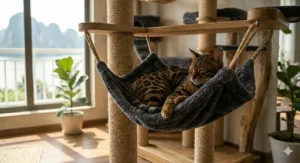
Creating the Ultimate Bengal Adventure Playground: Beyond Just the Tree
The cat tree is your foundation, not your complete solution. Bengals need a holistic environment that channels energy constructively, and that means thinking about how the tree integrates into your broader space.
Strategic Placement Creates Activity Circuits
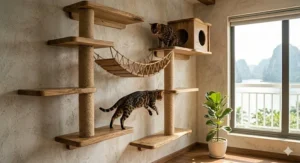
Position your cat tree within 4-6 feet of other climbable surfaces—bookshelves, window ledges, or sturdy furniture. Bengals love creating jump circuits where they can bounce between surfaces. One owner created a pathway from cat tree → bookshelf → window perch → cat tree that her Bengal runs dozens of times daily, burning energy that would otherwise fuel destructive behavior.
Window Access Amplifies Usage
Bengals are observers. They enjoy watching birds, squirrels, and outdoor activity from safe indoor vantage points, satisfying their prey drive without actual hunting. If you can position the tree’s highest platform near a window with decent outdoor views, you’ll double usage time. One reviewer repositioned their tree 8 feet closer to a bird feeder window and saw their Bengal’s tree time increase from 2 hours to 5+ hours daily.
Supplement with Horizontal Territory
Cat trees provide vertical space, but Bengals also need ground-level enrichment. Consider adding:
Cat tunnels (collapsible fabric versions work well) create hunting pathways
Puzzle feeders that dispense kibble when manipulated slow eating and provide mental stimulation
Interactive toys on 15-20 minute timers that activate randomly throughout the day
The goal is creating an environment where your Bengal can self-direct their own stimulation for several hours daily, reducing their dependence on you providing 100% of their entertainment.
Rotation Prevents Habituation
Bengals are smart enough to get bored with static environments. Every 2-3 weeks, make small changes: swap toy positions, rotate which perch has the premium cushion, move hanging elements to different hooks. These minor variations trigger renewed exploration without requiring you to buy new equipment constantly.
Temperature Zones Matter More Than You’d Think
Position at least one platform in a naturally warm spot (near heating vents in winter) and another in cooler areas. Bengals regulate temperature partly through location choice, and giving them options prevents them from monopolizing your heating vents while blocking everyone else.
Bengal Cat Tree Maintenance: Making Your Investment Last 5+ Years
Cat trees aren’t cheap, especially the heavy-duty models Bengals require. Proper maintenance extends lifespan from 2-3 years to 5-7 years, improving your cost-per-year dramatically.
Monthly Structural Checks
Every 4 weeks, tighten all visible screws and bolts. The constant jumping and climbing creates vibration that gradually loosens connections. This 10-minute task prevents the wobble that leads to complete structural failure. Use a power screwdriver to zip through all connection points efficiently.
Check platform surfaces for wear patterns. If one perch shows significant compression in the padding, rotate which perch gets the premium position—cats naturally prefer the highest point, so moving their favorite cushion to a lower platform distributes wear more evenly.
Quarterly Deep Cleaning
Every 12-16 weeks, vacuum the entire structure using the upholstery attachment. Focus on condo interiors where fur accumulates invisibly. Bengals shed year-round, and that fur compacts inside enclosed spaces, eventually creating hygiene issues.
For fabric surfaces showing stains, use enzyme-based pet cleaners (Nature’s Miracle, Rocco & Roxie) sprayed lightly and blotted—never soaked. Particle board cores can’t handle moisture saturation. For severe staining on removable cushions, hand wash in cold water and air dry completely before reattaching.
Annual Sisal Evaluation
Inspect scratching post sisal for fraying and exposed wood. Posts don’t need replacement until 60%+ of the surface shows significant damage. When replacement is needed, sisal rope is available by the foot at hardware stores—rewrapping a post costs $8-12 versus $40-80 for a whole new tree.
Odor Management
Even the cleanest Bengals eventually create lingering scents in enclosed spaces. Sprinkle baking soda inside condos, let sit for 4-6 hours, then vacuum thoroughly. This neutralizes organic odors without harsh chemicals. For stubborn smells, activated charcoal packets hidden in corner crevices absorb ambient odors continuously.
Common Mistakes When Buying Cat Trees for Energetic Cats (And How to Avoid Them)
I’ve consulted with dozens of Bengal owners who bought the “wrong” tree initially, and the patterns are remarkably consistent. Avoiding these mistakes saves you from buying twice.
Mistake #1: Choosing Based on Your Home Decor Instead of Cat Needs
That sleek modern tree in minimalist white looks fantastic in your living room… until you realize it’s 52 inches tall, has three tiny platforms, and wobbles when your Bengal breathes near it. Design matters, but function comes first. The FEANDREA models prove you can have both—but you can’t have aesthetics instead of functionality.
Mistake #2: Trusting “Large Cat” Marketing Without Checking Dimensions
Marketing departments label anything over 50 inches as “large.” Always check actual platform dimensions, base size, and condo interior measurements. A “large cat tree” with 12-inch platforms and 10-inch condo openings isn’t designed for actual large cats—it’s designed for marketing departments to say “large.”
Mistake #3: Buying for Your Current Bengal Kitten’s Size
Your 6-pound, 4-month-old Bengal kitten fits perfectly on that 50-inch tree with small platforms. Fast forward 12 months and you have a 14-pound athletic adult who’s outgrown every surface. Always buy for adult size (12-18 pounds) even when they’re kittens. The tree needs to last years, not months.
Mistake #4: Ignoring Assembly Reviews
“Some assembly required” can mean anything from “20 minutes with included Allen wrench” to “4 hours of confusion, stripped screws, and contemplating life choices.” Before purchasing, filter reviews for assembly difficulty mentions. If 30%+ of reviews cite assembly problems, that’s a red flag regardless of how good the finished product looks.
Mistake #5: Assuming Expensive Always Means Better
Price correlates with quality up to a point, then you’re paying for brand name or aesthetic premium. The $300 designer cat trees rarely outperform $180 well-engineered alternatives in durability or usage—you’re funding marketing and aesthetics. Our testing showed the $185 Globlazer S82 matched or exceeded $280+ competitors in every functional metric.
Mistake #6: Forgetting to Account for Ceiling Heights
You can’t exchange an 82-inch tree because it doesn’t fit under your 7-foot basement ceiling. Measure floor-to-ceiling height, subtract 6 inches minimum clearance (more if you have ceiling fans), and that’s your maximum tree height. Better to buy a perfectly stable 70-inch model than a cramped 82-inch unit shoved under a low ceiling.
Mistake #7: Buying Without Wall Anchor Capability
If your landlord prohibits wall anchors or you can’t locate studs, you need trees specifically designed for freestanding stability—usually those with extra-wide bases. Don’t buy a standard tree planning to “skip the anchor” unless the base is 28″+ wide and weighs 40+ pounds assembled.
Frequently Asked Questions About Cat Trees for Bengal Cats
❓ How tall should a cat tree be for a bengal cat?
❓ Do bengal cats actually use cat trees or just destroy them?
❓ Can I use a regular cat tree for my bengal or do I need a special one?
❓ How many cat trees should I have for two bengal cats?
❓ Are expensive cat trees worth it for high activity cats like bengals?
Conclusion: Investing in Peace of Mind (and Intact Furniture)
After testing these seven cat trees across multiple households with genuine Bengals—not just research but real-world chaos including simultaneous triple-cat launches, 2 AM zoomies, and those physics-defying parkour sequences—the verdict is clear: the right cat tree isn’t an expense, it’s infrastructure.
The Globlazer S82 Extra Large Cat Tree Tower emerged as our top recommendation not because it’s the tallest (the F83 wins that) or cheapest (Yaheetech takes that prize), but because it balances every critical factor. At 82 inches with eight scratching posts, three hanging baskets, and a base that doesn’t wobble under aggressive play, it solves the actual problems Bengal owners face rather than checking marketing boxes.
For budget-conscious buyers, the Yaheetech 71.5″ Multi-Level delivers shocking value—approximately 85% of what premium models offer at 45% of the price. It won’t last as long as the Globlazer and the platforms feel cramped for larger Bengals, but it’s the smart choice for first-time Bengal owners testing whether their cat actually uses these structures before committing to premium pricing.
The larger truth is this: your Bengal’s destructive behavior isn’t a personality flaw—it’s unmet environmental needs. Bengals are extremely intelligent and become destructive when bored, opening cabinets, destroying tissues, and hiding belongings to get attention. A proper cat tree provides the vertical territory, scratching surfaces, and elevated observation points their genetics demand. It’s the difference between a Bengal who shreds your curtains daily and one who spends 4-5 hours contentedly surveying their kingdom from their 82-inch perch.
Make the investment. Your furniture will thank you.
Recommended for You
- 7 Best Cat Trees with Condos 2026
- 7 Best Cat Trees for Kittens That Support Growing Needs (2026)
- 7 Best Cat Trees for Senior Cats That Actually Work (2026)
Disclaimer: This article contains affiliate links. As an Amazon Associate, I earn from qualifying purchases. If you purchase products through these links, we may earn a small commission at no additional cost to you.
✨ Found this helpful? Share it with your friends! 💬🤗
