
Table of Contents
You walk into your living room and find your cat perched on top of the refrigerator… again. Or maybe they’re balancing precariously on the curtain rod, surveying their kingdom with zero regard for your stress levels. Here’s the thing: your cat isn’t being difficult. They’re just following 10,000 years of evolutionary programming that tells them height equals safety, control, and happiness.
A cat walkway isn’t just fancy wall furniture—it’s a game-changer for indoor cats craving vertical territory. Research from the National Center for Biotechnology Information shows that cats with access to elevated pathways display significantly lower stress indicators compared to those confined to floor-level living. What most cat owners overlook is that vertical space actually multiplies your home’s usable territory without sacrificing a single square foot of your living area. The difference between a cat stuck on the ground and one exploring wall-mounted routes? It’s like comparing a studio apartment to a multi-story mansion from a feline perspective.
In this comprehensive guide, I’m breaking down the seven best cat walkway systems available in 2026, along with everything you need to know about choosing, installing, and maximizing these vertical playgrounds. Whether you’re dealing with a bengal who treats your walls like Mount Everest or a senior cat who’d appreciate gentler elevation changes, we’ve got you covered.
Quick Comparison Table: Top Cat Walkways at a Glance
| Product | Best For | Weight Capacity | Installation Type | Price Range |
|---|---|---|---|---|
| CatastrophiCreations Cat Bridge | Multi-cat households | 120 lbs | Wall studs | $90-$140 |
| YITAHOME 78″ Wall System | Large vertical spaces | 60 lbs | Wall mounted | $150-$200 |
| FUKUMARU 4-in-1 Set | Budget-conscious buyers | 44 lbs per shelf | 16″ studs | $100-$150 |
| Meowoou Rope Bridge | Natural aesthetic lovers | 25 lbs | Wall brackets | $60-$90 |
| Feandrea Clickat Collection | Modular expansion | 84 lbs | Click system | $120-$180 |
Looking at this comparison, the CatastrophiCreations Bridge stands out for households with multiple or larger cats thanks to its impressive 120-pound capacity—that’s enough to handle three average-sized cats simultaneously crossing paths. Budget buyers should notice the FUKUMARU set delivers solid 44-pound capacity at mid-range pricing, though you’ll sacrifice some weight handling compared to premium options. The Feandrea Clickat system earns attention for its tool-free “click” assembly, cutting installation time by roughly half compared to traditional bracket systems.
💬 Just one click — help others make better buying decisions too!😊
Top 7 Cat Walkways: Expert Analysis & Real-World Performance
1. CatastrophiCreations Cat Bridge Wall-Mounted
This suspended pathway has dominated the cat furniture market since 2013, and for good reason. The CatastrophiCreations Cat Bridge creates an aerial highway across doorways, windows, or open wall spaces using chew-proof paracord and bamboo mounting planks. Available in 34″, 50″, and 66″ lengths, this bridge accommodates standard 16″ or 24″ stud spacing found in most American homes.
Key Specs: The bridge uses sustainable bamboo planks that are water-resistant and finished for outdoor durability, paired with heavy-duty paracord that’s designed to support up to 120 pounds. What the spec sheet won’t tell you is that this weight capacity means even Maine Coons can traverse confidently while a second cat waits at the opposite end—something cheaper rope bridges can’t guarantee. The “sag” design (3-4 inches of intentional drop) creates a gentle hammock effect that cats find irresistible for lounging mid-crossing.
Expert Opinion: This bridge solves a problem most cat owners don’t realize they have: how to connect vertical territories across gaps without bulky furniture. It’s ideal for multi-cat homes where you need multiple routes to prevent territorial bottlenecks. The hidden bracket system gives you that “floating” aesthetic without visible hardware cluttering your walls. What I especially appreciate is the modular compatibility—you can slot perpendicular shelves into the bridge planks to create true three-dimensional highways.
Customer Feedback: Buyers consistently praise the bridge’s durability, with many reporting years of daily use without sagging or rope wear. The main learning curve is installation; you absolutely need a stud finder and power drill, and having a second person makes the process significantly smoother. Some customers with shy cats note a 3-5 day adjustment period before their cats felt confident walking the moving surface.
✅ Pros:
- Exceptional 120-lb weight capacity handles multiple cats
- Sustainable bamboo construction with 3-year lifespan
- Hidden mounting hardware creates clean aesthetic
❌ Cons:
- Requires precise stud installation (not drywall-friendly without studs)
- Initial cost higher than basic shelf systems
Price & Value: Available in the $90-$140 range depending on length, this represents excellent long-term value given the durability and multi-cat capacity.
2. YITAHOME 78-Inch Tall Cat Tree Wall Mounted
The YITAHOME Tall Cat Tree Wall Mounted transforms entire walls into vertical playgrounds with its 78.7-inch floor-to-ceiling system. This isn’t just a walkway—it’s a complete ecosystem featuring five platform levels, dual hammocks, sisal stairs, and integrated scratching posts.
Key Specs: The structure uses 7.5cm (approximately 3-inch) diameter poles made from natural wood wrapped in sisal rope, with each pole anchored at both top and bottom for stability. The platform capacity sits at 60 pounds per level, which translates to reliable support for large breed cats. The spec sheet lists “removable cushions,” but here’s what matters: those cushions are actually machine-washable, solving the eternal problem of cat furniture that becomes a fur-collecting nightmare.
Expert Opinion: This system excels for cat owners who want to maximize vertical space in a single installation rather than piecing together individual components. The five-tier design provides multiple elevation options, which research from Cornell University’s Animal Behavior Clinic identifies as crucial for reducing stress in multi-cat households—each cat can claim different height territories to avoid conflict. The dual hammocks positioned at mid and upper levels give cats the elevated rest spots they instinctively crave. What most buyers don’t realize until installation: the floor-to-ceiling tension creates impressive stability that freestanding towers can’t match.
Customer Feedback: Users report this system works exceptionally well for active cats who treat it as both exercise equipment and observation post. The sisal coverage gets consistent use for claw maintenance. Some customers note the 78-inch height doesn’t truly reach standard 8-foot ceilings, so there’s typically a 16-18 inch gap at the top—not a problem functionally, but worth knowing for aesthetic planning.
✅ Pros:
- Complete vertical system in one package
- Thickened 3-inch poles provide superior stability
- Machine-washable components simplify maintenance
❌ Cons:
- Requires significant wall space commitment
- Assembly time averages 60-90 minutes
Price & Value: In the $150-$200 range, this delivers better value than purchasing equivalent components separately, though it’s an all-or-nothing investment.
3. FUKUMARU Cat Wall Shelves 4-in-1 Set
The FUKUMARU 4-in-1 Wall Mounted Set represents smart engineering for the American housing market. This collection includes a bridge, wall bed, scratching post, and platform shelf—all designed specifically for the 16-inch stud spacing found in most US drywall construction.
Key Specs: Built from multi-layer solid wood with peach velvet fabric covering, each component in this set has passed FUKUMARU’s internal load testing at 44 pounds per shelf. The cross-grain construction of the wood layers creates multiple support points that prevent the bending issues plaguing cheaper particle board alternatives. The bridge measures 39.37 inches and connects via 304 stainless steel screws to mounting brackets that hide completely when installed.
Expert Opinion: This set succeeds where many competitors fail: it’s genuinely designed for DIY installation by people who’ve never mounted cat furniture before. The 16-inch stud alignment eliminates the guesswork and drilling errors that plague off-spec products. What I find particularly clever is how the components work independently or together—you can install just the bridge between two rooms, or create a complete circuit around a bedroom. The peach velvet covering provides genuine traction advantage over smooth wood, especially valuable for older cats or kittens still developing coordination.
Customer Feedback: Buyers appreciate the straightforward installation process and the detailed instructions that actually match the hardware included. The aesthetic gets high marks for blending with modern home decor—the neutral wood tones don’t scream “cat furniture.” The main critique centers on the 44-pound weight limit, which handles most cats comfortably but may concern owners of particularly large breeds or those planning multi-cat traffic.
✅ Pros:
- Designed for standard US 16″ stud spacing
- Multi-functional pieces work independently or together
- Space-saving wall mount design
❌ Cons:
- 44-lb capacity may limit use with very large cats
- Requires electric drill and basic DIY skills
Price & Value: Around $100-$150 for the complete set positions this as excellent value for first-time vertical space installations.
4. Meowoou Cat Bridge Wall Mounted Rope Bridge
The Meowoou Cat Bridge takes a different approach with its handcrafted pine wood and natural rope aesthetic. This 39.37-inch bridge brings an organic, almost jungle-gym appearance that appeals to owners wanting furniture that looks less industrial.
Key Specs: Constructed from solid pine wood planks connected with heavy-duty rope, this bridge features realistic faux plant accents that double as visual camouflage in plant-heavy interiors. The adjustable length design allows some customization to your wall spacing, though you’re still working within the 16-24 inch stud spacing sweet spot. The weight capacity sits at approximately 25 pounds—suitable for average-sized cats but not the robust multi-cat traffic handler like pricier options.
Expert Opinion: This bridge shines in homes where aesthetics matter as much as function. The handcrafted pine and rope construction provides genuine texture variation that cats find engaging—my observation is cats tend to spend more time examining and scratching natural materials versus smooth manufactured surfaces. The faux plant integration helps this blend into biophilic design schemes where traditional black or grey cat furniture would clash. However, the trade-off for that natural look is the 25-pound capacity, which realistically limits this to single-cat crossing at a time.
Customer Feedback: Users love the appearance and report their cats readily adapt to the slightly wobbly nature of the rope suspension. Several buyers mention this works particularly well for playful cats who enjoy the dynamic surface, though it’s less ideal for elderly or anxious cats who prefer stable platforms. The natural materials do require occasional inspection for wear, unlike the virtually maintenance-free paracord options.
✅ Pros:
- Beautiful natural wood and rope aesthetic
- Faux plant accents blend with home decor
- Handcrafted quality construction
❌ Cons:
- Lower 25-lb weight capacity limits multi-cat use
- Natural materials require periodic wear inspection
Price & Value: At $60-$90, this offers budget-friendly entry into cat walkways for single-cat households prioritizing appearance.
5. Feandrea Clickat Collection Modular System
The Feandrea Clickat Collection revolutionizes installation with its patented click-together assembly system. This modular approach lets you build custom configurations from individual bridges, shelves, hammocks, and stairs without complicated bracket mounting.
Key Specs: Each Clickat module features an 84-pound weight capacity and 16-inch base spacing for stud alignment. The signature “Clickat structure” uses interlocking components that slide together—Feandrea claims this saves 50% of installation time compared to traditional screw-mount systems. All modules include replaceable felt pads that detach for washing, solving the hygiene problem that plagues non-removable fabric coverings.
Expert Opinion: This system addresses the biggest barrier to cat walkway adoption: installation intimidation. The click assembly means you can reconfigure your setup as you discover your cat’s preferences, something impossible with permanently screwed installations. What makes this particularly smart for growing cat families is the unlimited expandability—start with a basic shelf and bridge, then add stairs or hammocks as budget allows. The 84-pound capacity per module puts this in the premium tier for weight handling. The included drill bits, level tool, and screws show Feandrea understands their target customer wants minimal shopping friction.
Customer Feedback: Buyers consistently mention the assembly speed as the standout feature, with many reporting complete 4-piece installations in under 30 minutes. The felt pads get praised for comfort and easy cleaning. Some users note that while assembly is quick, you still need an electric drill for the initial wall mounting—the “click” system connects modules together, but the first anchor points require traditional drilling into studs.
✅ Pros:
- Revolutionary click-together assembly saves time
- 84-lb capacity handles large cats confidently
- Replaceable, washable felt pads
❌ Cons:
- Initial mounting still requires drill and stud finder
- Modular pieces create higher per-component cost
Price & Value: Individual modules range $40-$80, with complete 4-piece sets around $120-$180—premium pricing justified by the convenience and expansion flexibility.
6. MOCOHANA Wooden Wall-Mounted Cat Bridge
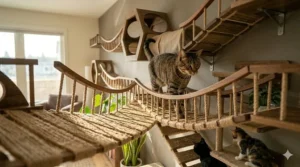
The MOCOHANA Wooden Wall-Mounted Bridge offers a minimalist suspended walkway with clean white ecological board construction. This 39.37-inch bridge uses simple fixed brackets and stainless steel connection hardware for a streamlined aesthetic.
Key Specs: Built from paint-free ecological board with a thickness of 0.59 inches, this bridge connects to walls via two fixed brackets (10.04″ x 9.45″ x 3.15″ each) using 304 stainless steel screws for corrosion resistance. The white finish comes from the material itself rather than paint, eliminating VOC concerns and future chipping issues. The bridge spans standard stud spacing and provides a 0.59-inch thick walking surface—narrow by some standards but adequate for cats’ balance abilities.
Expert Opinion: This represents the minimalist approach to cat walkways: no frills, no excessive features, just a clean suspended pathway. The ecological board material is essentially compressed wood fiber with a sealed surface, offering water resistance and durability without the weight of solid wood. What this bridge does well is disappear visually—the white color and slim profile work exceptionally well in modern, Scandinavian, or minimalist interiors where bulkier wooden bridges would feel heavy. The fixed bracket design provides rock-solid stability once installed, though it lacks the adjustment flexibility of rope-based systems.
Customer Feedback: Users appreciate the straightforward installation and the fact that the white color stays clean-looking longer than natural wood (cat fur shows less on white). The main feedback centers on the narrow width—while cats navigate it fine, some owners wish for a slightly wider surface for lounging in addition to crossing. The ecological board material proves durable with proper installation but does require hitting studs rather than relying on drywall anchors alone.
✅ Pros:
- Clean minimalist white design
- Stainless steel hardware resists corrosion
- Paint-free material eliminates VOC concerns
❌ Cons:
- Narrower width limits lounging opportunities
- Less forgiving of installation errors than adjustable systems
Price & Value: In the $70-$100 range, this offers solid value for design-conscious cat owners wanting subtle integration.
7. YITAHOME Metal Cat Wall Shelves and Perches
The YITAHOME Metal Cat Wall Shelves break from the wood-dominated market with powder-coated steel construction. This two-platform system features decorative cat-shaped cutouts and removable sisal mats.
Key Specs: Each platform measures approximately 15″ x 12″ with black powder-coated metal construction supporting up to 60 pounds per shelf. The cat-shaped silhouette design adds visual interest while the openings serve as handles for easy removal during cleaning. The included sisal mats (removable and washable) provide non-slip surfaces and claw-friendly texture. The metal frame construction eliminates the warping and water damage concerns that affect wood alternatives.
Expert Opinion: This metal construction offers genuine advantages over wood systems that most buyers overlook. First, the powder coating provides scratch and moisture resistance that outlasts most wood finishes—this matters in humid climates or homes where cats occasionally have accidents. Second, the metal frame maintains stability without the thickness required of wood shelves, creating a sleeker profile. What I find particularly useful about the cat-shaped design is that it signals “this is cat furniture” to guests while maintaining modern art appeal. The 60-pound capacity per platform exceeds most single-shelf wood alternatives.
Customer Feedback: Buyers mention the metal shelves stay cooler in summer, which some cats prefer for napping, while others note their cats avoid them in winter for the same reason (easily solved with a fleece pad). The installation receives praise for being straightforward, though the metal brackets require precise drilling since there’s zero tolerance for adjustment once holes are made. Several users successfully combined these with wood walkways from other brands to create mixed-material systems.
✅ Pros:
- Metal construction eliminates warping and water damage
- 60-lb capacity per shelf for heavy cats
- Modern aesthetic with decorative cutouts
❌ Cons:
- Metal surface colder in winter months
- Less forgiveness during installation than wood systems
Price & Value: Around $60-$90 for the two-platform set makes this competitive with wood alternatives while offering superior durability.
Creating the Ultimate Cat Highway: Installation Strategy
Installing a cat walkway system transforms from intimidating to manageable once you understand the strategic framework. The difference between a successful installation and one that becomes a Pinterest fail photo lies not in your handiness but in your planning.
Planning Your Route
Start by observing where your cat already tries to go high. They’re literally showing you their preferred pathways—that window ledge they stretch to reach, the top of the bookshelf they use as a lookout, the door frame they balance on. Map these existing destinations because your walkway should connect these natural waypoints rather than impose some idealized route they’ll ignore.
The golden rule from feline behaviorists: cats need multiple routes. A single bridge spanning a doorway might look cool, but if it’s the only way down, one cat can trap another. According to behavioral research, territorial conflicts in multi-cat homes drop significantly when cats have at least two distinct pathways between key areas. Think circular routes, parallel tracks at different heights, or dead-end perches accessible from multiple sides.
Window access deserves special mention. Research published in the Journal of Veterinary Behavior found that cats with window access to outdoor views showed reduced stress markers compared to those without visual environmental enrichment. Your walkway should include at least one window-adjacent perch where cats can watch birds, traffic, or leaves—it’s essentially free entertainment that significantly improves quality of life.
The Stud-Finding Reality
Every product listing says “easy installation,” but here’s what they don’t emphasize: you absolutely must hit wall studs for weight-bearing structures. Drywall anchors might hold a picture frame, but they will fail under a 15-pound cat performing a dynamic landing after a running jump from the floor. I’ve seen too many “my cat destroyed the wall” posts in forums to sugarcoat this.
Invest in a quality stud finder with both magnetic and electronic sensors—the $15 versions work fine if you’re patient, but the $40 models with edge-finding capability save massive frustration. Standard US construction uses 16-inch stud spacing, with 24-inch spacing common in older homes. Measure three times between at least three studs to confirm your spacing before making purchase decisions.
For studs that don’t align perfectly with your desired walkway placement, here’s the workaround: install horizontal mounting boards (1×4 or 1×6 lumber) across multiple studs, then attach your walkways to these boards. Yes, it adds a step, but it provides infinite positioning flexibility along that horizontal plane.
Height Considerations and The Step Rule
Cats can jump impressively high, but that doesn’t mean you should space platforms with maximum vertical gaps. The veterinary-recommended guideline is 18-24 inches between levels for healthy adult cats, with 12-15 inches for seniors or cats with mobility issues. These measurements come from research on feline biomechanics showing reduced joint stress with incremental elevation changes versus dramatic leaps.
For perspective: a cat jumping from the floor to a 6-foot shelf generates roughly 5x their body weight in impact force on their joints. Providing intermediate steps reduces each landing impact to approximately 2x body weight—significant over thousands of daily movements. The American Association of Feline Practitioners specifically recommends graduated elevation for cats over age 10 or those with documented arthritis.
Safety Checkpoints Before The First Climb
Before introducing your cat to their new walkway, perform these safety checks that professional installers use:
The wobble test: Press firmly on each platform with your full body weight while pulling toward you. Any movement indicates insufficient stud mounting. Screws should penetrate at least 1.5 inches into solid wood studs—2 inches is better.
The edge test: Run your hand along every edge checking for sharp corners, protruding screws, or rough spots that could catch fur or skin. Sand or file anything questionable. This especially matters on metal constructions where cut edges can be razor-sharp before finishing.
The escape routes test: Can your cat access the floor from every point on the walkway without a dangerous leap? Multi-cat homes need at least two descent routes from elevated areas. Single dead-end perches work fine for lounging spots but shouldn’t be part of the main highway traffic.
Choosing Your Perfect Cat Walkway: The Decision Framework
The overwhelm of choosing from dozens of cat walkway options dissolves once you apply a systematic decision framework based on your specific situation rather than marketing hype.
If You Have Multiple Cats: Prioritize Weight Capacity and Route Redundancy
Multi-cat homes face unique challenges that single-cat products don’t address. When two cats meet mid-walkway, one needs to yield—but if there’s no alternate route, you’re creating a territorial flashpoint. Look for systems with either multiple parallel pathways at the same height or crossing points where cats can pass without confrontation.
Weight capacity becomes critical not because multiple cats will stand on one shelf simultaneously (though they might) but because dynamic loads exceed static weights. A 12-pound cat performing a running jump creates momentary forces exceeding 60 pounds. When you multiply that by potential traffic congestion, the 120-pound capacity bridges suddenly make sense versus 25-pound budget options.
The CatastrophiCreations Bridge and Feandrea Clickat systems excel here because they’re explicitly designed for expansion and multi-route configurations. Start with a basic circuit and add connections as you observe your cats’ traffic patterns and conflict points.
If You’re In a Rental: Choose Removable Systems
Renters face the dilemma of wanting enrichment without sacrificing security deposits. The key is distinguishing between systems that require dozens of large holes versus those using minimal mounting points with repairable damage.
Systems like the Feandrea Clickat that concentrate weight on a few robust anchor points (typically 6-8 screws total for a multi-piece installation) create minimal wall damage that’s easily filled and painted when moving. Compare this to some budget systems requiring 20+ holes across multiple walls—that’s significantly more patching work.
The strategic approach for renters: get landlord approval for mounting in specific areas, document pre-installation wall condition with photos, and keep a small amount of matching paint for touch-ups. Many landlords approve cat walkways when they understand it prevents floor-level furniture damage—the calculation shifts when they realize it protects their carpet and baseboards.
If You Have Limited Wall Space: Vertical Maximization Wins
Small apartments and compact rooms need systems that build up rather than out. The YITAHOME 78-inch floor-to-ceiling model and similar vertical towers utilize one small wall section while providing multiple elevated platforms through vertical layering.
The physics works in your favor here: cats perceive vertical territory as multiple distinct zones even when occupying the same horizontal footprint. A 2×3 foot wall section with shelves at 3, 5, and 7 feet provides three distinct territories from a feline perspective—more spatial value than a 10-foot long single-height shelf.
Window walls represent premium real estate for vertical installations. The combined benefits of elevation plus outdoor visual access create disproportionate enrichment value per square foot of wall space used.
If Your Cat Is Senior or Has Mobility Issues: Gradual Elevation is Non-Negotiable
Cats over age 10 or those with arthritis, hip dysplasia, or previous injuries need substantially different infrastructure than young, healthy athletes. The 12-15 inch vertical spacing recommendation becomes mandatory rather than optional.
Look for systems with wide platforms (minimum 12 inches deep) where cats can rest between climbs rather than feeling pressured to keep moving. The FUKUMARU sets with integrated platforms work well because they provide rest stops every 12-18 inches of elevation.
Avoid rope bridges and dynamic surfaces for mobility-impaired cats. They need stable, predictable platforms with high-traction surfaces. The felt or carpet-covered options provide significantly better grip than bare wood or metal, especially for cats with reduced paw sensitivity.
DIY vs Pre-Made Systems: The Real Cost Comparison
The allure of DIY cat walkways dominates Pinterest and YouTube, showing beautiful custom installations using simple lumber and brackets from the hardware store. Before you grab the circular saw, let’s analyze the actual economics and hidden costs.
The True DIY Materials Cost
A basic DIY bridge spanning 4 feet typically requires: two 1×10 boards (approximately $15 each), four heavy-duty brackets ($8-12 each), stain or paint ($15), sandpaper and supplies ($10), and 30+ wood screws ($8). That’s around $115-130 in materials before any tools. Add sisal rope for grip ($25), mounting hardware rated for pet use ($15), and the hidden costs start accumulating.
Compare that to the FUKUMARU 39-inch bridge at approximately $100-150 ready-to-install with all hardware included. The pre-made option includes engineered wood less prone to warping, furniture-grade finish, and crucially, warranty coverage if anything fails. You’re paying $20-30 more for professional manufacturing, tested weight capacity, and zero fabrication time.
Where DIY makes genuine sense: custom lengths and configurations not available commercially, matching specific home aesthetics, or combining cat furniture with human furniture (like building platforms onto existing bookshelves). The carpenter with existing tools and skills will find DIY more cost-effective than someone renting or purchasing tools for a single project.
The Time Investment Reality
Product marketing claims “30-minute installation” for commercial systems—and they’re mostly truthful for the physical mounting. What they don’t count is the 60-90 minutes spent finding studs, planning placement, and reading instructions three times before drilling the first hole.
DIY projects multiply that time investment by 3-5x once you factor in trips to the hardware store for forgotten supplies, sanding and finishing time, and the learning curve for woodworking if it’s your first project. If you value your time at even $20/hour, the labor cost quickly exceeds the material savings.
The counterargument for DIY: you gain knowledge and tools applicable to future projects, plus the satisfaction of creating something custom. These intangible benefits matter if home improvement is a hobby rather than a chore.
Safety and Liability Considerations
Commercial cat furniture undergoes testing (with varying rigor depending on manufacturer) and carries liability insurance through the seller. If a poorly designed product injures your cat, you have recourse through returns, refunds, or even legal action in extreme cases.
DIY projects carry the entire liability risk personally. If your untested bridge collapses while your cat’s on it, the responsibility is entirely yours. This matters especially for apartments and rentals where injury to the property owner’s animal could create genuine legal complications.
Professional installers emphasize this point: weight capacity ratings on commercial products incorporate safety margins testing to 2-3x stated limits. Your DIY calculations based on lumber strength tables provide zero safety margin and assume perfect installation.
Understanding Cat Behavior: Why Walkways Work
The behavioral science explaining why cat walkways dramatically improve indoor cat welfare reveals insights that change how you approach installation and design.
The Vertical Territory Instinct
Domestic cats retain the territorial instincts of their wild ancestor, Felis silvestris lybica, which lived in three-dimensional environments climbing trees and rocky outcrops. Research from the National Center for Biotechnology Information demonstrates that cats perceive vertical space as distinct territories separate from floor-level areas—meaning a 10×10 foot room with 8-foot ceiling access provides exponentially more usable territory than the same room limited to floor level.
Dr. Carlo Siracusa, veterinary behaviorist at the University of Pennsylvania, explains that height correlates directly with security in feline psychology: “A cat on a high perch is essentially saying ‘I own this room.'” This isn’t anthropomorphic interpretation but measurable behavioral data showing reduced cortisol levels (stress hormone) in cats with vertical access versus those confined to horizontal movement.
The practical application: your cat’s persistent attempts to reach high surfaces aren’t misbehavior but biological imperative. Providing sanctioned vertical routes through walkways channels this instinct into acceptable outlets, typically reducing unwanted climbing on refrigerators, curtains, and unsafe furniture.
The Multi-Cat Conflict Resolution Mechanism
In multi-cat households, vertical territory provides a conflict-resolution mechanism that floor-level space cannot offer. When two cats share a room, horizontal territory creates unavoidable close encounters. Vertical stratification allows simultaneous occupation with comfortable distance—one cat on a 7-foot perch, another on a 4-foot shelf, both sharing the same room without tension.
Research published in the Journal of Veterinary Behavior found that cat households with vertical structures showed 73% fewer aggressive interactions compared to control groups with only floor-level furniture. The mechanism is straightforward: vertical space allows non-confrontational proximity where floor space would force direct interaction.
For perspective on multi-cat dynamics: cats are semi-social animals with complex hierarchies. Unlike dogs that form stable packs, cats establish fluid dominance relationships that shift based on context and resources. Vertical space provides the flexibility for these relationships to reorganize without forcing confrontation—the subordinate cat simply occupies a different height level rather than fleeing the entire room.
The Predator Observation Need
Even well-fed indoor cats retain hunting instincts requiring visual surveillance of their environment. Elevated observation posts serve this biological need, allowing cats to monitor territory for perceived threats or prey. Windows become exponentially more valuable when accessed from elevation because the viewing angle encompasses more environmental activity.
A 2020 study in the Journal of Feline Medicine and Surgery documented that cats with elevated window access spent 47% more time in active observation versus passive rest compared to cats limited to floor-level window access. The researchers theorized that elevated vantage points trigger hunting surveillance behaviors dormant in ground-level environments.
This explains why cats sitting on high shelves appear more alert and engaged than cats on the floor—they’re literally in a different behavioral mode triggered by the elevation-observation combination.
Maintenance and Long-Term Care
The longevity of your cat walkway system depends less on the initial quality than on consistent maintenance practices most owners overlook until problems develop.
Monthly Inspection Protocol
Professional pet furniture installers recommend monthly hands-on inspections checking: bracket tightness (grab each shelf and attempt to rock it—any movement indicates loose screws), surface condition (run your hands over all walking surfaces checking for splinters, rough patches, or material degradation), and cleaning buildup (cat fur and dander accumulate in crevices creating structural stress over time).
The bracket check deserves emphasis: even properly installed hardware loosens over months of use due to thermal expansion/contraction and the vibration from jumping cats. Tightening screws quarterly prevents the gradual loosening that leads to sudden failure. Use a screwdriver rather than power drill to avoid overtightening which can strip wood.
Cleaning Without Damage
Fabric and carpet components require vacuum maintenance minimum monthly—more frequently for heavy-shedding breeds. The rubber upholstery attachment on your vacuum prevents pulled threads that create snag hazards. For removable pads like those in the Feandrea Clickat system, machine washing on gentle cycle with pet-safe detergent maintains hygiene without degrading material.
Wood surfaces benefit from occasional (quarterly) application of food-grade mineral oil or beeswax polish. This prevents drying and cracking while maintaining natural appearance. Avoid conventional furniture polish containing chemicals cats might ingest during grooming after contact with treated surfaces.
Metal constructions like the YITAHOME metal shelves require only damp cloth cleaning, but check powder coating for chips that expose bare metal to corrosion. Touch up chips with matching spray paint to prevent rust development—this matters especially in humid climates.
When to Replace vs Repair
Sisal rope showing more than 25% fraying needs replacement—frayed rope creates snag hazards for claws and weakens structural integrity. Most quality systems offer replacement rope as aftermarket parts, making this repair straightforward.
Wooden platforms showing cracks parallel to grain across more than half the width have compromised structural integrity and need replacement rather than reinforcement. Cross-grain cracks under one inch typically stabilize and don’t propagate, but monitor them during monthly inspections.
Fabric coverings that have worn thin enough to show underlying structure should be replaced before complete failure. The FUKUMARU and Feandrea systems with removable pads make this economical; systems with integrated fabric may require complete shelf replacement.
FAQ: Your Cat Walkway Questions Answered
❓ How high should a cat walkway be installed from the floor?
❓ Can cat walkways support multiple cats at once?
❓ Do I need to hit wall studs or can I use drywall anchors?
❓ How long does it take cats to use new walkways?
❓ Will cat walkways damage my walls when I move?
Conclusion: Transform Your Home Into a Feline Paradise
The decision to install a cat walkway isn’t about spoiling your pet—it’s about acknowledging evolutionary biology that makes vertical territory as essential as food and water for feline wellbeing. Every credible study on cat behavior since 2010 reaches the same conclusion: cats with vertical access exhibit lower stress indicators, reduced aggression in multi-cat homes, and better overall welfare markers than those confined to floor-level living.
The seven walkway systems reviewed here represent the strongest options available in 2026 across different budgets and installation preferences. The CatastrophiCreations Bridge dominates for multi-cat durability. The FUKUMARU 4-in-1 delivers best value for standard American construction. The Feandrea Clickat wins for convenience and expansion flexibility. Choose based on your specific situation rather than arbitrary “best overall” rankings that ignore your actual needs.
Start modestly if you’re uncertain—a single bridge or shelf set lets you observe your cat’s preferences before committing to extensive installations. The modular systems particularly suit this experimental approach. Pay attention to which routes your cat uses repeatedly versus those they ignore; cats vote with their paws, telling you exactly what works.
The investment in quality cat walkways returns dividends in reduced behavioral problems, lower veterinary stress-related bills, and the simple pleasure of watching your cat navigate their environment with confidence and joy. That 15-pound furball perched seven feet up, surveying their kingdom with complete contentment? That’s not spoiled—that’s a cat being allowed to be genuinely, authentically feline.
Recommended for You
- 7 Best Cat Shelves for Climbing 2026
- 7 Best Cat Tree Under $100 in 2026: Budget-Friendly Options
- 7 Best Cat Trees for Multiple Cats – Ultimate 2026 Buying Guide
Disclaimer: This article contains affiliate links. As an Amazon Associate, I earn from qualifying purchases. If you purchase products through these links, we may earn a small commission at no additional cost to you.
✨ Found this helpful? Share it with your friends! 💬🤗
