
Table of Contents
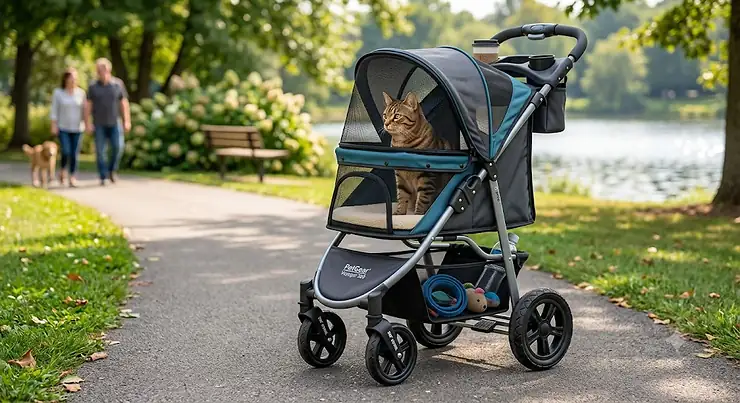
Somewhere between “my cat just stared at the leash like it personally insulted her” and “my vet said no more jumping on furniture,” a lot of cat owners land on the same conclusion: they need the best cat stroller they can find, and they need it to actually work in real life, not just in a glossy product photo. Cats are notoriously particular. They don’t do things because you want them to — they do things because the environment made it feel like their idea. A stroller happens to be one of the rare tools that checks that box: it lets a cat experience wind, birds, and the neighbor’s suspicious tabby from the safety of an enclosed, elevated, entirely non-negotiable pod.
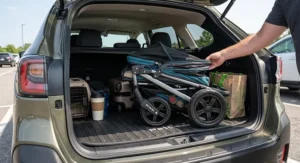
A cat stroller is a wheeled, enclosed carriage — sometimes called a pet stroller for cats, a cat buggy, or a cat pram depending on where you shop — designed to transport a cat outdoors while keeping them contained, ventilated, and protected from traffic, dogs, and their own impulsive decision-making. It’s not a leash replacement so much as a leash upgrade for cats who like the idea of outside more than the reality of pavement under their paws. Outdoor exposure taps into instincts that Ohio State University’s Indoor Pet Initiative identifies as core to feline enrichment, which is part of why strollers have become such a popular middle ground between strict indoor living and unsupervised roaming.
This guide breaks down seven real, currently available models, from a $60ish budget pick to a premium aluminum-frame option, and explains — with actual specs, not marketing fluff — who each one is built for. We’ll cover senior cat transport, apartment-friendly folding designs, multi-cat households, and the genuine safety considerations that come with taking any animal on outdoor walks. If you’ve been scrolling ten browser tabs trying to figure out which cat buggy won’t fall apart after a month, you can close the other nine. Let’s get into it.
Quick Comparison Table
Before the deep dive, here’s the fast version for anyone standing in a store aisle or hovering over the “Buy Now” button on their phone.
| Product | Weight Capacity | Best For | Price Range |
|---|---|---|---|
| Pet Gear No-Zip Happy Trails Lite | 25 lbs | Best overall value | $90-$130 |
| HPZ Pet Rover Lite | 45 lbs | Premium lightweight build | $150-$210 |
| VOMOVE Cat Stroller for 2 Cats | 45 lbs | Multi-cat households | $110-$160 |
| Ibiyaya NeoRider Compact 5-in-1 | 16 lbs | Small apartments, small cats | $90-$140 |
| Pet Gear View 360 Travel System | 45 lbs | 3-in-1 versatility | $130-$180 |
| VEVOR Pet Stroller GS302 | 35 lbs | Budget-conscious buyers | $60-$90 |
| Paws & Pals 3-Wheel Stroller | 30 lbs | First-time trial run | $70-$100 |
A quick read of that table tells you most of the story already: weight capacity and price move together more often than not, but not always in a straight line. The VOMOVE Cat Stroller for 2 Cats and the Pet Gear View 360 Travel System both land near 45 lbs of capacity at a noticeably lower price than the HPZ Pet Rover Lite, which means the premium tier here is buying you materials and engineering, not raw carrying capacity. Meanwhile, the Ibiyaya NeoRider Compact 5-in-1 intentionally caps out at 16 lbs because its whole design philosophy is about folding small, not hauling big — that’s a trade-off, not a flaw.
💬 Bookmark this comparison — you’ll want to reference it again once you see the full breakdowns below.
Top 7 Best Cat Strollers: Expert Analysis
Here’s where the specs actually get translated into “will my cat tolerate this thing,” which, let’s be honest, is the only question that matters once the box arrives.
1. Pet Gear No-Zip Happy Trails Lite — zipperless entry that won’t spook a nervous cat
The standout feature here is right in the name: no zippers. Pet Gear No-Zip Happy Trails Lite uses a latch-based, single-motion top opening instead, which matters more than it sounds like it should, because the metallic zzzzip sound is a documented trigger for skittish cats bolting mid-transfer.
Specs-wise, you’re looking at a compact 21.5″ L x 11.5″ W x 17″ H frame, an 11.5-lb stroller body, and a 25-lb maximum capacity, which comfortably covers the average adult cat with room to spare. The 6-inch rear wheels and 7-inch front wheels handle sidewalks and light gravel without the whole unit vibrating like a shopping cart with a bad wheel.
Based on the spec comparison against pricier no-zip models, this one earns its reputation as the entry point into the category rather than the top of it — and that’s exactly why it’s this list’s overall value pick. It’s built for someone who wants to test whether their cat even likes strolling before investing in something heavier-duty. Reviewers consistently report that the elevated paw rest and panoramic window keep cats engaged rather than anxious, which is the single biggest predictor of whether a stroller purchase gets used twice or twenty times.
Pros:
- ✅ Zipperless latch closes and opens without startling noise
- ✅ Elevated paw rest keeps cats interested in the view
- ✅ Lightweight 11.5-lb frame is easy to lift into a car
Cons:
- ❌ 25-lb capacity limits it to average-sized cats
- ❌ Basic wheels struggle on rougher unpaved trails
At around $90-$130, the value verdict is straightforward: this is the safest first purchase in the entire lineup, especially if you’re not yet sure your cat is a “stroller cat.”
2. HPZ Pet Rover Lite — lightest premium build in its class
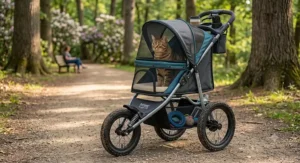
The HPZ Pet Rover Lite leads with its 15.6-lb aluminum frame, which is remarkably light considering it carries a 45-lb capacity and folds down smaller than a piece of airline carry-on luggage.
What most buyers overlook about this model is the retractable meal-bowl holder and PU-leather handlebar cover — small details, but they’re the kind of thing that separates “stroller that survives a season” from “stroller that survives five years of daily walks.” The stroller size runs 28″L x 40″H, with dual front-wheel suspension that noticeably smooths out cracked sidewalks and curb transitions compared to the rigid-axle budget models.
Here’s what to weigh: this is a stroller for someone who strolls often, not occasionally. Reviewers consistently note the “snap the wheels on and go” assembly as one of the fastest setup experiences in the category — genuinely useful if you’re the kind of owner who’ll want to grab it on a whim rather than dig it out of storage once a quarter.
Pros:
- ✅ Aluminum frame is rust-free and impressively light
- ✅ Front suspension smooths rough sidewalk transitions
- ✅ Sub-10-minute plug-and-play assembly
Cons:
- ❌ Premium pricing puts it out of casual-buyer range
- ❌ Compact size isn’t ideal for larger multi-cat setups
Priced in the $150-$210 range, the value case rests on longevity: buyers who walk their cats several times a week get more cost-per-use out of the sturdier build than they would replacing a budget model annually.
3. VOMOVE Cat Stroller for 2 Cats — purpose-built for multi-cat households
VOMOVE Cat Stroller for 2 Cats stands out immediately for its dual safety leashes and a detachable carrier that measures a genuinely spacious 22″ x 13″ x 11″ — big enough for two cats to lie down without climbing on top of each other.
The 45-lb total capacity and 30-lb carrier rating mean this isn’t a stretch-goal spec; it’s designed from the ground up for two-cat households, which is a narrower design brief than most competitors even attempt. All-terrain wheels with spring suspension and 360° front swivel wheels with locks give it real versatility between smooth sidewalks and slightly uneven park paths.
On paper, this means less territorial friction between cohabiting cats during transport, since each animal gets its own tether point rather than sharing a single anchor. What the spec sheet won’t tell you, but reviewers note, is that the detachable carrier doubles as a standalone car seat and carrier for vet visits — a two-birds-one-stroller situation that a lot of single-purpose models can’t match.
Pros:
- ✅ Dual safety leashes prevent one cat crowding the other
- ✅ Detachable carrier converts to a standalone car seat
- ✅ 180° open-view canopy keeps both cats visually engaged
Cons:
- ❌ Bulkier footprint than single-cat strollers
- ❌ Assembly instructions get mixed reviews for clarity
At $110-$160, this is the clear value leader for anyone managing two cats, since buying two single-cat strollers would run considerably higher.
4. Ibiyaya NeoRider Compact 5-in-1 — most convertible design for small apartments
The Ibiyaya NeoRider Compact 5-in-1 converts between a shoulder carrier, backpack, car seat, stroller, and wheeled carrier — five configurations from one purchase, which is a meaningfully different value proposition than a stroller-only design.
At a 16-lb weight capacity and 15.9-lb product weight, this is intentionally built for smaller cats and compact urban living, not large-breed multi-pet transport. Dimensions run 36″ x 37.4″ x 19″ unfolded and fold down to a compact 19″ x 12″ x 32.2″ — genuinely apartment-elevator-friendly, unlike some of the bulkier all-terrain options on this list.
Based on the spec comparison, this model trades weight capacity for footprint flexibility, which makes sense given its target buyer: someone in a walk-up apartment or small urban home who needs one product to handle a vet trip, a subway ride, and a weekend park stroll without owning three separate pieces of gear. The telescoping handle and one-handed folding mechanism matter more here than raw carrying capacity, because the entire design thesis is “fits in your closet and your life,” not “handles every possible pet size.”
Pros:
- ✅ Five configurations from a single purchase
- ✅ Compact folded size fits small closets and car trunks
- ✅ One-handed fold mechanism is genuinely quick
Cons:
- ❌ 16-lb capacity excludes larger or overweight cats
- ❌ Not built for rough or unpaved terrain
In the $90-$140 range, the value case is about versatility per square foot of storage — ideal for apartment dwellers who need one flexible tool rather than a fleet of pet gear.
5. Pet Gear View 360 Travel System — best 3-in-1 conversion between carrier, booster, and stroller
The Pet Gear View 360 Travel System converts from a carrier to a booster seat to a full stroller in seconds, and its 45-lb capacity means it can comfortably hold larger cats or two smaller ones riding together.
Reviewers consistently describe it as gliding smoothly over cement and taking turns easily, with slightly bumpier — but still functional — performance on grass and dirt. The detachable, no-zip carrier snaps open with a single button press, which is a genuine convenience upgrade for anyone managing arthritic hands or simply juggling a cat and a diaper bag at the same time.
Here’s what to weigh: the panoramic view window is consistently cited as a standout, giving cats a wide sightline that reduces the boxed-in feeling some cats associate with traditional carriers. One flagged inconsistency worth noting honestly — some units have a zipper gap on the carrier sides that doesn’t fully close, so supervision and a properly buckled interior tether matter more here than with fully sealed alternatives.
Pros:
- ✅ Converts between carrier, booster, and stroller modes
- ✅ Wide panoramic window reduces boxed-in feeling
- ✅ 45-lb capacity fits larger cats or two small ones
Cons:
- ❌ Some units report minor zipper gaps on the carrier
- ❌ Cup holder placement gets mixed feedback
At $130-$180, this sits comfortably mid-pack — a strong pick for anyone who wants true 3-in-1 flexibility without stepping into premium aluminum-frame pricing.
6. VEVOR Pet Stroller GS302 — most affordable entry into the category
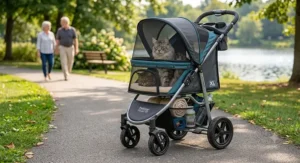
The VEVOR Pet Stroller GS302 keeps things simple: a 35-lb weight capacity, a 12.89-lb product weight, and a straightforward four-wheel layout (dual front, single rear) that doesn’t try to reinvent the category.
At this price tier, the honest analytical take is that you’re trading premium materials and suspension refinement for accessibility. The 6-inch front and 7-inch rear wheels are functional on sidewalks and smooth paths but will transmit more vibration on cracked pavement than the suspension-equipped models higher on this list. That’s a reasonable trade-off for a buyer who mainly plans short, flat neighborhood strolls rather than trail excursions.
What most buyers overlook about budget strollers in general — and this one specifically — is that the detachable carrier and mesh windows still deliver the core experience (ventilation, visibility, containment) that pricier models offer; what you’re paying more for elsewhere is durability under heavier or more frequent use, not the basic function.
Pros:
- ✅ Lowest price point on this entire list
- ✅ 35-lb capacity covers most adult cats
- ✅ Lightweight frame simplifies loading into a car
Cons:
- ❌ Less shock absorption on uneven surfaces
- ❌ Build materials feel noticeably thinner than premium tiers
Priced around $60-$90, this is the pragmatic pick for owners testing the waters or working with a tight budget who still want a functional, safe product.
7. Paws & Pals 3-Wheel Pet Stroller — lowest-risk way to find out if your cat tolerates strolling at all
The Paws & Pals 3-Wheel Pet Stroller exists to answer one honest question before you spend real money elsewhere: does your cat actually tolerate a stroller? Its multiple zippered mesh screens provide ventilation and insect protection, and it meets the GB14748 stroller safety standard, giving it a baseline safety certification some budget competitors skip entirely.
Specs include an undercarriage storage compartment, a cup holder, seatbelt-style tethers, rear brakes, and a flat-folding frame for storage between uses. The three-wheel configuration trades a bit of high-speed stability for a tighter turning radius, which is more relevant to sidewalk maneuvering than open-road speed anyway.
Based on the spec comparison, the honest flaw here is exactly what you’d expect at this price: the three-wheel setup is less stable than four-wheel configurations at speed, and the fabric and zippers are typically the first components to show wear under heavy daily use. For someone running a low-risk trial to see whether their cat enjoys outdoor walks before committing to a $200 aluminum-frame model, that trade-off is entirely reasonable.
Pros:
- ✅ Meets the GB14748 stroller safety standard
- ✅ Tight turning radius for sidewalk maneuvering
- ✅ Folds flat for easy apartment storage
Cons:
- ❌ Three-wheel design is less stable at higher speeds
- ❌ Fabric and zippers wear faster under heavy daily use
At $70-$100, this is the lowest-risk way to test the entire category before upgrading.
Top 7 Products: Full Spec Comparison
| Product | Product Weight | Capacity | Wheels | Best For |
|---|---|---|---|---|
| Pet Gear No-Zip Happy Trails Lite | 11.5 lbs | 25 lbs | 6″/7″ | Nervous, first-time cats |
| HPZ Pet Rover Lite | 15.6 lbs | 45 lbs | Suspension front | Frequent strollers |
| VOMOVE Cat Stroller for 2 Cats | ~14 lbs | 45 lbs | All-terrain, swivel | Two-cat households |
| Ibiyaya NeoRider Compact 5-in-1 | 15.9 lbs | 16 lbs | Standard swivel | Apartment dwellers |
| Pet Gear View 360 Travel System | ~13 lbs | 45 lbs | Swivel/lock | Versatility seekers |
| VEVOR Pet Stroller GS302 | 12.89 lbs | 35 lbs | 6″/7″ | Budget buyers |
| Paws & Pals 3-Wheel Stroller | ~11 lbs | 30 lbs | 3-wheel | Trial runs |
Looking at the comparison above, the HPZ Pet Rover Lite delivers the best capacity-to-weight ratio, carrying triple the load of the Pet Gear No-Zip Happy Trails Lite while adding only about four pounds to the stroller’s own weight. Budget buyers should note that the VEVOR Pet Stroller GS302 and Paws & Pals 3-Wheel Stroller sacrifice suspension quality for their lower price points, which matters more on cracked or uneven pavement than on smooth sidewalks. Multi-cat households have a genuinely narrow field here — the VOMOVE Cat Stroller for 2 Cats is really the only model on this list purpose-built around two-tether safety rather than retrofitted for it.
✨ Ready to find your match? Compare current prices and availability before your next walk.
Practical Usage Guide: Setup, First Walks, and Maintenance
Getting the stroller out of the box is the easy part. The first 30 days determine whether it becomes a regular routine or a guilt-inducing object gathering dust in the garage.
Start indoors. Let your cat sniff the stationary stroller for a few days before the wheels ever touch pavement — this mirrors the same desensitization principle used in harness training, where forcing an unfamiliar object onto a stressed cat backfires almost every time. Once your cat will climb in voluntarily for a treat, try a five-minute stationary session with the canopy open, then closed, before attempting any actual movement.
For the first outdoor walk, pick a quiet time of day with minimal foot traffic and no barking dogs nearby. Keep the first outing under ten minutes. A common mistake in the first 30 days is over-scheduling — trying to hit a daily walking streak before your cat has built tolerance, which tends to produce a cat who associates the stroller with stress rather than curiosity.
Maintenance is straightforward but easy to neglect: wipe down the wheels and axles monthly with a lightly oiled cloth to prevent squeaking and premature wear, spot-clean fabric liners with mild soap rather than harsh detergents, and inspect zippers or latches every few weeks for fraying. Optimization trick worth knowing — storing the folded stroller with the canopy partially open (rather than fully compressed) extends the life of the canopy’s structural ribs, since permanently folded canopy material is one of the more common early failure points across nearly every brand in this category.
Real-World Scenarios: Which Stroller Fits Your Situation
If you’re a college student in a studio apartment with one indoor cat who occasionally wants sunshine, the Ibiyaya NeoRider Compact 5-in-1 solves your actual problem — it stores in a closet, doubles as a carrier for the inevitable vet trips, and never requires you to own a “car-sized” piece of pet gear you don’t have space for.
If you’re managing two cats who tolerate each other but aren’t exactly best friends, the VOMOVE Cat Stroller for 2 Cats and its dual-leash system prevents the kind of mid-walk scuffle that a single-tether stroller can’t. Budget matters less here than the safety architecture, since a fight inside a moving stroller is a genuinely bad outcome for everyone involved.
If you’re caring for a senior cat with diagnosed or suspected joint stiffness, prioritize low-vibration wheels and easy-entry design over raw weight capacity — the HPZ Pet Rover Lite‘s front suspension and the Pet Gear No-Zip Happy Trails Lite‘s zipperless, no-fuss entry both reduce the physical strain of getting an arthritic cat in and out, which matters more for this group than for a young, agile cat who can hop in unassisted.
Problem → Solution: Common Cat Stroller Frustrations
Problem: Your cat freezes or tries to escape the moment the stroller starts moving. Solution: Return to stationary sessions for another week before attempting movement again — rushing the timeline is the single most common cause of stroller rejection.
Problem: The canopy zipper or latch makes a noise that spooks your cat. Solution: Choose a no-zip model like the Pet Gear No-Zip Happy Trails Lite, or practice opening and closing a zippered model slowly, away from your cat, until the sound is no longer novel.
Problem: The stroller tips or feels unstable on uneven sidewalks. Solution: Four-wheel models with locking swivel front wheels, like the HPZ Pet Rover Lite, distribute weight more evenly than three-wheel designs at speed.
Problem: Your cat overheats on warm-weather walks. Solution: Stick to early morning or evening walks, use the mesh ventilation panels fully open, and never leave a stroller parked in direct sun with a cat inside — even briefly.
Problem: Storage space is limited in your home. Solution: Prioritize compact-fold designs like the Ibiyaya NeoRider Compact 5-in-1 or the Paws & Pals 3-Wheel Stroller, both of which fold flatter than premium all-terrain frames.
How to Choose the Best Cat Stroller
- Confirm your cat’s actual weight against the stroller’s stated capacity, then add a buffer — a stroller rated right at your cat’s exact weight will feel cramped and strain the wheels faster than one with 5-10 lbs of headroom.
- Prioritize entry style based on temperament. Nervous or noise-sensitive cats generally do better with no-zip, latch-based entry than traditional zippered designs.
- Match wheel type to your walking terrain. Smooth sidewalks tolerate basic wheels fine; gravel paths or cracked pavement benefit from suspension and larger wheel diameters.
- Consider fold size against your storage reality, not your aspirational storage — a stroller that doesn’t fit your closet won’t get used regardless of how good it looks online.
- Check for a detachable carrier if you also need a standalone option for vet visits, since this effectively gives you two products for one price.
- Look for verified aggregated review themes, not star ratings alone — recurring complaints about zippers or wheel durability across multiple buyers are more informative than an average score.
- Decide if you need multi-pet capacity before you buy, since retrofitting a single-cat stroller for two cats after the fact rarely works well.
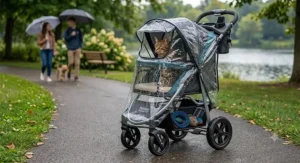
Common Mistakes When Buying a Cat Stroller
The most frequent mistake is buying based on weight capacity alone. A 45-lb capacity stroller with poor wheel suspension can be a worse experience for a small cat than a properly suspended 25-lb model, because comfort during movement matters as much as raw carrying capacity.
Another common misstep is skipping the indoor acclimation period entirely and going straight to an outdoor walk on day one. Reviewers across nearly every brand in this category flag the same pattern: cats introduced to strollers too quickly are more likely to associate the object with stress, which can sour the entire investment regardless of how well-built the stroller itself is.
A third mistake is underestimating storage requirements. Buyers frequently order all-terrain, suspension-heavy models for occasional weekend use, then find the folded footprint doesn’t fit their entryway or car trunk — a problem that’s easily avoided by measuring folded dimensions before ordering rather than after.
Cat Buggy vs Cat Pram vs Cat Stroller: Same Thing, Different Name?
If you’ve seen the terms cat buggy, cat pram, and cat stroller used interchangeably across different retailers, that’s not a mistake — they refer to the same category of product, with naming conventions shifting largely by region and by seller. “Cat pram” and “cat buggy” show up more frequently in UK and Australian listings, echoing the terminology used for baby strollers in those markets, while “cat stroller” and “pet stroller for cats” dominate U.S. search and retail listings.
Functionally, there’s no meaningful difference between a product labeled a cat buggy and one labeled a cat stroller — the safety features, wheel configurations, and carrier designs are drawn from the same manufacturing playbook regardless of what the listing calls it. What actually varies is brand-specific engineering: a VOMOVE Cat Stroller for 2 Cats and a similarly priced product marketed as a “cat pram” from a different manufacturer could differ substantially in build quality even while sharing near-identical marketing language. The lesson here is to shop by spec sheet and aggregated review sentiment, not by which regional term a listing happens to use.
What to Expect: Real-World Performance
Specs on a page don’t tell you what a walk actually feels like, so here’s the practical translation. On smooth concrete sidewalks, every model on this list performs adequately — differences in wheel quality become far more apparent on gravel, grass, or cracked pavement, where suspension-equipped options like the HPZ Pet Rover Lite noticeably reduce the jostling that can make a nervous cat tense up mid-walk.
Ventilation matters more in practice than most buyers expect going in. Mesh window placement affects not just airflow but also how much of the outside world a cat can actually see and smell — the sensory input that makes the whole exercise worthwhile in the first place. Models with wider panoramic windows, like the Pet Gear View 360 Travel System, tend to keep cats visibly more engaged during walks than narrower, more enclosed designs.
Real-world folding speed also diverges from marketing claims. “One-handed fold” often means one hand plus a bit of practice in the first week, not an instant collapse on the first try — budget in a short learning curve regardless of which model you choose.
Cat Strollers for Senior Cat Transport
Senior cat transport is one of the most common and most legitimate reasons owners search for a cat stroller in the first place, and it deserves its own dedicated consideration rather than being treated as an afterthought. The Cornell Feline Health Center explains that arthritic cats often struggle with tasks involving jumping or climbing, a pattern that extends logically to getting in and out of a stroller — low, wide entry points matter more for this group than for younger, more agile cats.
A former Cornell Feline Health Center consultant has also pointed out that slowed-down, more reclusive behavior can itself be a subtle early sign of joint discomfort in cats of any age. So if your senior cat seems reluctant to enter a stroller that a younger cat would hop into without hesitation, that reluctance is worth mentioning to your veterinarian rather than dismissing as pickiness.
For senior cat transport specifically, prioritize models with the lowest lift-in height and gentlest ride quality. The Pet Gear No-Zip Happy Trails Lite‘s elevated paw rest and latch entry reduce the awkward lifting motion that a stiff-jointed cat may resist, while the HPZ Pet Rover Lite‘s front suspension smooths out the vibration that can aggravate joint discomfort on longer outings. Skip anything marketed primarily around speed or rugged terrain performance — that’s solving a problem senior cats generally don’t have, at the cost of the gentle ride quality they do need.
Outdoor Cat Stroller Safety for Neighborhood Strolls
An outdoor cat stroller is only as safe as the habits built around it, and neighborhood strolls come with genuine considerations that go beyond picking the right product. Before any outdoor walks begin, confirm your cat is current on vaccinations and microchipped, since even a securely tethered cat can theoretically slip a harness during a startled reaction.
According to guidance shared by an ASPCA behavioral sciences counselor via Cat Friendly Homes, not every cat will ultimately enjoy walking outdoors, and a stroller doesn’t override that reality — it simply gives cats who do enjoy it a safer, lower-stress way to experience the outdoors than a leash alone. Keep neighborhood strolls to quiet times of day at first, away from off-leash dogs and heavy foot traffic, and always keep the stroller’s interior tether attached even with the canopy closed, in case of an unexpected opening.
A well-chosen outdoor cat stroller is one of the more direct ways to deliver enrichment without the risks of unsupervised roaming — traffic, predators, and territorial disputes with neighborhood cats chief among them. That matters even more with age: PetMD reports that feline osteoarthritis affects an estimated 70% to 90% of cats over 12 years old, which means low-impact outdoor exposure through a stroller becomes an increasingly practical option as cats age, rather than a novelty.
💬 Don’t Miss These Exclusive Deals!
🔍 Take your outdoor adventures to the next level with a stroller built for real neighborhood strolls. Click on any highlighted product above to check current pricing and availability. The right pick will turn hesitant first walks into a routine your cat actually looks forward to!
Long-Term Cost & Maintenance
A cat stroller’s true cost isn’t just the sticker price — it’s the sticker price divided by how many walks you actually get out of it before something breaks or you stop using it. A $70 budget model used twice before being abandoned in a closet is a worse value than a $180 model used weekly for three years, even though the upfront number looks better.
Wheel replacement, fabric wear, and zipper failure are the three most common long-term maintenance issues across this category. Models with pump-free rubber wheels, like those found on premium HPZ builds, tend to avoid the flat-tire failure mode entirely, while budget models with basic plastic wheels are more prone to cracking after a year or two of regular use. Liner replacement is usually the cheapest fix across any brand, since most strollers use a removable, washable liner rather than a fixed one — factor this into your total cost of ownership rather than assuming a worn liner means the whole stroller needs replacing.
Features That Actually Matter (And Those That Don’t)
Cup holders, phone pockets, and color options are genuinely nice-to-haves, but they shouldn’t move the needle on a purchase decision. What actually matters: entry mechanism (zip vs. no-zip), wheel suspension quality, weight capacity relative to your specific cat, folded storage size, and the presence of an interior safety tether. Everything else is a preference, not a functional differentiator.
Marketing terms like “all-terrain” deserve some skepticism — genuine all-terrain performance requires air-filled or suspension-equipped wheels, not just a larger wheel diameter. A stroller can have big wheels and still ride rough on gravel if it lacks any shock absorption, so check for suspension specifically rather than trusting the phrase alone.
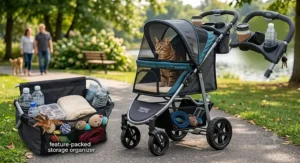
Featured FAQs
❓ What is a cat stroller?
❓ How much does a good cat stroller cost?
❓ Is a cat stroller better than a harness and leash?
❓ Can two cats share one stroller?
❓ How do I get my cat used to a stroller?
Conclusion
Finding the best cat stroller really comes down to matching a real product to your real cat and your real routine — not chasing the highest weight capacity or the flashiest all-terrain label. If you’re testing the waters, the Pet Gear No-Zip Happy Trails Lite or Paws & Pals 3-Wheel Stroller offer a low-risk way in. If you’re managing two cats, a senior cat, or want a genuinely premium ride, the VOMOVE Cat Stroller for 2 Cats, HPZ Pet Rover Lite, or Pet Gear View 360 Travel System each solve a more specific problem well.
Whatever you choose, the acclimation process matters more than the model itself. A great stroller introduced too quickly will still get rejected, while even a modest budget pick introduced patiently can become a genuinely enjoyed part of your cat’s week. Take the time, watch your cat’s body language, and let the outdoor world come to them at their own pace.
✨ Ready to pick your outdoor walks companion? Check current pricing on the model that fits your cat best, and give those neighborhood strolls a try this week!
Recommended for You
- Cat Car Seat 2026: 7 Safest Picks for Stress-Free Road Trips
- 7 Best Cat Carrier for Nervous Cats Picks That Actually Calm Them (2026)
- Expandable Cat Carrier: 7 Best Picks for Extra Room (2026)
Disclaimer: This article contains affiliate links. As an Amazon Associate, I earn from qualifying purchases. If you purchase products through these links, we may earn a small commission at no additional cost to you.
✨ Found this helpful? Share it with your friends! 💬🤗
