
Table of Contents
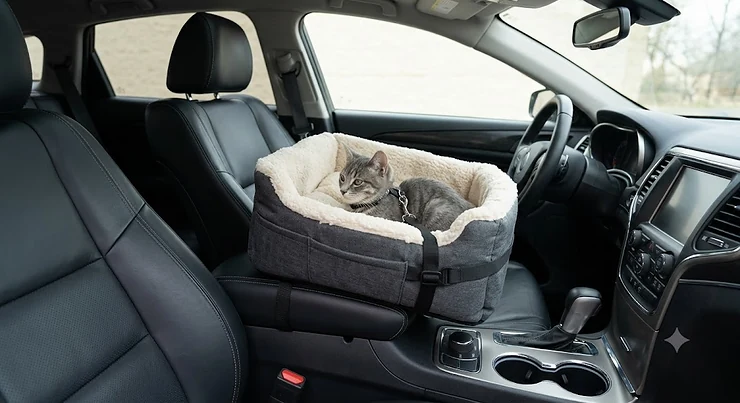
Cats are not small dogs, and nowhere is that more obvious than in the back seat of a car. A dog will often settle onto a booster cushion and watch the world roll by. A cat, more often than not, treats a moving vehicle like a personal emergency. That’s exactly why the right cat car seat matters so much more than pet retailers let on — it’s not a luxury accessory, it’s the difference between a cat who naps through a four-hour drive and one who’s wedged himself under the brake pedal at 65 miles per hour.
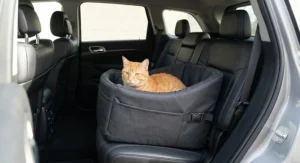
This guide breaks down seven real, currently available options — from full enclosed carriers to elevated booster-style seats — based on genuine specifications, aggregated owner feedback, and independent crash-test data where it exists. You’ll get honest analysis on who each product actually suits, not just a features list lifted from a product page. We’ll also dig into how a cat booster seat differs from a full car carrier for cats, when a cat seat belt carrier makes more sense than either, and what “crash protection” really means once you look past the marketing language.
What is a cat car seat? A cat car seat is a restraint system — either an elevated booster platform or a fully enclosed, seatbelt-anchored carrier — designed to keep a cat secured, calm, and contained in a moving vehicle, reducing both driver distraction and the risk of injury during sudden stops or collisions.
Whether you’re planning weekend road trips, a twice-yearly vet run, or a full cross-country move with a very unimpressed feline co-pilot, there’s a setup here that fits your cat, your car, and your budget.
Quick Comparison Table
Before diving into the full breakdown, here’s a fast-scan snapshot of how these seven options stack up on the factors that matter most: containment style, crash-test status, and who each one is really built for.
| Product | Style | Crash-Tested? | Best For |
|---|---|---|---|
| Sleepypod Air | Enclosed carrier/car seat | Yes (CPS-rated) | Frequent flyers who also drive |
| Sleepypod Mobile Pet Bed | Enclosed carrier/car seat | Yes (CPS 5-Star) | Anxious cats, daily use |
| PawsInCar Expandable Carrier | Enclosed carrier/car seat | Yes (CPS-rated) | Budget-conscious crash-test shoppers |
| K&H Travel Safety Carrier | Enclosed, seatbelt-anchored | No | Multi-cat households, tight budgets |
| K&H Bucket Booster | Elevated booster | No | Cats who like to see out |
| Snoozer Roll Around 4-in-1 | Convertible carrier/booster | No | Travelers who need one bag for everything |
| Petsfit Safety-Buckle Carrier | Soft-sided carrier | No | Lightweight everyday vet trips |
Looking at the spread above, the pattern is clear: only the CPS-certified group — Sleepypod Air, Sleepypod Mobile Pet Bed, and PawsInCar Expandable Carrier — has actually been subjected to independent crash simulation, and that distinction should weigh heavily if your cat rides with you often or at highway speeds. The remaining four options aren’t unsafe, exactly, but they’re built around containment and comfort rather than documented crash performance, which makes them better suited to shorter, slower trips. Budget shouldn’t be the only factor here — a $50 carrier that keeps your cat calm on a 10-minute vet run is doing its job, even without a crash-test certificate.
💬 Already have a favorite in mind? Scroll down to see the full breakdown — or jump straight to check today’s availability.
Top 7 Cat Car Seats: Expert Analysis
Every product below has been vetted for real specs, real availability, and (where it exists) real independent safety testing. Prices shift constantly on Amazon, so treat every figure here as a snapshot rather than gospel — always confirm current pricing before you buy.
1. Sleepypod Air — airline-approved and independently crash-tested
The Sleepypod Air built its reputation as an in-cabin airline carrier, but it doubles as a genuinely useful car seat, which is what makes it worth featuring first. Its ballistic nylon shell and Ultra Plush bedding sit inside a structure that’s been independently evaluated by the Center for Pet Safety, and the brand states it carries a top safety rating for cats up to 18 pounds — a rare claim in a market full of unverified “crash-tested” language.
What that means in practice: the four ventilation windows and privacy panel aren’t just comfort features, they’re part of a design meant to reduce a stressed cat’s urge to claw at mesh or squeeze through a zipper gap mid-drive. Based on the spec comparison with the rest of this list, the Sleepypod Air is the only entry doing double duty as an under-seat airline carrier and a documented car restraint, which matters if your travel includes both planes and long highway stretches.
Reviewers on Cats.com and independent pet-travel blogs consistently describe it as excellent for anxious cats specifically because the enclosed, den-like shape limits visual stimulation — though a recurring theme in owner feedback is that its rounded structure holds less usable interior space than a boxier soft-sided carrier of similar footprint.
Pros:
- ✅ Independently crash-tested and airline-cabin approved
- ✅ Privacy panel reduces visual stress on anxious cats
- ✅ Four-window ventilation design keeps airflow steady
Cons:
- ❌ Premium price relative to non-tested carriers
- ❌ Rounded shape sacrifices some interior space
Expect to pay in the $190-$220 range at the time of research — a steep ask next to a $40 booster, but reasonable if you weigh it against what documented crash protection is worth to you.
2. Sleepypod Mobile Pet Bed — CPS 5-star crash rating for cats up to 15 lbs
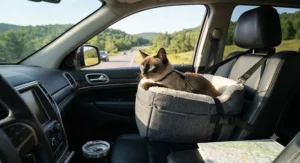
The Sleepypod Mobile Pet Bed is the product that put Sleepypod on the map, and it earned that reputation the hard way: in 2016, the Center for Pet Safety awarded it a 5-Star crash-test rating alongside the Sleepypod Mini, evaluating it under the same dynamic testing protocol used for child safety seats. That’s not a vague “lab-tested” sticker — it’s a specific, published rating from an independent nonprofit that has no financial stake in the brand’s sales.
In practice, the design works because it’s a bed first and a carrier second. The luggage-grade nylon base and plush interior are things your cat already sleeps on at home; zipping on the included mesh dome turns that familiar bed into a secured carrier without introducing a brand-new, anxiety-triggering object right before a drive. What most buyers overlook about this model is that the hook-and-loop seatbelt anchor points aren’t an afterthought — they’re integral to why it passed crash testing in the first place, unlike seats where a seatbelt loop was bolted on after the fact.
Aggregated owner sentiment across pet-travel blogs is largely positive on the anxiety-reduction angle, with multiple long-term owners reporting cats who transitioned from crying in the car to sleeping through drives. A recurring, more minor complaint is that the round silhouette is a little awkward to carry one-handed compared to a rectangular duffel-style bag.
Pros:
- ✅ CPS 5-Star crash-test rating, independently verified
- ✅ Doubles as an everyday bed to reduce carrier anxiety
- ✅ Machine-washable Ultra Plush bedding
Cons:
- ❌ Round shape is less compact for storage
- ❌ Higher cost than non-tested competitors
Pricing generally falls in the $140-$180 range depending on size and color, positioning it as a mid-to-premium pick with genuine safety data behind the number.
3. PawsInCar Crash-Tested Expandable Cat Carrier — budget-friendly CPS crash protection
If the Sleepypod line feels like more than your wallet wants to handle, the PawsInCar Crash-Tested Expandable Cat Carrier is the honest middle ground. It’s independently crash-tested in the U.S. by the Center for Pet Safety and certified under the same FMVSS 213b child-restraint standard, with published crash-force ratings in the hundreds of pounds depending on the exact model variant.
Here’s what the spec sheet won’t tell you outright: “expandable” means the carrier’s top and sides unzip outward once parked, giving your cat lounging room at a rest stop or campsite without needing a second product. That’s genuinely useful for road-trip owners who want one bag for the drive and the destination. Based on the comparison with the K&H and Petsfit options below, the PawsInCar Crash-Tested Expandable Cat Carrier is the only budget-tier pick that can back up a safety claim with an actual third-party rating, which is the single biggest reason it earns a spot this high on the list.
User reviews on Amazon commonly praise the multi-window ventilation and note it feels sturdier than typical soft-sided carriers in this price bracket, though some reviewers flag that the zippers require a firmer hand than expected to fully seal during setup.
Pros:
- ✅ CPS crash-tested under U.S. child-restraint standard
- ✅ Expands for extra room once parked
- ✅ Multiple mesh windows for airflow and visibility
Cons:
- ❌ Zippers can feel stiff on first few uses
- ❌ Bulkier than non-expandable carriers when folded
Look for it in the $60-$100 range, which makes documented crash protection accessible without a three-figure premium.
4. K&H Pet Travel Safety Carrier — 5-door enclosed carrier that seatbelts in securely
The K&H Pet Travel Safety Carrier takes a different approach entirely: no crash-test certification here, but a genuinely thoughtful containment design from a Colorado brand with more than two decades in pet gear. The carrier threads your existing seatbelt through a rear strap and loops a second strap around the headrest, anchoring it from two directions rather than relying on gravity and hope.
The real-world payoff is in the five zippered access points — two per side plus a front door — which means you can offer water or check on a stressed cat without unzipping the whole structure and risking an escape. Reviewers consistently note this matters more than it sounds on longer drives, since most single-entry carriers force you to fully open the carrier for even small interactions. Here’s what to weigh: this is a comfort-and-containment carrier, not a crash-rated one, so it’s best suited to cats who need calm confinement on moderate trips rather than families prioritizing documented impact protection above all else.
Owner feedback is strong on the washable base pad and the fact that it folds flat for trunk storage, with a common thread of praise for how easily it fits both front and back-seat setups.
Pros:
- ✅ Dual-strap seatbelt and headrest anchoring system
- ✅ Five zippered doors for low-stress access
- ✅ Folds flat for compact storage
Cons:
- ❌ No independent crash-test certification
- ❌ Medium size fits cats up to roughly 20 lbs only
Expect a price in the $45-$60 range for the medium size, making it one of the more accessible enclosed options on this list.
5. K&H Bucket Booster Car Seat — elevated bucket seat with dual safety leashes
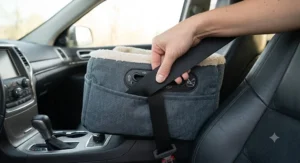
Not every cat wants to be zipped away from the view. The K&H Bucket Booster Car Seat is a heavy-denier fabric bucket with a plush quilted-fleece interior that elevates your cat to window height, buckling into the seatbelt itself (hidden discreetly under the removable cushion) rather than relying on straps alone.
What most buyers overlook about this style of seat is that the elevation isn’t just about the view — cats prone to motion sickness often do better with a stable sightline to the horizon than crouched at floor level in a carrier. The included dual safety leashes clip to a harness (not a collar) to keep your cat from vaulting the bolstered edge mid-drive, though the seat itself offers no crash-force protection, so this is a containment-and-comfort choice rather than a documented safety product.
Reviewers commonly describe the fit as snug and secure for front or back seats and appreciate the two-size range for accommodating different vehicle interiors, while a recurring critique is that determined climbers can still work their way toward the edge if the leash isn’t cinched tightly to a properly fitted harness.
Pros:
- ✅ Elevated design suits cats prone to motion sickness
- ✅ Seatbelt-secured with a hidden buckle system
- ✅ Two sizes fit most front or back seats
Cons:
- ❌ No crash-test certification
- ❌ Requires a harness, not just a collar, for the leashes
Pricing typically sits in the $40-$65 range, making it one of the more affordable ways to give a curious cat a window seat.
6. Snoozer Roll Around 4-in-1 Pet Carrier — converts from car seat to backpack to rolling carrier
For owners who resent owning three separate bags for one trip, the Snoozer Roll Around 4-in-1 Pet Carrier collapses that problem into a single purchase. It transitions between a wheeled rolling carrier, a backpack, a car seat, and a stationary pet bed, using a multi-stage telescoping handle and mesh panels on three sides for ventilation.
On paper this means a genuinely versatile travel companion for owners juggling airports, rideshares, and their own car in the same trip — the medium size holds pets up to 15 pounds and the large stretches to 30, covering most adult cats comfortably. What the spec sheet won’t emphasize is that “airline approved” comes with an asterisk: individual airlines set their own carrier dimension rules, so this needs a quick call to your specific carrier before a flight, even though the car-seat function needs no such check.
Owner reviews are largely positive on the versatility angle, especially from cat owners who split time between flying and driving, though a recurring maintenance note across retailer reviews mentions the internal base insert can loosen or crack under sustained heavy use, and a small share of reviewers wish a seatbelt attachment point were built in rather than relying on the car-seat conversion alone.
Pros:
- ✅ Converts between four distinct travel modes
- ✅ Telescoping handle adjusts to your height
- ✅ Two sizes cover cats up to 30 lbs
Cons:
- ❌ Base insert can loosen with heavy repeated use
- ❌ No dedicated seatbelt attachment point
You’ll typically find it in the $110-$140 range, positioning it as a mid-tier investment for genuinely multi-modal travelers.
7. Petsfit Soft-Sided Cat Carrier with Patented Safety Buckles — patented buckle system for escape-proof rides
Rounding out the list is the lightest, most budget-friendly option: the Petsfit Soft-Sided Cat Carrier with Patented Safety Buckles. Its standout feature is exactly what it sounds like — a patented buckle mechanism paired with lockable zippers and a built-in safety tether, aimed squarely at cats who’ve mastered the art of nosing a zipper open mid-drive.
Here’s what that means in real terms: most escape incidents in soft-sided carriers happen at zipper junctions, not seams, so a buckle-reinforced closure genuinely reduces the single most common failure point. Sized for airline under-seat compliance and rated up to 12 pounds, it’s built more for portability and vet-run frequency than for long highway hauls, and it carries no independent crash-test rating — this is a security-and-convenience product, not a documented safety one.
Reviewers consistently point to the light weight and easy one-hand carry as the top selling points, with a common caveat that cats over roughly 10 pounds will feel snug rather than roomy inside.
Pros:
- ✅ Patented buckle system resists mid-drive escapes
- ✅ Airline-compliant under-seat sizing
- ✅ Lightweight for easy one-hand carrying
Cons:
- ❌ No independent crash-test certification
- ❌ Snug fit for cats above roughly 10 lbs
Budget around $35-$50 for this one, making it the most accessible carrier on the list for occasional, shorter trips.
Road Trips With Your Cat: The Complete Prep Guide
A cat car seat is only half the equation — the other half is how you actually use it on a multi-hour drive. Start the trial run at least a week before departure: strap the empty seat or carrier into its final position and let your cat explore it at home, on their own schedule, with treats placed inside. This single step does more to prevent in-car panic than any product feature.
On travel day, feed a smaller-than-usual meal two to three hours before departure to reduce motion-sickness risk, and always place the carrier or booster in the back seat, never the front — airbags deploy with enough force to seriously injure a small animal. According to the American Veterinary Medical Association, the back seat properly restrained in a crate, carrier, or safety harness is consistently the safest position for a traveling pet.
Plan a bathroom-and-water break every two to three hours, even if your cat seems settled — dehydration and litter-box discomfort compound quietly over long stretches. A common first-30-days mistake is skipping the leash-to-harness connection inside booster-style seats; a collar alone can slip free or, worse, choke a cat who lunges against it during a hard stop. Keep the carrier or seat’s location consistent trip after trip — cats build a surprising amount of security from routine, and a car seat that’s always in “their spot” becomes less of a novelty and more of a known, tolerable ritual.
Real-World Scenarios: Matching the Right Seat to Your Life
The weekend road-tripper: If you’re driving four to six hours every month or two to visit family with a generally calm cat, a CPS-tested option like the PawsInCar Crash-Tested Expandable Cat Carrier earns its cost — you get documented protection without the premium of the Sleepypod line, and the expandable design gives your cat room to stretch once you arrive.
The anxious-cat owner: If your cat cries, pants, or hides at the first sign of the car keys, prioritize the Sleepypod Mobile Pet Bed. Because it’s already your cat’s everyday bed, the psychological transition into “car mode” is far gentler than introducing an unfamiliar carrier cold, and the CPS 5-Star rating means you’re not trading safety for comfort.
The budget-conscious, occasional traveler: If your “road trips” are really twice-a-year vet visits and the odd overnight at a relative’s house, the K&H Pet Travel Safety Carrier or Petsfit Soft-Sided Cat Carrier with Patented Safety Buckles cover the basics — secure containment and easy setup — without asking you to spend triple for crash-test data you’ll rarely stress-test on a 15-minute drive.
✨ Ready to pick your cat’s ride? Check current availability and pricing before your next trip!
How to Choose a Cat Car Seat: 7-Step Framework
- Start with your cat’s weight, not the marketing copy. Every seat on this list has a hard weight ceiling, and an overstuffed carrier compromises both comfort and structural integrity.
- Decide if crash-test certification is a must-have. If your cat rides often or at highway speeds, a CPS-rated pick like Sleepypod Air or PawsInCar Crash-Tested Expandable Cat Carrier is worth the added cost.
- Match the style to your cat’s temperament. Anxious cats generally do better enclosed and den-like; curious, calm cats often prefer elevated booster seats with a view.
- Check your back seat’s actual dimensions. A seat that fits a sedan’s bench seat may not sit flush in a truck’s rear bucket seats.
- Confirm the attachment method works with your seatbelts. Some vehicles have shorter buckle stalks that don’t accommodate every strap design.
- Factor in washability. Litter-box accidents and shed fur happen; a removable, machine-washable liner saves real time.
- Price against frequency of use, not sticker shock alone. A $200 seat used weekly costs less per trip than a $50 seat used twice.
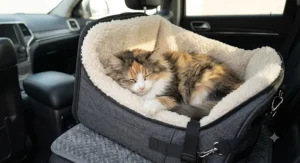
Cat Booster Seat vs Car Carrier for Cats: Which Wins?
A cat booster seat and a full car carrier for cats solve different problems, and conflating them is one of the more common buying mistakes. A booster — like the K&H Bucket Booster Car Seat — elevates your cat to window height inside an open bucket, secured by a harness-clipped leash rather than full enclosure. A car carrier for cats, by contrast, fully encloses the animal, typically anchored by seatbelt straps, and is the format every CPS crash-test-certified product on this list uses.
| Factor | Cat Booster Seat | Car Carrier for Cats |
|---|---|---|
| Visibility | High — open, elevated view | Low to moderate, mesh-dependent |
| Escape risk | Higher without a snug harness | Lower, fully enclosed |
| Crash protection available | Rare | Yes, in tested models like Sleepypod Air |
| Best for | Calm, curious cats | Anxious or first-time traveling cats |
The takeaway from this comparison is straightforward: if documented crash protection matters to you, a booster seat simply isn’t built to deliver it, since none of the widely available bucket-style boosters carry independent crash certification. Enclosed carriers like the PawsInCar Crash-Tested Expandable Cat Carrier or K&H Pet Travel Safety Carrier trade some visibility for meaningfully better containment, which is usually the safer trade for a cat you’re not 100% sure will stay calm.
Cat Seat Belt Carrier Systems Explained
The phrase “cat seat belt carrier” covers a specific mechanical detail that’s easy to overlook: how the carrier actually anchors to your car’s existing restraint hardware. Most enclosed options on this list use one of two systems — a strap that threads directly through your seatbelt buckle assembly, or a dual-point system that combines a seatbelt loop with a second headrest strap, as seen on the K&H Pet Travel Safety Carrier.
The dual-point approach generally outperforms a single seatbelt loop in everyday use, because it resists both forward sliding under braking and lateral tipping on turns — a single strap can still let a lightweight carrier rock side to side. CPS-certified products go a step further: their seatbelt anchor points aren’t just functional, they’re integral to the tested structure, meaning the carrier shell itself was engineered around that specific attachment method rather than having a strap added afterward. That distinction is exactly why a crash-tested carrier like the Sleepypod Mobile Pet Bed shouldn’t be swapped for a generic seatbelt loop from an unrelated product — the rating only applies to the system as tested.
Crash Protection Explained: What CPS Ratings Actually Mean
“Crash-tested” is one of the most casually thrown-around phrases in pet gear marketing, and it’s worth understanding what’s actually behind a legitimate claim. The Center for Pet Safety is the organization actually conducting this research in the U.S., using instrumented crash-test dummies at facilities that also test child safety seats, evaluated against the same FMVSS 213b federal standard used for children’s car seats.
A genuine CPS rating measures how well a carrier or restraint keeps a pet contained and limits injury-causing forces during a simulated 30 mph frontal impact — the same benchmark used in the original 2015 carrier crashworthiness study that established the protocol. Products earning a 5-Star rating, like the Sleepypod Mobile Pet Bed, passed the organization’s most demanding tier; other tested products, including several in the PawsInCar Crash-Tested Expandable Cat Carrier lineup, publish specific crash-force ratings in the hundreds of pounds under the same standard. What most buyers overlook is that CPS certification is entirely voluntary — a manufacturer that skips it isn’t necessarily building an unsafe product, but they also haven’t proven anything independently, which is a meaningfully different claim than “crash-tested.”
Safe Driving With a Cat On Board
An unrestrained cat isn’t just at risk itself — it’s a documented driver distraction. Research on this topic consistently comes back to the same finding: a meaningful share of drivers admit to being distracted by a pet in the car, and a much larger share admit to at least one distracting pet-related behavior behind the wheel, according to recent distracted-driving research.
The physics behind restraint matter too. An unrestrained animal becomes a projectile during sudden braking or a collision, and the smaller the animal, the more that force concentrates on impact. Reviewers consistently note that even cats who resist a carrier at home settle once the vehicle actually starts moving, since the motion itself becomes the primary source of stimulation rather than the confinement. Practically, that means the safest driving habit isn’t just buying a seat — it’s using it every single trip, including short ones, since most in-car incidents happen close to home rather than on long highway stretches.
Common Mistakes When Buying a Cat Car Seat
Buyers most often go wrong by matching price to trip frequency incorrectly — either overspending on CPS certification for a cat who rides twice a year, or underspending on a booster seat for a cat who travels weekly and would benefit from documented protection. A second common error is skipping the weight-limit math: a 14-pound cat squeezed into a carrier rated for 12 pounds compromises both comfort and the structural assumptions behind any safety claim.
A third mistake is assuming any seatbelt loop equals real security. As covered above, a strap that wasn’t part of the tested design doesn’t carry the same protection as an integrated system. Finally, many owners skip the trial-run period entirely, introducing the carrier for the first time on travel day itself — the single easiest habit to fix, and one that prevents the majority of in-car meltdowns before they start.
Long-Term Cost & Maintenance
Run the numbers past the sticker price and the value picture shifts. A $200 Sleepypod Air used for two flights and six road trips a year works out to roughly $25 per trip in year one alone, with washable bedding extending its usable life well past that. A $45 K&H Pet Travel Safety Carrier used twice a year for vet visits costs more per use over the same period, purely because it sits idle most of the year — though it’s still the more sensible buy for that lower-frequency scenario.
Maintenance costs stay low across this entire list: most linings are machine-washable, and none require replacement parts on a set schedule. The one exception worth budgeting for is the Snoozer Roll Around 4-in-1, where reviewers note the internal base insert can wear down under heavy, repeated use — a $15-20 replacement part rather than a full-carrier repurchase, but worth factoring into total cost of ownership if you’re a frequent flyer with your cat.
FAQ
❓ How fast can a cat get hurt in an unrestrained car seat?
❓ Is a cat booster seat as safe as a full carrier?
❓ Can I use a dog car seat for my cat?
❓ How do I introduce my cat to a new car seat?
❓ Do cat car seats work in every vehicle?
Conclusion
Choosing the right cat car seat comes down to two honest questions: how often does your cat actually travel, and how much does documented crash protection matter to you personally. For frequent travelers or anxious cats, the CPS-certified Sleepypod Mobile Pet Bed and Sleepypod Air are worth their premium. For occasional trips, the K&H Pet Travel Safety Carrier, K&H Bucket Booster Car Seat, or Petsfit Soft-Sided Cat Carrier with Patented Safety Buckles deliver solid containment without the added cost. And for owners who want one bag that does everything, the Snoozer Roll Around 4-in-1 Pet Carrier and the crash-tested PawsInCar Crash-Tested Expandable Cat Carrier both earn their spot on this list for very different reasons.
Whatever you choose, the safest option is always the one you’ll actually buckle in every single trip — not just the ones that feel long enough to matter.
Recommended for You
- 7 Best Cat Carrier for Nervous Cats Picks That Actually Calm Them (2026)
- Expandable Cat Carrier: 7 Best Picks for Extra Room (2026)
- Rolling Cat Carrier: 7 Best Picks for 2026 (Back-Saving)
Disclaimer: This article contains affiliate links. As an Amazon Associate, I earn from qualifying purchases. If you purchase products through these links, we may earn a small commission at no additional cost to you.
✨ Found this helpful? Share it with your friends! 💬🤗
