
Table of Contents
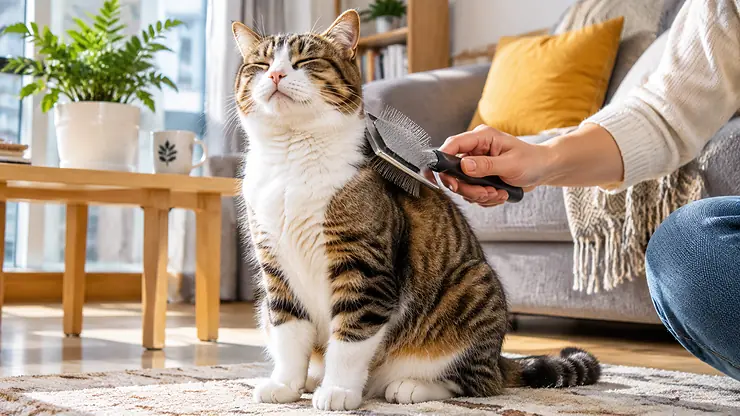
A deshedding tool for short-haired cats is a comb or brush with fine, closely spaced teeth or bristles. It is built to lift loose undercoat and dead hair from coats shorter than about two inches. It pulls out the hair that is already on its way out before it lands on your couch, or in your cat’s stomach.
Here’s the irony. Short-haired cats are sold as the low-maintenance option, and then you stand up from the sofa wearing a second, furrier outfit. Short hairs are tiny, stiff needles that weave themselves into fabric. They don’t tumble across the floor in dramatic tufts. They just quietly colonize everything. Indoor cats make it worse because they tend to shed a little all year, with no single “season” to brace for.
Fur on your sweater is only half the story. As veterinary guidance on managing hairballs explains, cats swallow loose hair while grooming. Frequent brushing reduces how much of it ends up inside them. So the right shedding brush for short-haired cats is as much a health tool as a housekeeping one.
This guide covers seven real products, from budget rubber brushes to stainless-steel undercoat specialists. I explain what each spec means in practice, summarize what reviewers consistently say, and point out where the evidence is thin. A quick note on method: I haven’t handled these tools. Everything here comes from spec sheets, retailer listings, and published roundups, and I flag anything I couldn’t verify.
Quick Comparison: Top Picks at a Glance
| Product | Type | Best For | Price Range |
|---|---|---|---|
| FURminator Short Hair deShedding Tool | Stainless-steel deshedding edge | Heavy shedders, dense short coats | $30-$40 range |
| Hepper Deshedding Cat Brush | Angled-pin brush, one-click cleaning | Daily upkeep, cats that chew tools | Check current price |
| KONG Cat ZoomGroom | Soft rubber brush | Sensitive cats, first-timers | Under $10 |
| Hertzko Self-Cleaning Slicker Brush | Retractable slicker | Surface fur, finishing passes | $12-$20 range |
| Safari Self-Cleaning Slicker Brush | Compact slicker | Small cats, tidy-minded owners | $15-$20 range |
| Delomo Pet Grooming Gloves | Nodule glove | Skittish cats, petting-style grooming | Around $10-$20 (glove category) |
| Pet Republique Dematting Rake | Rake | Seasonal heavy shedding | Check current price |
Reading across the table, the FURminator Short Hair deShedding Tool is the only one designed specifically to reach the undercoat of short coats. It costs more for that reason. The KONG Cat ZoomGroom and Delomo Pet Grooming Gloves win on gentleness and price. They remove less hair per pass, but a brush your cat tolerates beats a better one it flees from.
Price ranges reflect listings seen at the time of research and move constantly, so check current prices before you buy.
💬 Just one click — help others make better buying decisions too!😊
Top 7 Deshedding Tools for Short-Haired Cats: Expert Analysis
1. FURminator Short Hair deShedding Tool — best for dense undercoat removal
This is the benchmark, and most other tools get compared to it. A stainless-steel edge slides beneath the short topcoat to collect loose undercoat. A FURminator push-button ejects the hair afterward, and the handle is ergonomic. The small size is meant for cats up to roughly 10 pounds with hair under two inches. Examples include Abyssinians, American Shorthairs, Exotic Shorthairs and Singapuras. Medium/large versions exist for bigger cats, so pick by weight, not by wishful thinking.
On the cadence: retail guidance suggests one or two sessions a week of 10-20 minutes, and more during heavy shedding. The marketing claim of up to 90% less shedding is a ceiling, not a promise. The stated limits are firm. Use it only on a clean, dry, mat-free coat, never over sores or irritated skin, and always in the direction of hair growth.
Reviewers on major retail listings average around 4.7 out of 5 across thousands of ratings. They commonly report visibly less fur on their hands after petting and cats that seem to enjoy sessions. Some say it helps with hairballs. Recurring cautions include using light pressure on bony older cats, and a few long-time buyers who feel newer units are less sturdy than older ones.
Pros:
- ✅ Reaches undercoat other tools skip
- ✅ Self-ejecting button speeds cleanup
- ✅ Size options matched to cat weight
Cons:
- ❌ Overuse or pressure can irritate skin
- ❌ Costs several times more than rubber brushes
Price range: around $30-$40. Worth it if your cat sheds heavily, hard to justify for a light shedder.
2. Hepper Deshedding Cat Brush — chew-proof design with one-click cleaning
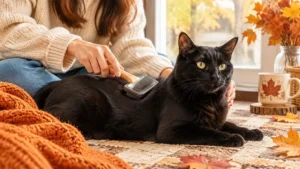
Hepper’s pitch is practical: angled pins for comfort, a construction that survives chewing, and a one-click button that releases hair. The angled pins matter because they glide across the coat instead of digging in. That makes it a middle path between a soft rubber brush and a bladed deshedder.
One honest caveat: the strongest “best overall” praise I found comes from Hepper’s own roundup, so weigh it accordingly. Independent roundups also place it highly, and it’s marketed for both long and short coats. I couldn’t verify a large pool of independent review data, so I won’t invent sentiment.
My read on the spec sheet: this suits owners who want a daily-use brush rather than a weekly deshedding event. The one-click cleaning is a bigger deal than it sounds, because tools that are annoying to clean get used less. If your cat likes to gnaw the brush mid-session, the chew-resistant build is a real advantage.
Pros:
- ✅ Angled pins reduce skin scratch risk
- ✅ One-click hair release
- ✅ Built to withstand chewing
Cons:
- ❌ Less aggressive on thick undercoat
- ❌ Limited independent review data found
Price range: check current price. Likely fine value for daily upkeep, but compare against the KONG Cat ZoomGroom first.
3. KONG Cat ZoomGroom — the gentlest, cheapest entry point
The KONG Cat ZoomGroom barely looks like a brush. It’s a soft rubber tool with short, flexible nubs that grip loose hair and massage the skin. Rubber works by friction and static: loose fur clings to it and rolls off in clumps. That makes it kind to the skin, though it won’t reach as deep as a bladed edge.
Roundups praise it for short- and medium-coated cats and for helping nervous cats get used to grooming. It doubles as a bath-time shampoo applicator. On Chewy, it sits around 4.5 stars across roughly a thousand ratings. The common criticism is that the nubs are too short for real penetration into thicker coats.
Think of it as the warm-up act. For a cat who bolts at the sight of a comb, a soft brush that feels like petting is how you earn the right to try something stronger. For a light shedder, it may be all you need.
Pros:
- ✅ Soft rubber suits sensitive cats
- ✅ Massage effect encourages tolerance
- ✅ Doubles as bath-time applicator
Cons:
- ❌ Nubs too short for deep undercoat
- ❌ Hair can cling stubbornly to rubber
Price range: under $10. Excellent value as a starter or backup.
4. Hertzko Self-Cleaning Slicker Brush — high volume, easy cleanup
This one has serious review volume. Its major retail listing shows an average around 4.5 stars across tens of thousands of ratings. The headline feature is a push-button that retracts the bristles so hair slides off in one clump. The bristles are fine wire, which is great at lifting surface hair and loosening mats.
Here’s the nuance most listings skip. Several roundups position it for medium-to-long coats, and one explicitly warns that on short-haired cats the fine teeth can scratch skin if you press. So the Hertzko Self-Cleaning Slicker Brush works on short coats, but technique matters. Think light, short strokes, a gentle angle, and brief sessions.
I’d use it as a finishing tool after a rubber brush or deshedding tool, not as the main event. It’s also forgiving for multi-cat homes with different coat lengths, since one brush covers them all.
Pros:
- ✅ Retractable bristles make cleanup effortless
- ✅ Huge review base and strong ratings
- ✅ Handles multiple coat lengths
Cons:
- ❌ Fine wires can scratch if pressed
- ❌ Not a true undercoat deshedder
Price range: around $12-$20. Strong value as a versatile all-rounder.
5. Safari Self-Cleaning Slicker Brush — compact slicker for small cats
The Safari Self-Cleaning Slicker Brush is a smaller-headed cousin of the slicker idea. Its push-button cleaning mechanism and compact size suit small cats and tight spots like legs and tail bases. Chewy lists it near 4.7 stars, and roundups call it a budget-friendly pick that gently removes loose fur.
The trade-offs are the same as for any slicker. One roundup notes its wire bristles are sharper than some competitors’, and it isn’t a dedicated deshedding tool. That second point matters. A slicker grabs surface hair, while an undercoat tool pulls the packed fur beneath. If your cat is a light-to-moderate shedder, that difference may not matter. For a heavy shedder, it will.
Where this brush shines is control. The small head lets you work around a wriggly cat in sections instead of wrestling them into one long session. I’d pair it with a soft rubber brush for sensitive areas.
Pros:
- ✅ Small head suits small cats
- ✅ Push-button hair release
- ✅ Strong ratings at an affordable level
Cons:
- ❌ Wire bristles can feel sharp
- ❌ Limited on thick undercoat
Price range: around $15-$20. Good value if a slicker suits your cat.
6. Delomo Pet Grooming Gloves — grooming that feels like petting
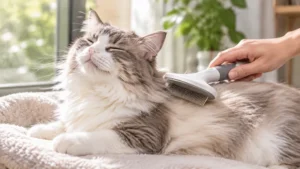
Grooming gloves are the stealth option. Rubber nodules on the palm and fingers lift loose hair while you pet your cat as usual. For a skittish cat, that is a huge psychological advantage, because there’s no “tool” to fear. Some listings describe the Delomo Pet Grooming Gloves as machine-washable.
Category-level comparisons rate gloves very high on gentleness but low on deshedding power. One roundup scored gloves about 2 out of 5 for deshedding and 5 out of 5 for comfort. A common complaint with gloves in general is that peeling fur off them can be fiddly and messy. I couldn’t verify review volume specific to this model, so treat the specifics cautiously.
My honest take is that gloves are a bonding tool first and a deshedder second. They’re brilliant for daily maintenance and for desensitizing a nervous rescue cat. They’re not a replacement for a stronger tool during heavy shedding.
Pros:
- ✅ Feels like petting, so cats stay calm
- ✅ Gentle enough for sensitive skin
- ✅ Easy to use on legs and belly
Cons:
- ❌ Weakest deshedding power here
- ❌ Fur removal from glove gets messy
Price range: around $10-$20 for the glove category. Good value as a trust-building tool.
7. Pet Republique Dematting Rake — seasonal heavy-duty option
The Pet Republique Dematting Rake shows up as a top pick in at least one major roundup. That roundup notes it’s marketed primarily for short-haired cats and can be used carefully on long coats during seasonal shedding. The ergonomic handle is meant to reduce hand fatigue, which matters if you’re working through a thick coat.
Rakes behave differently from slickers. Wider-spaced teeth pass through the topcoat and catch loose undercoat in clumps. Another roundup warns that large, widely spaced rakes can be less effective on short coats. Fine-tooth designs do better there, so check the tooth spacing before you commit. Independent review depth on this specific model was thin in my research, so I’d treat it as promising rather than proven.
Use it sparingly. A rake is a seasonal tool for the weeks when your cat is blowing coat, not a daily brush.
Pros:
- ✅ Handles heavier seasonal shedding
- ✅ Ergonomic handle eases long sessions
- ✅ Praised in at least one major roundup
Cons:
- ❌ Tooth spacing may suit thick coats better
- ❌ Limited independent review evidence
Price range: check current price. Reasonable if you want a seasonal specialist, but compare it with the FURminator Short Hair deShedding Tool first.
| Product | Reaches Undercoat | Skin Gentleness | Self-Cleaning | Review Sentiment |
|---|---|---|---|---|
| FURminator Short Hair deShedding Tool | High | Medium (technique-dependent) | Yes | Very positive, thousands of ratings |
| Hepper Deshedding Cat Brush | Medium | High | Yes | Positive in roundups, limited data |
| KONG Cat ZoomGroom | Low | Very high | No | Positive, around 4.5 stars |
| Hertzko Self-Cleaning Slicker Brush | Low-Medium | Medium | Yes | Very positive, large volume |
| Safari Self-Cleaning Slicker Brush | Low-Medium | Medium | Yes | Positive, around 4.7 stars |
| Delomo Pet Grooming Gloves | Low | Very high | No | Positive for comfort, weak for power |
| Pet Republique Dematting Rake | Medium-High | Medium | No | Positive in roundups, thin data |
The table shows a clear trade-off between power and gentleness. The FURminator Short Hair deShedding Tool leads on undercoat reach, while the KONG Cat ZoomGroom and Delomo Pet Grooming Gloves lead on tolerance. If you only buy one, match it to your cat’s patience, not just to your frustration with fur on your clothes.
✨ Don’t Miss These Exclusive Deals!
🔍 Take your grooming routine to the next level with these carefully selected tools. Click on any highlighted product to check current pricing and availability. They’ll help you build a calmer, cleaner, less hairy home!
How to Use a Deshedding Tool for Short-Haired Cats (Setup, Schedule, First 30 Days)
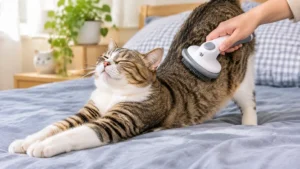
Technique decides whether a deshedding tool for short-haired cats helps or irritates. Start with these steps.
- Pick the moment. After a meal or play session, when your cat is relaxed. Never ambush a cat mid-zoomies.
- Inspect first. Check for mats, sores, scabs or irritated skin. Bladed tools aren’t meant for compromised skin or tangled fur.
- Work with the coat. Use short, light strokes in the direction of hair growth. If the tool is catching skin or making the cat flinch, you’re pressing too hard.
- Go in layers. Loosen with a rubber brush or glove, follow with a deshedding tool, then finish with a damp cloth to pick up stray hairs.
- Clean the tool. Use the ejector button or wipe it clean between passes so you aren’t re-depositing hair.
For cadence, FURminator guidance suggests one or two sessions a week of 10-20 minutes, increasing during heavy shedding. For a brand-new tool or a nervous cat, start with five minutes and stop on a good note. Reward with a treat so the tool becomes a predictable good thing.
The most common first-month mistakes follow a pattern. Owners press too hard, camp on one patch (overworked skin can get irritated), skip the skin check, or quit after one failed attempt. Short, calm, consistent sessions beat marathon efforts every time.
Real-World Scenarios: Matching Tools to Real Households
Here are three hypothetical profiles showing how the products above map to real situations.
The apartment tabby. A student in a small apartment shares it with one 9-pound short-haired cat. The cat sheds moderately all year, and the budget is tight. The practical combo is the KONG Cat ZoomGroom for daily sessions plus a small-size FURminator Short Hair deShedding Tool once a week. Total spend lands in the $40-$50 range, and the pairing covers both surface fur and undercoat.
The two-cat family. A household has a 17-pound short-haired cat and a leaner 11-pound one, plus a toddler who pets everything. Sizing is the issue here, since the larger cat needs the medium/large FURminator variant, while the smaller one suits the small size. One reviewer of the small size reported that two very large short-hair cats still got good results, but weight guidance exists for a reason. I’d add the Hertzko Self-Cleaning Slicker Brush as a quick all-purpose finisher shared between both cats.
The nervous rescue. A shy adult cat recoils from anything with teeth. Here, Delomo Pet Grooming Gloves are the right first step. Spend two weeks just petting with the glove, then introduce the KONG Cat ZoomGroom. Only move to a deshedding tool once your cat solicits the attention instead of tolerating it.
The pattern across all three is the same. Start gentle, build trust, then add power only where the coat demands it.
How to Choose a Deshedding Tool for Short-Haired Cats
Here are six steps for picking the right deshedding tool for short-haired cats:
- Check your cat’s weight and coat length. Sized tools like the FURminator Short Hair deShedding Tool are matched to weight (small is for cats up to roughly 10 pounds). Wrong size means poor contact or too much edge.
- Judge shedding volume honestly. If you pull a small handful from a rubber brush each session, rubber may be enough. If the couch looks furry within hours, you want an undercoat tool.
- Match the tool to temperament. Anxious cats do better with gloves or soft rubber. Confident cats tolerate edged tools.
- Prioritize skin safety. Look for guarded edges, rounded pin tips or flexible nubs. Avoid anything that scrapes.
- Value easy cleaning. Ejector buttons and retractable bristles remove the chore that makes owners quit.
- Plan the combo. Many households do best with two tools, a gentle daily brush and a weekly deshedder.
The decision rule is simple. If your cat is calm and sheds heavily, choose a bladed undercoat tool. If your cat is anxious, start with a glove or rubber brush. If you aren’t sure, begin cheap and upgrade.
Undercoat vs. Guard Hair: What Your Tool Is Actually Reaching
Understanding undercoat vs. guard hair explains why some brushes seem to do nothing. Most cats have a two-layer coat, which the VCA guide to feline grooming and coat care describes. Guard hairs form the smooth outer layer you see, carrying the color and pattern. The undercoat is finer, softer hair beneath that adds insulation. Picture a wool sweater under a raincoat.
Why does this matter for choosing a shedding brush for short-haired cats? Because most loose, ready-to-fall hair sits in the undercoat, packed close to the skin where a plain bristle brush glides right over it. That’s the job a stainless-steel edge is designed for. It slides beneath the topcoat and collects the loose hair while leaving guard hairs largely in place.
There’s a catch. Not every short-haired cat has much undercoat. Some breeds, such as Siamese and Devon Rex, have little to none, and a strong deshedding tool can be too much for them. For those cats, a rubber brush or glove is the safer bet.
Shedding Season and Indoor Cats: Why the Fur Never Fully Stops
What shedding season really means
Shedding season is the stretch when cats trade their coat for the next one. It is driven mostly by daylight rather than temperature. In cooler regions, heavy cycles typically hit in late spring and late fall. If you’re reading this in November, you may be in the middle of one right now. During those weeks, the undercoat can come out in clumps, which is when a rake or deshedding tool earns its keep.
Picking a deshedding brush for indoor cats
Indoor cats live under steady lighting and temperatures, which blur those natural cues. The result is usually low-level shedding all year, with milder bumps in spring and fall. That’s why a deshedding brush for indoor cats should be something you can use often and gently, rather than a once-a-season rescue. Daily rubber or glove sessions plus one weekly deshedding pass works well for most indoor cats.
Central heating can also dry out skin and coat, which may increase shedding. Humidity and diet play roles too. If shedding suddenly spikes, or you notice bald patches or irritated skin, that’s a vet question, not a brush question.
Hairball Prevention: Brushing, Hairball Reduction Brushes and Smart Habits
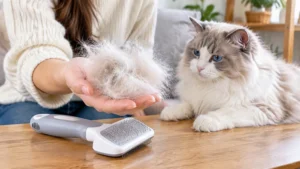
Hairball prevention starts with a simple idea: less loose hair on the cat means less hair in the cat. Veterinary sources consistently name regular brushing as the single most effective step. For short-haired cats, guidance ranges from at least once a week to two or three times weekly. During heavy shedding, go higher.
A hairball reduction brush isn’t a special category so much as a role. Any tool that reliably removes loose hair counts, and the best one is the one your cat tolerates. A deshedding tool does the heavy lifting. A rubber brush or glove handles daily upkeep.
Brushing works best alongside other habits. Hairball-control diets, good hydration, and year-round flea prevention all help, since itching leads to more licking and more swallowed hair. In multi-cat homes, remember that cats groom each other, so brush everyone.
Know the warning signs, too. University of Wisconsin veterinary guidance advises seeking care for unproductive hacking. Lethargy, loss of appetite, a hard belly or trouble passing stool also call for a vet. A hairball every so often is normal. Frequent ones may signal something else.
Deshedding Tool vs. Slicker Brush vs. Rubber Brush vs. Glove
| Option | Undercoat Removal | Gentleness | Best For |
|---|---|---|---|
| Deshedding tool (FURminator Short Hair deShedding Tool) | High | Medium | Heavy shedders, weekly sessions |
| Slicker (Hertzko Self-Cleaning Slicker Brush) | Low-Medium | Medium | Surface fur, finishing |
| Rubber brush (KONG Cat ZoomGroom) | Low | Very high | Sensitive cats, daily use |
| Glove (Delomo Pet Grooming Gloves) | Low | Very high | Skittish cats, bonding |
The table makes the logic clear. Deshedding tools win on hair removed per session, but they ask more of both you and your cat. Rubber and gloves remove less but get used more, and consistent use beats occasional power.
Slickers sit in between. They tidy the surface well but don’t reliably reach packed undercoat. Many short-haired cats do best with a two-tool setup, a gentle everyday brush plus a weekly undercoat pass.
If you’re tempted to skip tools and rely on vacuuming, consider the hairball angle. Vacuuming cleans your home, while brushing reduces what your cat swallows. They solve different problems.
Long-Term Cost and Maintenance
| Setup | Upfront Cost | Maintenance | Best For |
|---|---|---|---|
| Starter (KONG Cat ZoomGroom) | Under $10 | Rinse occasionally | Light shedders |
| Combo (KONG Cat ZoomGroom + FURminator Short Hair deShedding Tool) | Around $40-$50 | Clean after each use | Moderate to heavy shedders |
| Versatile (Hertzko Self-Cleaning Slicker Brush + glove) | Around $25-$40 | Wash glove, clean brush | Multi-cat, mixed coats |
| Seasonal (Pet Republique Dematting Rake) | Check current price | Wipe after use | Heavy coat-blow weeks |
A one-time spend of $30-$50 is small next to the cost of lint rollers, furniture covers, and hairball clean-ups. The FURminator Short Hair deShedding Tool costs more up front but is a durable steel tool you may use for years. Rubber and gloves are cheap enough to replace when worn.
Maintenance is minimal. Clear hair after every session, wipe the tool dry, and check edges and pins for damage occasionally. Retire anything that snags or bends. For deeper background on why frequent hairballs matter, AKC Reunite’s hairball guide covers the risk of intestinal blockages and the signs that warrant veterinary care.
Frequently Asked Questions
❓ What's the best budget shedding brush for short-haired cats?
❓ Is a deshedding tool safe for short-haired cats?
❓ How often should I use a deshedding tool on a short-haired cat?
❓ Which size FURminator should I buy?
❓ Do deshedding brushes really reduce hairballs?
Conclusion
Choosing a deshedding tool for short-haired cats comes down to matching power to temperament. If your cat is calm and sheds heavily, the FURminator Short Hair deShedding Tool is the strongest option for reaching loose undercoat. If your cat is nervous, start with the KONG Cat ZoomGroom or Delomo Pet Grooming Gloves and build trust first. The Hertzko Self-Cleaning Slicker Brush and Safari Self-Cleaning Slicker Brush add easy surface tidying, and the Hepper Deshedding Cat Brush and Pet Republique Dematting Rake are worth a look if their designs suit your cat.
Whichever tool you pick, consistency matters more than intensity. Short, gentle sessions a few times a week cut fur on your furniture and hair in your cat’s stomach. Pair brushing with good hydration, flea prevention, and a vet visit when hairballs get frequent. Prices change often, so check current pricing before buying.
Recommended for You
- Cat Grooming Kits: 7 Best Picks For 2026 (Ultimate Guide)
- Soft Wipes For Kittens: 7 Safest Picks For Tiny Skin In 2026
- Cat Wipes For Sanitary Area Cleanup On Long-Haired Cats: 7 Best 2026
Disclaimer: This article contains affiliate links. As an Amazon Associate, I earn from qualifying purchases. If you purchase products through these links, we may earn a small commission at no additional cost to you.
✨ Found this helpful? Share it with your friends! 💬🤗
