Table of Contents
Cat wipes for sanitary area cleanup on long-haired cats are pre-moistened, cat-safe cloths that lift stool, urine residue, and stray litter from the fur around the rear before it dries into a mat. Think of them as a between-bath reset button: fast, water-free, and far gentler than a wrestling match in the tub. 🐾
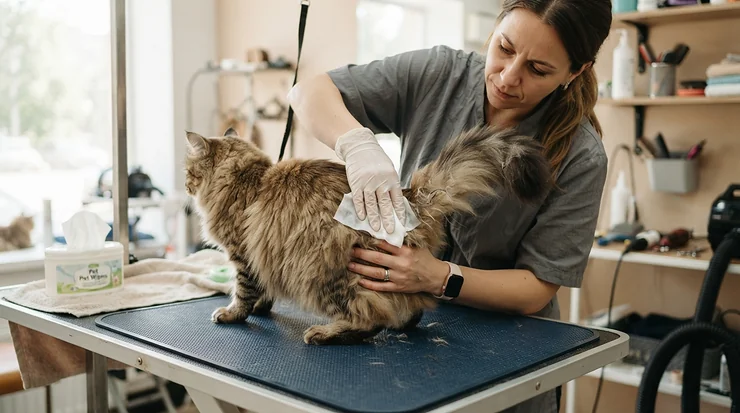
Here’s the awkward truth about a magnificent tail and a pair of feathered britches: they double as a very efficient litter-box mop. A Persian’s flowing coat, a Ragdoll’s plush hindquarters, a Maine Coon’s fluffy trousers all look gorgeous in the living room. The moment nature calls, they become a liability. Waste hitches a ride, dries into a crust, and suddenly you’re very interested in cat butt wipes at 7 a.m.
The good news is that most of these messes take under a minute to fix if you catch them early. Veterinary hospital groups such as VCA Hospitals recommend daily combing for long-haired cats, and that routine is your first line of defense. Brushing can’t undo a mess that has already happened, though. That’s where hygiene wipes for fluffy cats come in. They’re quick, bath-free, and kind to a cat who would rather negotiate a peace treaty than get wet.
This guide compares seven real, widely sold options using spec sheets, reviewer themes, and editorial roundups rather than hype. You’ll also get a step-by-step usage guide, a plain-English look at the sanitary trim, long-haired breed hygiene notes, and a cost breakdown. Where individual customer reviews couldn’t be verified, I say so. Prices appear as tiers and ranges because they change constantly.
Quick Comparison: 7 Cat Butt Wipes at a Glance
| Product | Count | Notable Trait | Price Tier* | Best For |
|---|---|---|---|---|
| Vetnique Labs Glandex Hygienic Rear Wipes | Varies by listing (about 75–100) | Thick, enzyme odor control | $$ | Targeted rear-end cleanup |
| Earthbath Hypo-Allergenic Cat Grooming Wipes | 100 | Fragrance-free, cat-specific | $$ | Sensitive skin |
| Hepper Wash Wipes | 30 | Thick, soft, hypoallergenic | $$ | Big cleanups and travel |
| Pogi’s Grooming Wipes | 100 | Large 8 x 9 in. bamboo sheets | $$ | Full-coverage wiping |
| Burt’s Bees for Cats Anti-Hairball Wipes | 50 | Quilted, grabs loose fur | $ | Light daily maintenance |
| Wet Ones Antibacterial Paw & Tushie Wipes | 30 | Cat-safe, handles long fur | $ | Purse-and-carrier backup |
| Petkin Dog & Cat Tushie Wipes | 100 | Snap-lid pack, very low cost | $ | High-volume stock-up |
*$ = budget, $$ = mid-range, based on listings at the time of research. Check current price before buying.
Looking at the comparison above, Vetnique Labs Glandex Hygienic Rear Wipes is the only entry built around rear-end hygiene, which matters when the mess is more than a smudge. Earthbath Hypo-Allergenic Cat Grooming Wipes and Pogi’s Grooming Wipes both give you 100 sheets, so they suit households that wipe daily. The budget pair, Wet Ones Antibacterial Paw & Tushie Wipes and Petkin Dog & Cat Tushie Wipes, cost less up front but come with trade-offs in pack size or sheet thickness.
One quick tip for reading the table: count and thickness trade off against each other. A big canister of thin wipes can end up costing more in practice if every cleanup takes two or three of them, so judge a pack by how many wipes the job actually needs, not by the number on the label.
💬 Just one click — help others make better buying decisions too!😊
Top 7 Cat Wipes for Sanitary Area Cleanup on Long-Haired Cats: Expert Analysis
Every pick below is a real product with a real spec sheet. The commentary comes from comparing those specs and aggregated reviewer themes, not from invented testing. Each pack of wipes earns its spot for a different type of long-haired mess.
1. Vetnique Labs Glandex Hygienic Rear Wipes — built specifically for rear-end cleanup
Most wipes are generalists. This one has a job title: perianal hygiene. That focus is why it opens this list of cat wipes for sanitary area cleanup on long-haired cats.
Cats.com’s roundup highlights a thick, durable texture, a natural enzyme meant to combat strong odors, and aloe with vitamin E to soothe skin. Thickness matters more than it sounds, because a flimsy wipe tears the moment it meets a dried clump. The enzyme angle targets the lingering smell that plain wiping can leave behind. Pack sizes vary by listing, with editorial roundups citing roughly 75 to 100 wipes.
Based on the spec comparison, this is the pick for cats whose mess regularly goes beyond a smudge, such as soft stools, dense britches, or a cat that has started skipping that part of grooming. Vetnique’s own veterinarian-reviewed guide positions these wipes as a bridge between trims and baths. That’s a brand source, so weigh it accordingly.
PangoVet and Rover both single it out as a go-to butt wipe for long-haired cats. I couldn’t verify a large pool of individual customer reviews, so treat that as editorial consensus rather than crowd-sourced proof.
Pros:
- ✅ Thick, durable texture resists tearing
- ✅ Enzyme formula targets lingering odors
- ✅ Aloe and vitamin E soothe skin
Cons:
- ❌ Pack count varies by listing, so check first
- ❌ Overkill for light smudges or paw cleanup
Mid-range price tier, so check current price. The value is strong if rear mess is a weekly event and weaker if it happens once a month.
2. Earthbath Hypo-Allergenic Cat Grooming Wipes — cat-specific and fragrance-free
If your cat’s skin reacts to everything, this is the plain-clothes option: no perfume, no drama.
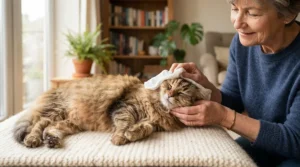
You get 100 plant-based wipes in a resealable pouch. Cats.com describes the formula as fragrance-free and pH-balanced specifically for cats. That means less chance of irritation on the delicate skin around the tail base. Cats lick whatever you just wiped, so a gentle formula is a safety feature rather than a luxury. Chewy’s product Q&A states that Earthbath products are lick-safe and fine for the rear end.
On paper, this is a strong everyday choice for cats with sensitive skin or for homes with allergy-prone humans. Cats.com notes it may help reduce dander. It’s tuned for general grooming rather than heavy-duty mess, so expect a second wipe when material has dried onto the fur.
Cats.com names it best for sensitive skin. One shopper on a competing brand’s Chewy page recommended it as the alternative after disliking that product’s scent, which is a small but telling data point.
Pros:
- ✅ Fragrance-free formula suits sensitive skin
- ✅ 100 wipes in a resealable pouch
- ✅ Cat-specific, pH-balanced formulation
Cons:
- ❌ Not rear-specific, so dried messes need extra wipes
- ❌ Per-wipe cost sits above the budget tier
Roughly $12–$18 for the 100-count at the time of research, depending on retailer. A fair value for daily users.
3. Hepper Wash Wipes — thick, soft, and generously sized
When you need one wipe to do the work of three, thickness is the whole game.
Each pack holds 30 generously sized wipes described as thick, soft, moisturizing, and hypoallergenic, and they’re made in the USA. A thick sheet can take a firm pass at a stubborn clump without shredding. At one wipe per day, 30 sheets also line up neatly with a month of use. Hepper positions them for recovering cats who can’t groom and for carrier accidents, which doubles them as travel-kit insurance.
My read: this is the “big cleanup day” wipe. It’s overkill for a speck of litter but excellent when the situation calls for real coverage. Note that Hepper’s own roundup ranks it first, and Hepper sells it, so factor in some brand enthusiasm. Catster’s roundup lists it as an odor-reducing, quick-cleaning option with large wipes. I couldn’t verify a big pool of independent customer reviews.
Pros:
- ✅ Thick and soft, so wipes resist tearing
- ✅ Hypoallergenic and moisturizing formula
- ✅ Large sheets cover more fur per pass
Cons:
- ❌ Only 30 wipes per pack
- ❌ May not suit every cat’s skin
Mid-range tier with a higher per-wipe cost than the 100-count packs. Check current price and pick it for quality over quantity.
4. Pogi’s Grooming Wipes — big 8 x 9-inch bamboo sheets
Size is the underrated spec. A larger sheet means a fresh surface every time you fold it.
You get 100 quilted bamboo wipes at about 8 x 9 inches, which Hepper notes is larger than most rivals. The material is biodegradable. The wipe is large enough to fold into quarters, giving you four clean faces from one sheet, and it can wrap a thick tail base without leaving you chasing fur with your fingertips. Pogi’s markets these for dogs and cats, so confirm the version you buy is labeled for cats too.
For fluffy cats with a lot of territory to cover, this suits full-coverage wiping well. Cats.com praises the soft, long-lasting moisture and calls the formula safe and non-irritating. The complaints are practical: Hepper found an odd smell, and both outlets note that wipes tend to come out stuck together.
Pros:
- ✅ Very large sheets for full coverage
- ✅ 100-count pack lasts a while
- ✅ Biodegradable bamboo material
Cons:
- ❌ Some reviewers dislike the smell
- ❌ Hard to pull out one wipe at a time
Retail listings ran from the mid-teens into the low-$20s depending on seller. Good value if you use them daily, so check current price.
5. Burt’s Bees for Cats Anti-Hairball Wipes — quilted wipes that also grab loose fur
On a long-haired cat, loose fur around the rear is part of the problem, and this wipe is designed to collect it.
The 50-count pack uses quilted wipes that Chewy’s listing says lift stubborn dirt, debris, and excess fur. The quilted texture works like tiny pockets, trapping stray strands instead of just pushing them around. The brand also says its pet line avoids parabens, phthalates, and sulfates.
My assessment: this is a maintenance wipe, not a rescue wipe. It’s great for a quick daily pass over the britches. For anything dried or heavily soiled, pair it with something thicker. One shopper on Chewy’s listing called the wipes high quality and fragrance-free and said they work for collecting shed hair. The verified review pool was tiny, so take that as an anecdote.
Pros:
- ✅ Quilted texture grabs loose fur
- ✅ Formula skips parabens and phthalates
- ✅ Budget-friendly 50-count pack
Cons:
- ❌ Not built for heavy rear-end messes
- ❌ Only 50 wipes per pack
Well under $10 at the time of research. Strong value for light-duty upkeep.
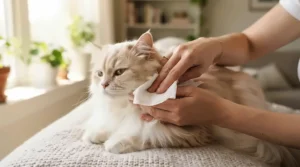
6. Wet Ones Antibacterial Paw & Tushie Wipes — pocket-friendly for travel and quick fixes
Not every cleanup happens at home. Sometimes it happens in a vet’s waiting room.
Catster describes these as perfectly cat-safe, effective even on long fur, and affordable if used in moderation. The 30-count pack is compact enough to live in a carrier pouch or glove box. Treat “antibacterial” as a convenience label rather than a reason to skip the cleanup basics. The mechanical lift of fur and residue is what does the real work.
This is the backup wipe: easy to grab, cheap enough to stash in three places, and good enough for most spot cleaning. Heavy daily users will burn through the pack, as Catster notes about frequent use. Catster places it in its top three for cat cleaning wipes.
Pros:
- ✅ Cat-safe, according to Catster’s roundup
- ✅ Handles long fur well
- ✅ Affordable for occasional use
Cons:
- ❌ Only 30 wipes per pack
- ❌ Daily users will run through packs fast
Budget tier at the time of research, so check current price. Good value as a travel companion.
7. Petkin Dog & Cat Tushie Wipes — 100-count budget stock-up
If you want a wipe in every room and nothing about the price tag to worry about, this is your candidate.
The pack holds 100 wipes with aloe vera, vitamin E, and a light eau de toilette scent. A snap lid keeps them moist. Hepper’s roundup calls them cheap enough to be the best for the money but flags two issues: the sheets are thin, and they run drier than expected. A thin wipe is a risk right where you need strength.
The fragrance deserves attention too. Hepper’s own buyer’s guide advises avoiding artificial fragrance because it can bother cats. For sensitive cats, this probably isn’t the one. For a resilient cat with light messes, it’s a decent backup wipe by the litter box.
Pros:
- ✅ Very low cost per wipe
- ✅ Snap lid keeps sheets moist
- ✅ 100-count pack lasts a while
Cons:
- ❌ Sheets are thin and can tear
- ❌ Drier than expected, so you may need two
Budget tier, so check current price. Good value for light use, but not the one to trust with a dried-on mess.
Spec Showdown: What the Differences Mean at Litter-Box Time
| Product | Texture | Scent Note | Watch-Out | Best For |
|---|---|---|---|---|
| Vetnique Labs Glandex Hygienic Rear Wipes | Thick, durable | Odor-neutralizing enzyme | Pack count varies | Heavy rear mess |
| Earthbath Hypo-Allergenic Cat Grooming Wipes | Soft, plant-based | Fragrance-free | Extra wipes for crusts | Sensitive skin |
| Hepper Wash Wipes | Thick, soft | Odor-reducing per Catster | Only 30 wipes | Big cleanups, travel |
| Pogi’s Grooming Wipes | Quilted bamboo, 8 x 9 in. | Fragrance-free option | Wipes cling together | Full coverage |
| Burt’s Bees for Cats Anti-Hairball Wipes | Quilted | Reviewer reports fragrance-free | Lighter duty | Loose fur, daily upkeep |
| Wet Ones Antibacterial Paw & Tushie Wipes | Not specified | Varies by variant | 30-count pack | Carrier backup |
| Petkin Dog & Cat Tushie Wipes | Thin | Eau de toilette scent | Thin and dry | Backup stock |
The pattern in the table above is clear: texture decides how well a wipe handles dried messes, and scent decides whether your cat tolerates it. Vetnique Labs Glandex Hygienic Rear Wipes and Hepper Wash Wipes lead on thickness, while Earthbath Hypo-Allergenic Cat Grooming Wipes leads on gentleness. The two budget wipes, Wet Ones Antibacterial Paw & Tushie Wipes and Petkin Dog & Cat Tushie Wipes, are fine for light, quick jobs, but neither is the one to count on for a stubborn crust.
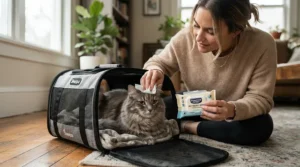
How to Choose Cat Butt Wipes: 7 Steps
Picking among cat butt wipes comes down to a handful of practical decisions. Work through them in order and the right pack usually becomes obvious.
- Match thickness to mess severity. Thin sheets handle smudges. Thick or quilted ones handle crusts without tearing.
- Check for fragrance. Hepper’s buyer’s guide recommends skipping artificial scents because they can irritate cats. Fragrance-free is the safe default.
- Confirm it’s labeled safe for cats. Cats lick everything you wipe, so look for lick-safe language or a cat-specific formula.
- Go bigger on size. Larger sheets are easier to control and fold, giving you more clean surface per wipe.
- Weigh count against moisture. A 100-count canister saves money only if the wipes stay wet. A resealable lid or snap pack matters.
- Look at the ingredients. Aloe, oatmeal, and vitamin E are common soothers. Avoid anything that smells like a cocktail.
- Match the pack to your routine. Daily wipers need 100-count packs. Occasional cleaners can do fine with 30–50.
How to Use Wipes for Soiled Fur Around the Rear: A Step-by-Step Guide
Having the right pack is half the job. Technique is the other half, and most wipes for soiled fur around the rear fail because of rushing rather than product quality.
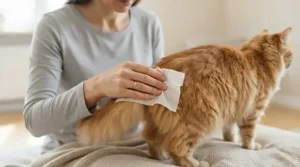
Step 1: Act early. Catster notes that wipes work best before the poop dries. Fresh mess lifts easily. Dried mess needs patience.
Step 2: Set the scene. Have two or three wipes out and a treat nearby. Choose a calm moment, not right after the zoomies.
Step 3: Lift the tail, don’t yank. Gently part the fur and expose the area. Think of it as peeling a curtain aside, not tearing it.
Step 4: Dab, then wipe outward. Press the wipe onto the soiled area for a couple of seconds to soften it. Then wipe away from the skin in short strokes. Scrubbing pushes mess deeper into long fur.
Step 5: Use a fresh wipe for each pass. Reusing a soiled wipe just spreads the problem. A fresh wipe also catches what the first one missed.
Step 6: Comb through when done. A wide-toothed comb separates damp fur and prevents re-tangling. Let the area dry before your cat settles back into a nap.
Step 7: Know when to stop. The vet-reviewed guide from PangoVet notes that some situations call for trimming the fur instead, especially when stool is very dry, forming mats, or stuck to the skin. If a wipe isn’t working after a couple of gentle tries, stop and escalate instead of pulling at the fur.
Common first-month mistakes: waiting until the mess dries, using too few wipes, and skipping the comb-through. Fix those three habits and cleanup gets dramatically easier.
Real-World Scenarios: Matching Wipes to Your Household
Here are three realistic profiles, built from the spec comparison rather than anyone’s personal anecdote. Find the one that looks like your home.
Scenario 1: The Persian owner with daily mess. A flat-faced Persian with dense, fine fur tends to need a rear cleanup most days. The ideal setup is a 100-count wipe that stays moist and a routine of one or two sheets daily. Earthbath Hypo-Allergenic Cat Grooming Wipes fits if the cat’s skin is sensitive. Pogi’s Grooming Wipes fits if you want large sheets that cover a lot of fur. Budget roughly $12–$22 per 100-count pack, and expect to need a pack every month or two.
Scenario 2: The semi-long Maine Coon in a multi-pet home. Maine Coons often fare better than Persians, but their britches still catch the occasional mess. A mixed setup works well here: Burt’s Bees for Cats Anti-Hairball Wipes for light daily upkeep and Vetnique Labs Glandex Hygienic Rear Wipes for rare, bigger cleanups. The pair covers both ends of the mess spectrum without overspending.
Scenario 3: The senior Ragdoll with stiff joints. Cats who can’t twist to groom their rear, whether from arthritis or extra weight, need more help. Vetnique’s guide flags mobility as a common cause of poor rear grooming. This household needs a dependable thick wipe, like Hepper Wash Wipes, plus regular sanitary trims and a vet conversation about the mobility issue itself.
✨ Ready to Make Cleanup Easier?
🔍 Take your long-haired breed hygiene routine up a notch with these carefully selected wipes. Tap any bolded product name above to check current pricing and availability. A cleaner rear end means a happier, fluffier cat and a calmer you! 🐱
Problem → Solution: Litter Clinging to Fur and Other Messy Moments
Long-haired cats attract trouble the way fleece attracts lint. These are the most common situations, with fixes that actually work.
Problem 1: Litter clinging to fur. Clumping litter loves to hitch a ride on britches and tail feathers. Brush the dry bits out with a wide-toothed comb first, then use a damp wipe to lift what’s left. Wiping first just turns litter into paste. Burt’s Bees for Cats Anti-Hairball Wipes is a handy fit here, since its quilted texture grabs loose strands.
Problem 2: A dried clump stuck to the fur. Press a damp wipe on it for several seconds to soften, then work outward gently. If it won’t budge, trim around it with blunt-tipped scissors held away from skin, or visit a groomer. Vetnique Labs Glandex Hygienic Rear Wipes gives the thick sheet you want for this kind of job.
Problem 3: Lingering smell after cleanup. Odor often means residue is still in the fur. Use a fresh wipe for a second pass and let the area dry fully. Enzyme-based formulas like the one in Vetnique Labs Glandex Hygienic Rear Wipes are designed for this.
Problem 4: Wipes drying out in the pack. Seal the lid completely after every use, and store the pack upright. Snap lids like the one on Petkin Dog & Cat Tushie Wipes help, but a loose seal defeats any packaging.
Problem 5: A cat who hates being wiped. Keep sessions short, offer a treat, and wipe the back first before moving to the rear. A calm cat tolerates far more than a startled one, and one clean pass is better than three frantic ones.
Wipes vs Sanitary Trim vs Baths: What Each One Does Best
Wipes aren’t the only tool in the box. Here’s how the main options compare for long-haired cats.
| Method | Strength | Weakness | Best For |
|---|---|---|---|
| Cat wipes | Fast, stress-free, no water | Won’t solve long fur at the root | Daily spot cleanup |
| Sanitary trim | Prevents mess before it happens | Needs skill or a groomer; regrows | Chronic rear-end mess |
| Full bath | Deep cleaning | Stressful; frequent baths can dry skin | Heavy contamination |
| Warm damp cloth | Cheap and simple | No odor control; slower | Light smudges |
Looking at the table above, wipes and trims work best as a team. Wipes handle the mess that happens, while the trim reduces how often it happens. A bath is a heavy tool you reach for when the situation is genuinely severe. For most long-haired cats, the practical stack is regular brushing, a periodic trim, and wipes for everything in between.
The Sanitary Trim: What It Is and How Wipes Fit In
A sanitary trim is exactly what it sounds like: shortening the fur around the anus and down the back of the thighs so waste has less to cling to. Groomers do it routinely, and Catster’s trimming guide describes it as a great choice for cats who struggle to clean their own bottoms.
Vetnique’s veterinarian-reviewed article suggests most long-haired cats do well with a sanitary trim every four to six weeks, though your groomer or vet can adjust that for coat length and texture. It’s a brand source, but the cadence is a sensible starting point.
A few ground rules keep it safe. Brush out tangles first. Clean the area beforehand if it’s visibly soiled. Never cut a mat close to the skin with scissors at home, because skin can lie much closer than it looks. If you do trim, use sharp, blunt-tipped scissors or clippers and keep the blades parallel to the body. When in doubt, a groomer or vet visit costs far less than an emergency.
Here’s where wipes fit. A trimmed cat produces smaller, easier messes, which means fewer wipes per cleanup and fewer stressful sessions. Wipes keep the area clean between visits. The trim keeps the problem small. Together they beat either one alone.
Hygiene Wipes for Fluffy Cats: Features That Actually Matter (And Those That Don’t)
The wipe aisle is full of shiny claims. Here’s the filtered version for hygiene wipes for fluffy cats.
Features that matter:
- Thickness and texture. A quilted or thick sheet survives contact with dried residue. A thin one doesn’t.
- Size. Bigger sheets mean more clean surface per wipe and less mess on your hands.
- Fragrance-free formulas. Because cats lick whatever you wipe, fewer additives is safer.
- Moisture retention. A resealable pack or snap lid keeps wipes usable to the last sheet.
- Cat-safe labeling. Look for lick-safe or cat-specific language, not just a picture of a cat.
Features that matter less:
- Antibacterial labels. Nice-sounding, but the mechanical lift of waste does the real work.
- Eco-friendly bamboo. A good bonus, as with Pogi’s Grooming Wipes, but it shouldn’t override performance.
- Heavy perfume. It masks smells without solving them and may bother sensitive cats.
- Medicated wipes. Products like antiseptic or antifungal wipes exist, but they belong in vet-guided situations, and Hepper’s roundup notes some can be pricey with strong smells.
If you only remember one rule, remember this: choose for the mess, not the marketing.
Common Mistakes When Buying Cat Butt Wipes
Even a good wipe gets undermined by a bad habit. These are the pitfalls worth dodging.
- Buying scented wipes for a sensitive cat. A pleasant smell to you can irritate your cat. Fragrance-free is the safer default.
- Assuming wipes replace brushing or trims. They’re a cleanup tool, not a prevention tool.
- Choosing by count alone. A 100-count pack of thin wipes can cost more in practice than a 30-count pack that works on the first try.
- Scrubbing hard. The skin around the rear is delicate. Dab, soften, and wipe gently.
- Reaching for human disinfecting wipes. They’re not designed for cats, and cats lick. Stick with products made for pets.
- Letting packs dry out. A forgotten lid turns your wipes into cardboard.
- Ignoring a recurring mess. If a cat keeps getting dirty, it may signal a health issue, not just a grooming issue.
Long-Haired Breed Hygiene: Persians, Maine Coons, Ragdolls and Beyond
Not every fluffy cat has the same problem. Long-haired breed hygiene varies with coat type, so your approach should too.
Persians and Himalayans sit at the high-maintenance end. The All Feline Hospital’s grooming guide notes that cats like Persians and domestic longhairs usually can’t keep up with their fur by themselves, which leads to extensive matting. Simply Cats describes long-haired fur as finer and denser, tangling more easily and trapping loose hair close to the skin. That’s a recipe for rear-end trouble.
Maine Coons are more forgiving. According to Wikipedia’s Maine Coon entry, the breed’s double coat is mostly self-maintaining thanks to a light-density undercoat, and VCA Hospitals’ breed profile similarly says the coat doesn’t mat as easily as other long-haired breeds. Even so, Vetnique’s guide lists Maine Coons alongside Persians, Ragdolls, Himalayans, and Norwegian Forest Cats as breeds prone to trapped waste, so the britches and tail base still deserve checks.
Ragdolls and Norwegian Forest Cats fall in between. Their plush hindquarters collect mess, so a weekly inspection and a trim schedule help. Regardless of breed, Cats.com advises checking long-haired cats for mats at least every couple of days, and the rear is the first place to look.
Long-Term Cost & Maintenance: What Wipes Really Cost Per Year
Wipes feel cheap until you do the math. Here’s an illustrative breakdown assuming a 100-count pack at roughly 12¢ to 20¢ per wipe, in line with the pricing ranges seen for the larger packs.
| Usage Level | Wipes per Year | Packs of 100 | Approx. Annual Cost | Best For |
|---|---|---|---|---|
| Light (2 per week) | About 104 | About 1 | $12–$21 | Well-trimmed cats, occasional mess |
| Moderate (1 per day) | About 365 | About 4 | $44–$73 | Most long-haired cats |
| Heavy (3 per day) | About 1,095 | About 11 | $131–$219 | Seniors, chronic mess, mobility issues |
The numbers in the table above show how fast wipes add up for heavy users. If you’re in the heavy row, that’s a signal to look at the cause, not just the supply. A sanitary trim, a diet or digestion check with your vet, and attention to mobility can shrink the bill and your cat’s discomfort at the same time. For light and moderate users, buying 100-count packs like Earthbath Hypo-Allergenic Cat Grooming Wipes or Pogi’s Grooming Wipes usually beats small packs on cost per wipe.
Maintenance matters too. Close lids tightly, store packs away from heat, and keep a small stash in the litter area so cleanups happen immediately rather than after the mess dries.
When Wipes Aren’t Enough: Health Red Flags to Watch For
Wipes solve mess. They don’t solve causes. Hepper’s vet-reviewed guidance notes that a cat who frequently has stool stuck to the fur may have a health problem that’s stopping normal grooming, and that cats with obesity or arthritis often can’t reach the area at all.
Call your vet if you notice any of the following:
- A persistent foul smell that cleaning doesn’t resolve
- Brown fluid leaking or staining furniture
- Redness, swelling, or pain when the area is touched
- Scooting along the floor
- A sudden stop in grooming with no obvious fur or weight change
- Recurring diarrhea or soft stool
- Mats that have been there for a while, since Hepper notes stool left in place can lead to complications, including maggots in neglected cases
Anal gland trouble is one common culprit behind scooting and rear-end discomfort. The Merck Veterinary Manual’s anal sac overview for cat owners explains the condition, and your vet can handle expression and infection checks. Don’t try to diagnose it at home.
The bottom line: wipes are a hygiene tool, not a diagnosis. If cleanup is becoming a daily battle, the cat is telling you something.
FAQ
❓ Can I use baby wipes as cat butt wipes?
❓ How often should I wipe a long-haired cat's rear?
❓ Are cat wipes safe if my cat licks them off?
❓ Do cat wipes replace a sanitary trim?
❓ How do I get dried poop out of long fur without a bath?
Conclusion
Long fur is a gift in the living room and a headache in the litter box. The fix isn’t heroic. It’s a small routine: brush often, trim the rear on a schedule, and keep a good pack of wipes within arm’s reach. Done consistently, the daily chore shrinks to about a minute, and the dramatic cleanups become rare.
Among the seven options, Vetnique Labs Glandex Hygienic Rear Wipes is the specialist for serious rear-end mess, Earthbath Hypo-Allergenic Cat Grooming Wipes is the gentle all-rounder for sensitive skin, and Hepper Wash Wipes is the thick, soft choice for big cleanups. Pogi’s Grooming Wipes offers large sheets for coverage, and Burt’s Bees for Cats Anti-Hairball Wipes handles loose fur and light upkeep. For backups and travel, Wet Ones Antibacterial Paw & Tushie Wipes and Petkin Dog & Cat Tushie Wipes keep the cost down.
Remember that wipes treat the symptom, not the cause. A cat who keeps getting dirty may need a trim, a mobility check, or a vet visit. Start small, stay consistent, and let the routine do the heavy lifting. Your cat’s fluffy tail will thank you, in its own silent, judgmental way.
✨ Ready to Upgrade Your Routine?
🔍 Pick the wipe that fits your cat’s coat and your daily mess level, then tap its bolded name above to check current pricing and availability. A cleaner, more comfortable cat is one small step away! 💬
Recommended for You
- Ear Cleaning Wipes For Cats With Waxy Ears: 7 Best Picks (2026)
- Paw Wipes For Cats After Litter Box Use: 7 Best Picks In 2026
- Grooming Wipes For Senior Cats Who Can’t Self-Groom: 7 Best (2026)
Disclaimer: This article contains affiliate links. As an Amazon Associate, I earn from qualifying purchases. If you purchase products through these links, we may earn a small commission at no additional cost to you.
✨ Found this helpful? Share it with your friends! 💬🤗
